

Garden and boundary walls are easy to treat as background maintenance. They can stand for decades without anyone formally inspecting them, and a little weathering, moss or tired pointing rarely feels urgent. But a freestanding masonry wall is still a structure, and once it begins to move the consequences of getting the diagnosis wrong can be considerably greater than the cost of the repair itself.
Government garden-wall safety guidance makes the point unusually plainly: garden and boundary walls are among the more common forms of masonry to collapse and are a recognised source of injuries from falling masonry. That does not mean every cracked wall is dangerous. Most deterioration is considerably less dramatic.
The job is telling the two apart before deciding whether to reach for a bag of mortar or a phone number for a structural engineer.
The signs that are often maintenance rather than structural trouble
An old wall is allowed to look old. Several defects are commonly repair issues rather than evidence that the whole structure is failing — provided they are isolated, stable and not accompanied by movement elsewhere.
Fine hairline cracking can fall into this category. Current government guidance for garden walls describes cracks of around 0–2mm as common and says they may not indicate a serious problem. That is deliberately less definite than saying every crack below 2mm is harmless: where the crack is new, changing, passes through the wall or sits beside a pier or gate post, its position and behaviour matter as much as its width.
Efflorescence — the white powdery deposit left as soluble salts move through damp masonry and crystallise at the surface — is usually a moisture symptom rather than a structural defect in itself. Persistent or extensive deposits are still worth tracing back to their moisture source rather than repeatedly brushing them away.
Weathered mortar joints are another ordinary maintenance problem. On older masonry, particularly walls built with lime mortar, the mortar is intended to be the more sacrificial part of the construction and may gradually erode. Localised repointing can be entirely appropriate. What matters is using a compatible mortar rather than automatically replacing old, softer mortar with a hard cement-rich mix. Historic England’s guidance on repointing brick and stone masonry explains why unsuitable repointing can itself damage older masonry.
A few frost-damaged or spalled bricks can also be local repair work where the surrounding masonry remains solid and the deterioration is not spreading across the wall.
The same applies to individual loose coping stones or damaged cappings, although anything loose enough to fall onto a path, driveway or neighbouring property becomes a safety issue regardless of whether the wall beneath it is structurally sound.
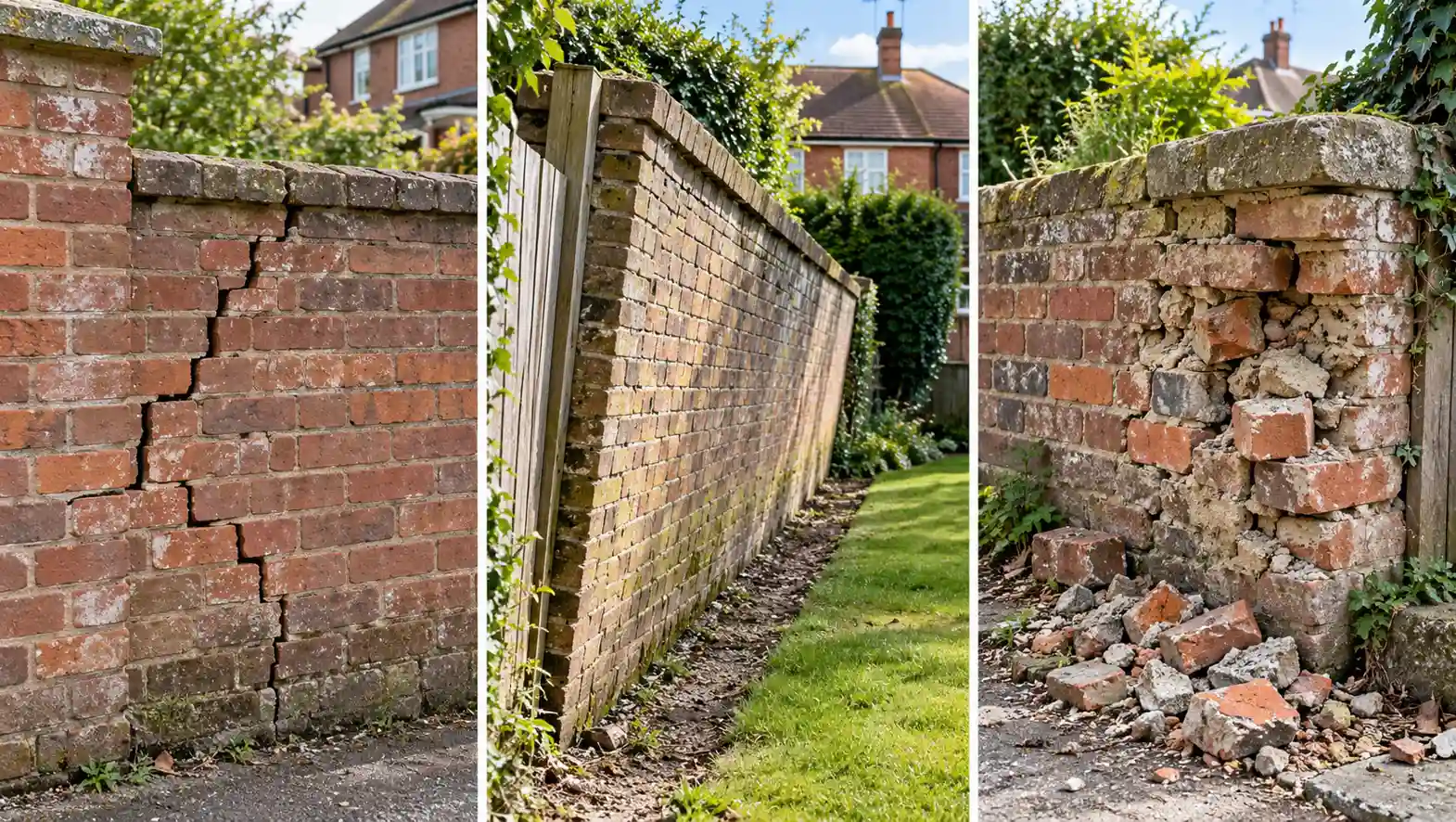
The important distinction is between isolated deterioration and deterioration that is becoming widespread. A few damaged bricks are one thing. Crumbling across large areas of both faces, deep loss of mortar, open joints or masonry that is starting to separate are something else.
The signs that deserve investigation before anyone starts repairing
Some defects should change the response from “repair it” to “find out why it has happened”.
Government guidance recommends expert advice for garden-wall cracks wider than about 2mm, but width should never be used as the only test. A narrower crack that is clearly growing can be more important than a wider crack that has remained unchanged for years.
Particular reasons to investigate include:
- cracking that is widening or extending, rather than remaining unchanged;
- diagonal or stepped cracking running through mortar joints, particularly where one part of the wall appears to have moved relative to another;
- horizontal cracking that passes through the wall, which government garden-wall guidance specifically identifies as requiring advice;
- cracks around piers, gate posts or other heavily loaded sections;
- a visibly increasing lean;
- bulging or bowing, where the face of the wall is no longer reasonably flat;
- separation between sections of masonry, or between a wall and its pier;
- movement following an impact, such as a vehicle striking a gate pier or boundary wall;
- movement that appears alongside drainage failure, major tree work, flooding or significant changes to the surrounding ground.
A retaining wall deserves particular caution. Once a wall is holding back soil, a raised garden or a change in ground level, it is resisting lateral pressure as well as its own weight and wind. The simple rules of thumb used for an ordinary freestanding boundary wall should not be treated as reassurance for a retaining wall that is leaning or bulging.
How much lean is too much?
There is a useful rule of thumb in official UK garden-wall guidance for when the lean of an ordinary freestanding brick wall should prompt expert advice:
| Approximate wall thickness | Lean at which expert advice is recommended |
|---|---|
| Half-brick — about 100mm | More than about 30mm |
| One-brick — about 215mm | More than about 70mm |
| Brick-and-a-half — about 325mm | More than about 100mm |
These are not legal safety limits and they do not mean a wall falling just below the figure is automatically safe.
Height matters. So do wind exposure, condition of the mortar, piers, gate loads, previous alterations, foundations and whether the wall is retaining soil. Government guidance also relates the recommended height of a freestanding wall to its thickness and the amount of wind exposure it faces. An unusually tall, thin or exposed wall may therefore justify assessment even if it appears reasonably straight and has no dramatic cracking.
The figures are best used as an alarm bell, not as permission to ignore everything below them.
There is another useful test that requires no calculation at all: has the lean changed? A wall that has visibly moved since last year, since a storm, after work next door or after a vehicle impact deserves a different response from a wall that has apparently stood slightly out of plumb for several decades. Photographs taken from a repeatable position can be surprisingly useful evidence of change, but they are not a substitute for assessment where stability is already in question.
What makes a garden wall move?
Cracks and leaning are symptoms. Repairing the symptom without understanding the cause is how the same defect can return.
Poor or shallow foundations are one possible explanation, particularly with older walls built long before modern expectations for foundation depth and ground preparation.
Trees and ground conditions are another. Roots can physically disturb shallow foundations. On shrinkable clay soils, changes in the amount of moisture taken up by vegetation can also affect ground movement. Removing a mature tree is not automatically the solution: official garden-wall guidance specifically warns that removing large trees can itself alter soil moisture conditions.
Drainage defects can matter where leaking drains, gullies or persistent water soften or wash material from around foundations. If a wall repeatedly becomes saturated at the same point, repairing the masonry without fixing the source of water may deal only with the visible consequence.
Water entering through failed coping or capping can gradually damage masonry from above. Once water gets into porous brick or stone, repeated wetting, freezing and thawing can contribute to surface loss and deterioration.
Thermal and moisture movement can create cracking in long lengths of masonry as materials expand and contract. Not every stepped or open crack is therefore evidence of “subsidence”, and it is worth resisting that label until the cause has actually been investigated.
Impact and alteration are easily overlooked. Widening a gateway, removing a supporting section, hanging heavier gates from an existing pier or striking the wall with a vehicle can materially alter how the remaining masonry behaves.
Wind exposure can change too. Removing another wall, fence, hedge or nearby structure may leave a wall more exposed than it was for most of its life.
Diagnose first, then decide how much repair is justified
One of the easiest mistakes is repointing a crack because the repair itself looks simple.
Official garden-wall guidance specifically advises against repointing cracks before establishing their cause. Fresh mortar can hide the evidence without doing anything about the movement underneath it.
For genuinely local maintenance — worn pointing, a few damaged bricks or a loose coping where the wall itself remains stable — an experienced bricklayer or mason may be all that is required.
Unexplained cracking or suspected movement is different. A chartered building surveyor experienced in structural defects can be a sensible first opinion where the diagnosis is unclear. Where there is substantial lean, bulging, instability, a retaining wall, significant foundation movement or a potentially dangerous wall, a structural engineer is the stronger route.
Where there is no immediate safety concern but it is unclear whether movement is active, a professional may recommend monitoring before specifying permanent repairs. Crack gauges, fixed measuring points and repeat photographs are all used for this purpose, but there is no universal “monitor it for twelve months” rule. The appropriate period depends on what movement is suspected and whether the structure is safe to leave while it is being observed.
A damaged wall does not automatically need demolishing from end to end. Equally, a visibly moving wall should not be kept standing simply because rebuilding is expensive.
Where the likely cost is significant, separating diagnosis from quotation can be particularly useful. An independent assessment from someone who is not also selling the rebuilding work can tell you whether the sensible solution is local masonry repair, drainage improvements, foundation work, partial reconstruction or a full rebuild.
That gives you a far stronger basis for obtaining comparable quotations than asking several contractors to diagnose the defect while simultaneously pricing the job.
For older walls, the repair specification matters too. Rebuilding or repointing with masonry and mortar substantially harder or less permeable than the original can create new deterioration rather than solve the old one. A structurally sound repair still needs to be compatible with the wall it is joining.
If the wall looks as though it could actually fall
This is the point at which garden maintenance stops being the right mindset.
Do not climb on it, push it back, remove bricks from it or begin dismantling a section simply to see what is happening. Keep children, pets and vehicles away from the potential fall zone, and consider whether the wall could fall onto a neighbour’s land, shared access, pavement or road.
If there appears to be an immediate risk to the public, contact the relevant local authority rather than waiting for an ordinary contractor appointment.
The precise legal machinery differs around the UK. In England and Wales, local authorities have powers to deal with dangerous buildings and structures under sections 77 and 78 of the Building Act 1984, including emergency action where necessary.
Scotland has its own dangerous-building regime under the Building (Scotland) Act 2003, explained in the Scottish Government’s current Building Standards Procedural Handbook.
In Northern Ireland, the practical first step is to contact the local council if a wall, fence or other structure appears dangerous. nidirect’s guidance on dangerous or derelict properties explains how these concerns should be reported.
Those powers are separate from an argument over who owns the boundary or who ought ultimately to pay.
Two related questions often appear immediately afterwards: who is responsible for maintaining a boundary wall, and what happens if a neighbour’s building work has caused the damage. Those are separate ownership and liability questions covered elsewhere on Property Front Page.
Work out what is happening to the wall first. Then decide what repair is proportionate. Only after that does it make sense to establish who is responsible for carrying it out and paying for it.
Important: This article provides general property information and is not a structural assessment or legal advice about an individual wall. Crack width and lean measurements are indicators, not guarantees of safety. If a wall is significantly leaning, bulging, moving, retaining soil or could fall onto an area used by other people, keep clear of the potential fall zone and obtain appropriate professional or local-authority advice.

