

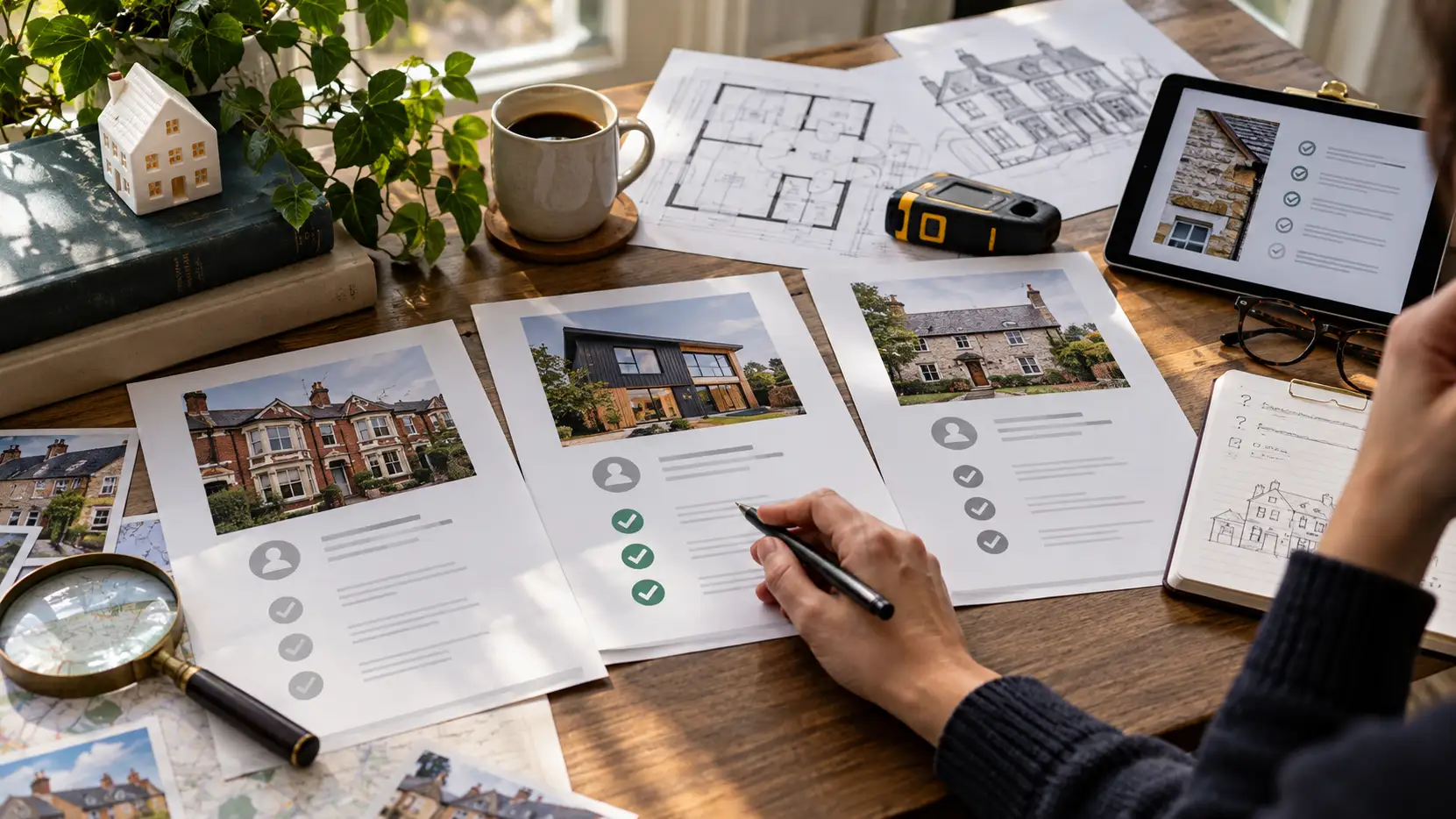
By the time most buyers start comparing surveyors, they’ve usually got three or four quotes in front of them, a recommendation from the estate agent, perhaps another from a mortgage broker, and no obvious way to tell which is actually the right person to inspect the property they’re about to spend most of their savings on.
The instinct is to compare prices. The better question is closer to: who is actually suited to this property?
A £100 difference between quotes matters considerably less if one surveyor regularly inspects buildings like yours and the other rarely does. Qualifications matter, but so do the person’s experience, the scope of the survey, what happens when something unusual is found and whether you’ll be able to make sense of the report once it arrives.
Check the surveyor and the firm — they are not quite the same thing
RICS is a sensible place for many buyers to start, but there is an important distinction between the individual surveyor’s qualifications and the regulatory status of the firm employing them.
RICS says an RICS Home Survey must be completed by an RICS member with the appropriate experience. Individual members may hold designations such as AssocRICS, MRICS or FRICS, and you can check someone’s current status through the organisation’s Find a Member service.
The firm itself is a separate question. A business described as RICS regulated is subject to specific firm-level requirements, including professional indemnity insurance meeting RICS requirements, a complaints-handling procedure and access to an approved alternative dispute resolution service where a consumer complaint cannot be resolved. RICS explains those protections in its consumer guidance on regulated firms.
That distinction is worth checking rather than assuming. Not every business that appears through RICS’s wider surveyor-search services is necessarily an RICS-regulated firm.
For most buyers looking for an RICS Home Survey, the useful checks are therefore straightforward: who is the individual carrying out the work, are they an active RICS member, and is the business itself RICS regulated?
If the service includes a formal valuation, it is also worth checking whether the person providing it is an RICS Registered Valuer.
None of this tells you whether that person is the best surveyor for your particular house. It establishes the professional framework. The next question is whether their experience actually matches the building in front of them.
Relevant property experience matters more than a postcode
A surveyor who regularly inspects standard modern housing may have perfectly good professional credentials but relatively little experience of a thatched cottage, listed building, converted warehouse, timber-framed home or property built using a less common construction system. That does not make them a poor surveyor; it may simply make somebody else a better fit for that particular building.
RICS’s own guidance on house surveys advises buyers to consider relevant experience of the property’s type, age and construction when choosing a surveyor.
Ask directly. “How often do you survey houses of this age and construction?” is much more useful than asking vaguely whether the firm covers your area.
Local knowledge still has value. A surveyor who works regularly in the same town or district may recognise recurring construction details, weather exposure, patterns of movement or defects common to a particular generation of local housing. They may also know when something that initially looks unusual is commonplace locally — or when it deserves further investigation.
But “local” is not automatically better than “specialist”. A surveyor travelling further who has inspected dozens of properties built in the same unusual way may be a stronger choice than somebody based five miles away who mainly surveys conventional modern homes.
Nor should local survey knowledge be confused with the legal and environmental investigations carried out elsewhere in the buying process. A building survey is not a substitute for conveyancing searches or specialist investigations into matters such as mining, flooding or contamination where those are required.
The useful question is therefore not how close the surveyor’s office is to the property. It is how closely their experience matches the building.
Ask whether you’re booking the right survey, not just the right surveyor
Choosing a good surveyor and choosing the correct level of inspection are connected decisions.
A quote for a Level 2 survey is not especially helpful if the property really warrants a more detailed Level 3 inspection. Equally, paying for a more extensive service purely because a house is old does not automatically guarantee more useful information unless that service suits the building and the buyer’s concerns.
Before booking, ask the surveyor what level of survey they recommend for this particular property and why.
If you’ve already noticed something that concerns you — cracking, damp staining, an altered roof, an extension, signs of movement or an unusual construction feature — mention it before the inspection. That gives the surveyor the opportunity to consider the concern when advising on the appropriate service and carrying out the inspection.
This is also the point to read the terms of engagement rather than treating them as paperwork to accept after choosing on price. Find out what will actually be inspected, what sits outside the scope, what happens where part of the property cannot safely be accessed and whether specialist investigation might be recommended rather than carried out by the surveyor themselves.
A house survey is not automatically a test of the electrics, plumbing, drainage or every concealed element of the structure. Understanding those limitations before booking is considerably more useful than discovering them when the finished report arrives.
PFP covers the differences between Level 2 and Level 3 surveys separately. The important point here is that a good surveyor should be able to explain why the service they are quoting for fits this particular property rather than simply selling whichever report the buyer initially asks for.
Who actually turns up — and can you speak to them afterwards?
Two practical questions are particularly worth asking before booking.
The first is who will personally carry out the inspection. At a larger firm, the person who prepares the quote or takes the initial enquiry may not be the person who visits the property. Ask for the surveyor’s name and, where relevant, verify their professional status and experience.
“Our firm has surveyed hundreds of Victorian houses” is less useful than knowing whether the person actually attending has meaningful experience of them.
The second question is what happens after the report arrives.
A written report may identify a roof defect, movement, damp or an issue requiring further investigation without being able to tell you exactly what the eventual repair will cost. A short conversation with the person who actually saw the property can be extremely useful in separating a serious concern from something that simply needs further checking before exchange.
Ask whether a post-report telephone conversation is included in the fee, whether there is a time limit on it and whether follow-up questions are charged separately.
It is also worth asking for a sample report before instructing. Some surveyors produce reports that make priorities, uncertainty and sensible next steps unusually clear; others may provide technically adequate information in a format the buyer finds considerably harder to interpret.
Online reviews can help too, but the overall star rating is less useful than the detail underneath it. Look for comments about the thoroughness of the inspection, clarity of the report, whether defects were explained properly and whether the surveyor remained available after the report was issued. For larger firms, check whether the feedback relates to the individual surveyor or simply the company as a whole. Thousands of reviews for a national brand tell you less about the person inspecting your house than repeated feedback about that individual’s work.
The technical quality of the inspection matters most, but clarity and accessibility matter too. A report only becomes genuinely useful if the buyer can understand what should happen next.
Why two quotes for the “same” survey may not be the same service
Price is a legitimate consideration. It just makes a poor first filter if the quotes do not actually cover the same thing.
Even two RICS Level 2 quotes can differ because one is for a survey alone while another includes a valuation. Property size, complexity, location, travel, likely inspection time, specialist experience and whether post-report discussion is included can all affect the fee.
Turnaround matters as well. A competitively priced surveyor who cannot inspect for three weeks may not be the right choice in a transaction already moving quickly, while paying more purely for the earliest appointment makes little sense if the surveyor lacks the relevant property experience.
Compare the actual service rather than the headline figure:
- Which survey level is being provided, and why is it appropriate for this property?
- Who will personally inspect the property, and what relevant experience do they have?
- Is a valuation included if you need one?
- What important areas, systems or services sit outside the inspection?
- Can you discuss the findings with the surveyor afterwards?
- When can the inspection take place, and when should the report arrive?
- Is the quoted figure the total price, including VAT and any likely extras?
A notably cheaper quote is not automatically a false economy. A notably more expensive one is not automatically more thorough. The useful difference is what you are actually buying.
Estate agent recommendations aren’t automatically a problem
Being handed a surveyor’s details by the estate agent selling the property is common. So is receiving a recommendation through a mortgage lender or another professional involved in the purchase.
There is nothing inherently wrong with using that recommendation. The issue is whether you understand the relationship behind it and still make your own choice.
Current government guidance on buying a home says buyers should be told where an estate agent or mortgage lender receives a referral payment from a business it recommends. You remain free to instruct somebody else.
A disclosed referral payment does not prove that the surveyor is unsuitable. Equally, the fact that an estate agent recommends somebody is not evidence that they are the best surveyor for the property.
Ask whether a commercial referral arrangement exists, then judge the surveyor in the same way you would if you had found them independently: qualifications, firm regulation, relevant property experience, scope of inspection, communication and total price.
Convenience is a perfectly reasonable factor in a busy transaction. It just should not be the only one.
Scotland works differently
For buyers in Scotland, the starting point is different because most homes marketed for sale already have a Home Report commissioned by the seller.
That includes a Single Survey and valuation, along with the property questionnaire and energy report. The official mygov.scot guidance on Home Reports explains what each part contains.
A Scottish buyer may still decide that further surveying or specialist investigation is appropriate — for example, where the Home Report raises a particular concern or the buyer wants more detailed investigation of part of the property — but the normal starting point is therefore different from commissioning a buyer’s Level 2 or Level 3 Home Survey elsewhere.
The same selection principle still applies if further professional advice is needed: choose somebody whose competence fits the question the property is actually asking.
The combination that actually matters
No single factor settles the choice.
An RICS designation does not tell you how many homes of this construction the surveyor has inspected. A local postcode does not prove relevant specialist knowledge. A recommendation does not establish suitability. A five-star average does not tell you who will actually turn up. The highest fee does not guarantee the best inspection, and the cheapest quote is not automatically poor value.
The strongest combination is a surveyor whose credentials you can verify, whose professional protections you understand, who has meaningful experience of the property’s age and construction, who can explain why the proposed survey is appropriate and who will still be available when the report raises the questions you didn’t know you needed to ask.
That is a better way to choose than starting with three prices and picking the one in the middle.
This article provides general property information and is not a recommendation or endorsement of any individual surveyor, surveying firm or professional body. Survey requirements and buying processes differ across the UK, particularly in Scotland. Before instructing a surveyor, confirm the individual’s current qualifications, the firm’s regulatory status where relevant, the scope and limitations of the proposed inspection and whether the surveyor has appropriate experience of the property concerned.

