

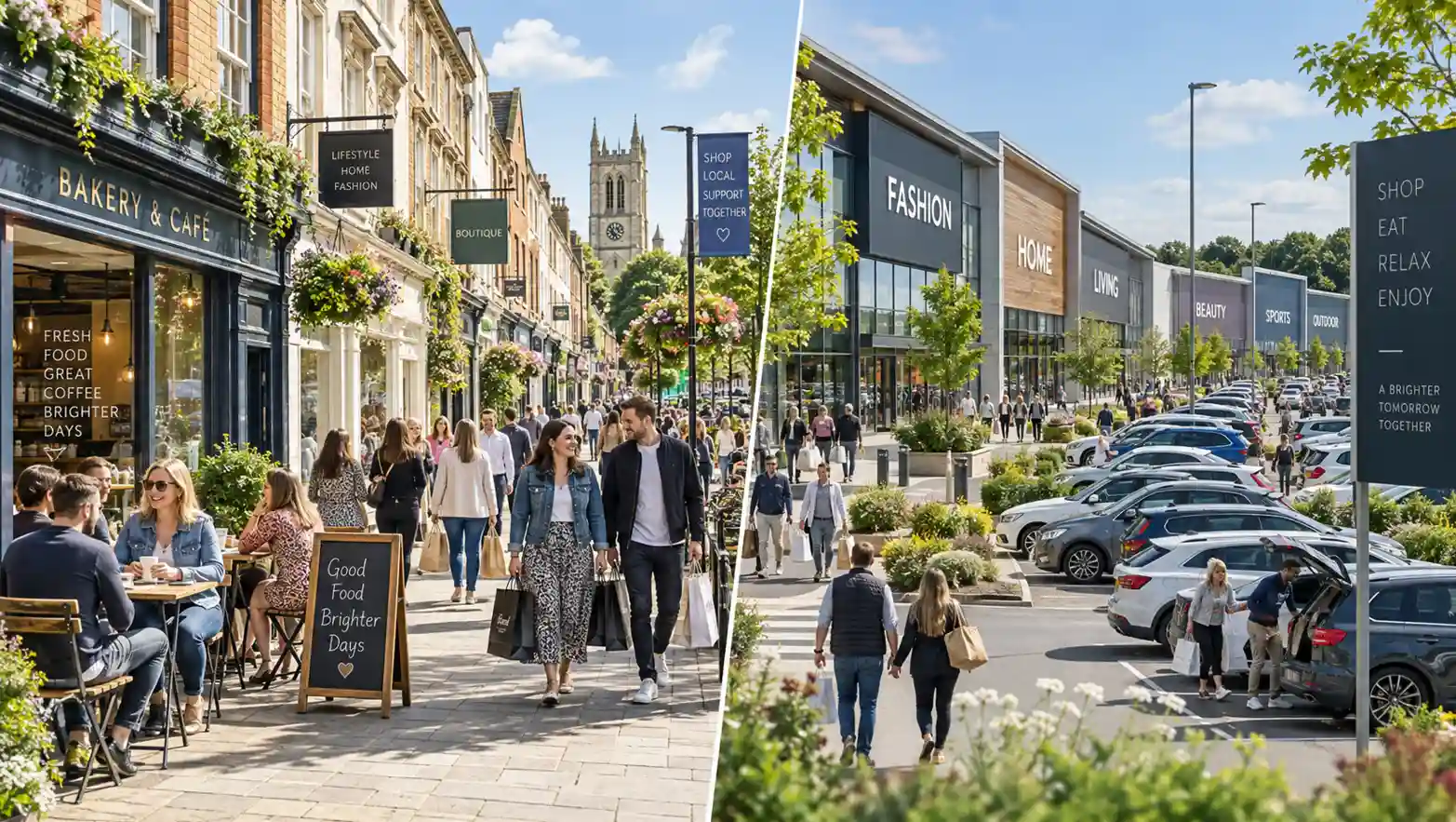
Walk down one high street and you’ll count the empty units — shutters down, “to let” boards fading in the window, a vacancy rate you can see without needing a report to confirm it. Drive to the retail park twenty minutes away and you’ll struggle to find anywhere to park on a Saturday, most of the units full, some with queues at the door.
Both of those places are trading in the same national retail market, in some cases the same town. “Physical retail is struggling” is the story that gets told about both of them, and it’s wrong about at least one.
The UK retail property market in 2026 isn’t moving in one direction. It’s polarising — sharply, and in ways that become obvious once national vacancy figures are broken down by format, location and quality.
Retire the phrase “death of the high street”
As a description of the whole market, it has become too blunt to be useful.
Knight Frank put national retail vacancy at 13.5% in the third quarter of 2025, its lowest level since 2020, and suggested it could move towards the pre-Covid level of roughly 12.4% by the end of 2026. But that national figure averages together parts of the market behaving very differently.
Retail parks were running at 6.1% vacancy in the same Knight Frank data. Shopping centres were at 16.5%, with the figure disproportionately influenced by secondary schemes. CBRE, meanwhile, reported major Central London retail streets at around 5% vacancy or below and expected supply shortages in the strongest locations to continue through 2026.
Knight Frank — Retail in 2026: Retaining the Crown
The honest description isn’t that physical retail has either died or recovered. It is that a smaller pool of strong locations is attracting occupiers and supporting rental growth while weaker locations continue to carry structural vacancy.
For anyone deciding whether to lease, buy, refurbish or reposition retail property, identifying which side of that divide a particular location sits on matters far more than the national average.
Why some high streets are still working
There is no single formula for a successful high street, but the stronger ones tend to combine several favourable conditions.
An affluent or sufficiently large catchment helps. Tourism can provide demand beyond the resident population. Local employment supports weekday trade. Good transport connections expand the practical catchment. Food, leisure and services give people reasons to visit beyond a single purchase. Strong anchors can generate footfall that smaller businesses then benefit from, while a varied occupier mix reduces dependence on one type of retail demand.
The weaker high streets often face some combination of the opposite pressures: insufficient footfall, poor access, loss of important anchors, weak local spending power, too much retail floorspace for the demand that remains, units that do not suit the formats currently seeking space and occupancy costs that are still too high relative to the turnover the pitch can support.
That last point matters. A rent can fall substantially from its historic peak and still be too expensive if the business occupying the unit cannot generate sufficient sales from the location. Cheap relative to ten years ago is not the same thing as commercially viable today.
Nor is every empty unit evidence of insufficient demand for the entire location. Sometimes the problem is the building itself — the wrong size, awkward upper floors, poor servicing, weak visibility, inadequate power or extraction, or a configuration that simply doesn’t match what active occupiers require.
That distinction becomes increasingly important as the market polarises.
Retail parks: why the format keeps winning
Retail parks have been one of the clearest beneficiaries of the changing way people use physical retail.
The advantages are structural rather than mysterious. They typically offer easy vehicle access and substantial parking, larger and more flexible units, relatively straightforward servicing and a format that works particularly well for customers combining physical shopping with online ordering, collection and returns.
Their occupier mix has broadened too. Food, gyms, leisure, drive-through formats, supermarkets and services increasingly sit alongside the bulky-goods and comparison retail traditionally associated with the format.
The supply side matters just as much. CBRE recorded retail-park vacancy at 6.1% in 2025 and said the sector had produced the strongest five-year rental growth of the major retail formats, at 4.7%. Its mid-year 2026 review reported that retail-park vacancy had continued to fall during the first half of the year while new development remained exceptionally limited.
Current footfall data tells a similar, although not perfectly uniform, story. BRC-Sensormatic reported that in August 2026 UK high-street footfall was down 3.1% year on year and shopping-centre footfall down 0.5%, while retail-park footfall increased by 1.0%.
British Retail Consortium — August 2026 footfall by retail location
One month does not establish the long-term future of a property format, and retail parks are not immune from poor location, weak anchors or the wrong tenant mix. But the combination of low vacancy, limited new supply and resilient occupier demand makes their relative strength difficult to dismiss as a temporary anomaly.
Shopping centres: the widest gap of any format
Shopping centres demonstrate why format-level averages have to be treated carefully.
Knight Frank’s Q3 2025 figures put shopping-centre vacancy at 16.5%, the highest of the three principal retail formats it tracked. Yet CBRE’s 2026 outlook described the strongest shopping centres as approaching full occupancy.
Both can be true. A dominant centre with a large catchment, strong anchors, sustained owner investment and the right leisure and food offer is an entirely different proposition from an ageing secondary centre that has lost a major department store and has more space than its market can absorb.
That makes shopping centres perhaps the clearest example of the wider retail-property divide. The question isn’t really whether “shopping centres” are succeeding or failing. It is which centres have retained enough relevance, investment, catchment strength and occupier demand to remain destinations — and which have not.
Tenant mix: what actually fills a strong location now
This is where “Retail, Leisure & Hospitality” earns its combined name.
A successful high street or centre increasingly cannot be understood simply by counting traditional shops.
Restaurants and cafés, gyms and fitness operators, health and wellbeing businesses, beauty and personal care, entertainment, professional and consumer services, supermarkets, convenience operators and conventional retailers can all contribute to the same location.
There is measurable evidence behind that shift. ONS analysis of Great Britain’s central high streets found that retail employment fell by 19% between 2015 and 2024, while employment in accommodation and food services increased by 18%.
ONS — High streets and retail areas in Great Britain, March 2026
That does not mean retail is being replaced wholesale by restaurants. It means successful locations increasingly have to accommodate a broader set of reasons for people to visit.
For property owners, that changes what constitutes usable retail stock. A unit designed around the requirements of a retailer thirty years ago may need different services, configuration, frontage or planning flexibility to appeal to the businesses expanding now.
“Experience-led retail”: a claim worth testing, not repeating
This phrase appears constantly in landlord and agent marketing material, and it deserves a degree of scepticism.
There is a credible idea underneath it. A location offering food, leisure, events, distinctive surroundings or other reasons to spend time there can create a different customer proposition from one offering nothing beyond a collection of transactions.
But “experience” has also become an easy label to apply to almost any refurbishment or repositioning. A new seating area, fresh signage and some planting do not necessarily change customer behaviour.
For a business or investor assessing a particular location, the useful question isn’t whether the marketing brochure calls it experience-led. It is whether something measurable has changed: the occupier mix, reasons to visit, dwell time, repeat visits, footfall at different times of day or the catchment from which customers are being drawn.
The label matters far less than the behaviour underneath it.
What ecommerce actually did to physical retail
The simple version — “online retail killed physical shops” — doesn’t describe what actually happened.
Online shopping took a very substantial share of retail expenditure and permanently altered the economics of many traditional store networks. It remains a major part of the market: ONS’s internet-sales series put online sales at 27.3% of total Great Britain retail sales in August 2026.
ONS — Internet sales as a percentage of total retail sales
But physical space has not simply disappeared. Its role has changed.
Stores can still sell in the conventional sense, but they can also operate as showrooms, collection and returns points, fulfilment nodes, places to experience products physically, customer-service locations and brand platforms.
A location no longer has to defeat ecommerce in order to succeed. It has to fit a retail model in which physical and digital channels increasingly interact.
Retail parks have adapted particularly well to some of those behaviours because collection, returns and car access can be relatively straightforward. Strong urban high streets and centres can compete differently, through convenience, destination appeal, brand presence and the concentration of other things to do nearby.
Weaker locations can struggle when they offer neither.
Why occupier quality matters to a location, not just to individual units
For a landlord, the highest headline rent is not automatically the best letting if the business paying it has little prospect of surviving the term.
The strength of the occupier’s model matters to the wider property as well.
Repeated closures create void costs, incentives and reletting expenses for owners. For neighbouring businesses they can remove complementary footfall. For customers, too many empty frontages can weaken the sense that a place is worth visiting.
“Occupier quality” does not simply mean a famous national covenant. A strong independent business that suits the catchment and adds something the location is missing can potentially contribute more to the place than a better-known brand with the wrong proposition.
The commercial question is whether the business is sustainable in that particular location and whether it strengthens, or at least fits, the wider mix.
When empty units start feeding on themselves
Vacancy can become self-reinforcing.
A few empty shops do not destroy a high street. But as active frontage disappears, there can be fewer reasons to visit. Reduced footfall can make the remaining units harder to let. That can weaken the economics for existing occupiers and reduce the range of businesses prepared to take the next vacancy.
At some point, waiting for the national retail market to improve is no longer a strategy.
The response may involve bringing different uses into the location, converting genuinely surplus retail floorspace, creating more residential occupation nearby, investing in public realm, introducing leisure or hospitality, or physically reconfiguring units so that they better match current demand.
Sometimes that means subdividing oversized shops. Elsewhere it can mean combining small units to create the floorplate an occupier actually wants.
The important point is that structural oversupply cannot necessarily be solved by lowering the rent on every unit and hoping traditional retailers return. If there is fundamentally more retail accommodation than the catchment needs, some of that space may need to become something else.
The one map worth using
The genuinely useful way to read the UK retail property market in 2026 isn’t as one national vacancy figure, however often it gets quoted.
It is a map with very different territories on it.
There are sought-after locations where suitable space is scarce, occupiers compete for units and landlords can achieve rental growth. There are viable middle-ground locations where good businesses can still perform but where unit selection, rent and micro-location matter enormously. And there are structurally weak locations where the amount or type of retail space no longer matches the demand available to support it.
But the vacancy percentage itself is only the beginning of that analysis.
A location showing 10% vacancy because one or two obsolete anchor boxes have been empty for years presents a very different letting and investment picture from another location showing the same 10% vacancy across smaller units that regularly turn over and re-let.
Look at what is vacant, how long it has been vacant and whether the empty space actually matches the requirements of occupiers active in that market.
Long-term vacancy concentrated in awkward, oversized or technically obsolete units can coexist with intense competition for the handful of units businesses genuinely want. Conversely, widespread vacancy across otherwise usable space — especially where units remain empty despite falling rents and meaningful incentives — can be a much stronger signal that underlying occupier demand is weak.
That is why vacancy composition and duration matter alongside the headline percentage.
Even the broad categories are not absolute. A poor unit can sit in a strong location, and an unusually good micro-pitch can exist within a weaker town.
That is why the national story matters less at the point a particular property decision is being made.
For an occupier, the question is whether enough of the right customers exist to support the business at the occupancy cost being asked.
For an owner, it is whether the unit and the wider location still match the types of occupier capable of trading profitably there.
And for an investor, it is whether low vacancy reflects genuine demand or merely the absence of immediately available stock — and whether high vacancy is cyclical, concentrated in obsolete accommodation, fixable through repositioning, or evidence that the location is carrying more retail space than its market now needs.
The UK retail market hasn’t resolved into winners and losers by format alone.
It has become a market in which location quality, unit suitability, tenant mix, vacancy composition and occupier economics increasingly determine the outcome.
That is a much more useful starting point than asking whether the high street is dead.
This article provides general market information for readers with an interest in UK retail, leisure and hospitality property, not investment, valuation or professional advice. Vacancy, rent and footfall measures vary between data providers and change over time, and national or format-level figures should not be treated as evidence about the prospects of an individual location or property.

