

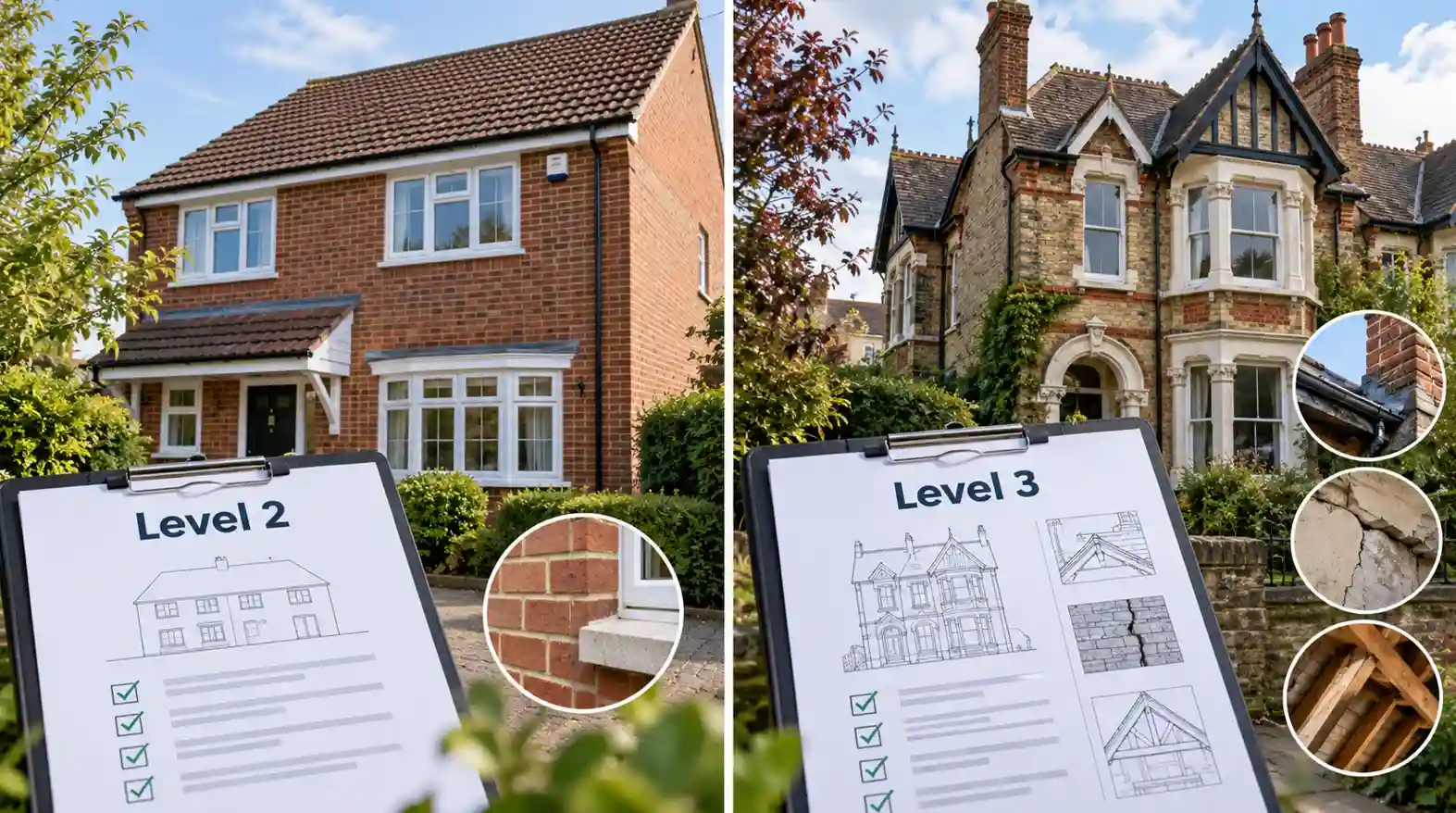
Once an offer’s accepted, the survey decision arrives fast, and it’s usually made under mild pressure — a solicitor asking for instructions, a mortgage timeline ticking, a buyer who has never had to think about the difference between “Level 2” and “Level 3” suddenly needing to choose.
The honest answer is that neither option is inherently better. One is proportionate to a large share of ordinary homes; the other exists because a meaningful minority of properties genuinely need more than that.
The job is matching the property in front of you to the right one.
For buyers in England, Wales and Northern Ireland, that usually means deciding what level of survey to commission for themselves. Scotland has a different starting point because the seller normally provides a Home Report before the property is marketed, and that’s covered separately below.
What currently exists, and what’s changing
The current framework is the RICS Home Survey Standard, first published in 2019 and effective since 2021.
It provides three levels of RICS Home Survey: Level 1, Level 2 and Level 3.
Level 2 is available either as survey only or survey and valuation. The latter adds the surveyor’s opinion of market value and an insurance reinstatement figure. A standard Level 3 does not include those valuation elements, although additional valuation work may be available separately if agreed with the surveyor.
Older terminology still survives. What used to be called a HomeBuyer Report broadly corresponds to today’s Level 2, while Level 3 is still commonly described as a Building Survey. Buyers may also hear the much looser term “structural survey”, although that is not the current RICS service name.
RICS is reviewing the standard and developing a second edition, but the practical position for a buyer commissioning a survey now is straightforward: the first edition remains the standard in force until a replacement formally takes effect.
So the Level 1, 2 and 3 system described here is the one buyers are dealing with today.
What genuinely changes between the levels
Level 1 is the lightest option. It gives a professional overview of the condition of a conventionally built property in good condition, identifying visible defects and matters requiring attention without the more detailed repair and maintenance advice provided by the higher levels.
For most buyers deciding between Level 2 and Level 3, though, the real question begins one step further up.
A Level 2 survey is intended for conventional properties built from familiar materials, in reasonable condition and relatively straightforward in their form and layout.
It goes beyond recording condition. The report gives advice about defects, repairs and future maintenance, and the inspection extends further than Level 1 into areas such as accessible roof spaces and drainage chambers where appropriate.
That makes it a proportionate choice for a great many ordinary houses and flats where neither the construction nor the condition is presenting unusual questions.
A Level 3 survey goes further.
The inspection is more extensive and the report gives greater consideration to how the property is built, the materials used, visible defects and the possibility of problems that may be concealed. It goes further into likely causes, repair options, the consequences of leaving significant defects untreated and, where appropriate and agreed, priorities or likely timescales for work.
RICS points buyers towards Level 3 for properties that are large, older, run-down, unusual, substantially altered, or where major works are planned. Its consumer guidance on choosing a home survey makes the broader principle clear: the appropriate level depends on the property’s age, size, condition, complexity and originality.
That extra depth is what the buyer is paying for.
It does not turn Level 3 into an invasive forensic examination. Walls aren’t routinely opened, floors aren’t automatically lifted and services aren’t comprehensively tested simply because the buyer has chosen the most detailed survey level.
A surveyor recommending further investigation can therefore be an entirely appropriate outcome. Movement may need a structural engineer. Electrics may need testing. Drainage may need a camera survey. A roof that cannot safely be inspected closely may require a specialist examination.
That isn’t evidence that the Level 3 survey has failed. Sometimes the useful finding is identifying exactly what needs investigating next.
Nor is a mortgage valuation a substitute for either survey.
A lender’s valuation exists primarily to help the lender decide whether the property provides adequate security for the mortgage. RICS explicitly distinguishes that from a buyer’s survey, which is concerned with helping the purchaser understand the condition of the property they’re actually buying.
A lender can therefore be satisfied with its security while a buyer still has good reason to want much more information about the building.
Matching the property to the survey
Rather than treating age as an automatic cut-off, it’s more useful to weigh several factors together.
Age and construction type. Age matters because older buildings are more likely to use materials and construction methods that need different interpretation, but there is no useful rule that a house built before one particular year automatically needs Level 3.
A straightforward older house that has been well maintained may present fewer uncertainties than a much newer property that has been heavily altered or built using an unusual construction system.
The stronger question is how conventional the building actually is. Historic solid-wall construction, cob, thatch, substantial timber construction, unusual conversions and recognised non-standard systems all strengthen the case for greater detail — and for a surveyor who understands that particular type of building.
Visible condition. A conventional property in apparently good order supports the case for Level 2.
Cracking, recurring damp staining, obvious roof deterioration, movement or a generally neglected exterior change the calculation. Once the buyer needs more explanation about cause, consequence and likely repair rather than simply confirmation that a defect exists, the extra depth of Level 3 becomes more valuable.
Extensions and alterations. A modest extension doesn’t automatically turn a straightforward house into a Level 3 property. But repeated or substantial alteration creates more to understand.
A loft conversion, major extensions, removed structural walls, a basement conversion or a building that has moved between different uses can leave the surveyor considering several generations of construction rather than one.
Whether those alterations have the correct planning or building-control paperwork is a separate legal question for the conveyancing process. How they appear to have affected the physical building is part of the survey.
Planned major works. A buyer intending substantial renovation, conversion or extension has more reason to understand the existing building in depth before committing to it.
A Level 3 survey won’t design a proposed extension, guarantee planning permission or replace a structural engineer where one is needed. What it can provide is a better understanding of the construction, condition and existing defects of the building the buyer intends to alter.
Listed, historic or unusual property. These are strong candidates for Level 3, but the surveyor matters as much as the label on the report.
A detailed survey from somebody unfamiliar with traditional solid-wall construction, historic timber, cob or another specialist building type can be less useful than one carried out by a surveyor who works with that construction regularly.
The question shouldn’t therefore be only “Level 2 or Level 3?”
It should also be “Is this the right surveyor for this property?”
If the choice genuinely feels borderline, the buyer doesn’t need to solve it unaided. Send prospective surveyors the property listing, explain any known alterations or visible concerns and tell them about major work you’re considering. Ask which level they recommend for that particular property and why.
RICS itself says the appropriate level depends on the individual property and that an RICS member can advise on the survey that fits it.
A useful surveyor should be able to explain the reasoning before the inspection is booked.
None of this makes Level 2 the “cheap” or lesser option.
On a conventional property in reasonable condition, a well-executed Level 2 can be exactly the right amount of investigation and advice. Paying for a Level 3 where the extra depth adds little isn’t automatically a better decision simply because the report is longer.
Equally, choosing Level 2 purely because it costs less is a false economy if the property is unusual or complex enough that what the buyer really needs is the greater investigation and explanation of Level 3.
Cost
Survey prices vary with the size, value, location and complexity of the property, the level of survey and the firm carrying it out.
That makes national “a Level 2 costs £X” figures less useful than they first appear.
The broad hierarchy is predictable — Level 1 generally costs least, Level 2 more and Level 3 more again — but the actual difference can vary considerably. A Level 3 on a large, heavily altered or unusual building is not directly comparable with a Level 2 on a straightforward two-bedroom house.
Get quotes for the specific property, and look beyond the total at what is actually included.
The cheapest Level 3 quote isn’t necessarily the best value if the surveyor has little experience of the building type, just as the most expensive report isn’t automatically the most useful.
For a property with genuine complexity, relevant experience is worth asking about explicitly before choosing between firms.
Scotland: a different starting point entirely
Scotland changes the starting point rather than making questions about condition disappear.
In most Scottish sales, the seller provides a Home Report before the property is marketed. It contains three components: a Single Survey and valuation, an Energy Report and a Property Questionnaire.
The Single Survey is based on a visual inspection by a chartered surveyor and gives prospective buyers information about the property’s condition, accessibility, repairs and market value.
So a Scottish buyer usually isn’t starting from the position of an English or Welsh buyer who has had an offer accepted and now needs to choose their first survey from Levels 1, 2 and 3. There is already survey information available before the offer is made.
That doesn’t mean the Home Report must answer every question.
An older or unusual property, significant defects highlighted in the Single Survey, extensive alterations or a specific concern that needs closer investigation may still give the buyer good reason to seek further independent professional advice before becoming committed.
The question in Scotland is therefore often less “Which standard survey should I start with?” and more “Does what I already have give me enough information about this particular property?”
That is an important difference.
The decision, in short
There is no prize for commissioning the longest report, and no virtue in choosing the cheapest survey if it doesn’t match the building.
A conventional property in reasonable condition, with familiar construction and no major alterations, will often sit naturally within Level 2 territory.
As the property becomes more unusual, more altered, more visibly defective or more difficult to understand — or as the buyer’s own plans for it become more ambitious — the case for Level 3 becomes stronger.
But the dividing line isn’t a particular construction date, property value or number of bedrooms.
It’s how much uncertainty the building presents and how much explanation the buyer needs before deciding whether to own it.
Where that isn’t obvious, ask the surveyor.
Choosing Level 2 for a property whose complexity genuinely calls for Level 3 can leave the buyer with less investigation and less explanation precisely where they need more. Choosing Level 3 for a straightforward home simply because it sounds safer may buy considerably more report without materially changing the decision.
The right survey is the one that’s proportionate to the property — carried out by somebody who understands what they’re looking at.
Important: This article provides general information about residential property surveys and does not replace advice from a chartered surveyor, solicitor, conveyancer, engineer or other appropriately qualified professional. Survey scope, property construction and buying processes vary, and additional specialist investigations may be recommended depending on the individual property. Buyers should confirm the precise scope and terms of any survey with the surveyor before instructing them.

