

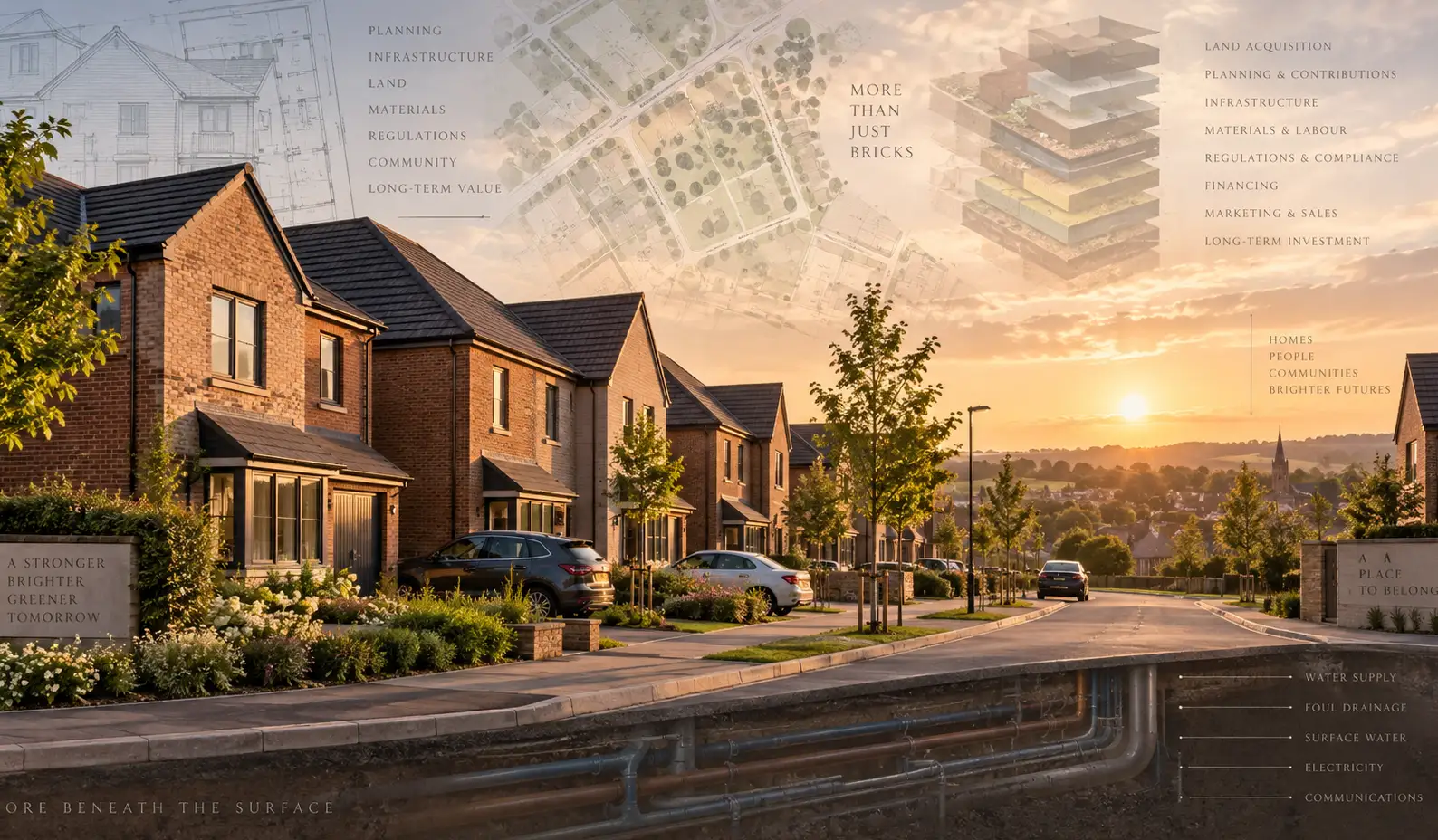
A modest three-bedroom new-build house, on what was recently a field, priced at several hundred thousand pounds, understandably prompts a straightforward question: how can it possibly cost this much? The instinctive answer — developer greed — is too simple to actually explain what’s happening, and it misses something important about how the price of a new home gets set in the first place.
That doesn’t mean every land price, viability claim or developer margin should be accepted uncritically. This is simply an attempt to follow the money from raw land to completed sale before deciding where the problem actually lies.
The detailed planning and viability rules discussed below relate primarily to England.
The price isn’t built from the ground up — it works backwards
This is the single most important thing to understand before any of the individual cost categories below make sense. A developer does not typically calculate the selling price by adding up the construction cost, land and professional fees and then placing a fixed markup on top. The achievable sale value in the local housing market — what buyers in that area will actually pay for those homes — is usually the starting point, and the development has to work backwards from there.
Development appraisal commonly describes the expected value of all the completed homes as the gross development value, or GDV. Construction, infrastructure, professional costs, planning obligations, finance and the return required for undertaking the development then have to fit beneath that value, with what remains determining how much the scheme can support for the land. Homes England’s guidance on financial viability for housing-led projects describes this residual approach directly.
A simplified example makes the principle easier to see. Suppose a development is expected to produce £40 million from selling its completed homes. If construction, infrastructure, professional work, finance, planning obligations and the required development return account for £34 million, the scheme can support roughly £6 million for the land. If those other costs rise by £2 million while the expected selling value remains unchanged, the amount available for land falls to about £4 million. If the land has already been acquired or contracted at £6 million, something else in the appraisal has to absorb that change or the scheme’s viability deteriorates.
Those figures are purely illustrative, not a typical development breakdown. The point is the direction of the calculation.
It also explains why essentially the same house design can sell for dramatically different prices in different parts of the country. The physical cost of constructing it varies, but not by anything approaching the entire gap between a high-value market and a much cheaper one elsewhere. The finished home is being sold into a local property market, not priced according to what the bricks cost.
Land
Land cost is genuinely significant, but it doesn’t work quite the way it’s sometimes assumed to. Land capable of residential development can be worth considerably more than the same land in agricultural, industrial or another existing use, and that uplift in potential value is one reason planning allocations and permissions matter so much to landowners.
But a developer cannot simply pay any price a landowner asks and assume that cost can be passed through to buyers. The land value the scheme can support is constrained by the expected selling value of the homes after the other costs of delivering them have been accounted for.
Government planning viability guidance reflects that principle by expecting land value in viability assessments to have regard to existing use, an appropriate incentive for the landowner to release the site, development costs and planning-policy requirements.
That creates one of the recurring tensions in development economics. If too much of the value created by planning permission is captured in the land price, there is less room elsewhere in the appraisal for infrastructure, affordable housing and other obligations. Equally, a developer who knowingly pays too much for land cannot automatically use that decision later as justification for reducing policy requirements.
The economics of a new home therefore begin long before anybody starts laying bricks.
Construction
The physical building is obviously one of the largest costs, but quoting a single national “cost per square metre” for a new home can be more misleading than useful.
Construction costs vary with location, building type, density, specification, site conditions and procurement. Low-rise estate housing has a different cost structure from an apartment block with lifts, communal areas and complex structure. A constrained urban site differs from an open site on the edge of a town, while contamination, difficult foundations or retaining structures can change the cost again.
Government viability guidance consequently expects development costs to use appropriate local and scheme-specific evidence rather than one universal national figure. Government guidance on viability
Building standards add another element. Requirements covering insulation, ventilation, energy use and other aspects of performance have tightened over time, and the government published the Future Homes and Buildings Standards in March 2026. Subject to transitional arrangements, the principal new requirements are due to come into force from March 2027, including higher energy-performance requirements, low-carbon heating and on-site renewable electricity generation for new dwellings. Future Homes and Buildings Standards
Those standards are intended to produce homes that consume less energy and carbon over their lives, which has genuine value for the eventual occupant. They also have to be delivered and paid for during construction.
The useful distinction is therefore not between an expensive finished house and a cheap pile of building materials. Physical construction is substantial, but it is only one part of the development.
Infrastructure
Beyond the buildings themselves, housing developments need the infrastructure that allows them to function.
Depending on the site, that can include roads, drainage, landscaping, electricity infrastructure and connections or upgrades to water and wastewater networks. Larger edge-of-settlement schemes may have to create substantial new infrastructure before many homes can be occupied, while smaller sites within existing settlements may be able to connect more readily into what is already there.
These costs sit outside a simple calculation of what it costs to construct the house itself, and two developments containing superficially similar homes can therefore carry very different underlying infrastructure costs.
Wastewater capacity is an increasingly visible example, covered in more detail in our companion article Why Isn’t Britain Building Enough Homes?, where insufficient treatment capacity has contributed to delays on proposed developments in parts of England.
Infrastructure isn’t something added to the finished estate for convenience. It is part of what makes the estate capable of existing.
Planning obligations
Development also carries costs created through the planning system, most visibly affordable housing and contributions towards infrastructure or mitigation required to make a development acceptable.
Section 106 agreements can secure affordable housing and site-specific works or financial contributions, while authorities that charge the Community Infrastructure Levy can use it to help fund wider infrastructure. Government guidance requires planning obligations to be necessary, directly related to the development and fairly and reasonably related to it in scale and kind. Government guidance on planning obligations
It is worth resisting the temptation to describe these obligations simply as a tax on new housing. Development can create additional demands on roads, schools, public space and other infrastructure, while affordable housing delivered through market development is an important part of England’s housing system.
Official statistics show how significant that role has become: in 2024/25, affordable homes delivered through Section 106 agreements without government grant accounted for 36% of all affordable homes delivered in England. Affordable housing supply in England, 2024/25
At the same time, those obligations are real development costs. More value required for affordable housing, infrastructure or mitigation means less residual value is available elsewhere in the appraisal, which is why arguments about development viability become so contested.
The legitimate debate is not whether these costs exist, but whether the assumptions being used are credible and where adjustments should fall when the overall numbers stop working.
Professional and legal costs
A development also involves considerably more professional work than is visible once the houses are standing.
Architects, civil and structural engineers, planning consultants, quantity surveyors, ecologists, transport specialists, solicitors and other professionals may be involved at different stages, along with building-control, warranty, project-management, sales and marketing costs.
Some of that expenditure begins years before the first completed home is sold.
Individually these items look modest beside the land or construction bill. Collectively they form another substantial part of delivering a development through planning, design, construction and sale.
Finance
Development finance carries its own real cost because expenditure and income arrive at very different times.
Land, design work, planning, infrastructure and construction can require large sums of money long before enough completed homes have been sold for that money to begin returning to the developer. Borrowed development finance is therefore considerably different from an ordinary residential mortgage and is priced for a different level of commercial risk.
The longer the gap between money going out and sales revenue coming back in, the more important financing becomes. A planning or infrastructure delay doesn’t simply move a date in the programme; it can leave capital tied up for longer while interest and other holding costs continue.
That is why certainty and speed in the development process themselves have a financial value.
Risk
Development also contains genuine uncertainty. Ground conditions can turn out worse than expected. Construction costs can move between appraisal and procurement. Infrastructure or planning can take longer than assumed. Mortgage conditions can change what buyers can afford, and a sales market expected to be strong when a site was acquired can weaken by the time the homes are ready.
Some uncertainty may require specific contingencies within the development budget. More broadly, however, risk is also one of the reasons a developer requires a return for committing capital in the first place.
That distinction matters because the same risk should not simply be priced repeatedly into different parts of the appraisal. A scheme that assumes absolutely everything will go perfectly is unrealistic; an appraisal that loads excessive allowances into several different headings deserves scrutiny for the opposite reason.
Developer margin
Profit exists in development for the same broad reason it exists in any capital-intensive and risky commercial activity: somebody has to be willing to commit substantial capital for years without knowing exactly what the eventual outcome will be.
There is at least a useful benchmark for understanding what the planning system considers plausible. Current government viability guidance says that, for plan-making purposes, a return of around 15–20% of gross development value may be considered a suitable assumption, while recognising that different development types and risk profiles can justify different figures. Government viability guidance on developer returns
That should not be read as saying housebuilders automatically earn 15–20% on every development, or that this percentage is simply added to the physical construction cost of each home. It is an appraisal assumption applied to the value of the overall development; actual returns can finish higher or lower depending on what happens to costs, delays and sale values over the life of the scheme.
Nor does the existence of a required return put developer margins beyond scrutiny. Viability evidence can and should be challenged where its assumptions are weak, particularly when it is being used to justify reductions in affordable housing or other obligations.
But removing the profit line from an appraisal does not make land, construction, infrastructure or finance cheaper. If the expected return becomes too low for the capital and risk involved, the likely consequence may be that the development is delayed, changed or not funded at all rather than that the same homes simply appear at a lower price.
The meaningful argument is therefore about what constitutes a reasonable return for the actual risk involved.
Does a new build actually cost more than an equivalent existing home?
New-build homes can sell at a premium to comparable existing homes, but that is something to investigate locally rather than assume from broad averages.
Part of the premium can reflect things the existing market may not offer in the same combination: current energy performance, a structural warranty, new fixtures and finishes, modern layouts, lower immediate maintenance requirements and, for some buyers, the simple appeal of a property nobody has previously occupied.
Developers also use incentives, including contributions and specification upgrades, which can make the effective purchase package different from the headline asking price and complicate comparisons further.
None of those things proves that a particular new home represents good value. A buyer still needs to compare it against genuinely similar existing homes in the same location and ask whether whatever premium remains is worth paying for the advantages offered.
What should not be assumed is that the difference between a new-build asking price and the physical cost of constructing it is simply developer profit. The asking price belongs to the housing market; the construction cost is one item inside the economics required to create the property being sold.
The separate buyer question — whether a new build or an existing home is the better purchase — belongs in our Buying a Home coverage rather than being answered by development economics alone.
“Just build more cheap houses” is harder than it sounds
None of this is intended to close down legitimate questions about whether a specific development, or the housebuilding industry more broadly, provides good value. Land prices deserve scrutiny. Viability assumptions deserve scrutiny. Infrastructure costs matter. Affordable-housing negotiations matter. Developer margins are a legitimate subject of debate, and buyers are perfectly entitled to decide that the finished home simply isn’t worth what is being asked.
What the economics shows is that a new-build home’s price isn’t construction cost plus an arbitrary markup.
The local housing market establishes what the completed homes are likely to be worth. Working backwards from that value are land, construction, infrastructure, professional work, planning obligations, finance and the return required to justify committing the capital and taking the risk. If those figures no longer fit together, something has to change — the land value, design, density, obligations, expected selling price, return, or whether the scheme proceeds at all.
Understanding that chain doesn’t prove new-build homes are fairly priced.
It explains why looking at a £400,000 new house and asking how the bricks could possibly have cost £400,000 starts with the wrong question.
The bricks never did.
This article provides general information about housing-development economics in England and is not valuation, planning, development-finance or investment advice. Development costs, land values, planning obligations, finance and developer returns vary considerably by scheme, location and market conditions. Cost and policy information can also change; use current scheme-specific evidence when assessing any individual development.

