

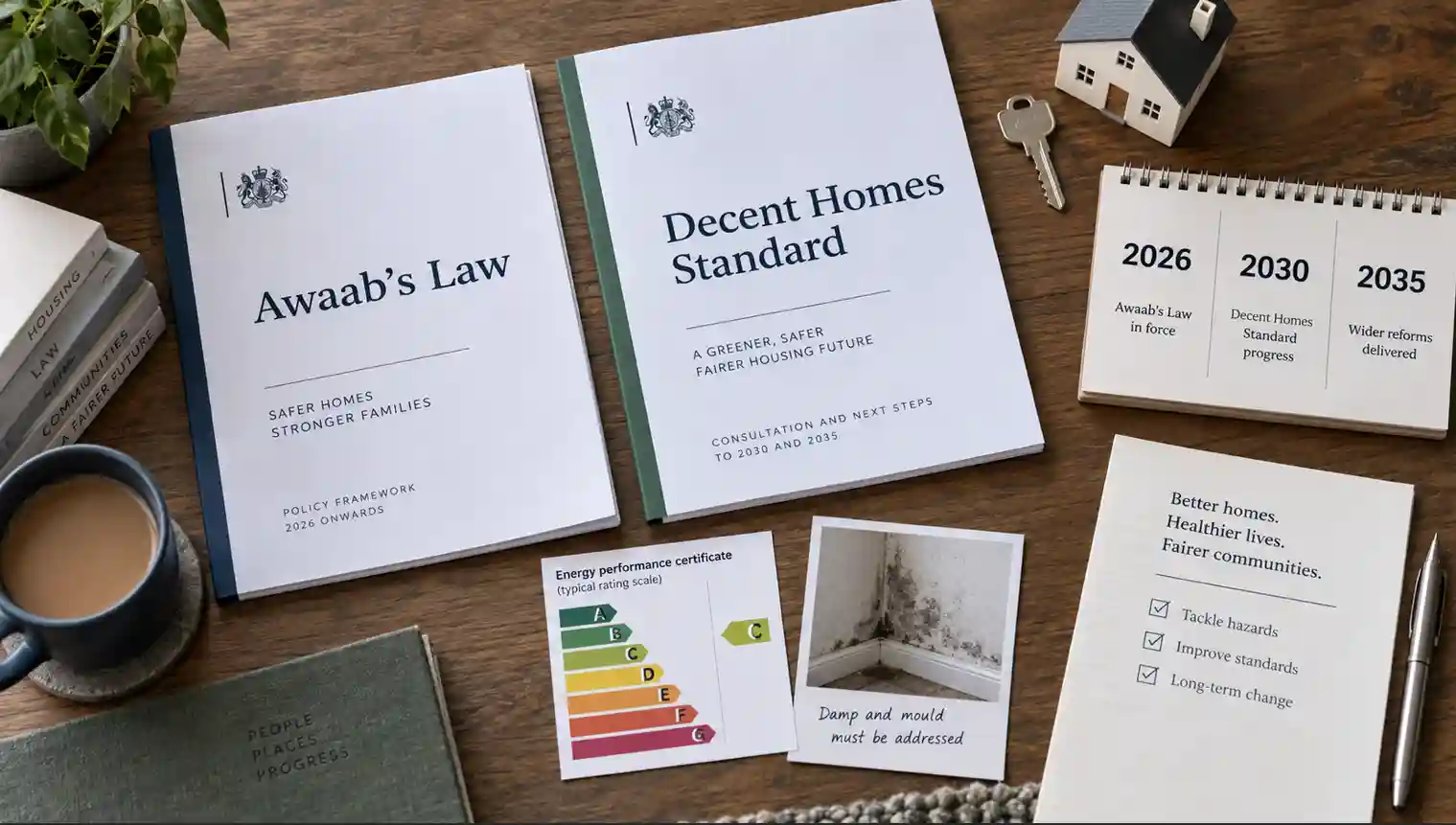
Two of the biggest reforms to housing quality standards in England in a generation are moving through implementation at the same time — and for private renters, neither currently operates in quite the way the headlines around them can suggest. Getting the timeline right matters, because the gap between what’s already in force, what’s confirmed but still to come, and what’s dependent on further regulations or consultation is genuinely wide.
Awaab’s Law: where it actually stands today
Awaab’s Law — named for Awaab Ishak, a two-year-old boy who died in 2020 from a severe respiratory condition caused by prolonged exposure to mould in his family’s social housing home, despite repeated complaints to his landlord — sets fixed, legally enforceable timescales for social landlords to investigate and deal with serious hazards. It is currently in force, but only in social housing.
Phase 1, live since 27 October 2025, covers emergency hazards and significant damp and mould. Social landlords must investigate a reported significant damp or mould hazard within 10 working days and make the home safe within 5 working days after the investigation concludes. A written summary must normally follow within 3 working days of the investigation finishing. Emergency hazards have to be investigated and made safe within 24 hours. If the home can’t be made safe within the required period, suitable alternative accommodation must be offered. The government’s Awaab’s Law guidance for social housing tenants sets out the current Phase 1 protections.
Phase 2 is not in force yet. It takes effect on 30 November 2026 and extends Awaab’s Law to significant hazards involving excess cold and heat, falls, structural collapse, fire and explosions, electrical hazards, and domestic and personal hygiene and food safety. The government has already published Phase 2 guidance ahead of commencement.
Phase 3 is planned for 2027 and will extend the social-housing regime to the remaining HHSRS hazards where they present a significant risk, with overcrowding excluded. An exact Phase 3 commencement date has not yet been confirmed.
None of those fixed Awaab’s Law deadlines currently applies to an ordinary private landlord. The Renters’ Rights Act 2025 provides for Awaab’s Law to be extended to the private rented sector through future regulations, but the government has not yet brought those duties into force for private renting. Its current Renters’ Rights Act implementation roadmap lists the private-sector commencement date as TBC and subject to consultation.
The government has said it will consult on how that extension should work. As of September 2026, however, there is no confirmed commencement date. If you rent privately and are told that Awaab’s Law’s fixed 10-day, 5-day or 24-hour deadlines protect you today, that’s not yet accurate — it’s a genuine future protection, not a current one.
The Decent Homes Standard: a bigger, slower-moving reform
The Decent Homes Standard has existed for social housing for years, but on 28 January 2026 the government published a new Decent Homes Standard policy statement, confirming a substantially reformed version that will eventually apply to private rented homes as well as social housing.
The new standard rests on five criteria.
A home must be free from the most dangerous Category 1 hazards under HHSRS; be in a reasonable state of repair; provide specified core facilities and services; provide a reasonable degree of thermal comfort; and be free from damp and mould.
There is more detail beneath those headings. Kitchens, bathrooms, heating systems, roofs, windows and other important components can determine whether the repair criterion is met. The facilities criterion includes requirements around kitchen and bathroom provision, external noise insulation and, for flats, common entrance areas. Homes will also need child-resistant window restrictors on windows that meet the specified fall-risk conditions. Damp and mould becomes a standalone criterion in its own right rather than simply disappearing into a wider assessment of general condition.
The HHSRS element has itself changed since the Decent Homes policy was being developed. England’s revised HHSRS came into force on 23 June 2026, reducing the hazard profiles from 29 to 21 and introducing clearer high, moderate and low risk descriptions. Category 1 remains the statutory dividing line for the most serious hazards: a score of 1,000 or more is a Category 1, high-risk hazard.
Here’s the detail that matters most for a private renter reading this today: the new Decent Homes Standard doesn’t become enforceable in the private rented sector until 2035.
That is now considerably firmer than the earlier Renters’ Rights Act roadmap, which had left the final DHS date subject to consultation. The January 2026 policy statement set 2035 as the implementation point for the new standard in both the social and private rented sectors, with regulation and enforcement against the new standard beginning then.
One element moves substantially faster than the rest: private rented homes are due to meet the new Minimum Energy Efficiency Standard — broadly EPC C or equivalent under the reformed system — by 1 October 2030, unless a valid exemption or applicable transitional provision applies.
That energy-efficiency requirement sits within the thermal-comfort criterion of the future Decent Homes Standard, but it operates through its own regulatory framework and arrives years before the rest of the DHS.
What’s actually different now, and what’s coming later
This is the part worth keeping straight. A policy can be announced, legislated for, regulated, or actually in force — and those aren’t interchangeable stages.
| Reform | Position on 9 September 2026 | What happens next |
|---|---|---|
| Revised HHSRS | In force now. The 21-hazard system has applied since 23 June 2026 and councils can use it when enforcing housing standards in private rented homes. | Already part of the current protection for private renters. |
| Awaab’s Law Phase 1 | In force since 27 October 2025, but social housing only. Covers significant damp and mould and all emergency hazards. | Continues alongside later social-housing phases. |
| Awaab’s Law Phase 2 | Not yet in force. | Starts in social housing on 30 November 2026, extending fixed deadlines to further significant hazards. |
| Awaab’s Law Phase 3 | Not yet in force. | Planned during 2027 for remaining significant HHSRS hazards except overcrowding. |
| Awaab’s Law for private renting | Not currently in force. | Extension is confirmed in principle, but commencement is TBC and subject to consultation. |
| Private rented MEES | Future requirement. | New and existing private tenancies are due to meet the higher EPC C-or-equivalent standard by 1 October 2030, subject to the final regulatory framework and applicable exemptions. |
| New Decent Homes Standard for private renting | Confirmed, but not yet enforceable. | Applies from 2035, when local-authority enforcement against the new standard is due to begin. |
That table is probably the most important distinction in the article. For a private renter today, the revised HHSRS is real and current; Awaab’s Law’s fixed deadlines and the new Decent Homes Standard are not.
What the 2035 standard would actually add
It’s easy to hear “Decent Homes Standard” and assume this simply gives a new name to protections tenants already have. It goes further than that.
Private landlords already have repair obligations. Homes already have to be fit for human habitation. Councils can already act against serious hazards through HHSRS. Those protections don’t disappear while the new standard is being introduced.
What the new DHS adds is a more explicit common definition of what a decent rented home should contain and how its condition should be assessed.
That includes a clearer test for whether important building components are in reasonable repair; defined expectations around core facilities and services; specific requirements for windows presenting a fall risk; thermal-comfort and energy-efficiency requirements; and a standalone expectation that damp and mould is remedied.
For tenants, the practical advantage is partly clarity. A problem won’t always have to be squeezed into the question of whether a particular component is technically “in disrepair” or whether the whole property has crossed the fitness-for-human-habitation threshold. The new standard creates another, more detailed benchmark against which rented housing can eventually be assessed.
But 2035 is not a grace period for unsafe housing.
A private landlord can’t point to the future Decent Homes Standard and argue that they have until then to fix a dangerous boiler, severe damp, structural disrepair or another problem already covered by existing law. Current repairing obligations, fitness-for-human-habitation requirements and council HHSRS powers continue to apply throughout the transition.
What this could mean for a private renter down the line
Once Awaab’s Law is eventually extended to private renting, the practical shift could be significant: instead of relying solely on broader duties to deal with hazards within the timescale the law presently requires in the circumstances, tenants would gain specific, legally enforceable deadlines for defined serious hazards.
The new Decent Homes Standard tackles a different part of the same problem. It sets out a more detailed baseline for the condition and facilities of the home itself.
The two reforms therefore shouldn’t be thought of as substitutes for one another.
Awaab’s Law is fundamentally about how quickly a landlord must respond when a qualifying hazard exists. The Decent Homes Standard is fundamentally about the condition a rented home is expected to meet.
That distinction is useful because the names are often discussed together even though they perform different jobs.
None of that removes the protections a private renter has this year. What protects a private renter today remains what’s covered in our companion article on minimum property standards — including the existing fitness-for-human-habitation duty and HHSRS enforcement — genuinely real protections, just without Awaab’s Law’s specific private-sector deadlines or the new Decent Homes Standard’s full set of criteria attached to them yet.
The honest summary
Something significant is genuinely changing in how England assesses and enforces rented-home quality — but it’s changing in stages, over years, and largely for social housing first.
A private renter today can rely on the legal protections that already exist: repairing obligations, a home that must be fit for human habitation, and council enforcement against serious housing hazards. The revised HHSRS is already part of that landscape.
What’s coming is more explicit: fixed response deadlines through Awaab’s Law once the private-sector regulations eventually arrive, a higher energy-efficiency standard from 2030, and a common modernised Decent Homes Standard from 2035.
Those are substantial changes. They’re just arriving later — and on a more complicated timetable — than a headline announcing that they’ve “become law” can make it sound.
This article reflects the policy and implementation position as at 9 September 2026 and does not constitute legal advice. Implementation timelines and secondary legislation can change; check current GOV.UK guidance before relying on a future commencement date.

