

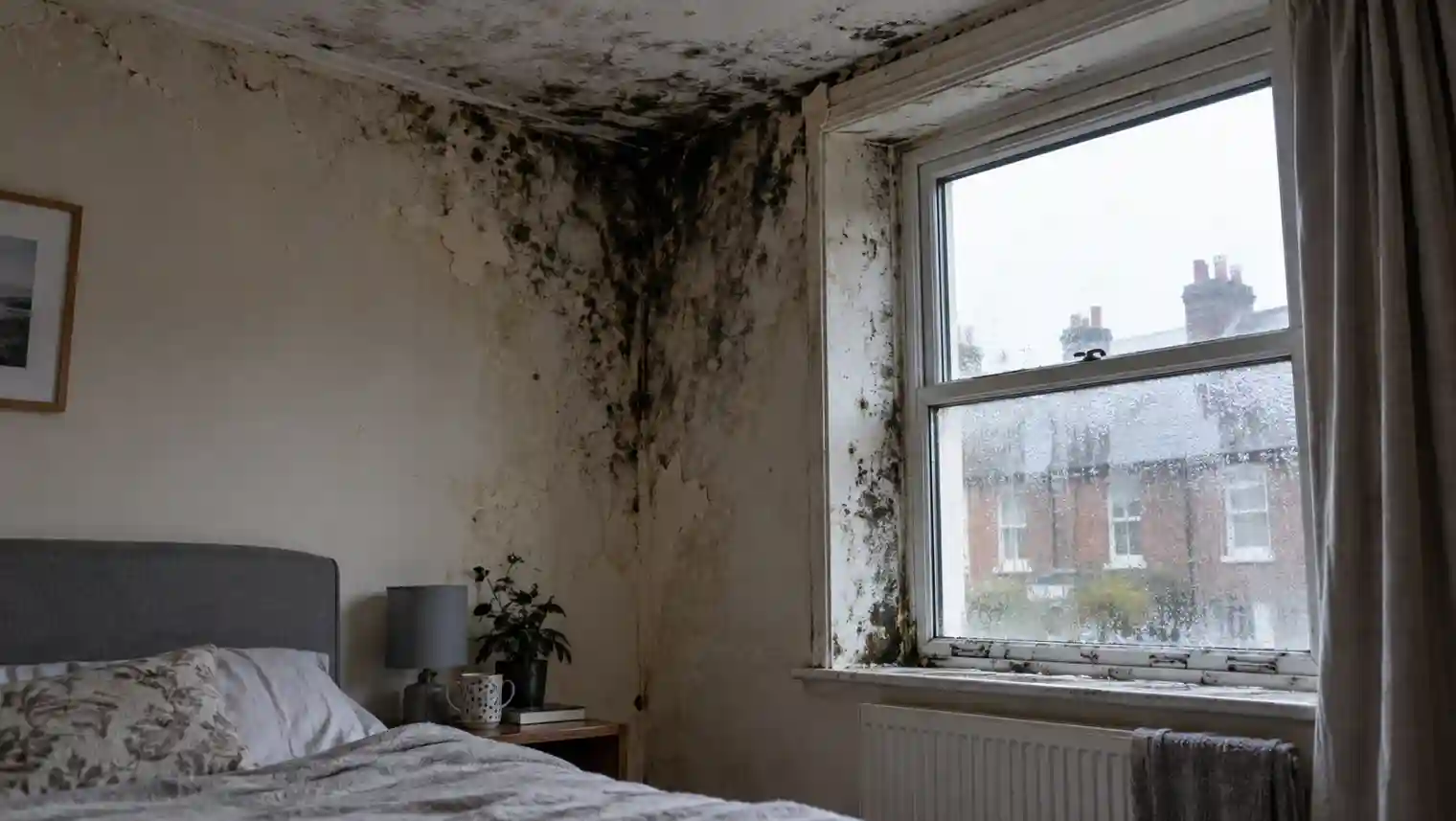
Black spots creeping across a bedroom ceiling, a musty smell that won’t shift, condensation streaming down a window every morning — damp and mould sit at the centre of some of the most persistent tenancy disputes, and a large part of the reason is that the cause genuinely isn’t always obvious. Unlike a burst pipe, where the fault is usually visible and undeniable, damp can stem from several different sources at once, some clearly the landlord’s problem, some affected by how the property is being used, and plenty that sit somewhere in between.
Why the cause changes everything
Damp isn’t one problem — it’s a symptom that can have several distinct causes, and responsibility follows the cause, not the symptom.
Penetrating damp — water getting in from outside through a defective roof, damaged brickwork, a failed seal around a window, or another defect in the structure or exterior — will usually point towards a repair problem for the landlord to investigate and remedy. Leaks from pipes, heating systems or other installations the landlord is responsible for can produce much the same result. The government’s private-renting repairs guidance sets out the landlord’s core responsibilities for the structure, exterior and key installations.
Rising damp, where moisture travels upwards through walls from the ground, similarly points towards a problem with the building rather than ordinary tenant behaviour. Depending on the underlying defect, the legal route may be the landlord’s repair duty, the fitness-for-human-habitation duty, or both.
Condensation damp is the genuinely more complicated category, because moisture produced through normal life — cooking, bathing, drying laundry, simply breathing — can condense when it meets cold surfaces and can’t escape properly. Poor ventilation, inadequate insulation, cold walls, inefficient heating and the way the property is occupied can all affect how severe the problem becomes.
But that doesn’t mean “tenant lifestyle” is an adequate diagnosis. Current government guidance on damp and mould is explicit that landlords shouldn’t blame normal domestic activities for damp and mould. Small, reasonable changes in how a home is used may sometimes help, but they aren’t a substitute for identifying building deficiencies, inadequate ventilation, ineffective heating or poor energy efficiency.
The law reflects this complexity rather than pretending it away. Condensation-driven damp doesn’t always fit neatly within a landlord’s core Section 11 repair duty, because there may be no obvious “disrepair” as such — just a cold, poorly ventilated building. But it can still breach the separate fitness-for-human-habitation standard, which looks at the property’s actual habitability rather than requiring a particular broken component to point to.
Tenant behaviour can still matter. The fitness rules contain exceptions where the problem has genuinely been caused by the tenant, and deliberately blocking ventilation, refusing reasonable access for investigation or repair, or other conduct that actually creates or substantially worsens the problem may affect responsibility. That’s very different from treating ordinary cooking, bathing or drying clothes as proof that the tenant caused the mould.
What this means in practice
Don’t assume every mould problem is the landlord cutting corners, and don’t assume every mould problem is the tenant not opening a window enough. Both assumptions are wrong often enough to be actively unhelpful.
A landlord faced with a damp report should investigate the underlying cause properly — not simply suggest more ventilation and move on, but consider what is actually happening in the building. That may mean checking for leaks and defects, assessing ventilation, looking at insulation or unusually cold surfaces, and making sure the heating system is capable of heating the home effectively. Simply cleaning the visible mould without dealing with its cause may only mean it comes back.
Equally, a tenant has sensible responsibilities here: reporting problems promptly rather than letting them develop for months, making reasonable use of heating and ventilation where they’re genuinely available, not deliberately blocking trickle vents or extractor fans, and allowing proper access for the landlord to investigate.
“Reasonable use” matters. It doesn’t mean a tenant should be expected to run the heating constantly regardless of cost, any more than it means ignoring an effective extractor fan or permanently blocking ventilation.
If the answer is simply “it’s condensation”
This is where one useful distinction can prevent a lot of circular argument: condensation describes how moisture becomes water on a surface; it doesn’t, by itself, establish who is responsible for the conditions that allowed it to happen.
If a landlord or agent dismisses a recurring mould problem as condensation, ask what has actually been checked. Does the extractor work properly? Are the vents clear and effective? Is there adequate heating in the affected room? Is there evidence of a leak, defective seal or unusually cold section of wall? Does the mould keep returning after being cleaned?
You don’t need to diagnose the building yourself. The point is simply that “condensation” should be the beginning of finding the cause, not the end of the investigation.
Building a record that actually helps
If you’re dealing with damp or mould, the evidence that matters most is straightforward: dated photographs showing how the problem develops over time, not just a single snapshot; the date you first reported it and how; any response, or lack of one, from the landlord or agent; and, where genuinely useful, a simple note of conditions — whether windows can actually be opened, whether an extractor fan works, whether the property has any effective heating in the affected room at all.
This doesn’t need to become a scientific investigation, and there’s no need to track humidity readings obsessively or turn this into a health study of your own home. A clear, dated timeline with photographs and correspondence can be extremely useful if the cause or response later becomes disputed.
Damp and mould can be a health problem, not just a housing problem
Damp and mould primarily affect the airways and lungs. Exposure can be associated with coughing, wheezing and shortness of breath, and can contribute to or worsen conditions including asthma and other respiratory illnesses. Some people may also experience irritated eyes, eczema or skin rashes, and persistent damp and mould can affect mental wellbeing as well as physical health.
Anyone can be affected, but the risks can be greater for young children, older people, people with existing respiratory or cardiovascular conditions, people with weakened immune systems, pregnant women and some people whose health or mobility makes prolonged exposure harder to avoid.
If you believe damp or mould is affecting someone’s health, say so clearly and factually when reporting it. You don’t need to wait for a doctor’s letter before telling the landlord, and official guidance says action shouldn’t be delayed while medical evidence is being obtained. If you’re concerned about symptoms, seek appropriate healthcare advice as well.
And don’t get too distracted by trying to identify the mould yourself. Black, green or differently coloured growth may look alarming, but its appearance alone doesn’t tell you enough about why it’s there or how serious the underlying housing problem is. You don’t need to identify the species before reporting it. What matters more is the extent of the damp or mould, how long it has been present, whether people are being affected, and — crucially — what’s causing the moisture in the first place.
Where Awaab’s Law fits in — and where it doesn’t yet
Awaab’s Law is frequently mentioned in connection with damp and mould, and it’s worth being precise about what it actually covers today.
It currently applies to social housing in England, where its first phase has operated since 27 October 2025. For significant damp and mould hazards, social landlords must investigate within 10 working days and make the home safe within 5 working days after the investigation concludes. A written summary is generally required within 3 working days of the investigation finishing where further work is needed. Emergency hazards must be investigated and made safe within 24 hours.
If a significant damp or mould hazard can’t be made safe within the required period, the landlord must offer suitable alternative accommodation until it can be. The government’s Awaab’s Law guidance for social housing tenants explains the current deadlines and remedies.
Those fixed Awaab’s Law deadlines do not currently apply to ordinary private landlords.
The Renters’ Rights Act 2025 provides for Awaab’s Law to be extended to the private rented sector, but the government’s current implementation roadmap leaves the commencement date to be confirmed following consultation. As of September 2026, no firm start date for the private rented sector has been announced.
Anyone telling you that the social-housing deadlines already bind an ordinary private landlord is therefore describing where the law is intended to go, not where it currently stands.
Private tenants still have real protections in the meantime through landlords’ repairing obligations, the fitness-for-human-habitation duty and local-authority enforcement where conditions amount to serious housing hazards — they simply don’t yet have Awaab’s Law’s fixed private-sector deadlines.
Where the deeper detail lives
This article has deliberately focused on where responsibility sits, how it’s investigated and why the health implications matter. It hasn’t tried to turn visible mould into a DIY diagnosis.
Detailed content on penetrating damp, rising damp, condensation, mould removal, ventilation and identifying the physical cause belongs in our Property Problems section, under Damp, Mould & Condensation, and is worth reading alongside this article if you’re trying to understand exactly what’s happening in your specific property.
This article provides general information about damp and mould responsibility in England and does not constitute legal or medical advice. If damp or mould is affecting your health, consider seeking appropriate healthcare advice. If a landlord isn’t responding appropriately to a genuine report, consider contacting your local authority’s environmental health or private-sector housing team, or a housing advice service.

