

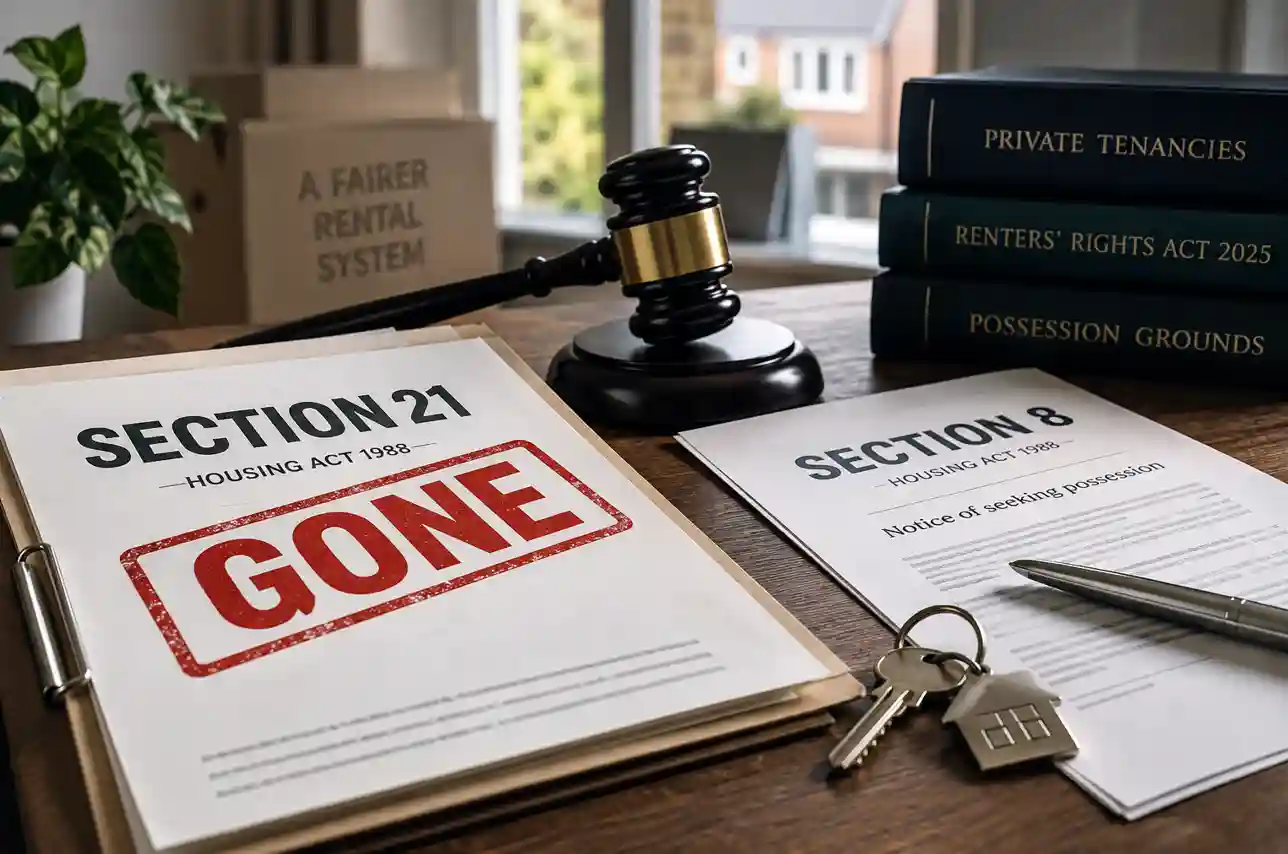
For more than three decades, Section 21 was the quiet mechanism sitting behind most private assured shorthold tenancies in England — a notice a landlord could serve giving at least two months to leave, no reason required, no fault alleged. It’s gone now. Since 1 May 2026, it can no longer be served at all, and the final deadline for starting a court claim using a qualifying Section 21 notice served before the change passed on 31 July 2026.
What hasn’t gone is a landlord’s ability to eventually regain their property. What’s changed is the entire structure around how, when, and on what basis that can happen — and understanding that structure matters more than simply knowing the old route is closed.
Every assured tenancy is now open-ended, from day one
The reform that makes everything else make sense is this: for the private-sector assured tenancies covered by the new system, tenancies are now periodic — rolling, with no fixed end date. Existing assured and assured shorthold tenancies converted automatically on 1 May 2026; new assured tenancies are periodic from the start. An end date written into a new assured tenancy doesn’t make it a fixed term in the old sense.
That doesn’t mean every private renting arrangement in England works this way. Lodgers living with a resident landlord, some licences, holiday lets and other tenancies outside the assured regime have different rules. But for the mainstream private assured tenancy, the fixed-term structure that used to dominate the sector has gone.
This single change is what actually closed the door Section 21 used to walk through. With no fixed term left simply to expire and no Section 21 route to fall back on, a landlord who wants possession of an assured periodic tenancy now has to rely on a legally recognised ground.
Section 8: the route landlords now have to use
That route is Section 8 of the Housing Act 1988 — not new, but now the possession-notice mechanism landlords must use for assured periodic tenancies, where previously it sat alongside the much simpler Section 21.
A landlord has to identify one or more statutory grounds, give the notice required for the ground being relied upon and — critically — be prepared to show that the ground actually applies if the tenant doesn’t leave and the case goes to court. The government’s grounds for possession guidance sets out the full list.
This is a meaningfully different structure from Section 21. It’s not simply a replacement form to fill in; the landlord is now saying, in effect, “this is the legal reason I am seeking possession, and this is why I say it applies.”
The grounds themselves split into two types. Mandatory grounds mean the court must usually make a possession order if the landlord proves the ground and the relevant legal requirements have been met. They include the landlord or certain close family members needing to live in the property, a genuine intention to sell, and sufficiently serious rent arrears.
Discretionary grounds allow the court to decide whether making a possession order is reasonable even where the factual ground has been established. These include lower-level rent arrears, persistent late payment, some tenancy breaches and deterioration of the property.
Some of the main grounds at a glance
This isn’t the full list, but it shows why receiving a “Section 8 notice” doesn’t by itself tell you how long the process will take or whether possession is automatic.
| Reason relied upon | Ground | Type | Minimum notice before court action |
|---|---|---|---|
| Landlord or qualifying family member wants to move in | 1 | Mandatory | 4 months |
| Landlord genuinely intends to sell | 1A | Mandatory | 4 months |
| Serious rent arrears — generally at least three months where rent is monthly | 8 | Mandatory | 4 weeks |
| Some rent arrears | 10 | Discretionary | 4 weeks |
| Persistent late payment of rent | 11 | Discretionary | 4 weeks |
| Breach of a non-rent tenancy term | 12 | Discretionary | 2 weeks |
| Anti-social behaviour | 14 | Discretionary | No minimum notice period before the landlord can apply to court, although the court cannot make the possession order immediately |
The notice period is only one part of the test. Each ground has its own conditions, and using more than one ground can affect which notice period applies.
What abolition doesn’t mean
It’s worth being precise here, because the natural shorthand — “landlords can no longer evict tenants without fault” — can create the wrong impression, and the opposite shorthand — “landlords can’t get their property back unless the tenant’s done something wrong” — is plainly incorrect.
A landlord who genuinely wants to sell the property, or genuinely needs it for themselves or a qualifying close family member to live in, still has a clear route to possession. Ground 1 covers occupation by the landlord or qualifying family; Ground 1A covers a genuine intention to sell. Both are mandatory grounds and normally require four months’ notice.
There is an important first-year protection. A tenant can’t be required to leave under either of these grounds during the first 12 months of a new tenancy. A landlord can serve the notice before those 12 months have finished, but it must not expire until the protected period has ended.
There is also a separate 12-month restricted period following use of Grounds 1 or 1A. Broadly, it prevents a landlord from simply using “I’m moving in” or “I’m selling” to get a tenant out and then immediately putting the property back on the rental market. The period generally runs from the date the relevant possession notice was served, with statutory exceptions and circumstances in which it can end early.
Breaching the re-letting or remarketing rules can amount to an offence, and in qualifying cases can expose the landlord to enforcement action and a tenant application for a Rent Repayment Order.
The important thing is therefore not that these grounds are difficult to use for a genuine sale or move-in. It’s that they now have conditions attached designed to make a false reason much harder to use as a substitute for Section 21.
Notice expiring doesn’t mean the tenant has to leave that day
A Section 8 notice, once it expires, doesn’t itself end the tenancy or authorise the landlord to remove the tenant.
If the tenant doesn’t leave voluntarily, the landlord’s next step is normally to apply to court for a possession order. If the court grants an outright possession order and the tenant still doesn’t leave by the date in that order, the landlord can then apply for a warrant so that the eviction can be carried out by a county court bailiff.
So the sequence is broadly:
possession ground → Section 8 notice → notice expires → court claim → possession order → enforcement if necessary.
The government’s current possession-process guidance explains that court route in more detail.
This distinction matters. The date on a possession notice is not the same thing as a bailiff appointment, and a landlord cannot simply change the locks because the notice period has expired.
The full notice-to-bailiffs process is substantial enough that we’ve given it its own treatment in our companion article on what actually happens after a possession notice.
What happened to notices served before the change
Landlords who served a valid Section 21 notice on or before 30 April 2026 were given a limited transitional route to use it.
But the deadline wasn’t simply “31 July regardless”. A landlord needed to start the court claim by the earlier of the normal time limit applying to that notice and 31 July 2026.
That route has now closed. The government’s transitional possession guidance confirms that landlords can no longer start a possession claim using one of those old Section 21 notices.
There is one important distinction: Section 21 court cases that were validly started by the deadline can still be working their way through the courts. So Section 21 has disappeared as a route for starting a new claim, but that doesn’t mean every pre-May Section 21 court case ceased to exist on 31 July.
For landlords who now need to begin a fresh possession process, the post-1 May Section 8 system applies.
This is England’s story specifically
England’s abolition of Section 21 shouldn’t be read across the rest of the UK. Each nation now has a materially different system.
Wales retains a landlord no-fault route under Section 173 of the Renting Homes (Wales) Act 2016. For most newer periodic standard occupation contracts, the landlord must give at least six months’ notice and cannot serve the notice during the first six months of occupation. GOV.WALES explains the current arrangements in its guidance for tenants. Converted contracts can involve additional rules, so the position isn’t identical for every Welsh renter.
Scotland has operated a different model since the Private Residential Tenancy was introduced in December 2017. There is no Section 21-style notice under which a landlord simply gives notice without identifying a reason: a landlord seeking to end a private residential tenancy must rely on one or more statutory eviction grounds and, if the tenant stays, obtain an eviction order from the First-tier Tribunal. Scottish Government tenancy guidance explains that structure.
Northern Ireland is different again. It retains its own notice-to-quit framework rather than adopting England’s new Section 8-only structure. Minimum notice generally depends on how long the tenancy has existed — currently at least four weeks for a tenancy of up to 12 months, eight weeks for one lasting more than 12 months but no more than 10 years, and 12 weeks for a tenancy over 10 years. Fixed-term tenancies also operate differently from England’s new assured periodic model. NI Direct summarises the private tenancy rules.
The end of Section 21 is a genuinely major reform, and it deserves the attention it’s getting. But it is an England-specific reform inside a UK rental system that has increasingly diverged by nation.
This article provides general information about possession law in England as it stood at the time of writing and does not constitute legal advice. Different rules apply to some tenancies and licences outside the assured tenancy regime. If you’re facing a specific possession notice or considering serving one, consider seeking advice from a housing advice service or solicitor.

