

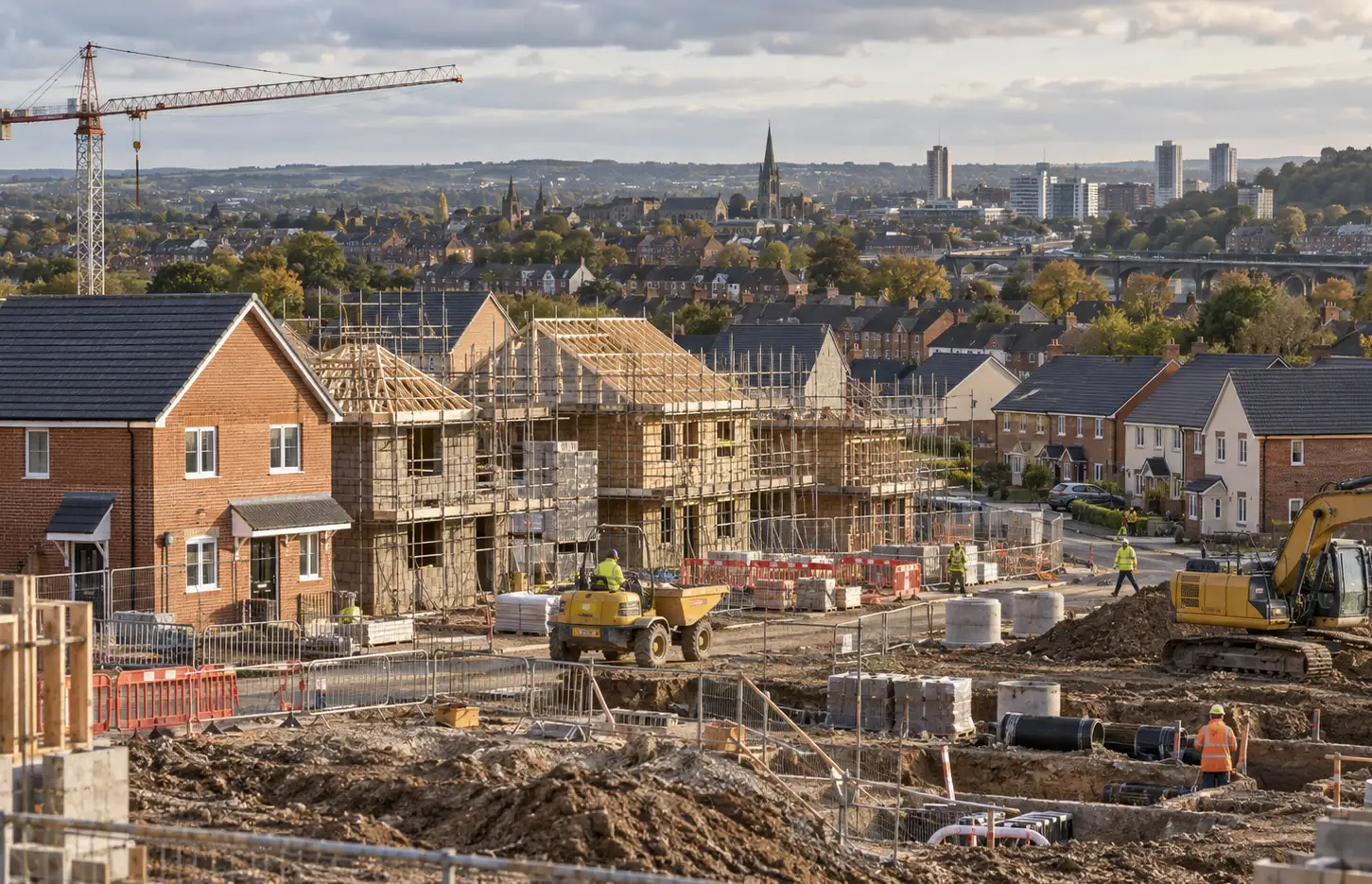
Successive governments and the major political parties have argued that Britain needs more homes. Developers make money by building and selling them. Buyers and renters across the country struggle with the cost and availability of housing. On paper, the incentives appear to point in the same direction — and yet delivery continues to fall short.
England recorded 208,600 net additional homes in 2024/25, 6% fewer than the year before and the third consecutive annual decline. That figure included 190,600 new-build homes, with the remainder coming from conversions, changes of use and other additions, less demolitions; it should not therefore be read as 208,600 newly constructed homes. Official housing-supply statistics for England, 2024/25
Against that sits the government’s ambition to deliver 1.5 million net additional homes in England over the course of this Parliament. The latest official estimate, based partly on Energy Performance Certificate data adjusted for demolitions, put delivery at approximately 392,400 net additions between the start of the Parliament on 9 July 2024 and 14 June 2026. More than 1.1 million would therefore still have to be added to reach 1.5 million, which makes the scale of the required acceleration clear without needing to predict now whether the target ultimately will or won’t be met. Latest official estimate of progress towards 1.5 million homes
One reason the debate becomes confusing is that several different measures are often used as though they mean the same thing. Planning permissions are not housing starts; starts are not completions; completions are not quite the same as net additions, which can also include conversions and changes of use and subtract demolitions. Each number describes a different point in the delivery process, and a large pipeline near the beginning doesn’t guarantee the same number of homes appearing at the end.
The obvious response is “then why don’t we just build more houses?” The honest answer is that housebuilding isn’t one decision made at one point. It’s a chain running from land to planning, infrastructure, finance, construction and ultimately someone able to occupy or buy the completed home, and a scheme can slow down or stop at almost any link even when there is genuine demand for more housing.
Data and policy last checked: 15 September 2026.
Resist the single-cause explanation
It’s tempting to reach for one villain — planning is too slow, developers are land banking, local objections block everything, land is too expensive — and each of these can matter somewhere in the system. None of them on its own explains persistent national under-delivery.
A site can clear planning and still stall on financing or infrastructure. A developer can want to start and still be unable to connect the development to the wastewater network on the timetable required. Land can appear empty and still need remediation, assembly or substantial enabling infrastructure before anybody can realistically build on it.
The Competition and Markets Authority’s major study of housebuilding reached a similarly uncomfortable conclusion. It found serious problems with the complexity, cost and unpredictability of the planning system and with the limitations of Britain’s reliance on speculative private development, but did not find that the aggregate size of housebuilders’ land banks was itself a primary cause of the shortage. In the CMA’s analysis, land banking was often a symptom of the long and uncertain development process rather than a standalone explanation for why homes weren’t being built. Competition and Markets Authority housebuilding market study
Following the actual chain is therefore more useful than starting with a culprit and trying to make every stalled development fit it.
Link one: land
Before anything else, a viable site has to exist.
“Undeveloped land” is a much broader category than “land that could realistically become housing”. A potential development may need several ownership interests assembled into one site. Former industrial land can require expensive remediation. Access, drainage or other infrastructure can make apparently inexpensive land costly to develop. A landowner may simply decide that the price a viable housing scheme can afford to pay isn’t enough to persuade them to sell.
That doesn’t mean Britain simply has a national shortage of physical land. The CMA found that the operation of the land market itself was not a principal driver of poor housebuilding outcomes and that potentially developable land was generally available in many areas. The problem is more specific: the right land has to be available, capable of obtaining permission, capable of being serviced and purchasable at a price at which the eventual scheme still works.
A green field on a map and a deliverable housing site are two very different things.
Link two: planning
Planning is a genuinely important part of the chain, but it is one part among several rather than the whole story.
At a high level, land normally needs either to fit within the development strategy established through the local-plan system or otherwise demonstrate through a planning application why residential development should be permitted. The eventual permission then determines the scale, design and obligations attached to the scheme.
The CMA found the planning systems to be a significant downward pressure on housing supply, identifying three recurring problems: lack of predictability; the length, cost and complexity of obtaining permission; and insufficient clarity and consistency around housing objectives and incentives. It also found those problems could fall disproportionately heavily on smaller builders.
That matters because planning affects the chain twice. It determines whether enough development opportunities enter the pipeline in the first place, and the time and uncertainty involved affect how much land and capital developers need to carry while waiting for a decision.
But permission isn’t the end of the process.
Link three: permission is not completion
This deserves emphasis because it’s widely misunderstood.
Planning permission is frequently treated in public debate as though the home effectively exists and the developer could start building the following morning. In practice, permission is often the beginning of another substantial stage.
Conditions may need to be discharged. Reserved matters may still have to be agreed after an outline permission. Detailed engineering and drainage work may need completing. Ecological, archaeological or contamination requirements can remain outstanding. Highways arrangements may need finalising, and the infrastructure required to serve the development has to be available on a timetable that works with construction.
The CMA’s description of the development process explicitly separates obtaining planning permission from getting onto site: after permission can still come final land acquisition, discharge of conditions, reserved matters, labour and material assembly, groundworks, access and enabling infrastructure.
There is another complication hidden inside the permission figures. The organisation that promotes land through the planning system is not necessarily the housebuilder that ultimately constructs the homes. Land promoters can secure outline permission and then sell or transfer the permissioned site into the development market, meaning that “permission granted” can still sit some distance from a builder owning a fully designed, financed and construction-ready scheme.
Wastewater capacity has become a particularly visible example. Research by the Home Builders Federation in 2025 estimated that almost 30,000 proposed homes were being delayed by wastewater infrastructure issues, although that is an industry estimate rather than an official measure of total national stalled supply. Home Builders Federation: A Drain on the Nation
The problem is not merely theoretical. In July 2026 the government’s Water Delivery Taskforce announced an agreement with Anglian Water intended to move 18,771 homes closer to delivery after wastewater treatment capacity had contributed to objections to large developments. Government Water Delivery Taskforce announcement
That should also be kept separate from nutrient neutrality, another environmental constraint that has affected housebuilding in certain protected catchments. In 2024 the government allocated £47 million specifically to help unlock around 28,000 homes identified as stalled by nutrient-neutrality requirements through local mitigation schemes. Government funding for nutrient-neutrality stalled homes
These are different problems, even though both can produce the same visible result: a site with housing ambitions attached to it but no finished homes appearing.
None of these post-permission stages necessarily demonstrates bad faith. They are part of delivering a complex piece of infrastructure. But they explain why the stock of homes with some form of planning permission should never be treated as though it were a stock of houses ready to be completed immediately.
Link four: viability
This is the concept that decides whether a permitted and technically deliverable site actually makes financial sense to build.
A development has to generate enough eventual value to pay for the land, construction, financing, infrastructure, professional fees, planning obligations — including affordable housing where required — and a sufficient return to compensate for the capital and risk involved. Large amounts of money are committed long before the final homes are sold.
Change one side of that equation and the entire scheme can move.
Higher build or borrowing costs reduce what the development can absorb elsewhere. Lower achievable sale prices reduce the revenue available to cover those costs. New infrastructure requirements can turn a marginal project into an unviable one. A scheme designed when mortgage rates and buyer demand looked very different can cease to make sense by the time it is ready to start.
That doesn’t mean every viability argument made by every developer should be accepted without scrutiny. Viability assessments can become contested, particularly where developers seek to renegotiate affordable-housing or other planning obligations after a permission has been granted.
But the underlying concept is real. A permission creates the legal opportunity to develop; it doesn’t make the economics of development disappear.
Link five: construction capacity
Even a fully financed and fully permitted scheme still needs people and materials to build it.
Bricklayers, electricians, plumbers, engineers, site managers and many other trades cannot be scaled up instantly simply because national housing targets rise. Contractors themselves need sufficient labour, finance and confidence to expand, while materials and specialist components need to be available at prices that fit the original development appraisal.
This matters particularly when government ambition requires a rapid increase in annual output rather than a gradual one. Planning reform can put more sites into the pipeline, but if construction capacity doesn’t expand with it, the bottleneck simply moves further along the chain.
The same principle applies to local-authority planning and delivery teams. More applications and more complex schemes require planners, surveyors and other specialists to process and deliver them, which is why current government programmes include funding specifically aimed at increasing public-sector housing and planning capacity.
Link six: whether anyone can actually buy the homes
This is the part of the chain most often left out of public debate, and it matters enormously.
Most private housebuilding in Britain still operates through a speculative model: developers buy or control land, obtain permission and build homes without having a final purchaser contracted for every unit in advance. They therefore carry the risk that the completed homes have to be sold into whatever market exists when they are released.
Mortgage rates, household affordability and buyer confidence consequently affect supply as well as demand. A developer isn’t normally going to complete hundreds of homes substantially faster than the local market can buy them at prices that keep the development viable.
This is where an important distinction appears between housing need and effective market demand. A household can desperately need a better or more affordable home without being able to buy a £350,000 new-build property. Thousands of households can be struggling with housing costs while the pool of people with sufficient deposits, incomes and mortgage capacity to buy a particular development remains much smaller.
There is no contradiction in those two things happening at once.
An area can therefore have an obvious housing shortage, high rents and substantial unmet need while a private development still cannot sell unlimited numbers of new homes at the price its economics require. Need exists socially; effective demand is the portion of that need that can actually transact in the market on the terms available.
The CMA identified this as a structural limitation of the current system. More than 60% of homes in its 2021/22 evidence were delivered through speculative private development, and builders had an incentive to release homes at a rate that allowed them to sell without materially cutting prices.
That brings us to one of the least intuitive pieces of the housing-supply problem.
Why an entire 2,000-home site doesn’t get built in one go
The concept is usually called the absorption rate: how quickly a local market can buy the homes being offered without the developer having to reduce prices substantially to clear them.
A development with permission for 2,000 homes is therefore not ordinarily built as 2,000 finished homes appearing simultaneously. Hundreds of similar properties released into one local market at once could require significant price reductions to find enough purchasers.
The obvious response is that developers could simply accept those lower prices and build faster. Sometimes prices do have to move, and developers aren’t entitled to a particular margin simply because it appeared in an original appraisal. But substantial price reductions across a large site also reduce its gross development value, which can affect the economics of later phases, financing arrangements, affordable-housing contributions and what could originally be paid for the land.
Under a speculative model, the commercial incentive is therefore usually to match production reasonably closely to the rate at which homes can be sold rather than deliberately create a large unsold stock and then discount it heavily.
This isn’t merely an industry defence. The CMA concluded that private housebuilders generally build at a rate consistent with local absorption and that competitive pressure to supply materially faster than that rate is weak. It also found that large land banks should partly be understood through this mechanism: if sites build out over several years, developers need a continuing pipeline of permissioned land.
The earlier independent review of build-out led by Sir Oliver Letwin reached a closely related conclusion on large sites: one of the strongest ways to increase build-out rates was to increase the diversity of what was being offered, rather than simply putting larger numbers of essentially similar homes into the same private-sale market. Independent review of build out: final report
That helps explain why tenure mix matters to speed. A large development relying almost entirely on individual owner-occupiers has one principal pool of demand. Social and affordable housing, build-to-rent, older people’s housing and different price points can bring in different purchasers or occupants and allow more homes to be delivered simultaneously without each unit competing for exactly the same mortgage-funded buyer.
None of that should be stretched into an explanation for every slow site. Some developments really are delayed by planning conditions, infrastructure, finance or other problems.
But absorption is one reason simply granting permission for a very large number of homes doesn’t automatically translate into the same number of completions shortly afterwards.
Housing supply is therefore partly a question of how much land can be permitted, but also of how many different routes exist for turning that permission into occupied homes.
Small builders face a different set of constraints
Large national housebuilders generally have greater access to development finance, in-house planning and technical expertise, and enough scale to spread the fixed costs of a long planning process across substantial developments.
Smaller and medium-sized builders face the same planning and regulatory system on much smaller schemes, where those fixed costs can represent a much larger share of the eventual project value. Access to suitable small sites and development finance can be harder as well.
The scale of the structural change is striking. A House of Commons Library briefing, drawing on the House of Lords Built Environment Committee, records that SME builders delivered around 39% of new homes in 1988 but only around 10% in 2020. House of Commons Library: future of SME housebuilders
The CMA subsequently found that planning problems were likely to be felt disproportionately by SMEs and noted a significant long-term decline in the number of smaller builders.
That matters beyond nostalgia for local building firms. A housing system dependent on fewer large developers is also more dependent on the sites, financing models and sales rates that suit those companies. Increasing the number and diversity of builders potentially increases the number and diversity of sites capable of entering the supply pipeline.
What government is currently doing
The current government has attacked several links in the chain rather than relying on one reform.
Changes to the National Planning Policy Framework increased local housing expectations and introduced the current grey-belt approach. The Planning and Infrastructure Act 2025 is intended to streamline planning and infrastructure delivery, while the New Homes Accelerator intervenes in stalled schemes where planning, regulation, funding or infrastructure problems can potentially be resolved. Planning and Infrastructure Act announcement
From 2026, the £5 billion National Housing Delivery Fund is also intended to support land, remediation and infrastructure on schemes that would otherwise struggle to proceed, including projects led by smaller builders. National Housing Delivery Fund
Wastewater capacity is now being tackled through the Water Delivery Taskforce, while separate reforms and funding address planning capacity, smaller sites, social and affordable housing and construction skills.
The common thread is revealing in itself. If the housing shortage had one cause, the policy response could concentrate on one lever. Instead, government intervention now stretches from land and planning through infrastructure and financing to skills and stalled-site intervention, because the delivery problem itself stretches across the same chain.
Whether those measures ultimately produce the required homes is a different question. A policy announcement, a planning permission or even a housing start isn’t a completed home, and a completion isn’t necessarily the same thing as a net addition to the national stock.
The most useful test therefore remains the official delivery statistics as they emerge, rather than the number of reforms, permissions or funding announcements accumulated along the way.
This is an England-heavy picture — the rest of the UK differs
Housing and planning policy are devolved matters. Scotland, Wales and Northern Ireland run their own planning systems and housing programmes and face their own versions of many of these pressures, shaped by different land markets, institutions and policy choices.
Much of the numerical and policy detail above is therefore deliberately England-specific because the 1.5 million target, the current National Planning Policy Framework reforms, grey-belt policy and the official progress measure discussed at the beginning all apply to England.
The wider idea travels more easily than the individual rules. Wherever homes are being built, land has to become developable, permission has to become deliverable, infrastructure has to support it, the scheme has to remain financially workable and somebody ultimately has to finance or occupy what gets built.
The precise bottleneck can be different on either side of a national border.
One bottleneck, or several?
The useful conclusion isn’t a single fix. It’s recognising that a home can be delayed or stopped at almost any point in the chain: land that isn’t genuinely deliverable, a slow or uncertain planning process, conditions that remain unresolved after permission, infrastructure that isn’t ready, a scheme whose economics no longer work, insufficient construction capacity, or a market unable to absorb completed private homes quickly enough at the prices needed to support the development.
Some explanations also turn out to be weaker than they first appear. The evidence doesn’t support treating land banking as the single national cause, and planning permission on its own does not prove that a site is immediately capable of being built. Equally, a large amount of unmet housing need doesn’t automatically create the mortgage-funded demand required to buy every new private home a developer could physically construct.
Britain’s housing shortage is difficult precisely because the constraints interact. Fix planning while wastewater capacity remains inadequate and the bottleneck moves. Unlock infrastructure on a scheme that buyers cannot afford and delivery can still slow. Increase permissions without enough builders, finance or alternative tenures and the pipeline may grow faster than completions.
That is why no single policy change, however well designed, has so far been enough to close the gap between housing ambition and actual delivery.
The field-to-front-door chain only moves as quickly as the links that are holding it back.
This article provides general information about housing supply and development, with much of the detailed policy and statistical discussion applying specifically to England. Planning systems, housing programmes and development rules differ in Scotland, Wales and Northern Ireland. Housing-supply statistics, government programmes and policy can change; check the linked official sources for the latest position.

