

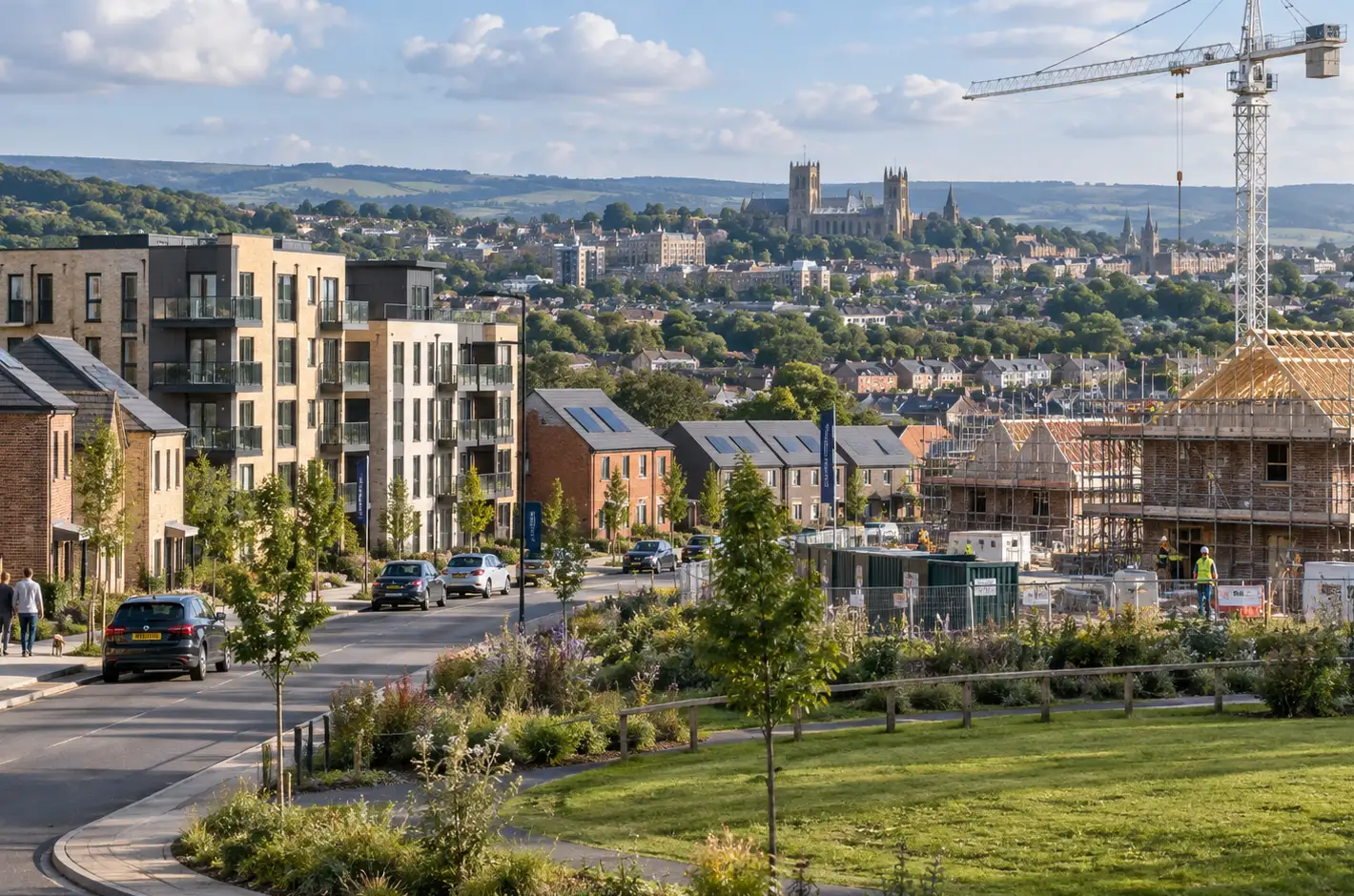
“Build more houses and the housing crisis will ease” is the closest thing housing policy has to a consensus slogan — repeated across the political spectrum from very different starting positions. It’s also a claim that deserves testing rather than simply accepting, because housing markets are considerably more complicated than the basic supply-and-demand intuition suggests, and the honest answer sits somewhere more nuanced than either “yes, obviously” or “no, it’s a myth.”
Start with the intuition, then complicate it
The basic economic logic is sound as far as it goes: increase the supply of something relative to demand for it, and — all else being equal — the price should face less upward pressure than it otherwise would. The problem is the phrase “all else being equal.” Housing markets don’t hold still while new homes are built. Population changes, households form and split, wages rise or fall, mortgage rates move, credit becomes easier or harder to obtain, employment shifts between places and demand itself responds to those changes.
The Competition and Markets Authority’s housebuilding study makes essentially the same point from the opposite direction: housing affordability is influenced by supply, but also by household composition, population, incomes and credit conditions. Competition and Markets Authority housebuilding market study
None of that disproves the underlying supply argument. It means supply is one major part of a system with several moving parts, rather than a solitary lever that determines house prices by itself.
The question worth actually asking
Much of the public debate gets stuck on a version of this question that the evidence can’t really answer: “will building more homes make prices fall next year?”
Nobody can promise that, and treating it as the test misses the point. The more useful question is whether substantially increasing housing supply, sustained over years, would leave housing more affordable than it would otherwise have been if supply continued to fall short of demand.
That distinction is crucial. Suppose house prices in an area rise by 10% during a period in which a substantial number of additional homes are built. It doesn’t follow that the new supply had no effect: if prices would otherwise have risen by 20%, housing is still cheaper relative to the alternative. The same logic applies to rents.
The evidence therefore needs to be read as a comparison with the world in which the additional homes were not built, rather than against an assumption that successful housing policy must immediately produce falling nominal prices.
What’s actually driving demand alongside supply
Housing demand isn’t fixed. It moves with population growth and household formation — including the long-running trend towards smaller households, which can increase the number of homes needed even without equivalent population growth. It moves with wages and employment, since affordability is always a relationship between housing costs and what people earn, not prices alone. Mortgage rates and credit conditions change how much a given income can borrow, while employment growth and transport links can make demand in one place very different from another.
Demand from landlords and investors can also compete with owner-occupiers for the same stock, although moving a home between ownership and private renting doesn’t itself change the number of dwellings available for people to live in. None of these factors cancels out the effect of supply; they help explain why building more homes can exert downward pressure on housing costs while prices or rents are still being pushed in the opposite direction by other forces at the same time.
Where the homes get built matters as much as how many
This is essential, and it’s a genuine limitation on a purely national housing target. Building homes in an area with weak underlying demand does relatively little to ease acute pressure in a constrained city, employment centre or high-demand commuter area many miles away. Housing markets overlap and people move between them, but Britain doesn’t function as one national pool in which an additional home anywhere automatically relieves pressure everywhere else.
A thousand homes in or around a city where jobs, schools, universities and transport are drawing more households can therefore have a very different affordability effect from a thousand homes in an area where population and employment are stagnant. A national net-additions figure, however impressive, doesn’t tell you on its own whether supply is appearing where the shortage is most severe.
The type of home matters too
Housing need isn’t one undifferentiated category. An area short of family houses isn’t necessarily helped enough by delivering large numbers of one-bedroom flats, while a household that cannot afford market rent isn’t suddenly secure because more expensive owner-occupied homes have been completed nearby. First-time buyers, private renters, families requiring larger properties and households needing social or affordable rent overlap in the housing market, but they are not interchangeable.
That doesn’t mean new supply in one part of the market has no effect elsewhere. People moving into new homes vacate existing homes, setting off chains of moves through the wider stock, and those indirect effects are important. But the type and tenure of new housing still determine who benefits most directly, which is why building more market housing and building social and affordable housing should not be treated as competing explanations of the same problem.
More market supply can reduce scarcity and improve affordability across the wider market. It still cannot guarantee that households on very low incomes can afford market prices or rents, which is a different problem requiring more direct forms of provision or support.
Affordability doesn’t require a price crash — this is the central point
Affordability is fundamentally a relationship between housing costs and income, not a particular nominal price on an estate-agent’s board. If house prices rise more slowly than wages over a sustained period, the price-to-income ratio improves even though homes are still becoming more expensive in pounds. The same applies if rents rise more slowly than household incomes.
Recent English data provides a useful illustration. The Office for National Statistics reported that between 2021 and 2025 the median house sale price in England rose by around 5%, while average full-time earnings rose by around 25%. The resulting affordability measure improved, with the median home costing about 7.6 times annual earnings in 2025 compared with a higher ratio at the 2021 peak. ONS housing affordability in England and Wales: 2025
It would be wrong to credit that improvement simply to additional housebuilding — interest rates, earnings and wider market conditions changed substantially over the same period — but it demonstrates the principle cleanly. Affordability can improve without nominal prices falling.
Greater supply can also mean more choice for buyers and tenants and less competition for each available property than would otherwise exist. Treating “will more homes crash house prices?” as the test therefore asks a much narrower question than the one that actually matters.
What this means for existing homeowners
This is worth addressing directly, because concern about existing property values quietly shapes a great deal of opposition to new development.
Would significantly increasing supply reduce the value of an existing home? No honest answer can promise what will happen to one property. Local markets differ, interest rates and incomes can change at the same time, new development can alter an area’s character and amenities, and different property types can respond differently.
The better-supported general claim is that additional supply puts downward pressure on housing costs relative to what would otherwise have happened. That could mean prices rising more slowly, remaining flat for longer, becoming cheaper relative to earnings, or in some places and periods falling in real or nominal terms. There is no reason to insist in advance that the adjustment must take only one form.
Very local effects can be more complicated still. New housing can bring better infrastructure, shops and services that make an area more desirable even while the additional homes are easing pressure across the wider housing market. A Greater London Authority review of recent research found this distinction repeatedly: new market-rate supply generally improves affordability across broader housing-market areas, while immediate local effects can differ where the development itself also increases demand for the neighbourhood. GLA review of the affordability impacts of new housing supply
“Build enough homes and my house must collapse in value” is therefore considerably stronger than the evidence supports. So is the opposite reassurance that housing supply can be increased substantially without influencing the path of existing values at all.
Renters are just as central to this question as buyers
Increased supply matters for the rental market independently of what happens to purchase prices, and some of the clearest evidence concerns rents.
Generation Rent’s 2024 analysis of official rent, earnings, housing-stock and population data across English urban areas found that places where housing stock failed to keep pace with population growth were much more likely to experience deteriorating rent affordability, while stronger housing growth was associated with better outcomes. Its model estimated that adding 20 homes per 1,000 people was associated with a 2.8 percentage-point reduction in rent as a share of average salary. Generation Rent analysis of housing supply and rent affordability
That result needs the same caution as any observational analysis. Generation Rent is a campaigning organisation, and wages, migration, local economic performance and other factors move alongside housing stock; the figures don’t prove that every difference between two towns was caused by new construction alone. But the pattern is consistent with the wider evidence that supply matters, and it contains another useful warning: simply keeping housing growth level with population growth may not be enough where a substantial shortage already exists. Preventing an existing shortage from becoming worse isn’t the same thing as repairing it.
The effects also extend beyond the people who move directly into the new properties. Recent research has followed households moving into newly constructed market-rate homes and then traced the people moving into the homes those households leave behind. These “moving chains” can travel through several levels of the market, increasing availability well beyond the original development. The GLA’s review of this international literature concludes that market-rate construction generally improves affordability across the wider housing market, including indirectly for lower-income households, although not as directly as dedicated social or affordable housing.
That distinction matters. The fact that a new market-rate flat is unaffordable to a low-income household doesn’t mean its construction has no wider effect, but neither should those indirect effects be used to pretend that market supply removes the need for housing specifically intended for people who cannot afford market prices.
The developer viability tension
There is a genuine feedback loop here that deserves to be stated plainly. If a very large increase in supply pushed achievable sale prices sharply down over a short period, it could simultaneously make some proposed development financially unviable. Developers still have to pay for land, construction, labour, finance, infrastructure and planning obligations, and those costs don’t automatically fall because purchasers are prepared to pay less.
This isn’t an argument that developer margins should be protected from competition as a matter of principle. It’s a structural feature of a system in which much private housing is built speculatively for sale into the market, and it helps explain why improving affordability sustainably doesn’t necessarily look like one enormous wave of construction producing an immediate price crash. Our companion article Why Isn’t Britain Building Enough Homes? deals with viability, absorption rates and the wider delivery chain in more detail.
A more realistic path is years of sufficient supply gradually reducing scarcity, widening choice and allowing earnings to catch up with housing costs rather than decades of shortage continually pushing the relationship in the opposite direction.
What the evidence shows, without cherry-picking
Credible research doesn’t support either of the absolute positions often heard in the debate. It doesn’t show that adding a given number of homes guarantees a particular percentage fall in prices or rents, because housing markets are too local, demand changes and effects occur over different time periods. But neither does it support the claim that supply makes little meaningful difference.
Long-run English research using data from 353 local planning authorities found that regulatory constraints on housing supply materially increased the responsiveness of house prices to local demand pressures. The Impact of Supply Constraints on House Prices in England
The CMA’s housebuilding study similarly concluded that persistent under-delivery compounds into housing shortfalls that add to affordability pressures, while recognising that household structure, incomes, population and credit conditions matter as well. Research on rents and moving chains points in the same broad direction: additional supply tends to leave housing costs lower than they would otherwise have been, including when the new homes themselves sit towards the more expensive end of the market.
The size and speed of that effect are legitimately debated, and a specific development in a specific place can produce outcomes that differ from the national picture. What is much harder to sustain from the evidence is the stronger claim that supply is largely irrelevant to affordability.
The honest answer
Building more homes will not, by itself, make British housing suddenly cheap, and no credible piece of research promises that it will. Housing demand will continue to change, mortgage rates and wages will continue to matter, some places will remain much more desirable than others, and the wrong mix of housing can leave important needs unmet even while the total stock grows.
Households at the lowest incomes will also continue to need housing that is directly affordable to them rather than waiting for the wider market to adjust around them.
But sustained housing supply in the places where demand exists changes the balance. It gives households more options, reduces the scarcity that allows prices and rents to be bid higher, creates chains of moves through the existing stock and gives incomes a better chance of catching up with housing costs.
The realistic promise isn’t that building more homes makes tomorrow’s house price lower than today’s. It’s that, over time, housing becomes more affordable than it would have been if the shortage had simply been allowed to deepen.
That’s a more modest claim than the slogans on either side of the argument tend to offer, and it’s also the one the evidence supports.
This article provides general information about housing supply and affordability and is not a prediction of future house prices or rents. Much of the UK-specific evidence cited relates to England or London, while housing markets and policy differ across Scotland, Wales and Northern Ireland. Research findings vary by market, methodology and period, and the effect of additional supply on any individual property or local area cannot be predicted precisely.

