

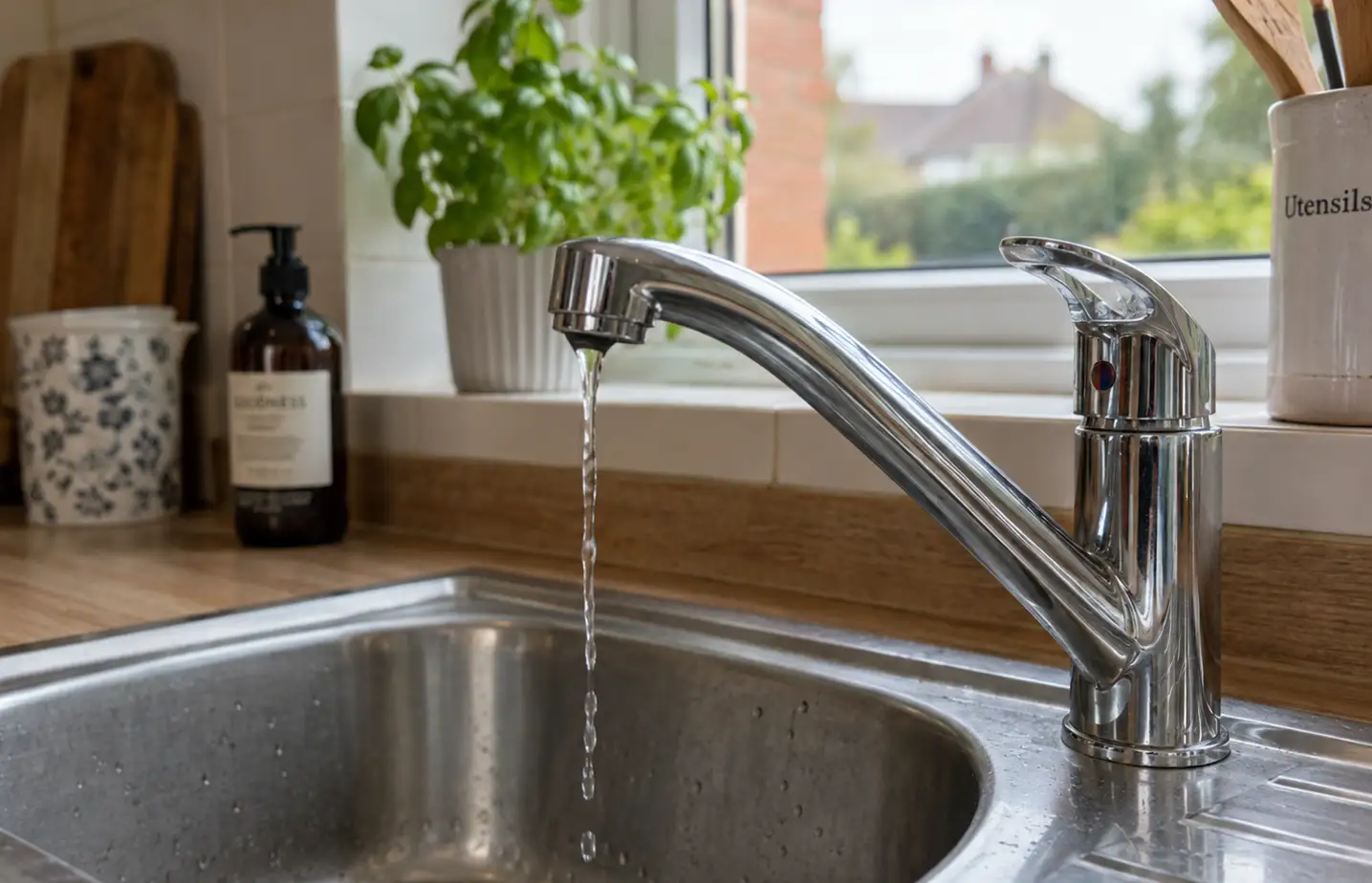
The shower’s a disappointment, the kitchen tap takes an age to fill a kettle, and someone’s suggested a pump. Before that purchase happens, it’s worth pausing on the assumption behind it, because “weak shower, therefore buy a pump” skips a diagnostic step that can save a genuinely significant amount of money: working out what’s actually causing the problem. A pump can be exactly the right answer to some pressure problems, but it won’t cure a restricted pipe, a partly closed valve, a hidden leak or a problem with the water supply reaching the property in the first place.
Pressure and flow are not the same thing
This distinction sits underneath almost everything else in this subject, and it’s worth understanding properly rather than glossing over.
Pressure is the force pushing water through the system. Flow is the volume of water actually delivered over time, usually expressed in litres per minute. They’re related, but they aren’t interchangeable.
A property can have reasonable static pressure but disappointing flow because something is restricting how much water can actually pass through the system. Narrow, deteriorated or partially obstructed pipework, a valve that isn’t fully open, a clogged fitting or an inadequate incoming supply pipe can all limit flow even when a pressure reading doesn’t initially look disastrous.
Conversely, genuinely low incoming pressure can limit what the system is capable of delivering even when the internal pipework is perfectly sound.
This matters practically because simply adding pressure doesn’t remove a physical restriction. A correctly specified pump or booster can improve pressure and, where sufficient water is available to feed it, improve usable flow as well. It cannot make an undersized, obstructed or inadequate supply pipe cease to be the bottleneck.
You can get a rough indication of flow yourself by timing how long an outlet takes to fill a known volume. For example, if a one-litre jug fills in five seconds, that outlet is delivering roughly 12 litres per minute. That is a flow measurement, not a pressure measurement; establishing actual pressure requires an appropriate gauge and is something a plumber or water company can measure properly.
Ofwat’s guidance on water pressure makes the same underlying distinction: pressure affects the flow available at your taps, but property height, local demand and the plumbing within the property can all affect what you actually experience.
Work out the pattern before guessing at a cause
A handful of simple questions, worked through in order, narrow down the likely cause far more reliably than jumping straight to a solution.
Is it one outlet, or the whole house? If only a single tap or shower is weak while everything else in the property performs normally, the problem is much more likely to be local to that fitting or its immediate pipework. A scaled-up tap aerator, shower head, flow regulator, flexible hose, local isolation valve or mixer can all restrict one outlet without there being anything wrong with the property’s overall supply.
Is it hot water, cold water, or both? A problem confined to the hot side points towards the hot-water system or the route feeding that outlet rather than automatically towards the incoming mains. A combi boiler’s hot-water capability, a cylinder system, valves, pipework or the fitting itself may all be relevant. If the cold mains itself is weak at several outlets, the investigation moves further upstream.
Is it constant, or does it only happen at certain times? Performance dropping during busy periods can be associated with increased demand on the water company’s network, but it can also expose weaknesses in a shared or restricted private supply. If the shower becomes poor only when another tap is opened inside your own home, that tells you something different from the whole street experiencing weak supply at the same time.
Did it change suddenly, or has it always been like this? A sudden drop from previously normal performance suggests something has changed: local network work or a burst, a partly closed valve, a developing leak, a new restriction or recent plumbing work are all possibilities. A system that’s behaved the same way for years is more likely to reflect the property’s underlying supply, pipe sizing or hot-water design.
Taken together, those patterns can narrow the investigation considerably:
| What you notice | What it points towards first | Sensible first check |
|---|---|---|
| One tap or shower is weak | Local fitting or branch restriction | Check aerator, shower head, local valve and hose |
| Hot water is weak but cold is good | Hot-water system or hot-side pipework | Check whether the issue affects every hot outlet |
| Hot and cold are weak throughout | Incoming supply or whole-house restriction | Check the internal stop valve and compare with neighbours |
| Pressure/flow drops when several outlets run | Supply or pipework can’t sustain combined demand | Compare single-outlet and simultaneous use |
| Performance worsens at particular times | Network demand, shared supply or marginal incoming supply | Check neighbours and try again off-peak |
| Sudden unexplained drop | Fault, leak, valve or network issue | Check supplier service information before buying anything |
The table doesn’t diagnose the problem by itself, but it does tell you where to start. That’s a much better basis for spending money than simply replacing whichever shower happens to be disappointing.
The range of things that can actually be going on
With the pattern in mind, the field of likely causes narrows considerably, but it’s worth knowing the range rather than assuming any single one is the answer.
The water company’s supply can genuinely be low at a particular property because of network conditions, local demand and the height of the property relative to the supply system. Houses higher up a hill can receive lower pressure than those below them.
A stop tap or isolation valve that isn’t fully open can restrict flow throughout the property or to a particular branch. This is one of the simplest things to rule out, although a stiff or seized valve shouldn’t be forced.
A leak on the private supply pipe or internal plumbing can reduce the water available elsewhere. If pressure or flow has deteriorated unexpectedly and there are other signs of leakage or unexplained metered use, that needs investigating rather than masking with a booster.
Restricted pipework is another possibility. Scale, corrosion, old fittings and reductions in internal pipe diameter can all impede flow. In older properties, the incoming supply itself may be smaller or shared between several homes; if neighbours are drawing from the same supply, performance can deteriorate when several properties use water simultaneously.
Gravity-fed systems behave differently again. Where a cold-water storage cistern feeds a hot-water cylinder and outlets rely principally on the height of stored water above them, the available pressure can be relatively modest — particularly at an upstairs shower close to the cistern’s level.
The hot-water system matters too. A combi boiler produces hot water on demand and can only deliver within the limits of both its own output and the cold water reaching it. An unvented cylinder relies on mains supply performance. Neither should automatically be treated as though it were an old gravity-fed cylinder system simply because the shower feels weak.
And individual fittings matter more than homeowners sometimes realise. Water-saving shower heads, flow regulators, aerators and thermostatic mixers can deliberately limit flow, while scale or debris can make that restriction much more pronounced.
No single cause is inherently the most likely across every property — which is exactly why working through the pattern first matters so much.
Pumps: what UK regulations actually allow
Before talking about regulations, there’s an important distinction that often gets lost in conversations about “a pump”.
A conventional shower pump and a mains booster pump are not the same thing.
Traditional shower pumps are generally intended to boost water from a gravity-fed stored-water system — typically a cold-water storage cistern in the loft feeding a hot-water cylinder. They are not simply fitted onto the incoming mains supply, a combi boiler or an unvented cylinder because the shower feels weak.
A mains booster is different equipment designed specifically to improve an inadequate mains-pressure supply within the limits of the relevant water regulations.
That distinction alone can prevent an expensive wrong purchase.
The regulatory position around the often-quoted 12 litres per minute figure also deserves precision. In England and Wales, Regulation 5 of the Water Supply (Water Fittings) Regulations 1999 makes the installation of a pump or booster drawing more than 12 litres per minute, connected directly or indirectly to a supply pipe, notifiable work. The water undertaker must be notified and consent obtained before that work begins.
Water Regs UK’s England and Wales guidance sets out that notification requirement.
That is not the same thing as saying that UK law absolutely prohibits any mains boosting above 12 litres per minute. A correctly designed system above that threshold may be possible with the water supplier’s consent and any conditions it imposes.
Scotland operates under the Water Supply (Water Fittings) (Scotland) Byelaws 2014 and uses the same more-than-12-litres-per-minute threshold for notifying a pump or booster connected directly or indirectly to a supply pipe. Northern Ireland’s 2009 Water Fittings Regulations contain an equivalent requirement.
Where a property needs substantially greater flow than a direct mains booster can appropriately provide, a break cistern or tank feeding a separate booster set is one commonly used solution. The incoming mains fills the storage vessel, and the pump then serves the property from the stored water rather than attempting to draw the entire peak demand directly from the public supply.
Exactly which arrangement is appropriate depends on the measured incoming pressure and flow, the home’s peak demand, the hot-water system and the relevant water supplier’s requirements. This is therefore one of the occasions where proper measurement before buying equipment matters far more than choosing a pump from its headline bar rating.
Before you replace anything
This is the point worth returning to before any money is spent: replacing a shower, a boiler or installing a pump without first establishing the actual problem risks solving nothing.
A new high-flow shower fitted to inadequate pipework can perform no better than the old one. A mains booster fitted where the real fault is a partly closed stop tap is unnecessary. A pump fitted while a supply pipe is leaking may disguise the symptom while leaving the water loss and underlying defect untouched.
There are several simple things worth establishing before commissioning major work. Check whether the internal stop valve is fully open without forcing it. Compare several outlets rather than judging the whole house from one shower. Remove and clean an obviously scaled tap aerator or shower head if it can be done safely and according to the manufacturer’s instructions. Notice what happens when a second outlet is opened. Ask an immediate neighbour whether their pressure has also changed.
Most importantly, have the incoming pressure and flow measured if you’re considering spending significant money on boosting equipment or replacing a hot-water system. Those two measurements, taken in the right place and under realistic demand, turn the conversation from guesswork into system design.
Diagnosing the actual cause first — even if that means paying a competent plumber for an assessment — is very often the cheaper route overall.
When it’s genuinely the water company’s problem
If pressure is poor consistently across the property, particularly at the cold kitchen tap or point where the mains supply first enters, and neighbours are experiencing the same thing, it’s worth contacting the water supplier before spending money on your own system.
For customers in England and Wales, Ofwat’s Guaranteed Standards Scheme requires water companies to maintain a minimum pressure of seven metres static head — approximately 0.7 bar — in the communication pipe serving the premises. That’s the company’s side of the supply at the property boundary; it is not a guarantee that every shower or upstairs tap inside the house will receive 0.7 bar after losses through the private supply and internal plumbing.
Under the current GSS, low-pressure compensation can become payable where pressure falls below the minimum on two qualifying occasions, each lasting more than one hour, within a 28-day period, subject to the scheme’s exceptions and conditions. Ofwat’s current water-pressure guidance explains the standard and recommends contacting the water company so it can measure both pressure and flow.
Scotland has a different system. Scottish Water currently says it aims to provide at least 1.0 bar at the point of connection or boundary stopcock, and operates its own low-pressure investigation and service arrangements. Scottish Water’s water-pressure guidance explains what it will investigate where customers report poor supply.
Northern Ireland also operates separately through NI Water. Its guidance starts with much the same practical distinction this article makes: check the cold kitchen tap, make sure the internal stop valve is open, and ask neighbours whether they have the same problem before concluding that the fault is inside your own home. NI Water’s low-pressure guidance sets out that process.
The important point is that “UK minimum pressure” isn’t one single consumer standard administered identically across all four nations. Establish which water provider and regulatory system applies before assuming the cost of fixing poor supply belongs to you.
The decision, simply put
Poor water pressure or poor flow has a cause, and that cause determines the fix.
Start by establishing whether the problem affects one outlet or the whole property, hot water or cold, constantly or only under demand. Rule out simple restrictions and recent faults. Check whether neighbours have the same problem. And if you’re considering a pump or a new hot-water system, get the incoming pressure and flow measured before specifying anything.
A shower pump can be the right answer for an appropriate gravity-fed system. A mains booster can be the right answer where the incoming mains needs legitimate boosting. A storage-and-booster arrangement may suit a property with higher demand.
None of those is the right answer to a blocked aerator, a partly closed valve, leaking pipework, an undersized supply or a water-company problem that isn’t yours to solve.
The expensive mistake isn’t necessarily buying the wrong pump. It’s buying a solution before you’ve established what problem you’re actually trying to solve.
This article provides general property information, not a diagnosis or specification for your plumbing system. Water fittings rules and supplier requirements differ across the UK. Pump and booster systems should be assessed and installed by a competent plumber familiar with the requirements applicable in your nation and water-supply area.

