

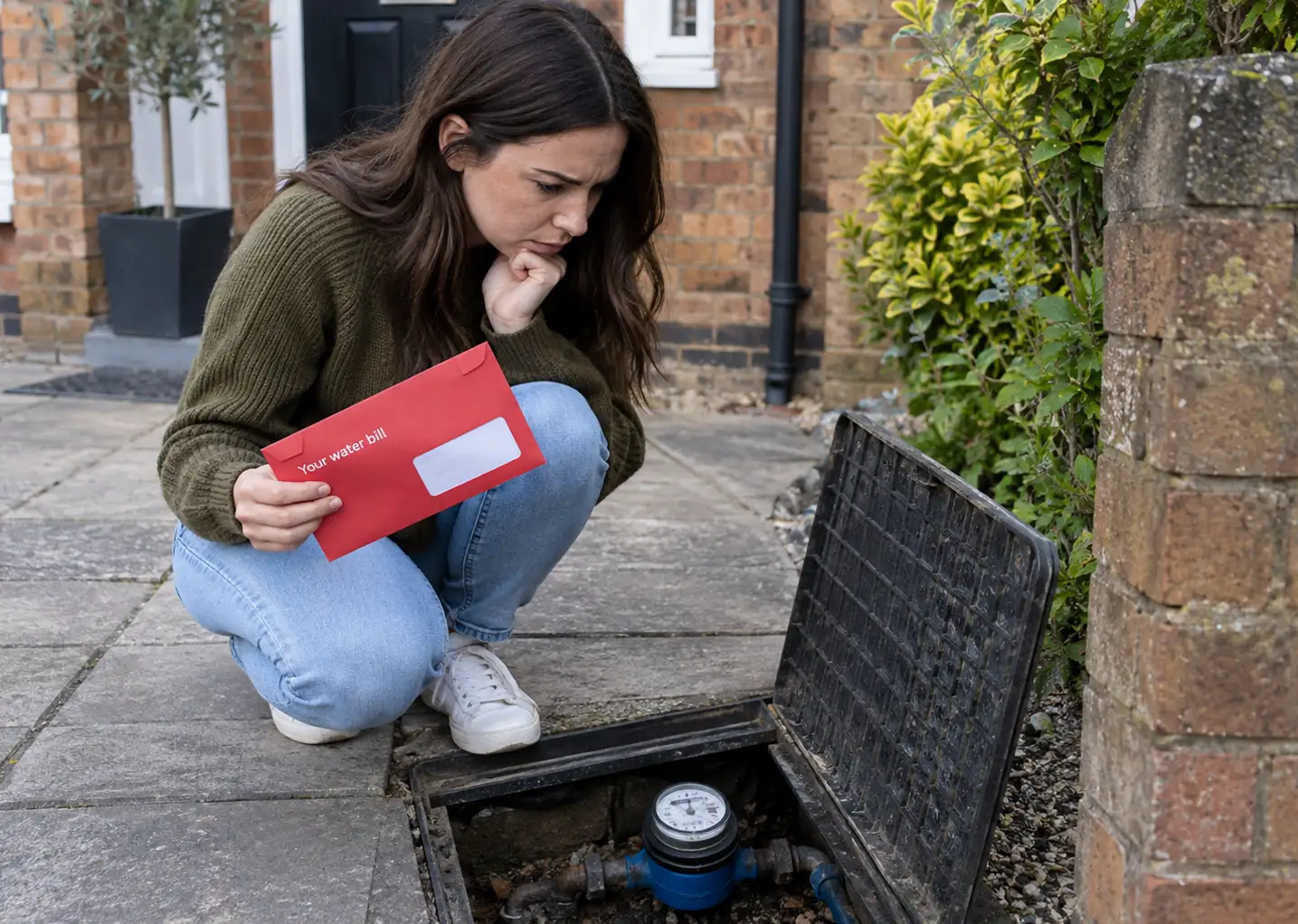
A water bill lands that’s noticeably, sometimes dramatically, higher than usual, and there’s no obvious explanation — nobody’s filled a pool, nobody’s moved in, nothing’s changed. Before accepting that figure as genuine household consumption, it’s worth asking a more precise question: is water actually flowing somewhere in this property right now, while nobody is using any?
This article is principally about households whose charges depend on metered consumption. Household water charging isn’t identical across the UK — most homes in Scotland, for example, are charged on an unmetered basis through Council Tax, while a much smaller number have meters — so an unexplained leak won’t affect every household bill in the same way. The leak-detection steps themselves are still useful wherever a meter is available.
Rule out the boring explanations first
Not every high bill means a leak, and it’s worth eliminating the mundane possibilities before assuming the dramatic one. Check whether the bill covers a longer period than usual, or follows an estimated reading being corrected against an actual meter reading — a jump that looks alarming in isolation sometimes reflects catching up on genuine past usage rather than anything new.
Compare the meter reading shown on the bill with the meter itself if you can safely access it. If the physical meter reading is already significantly lower than the reading you’ve been billed for, or you suspect the wrong meter has been associated with the account, that’s a billing question to raise with the water company rather than evidence of a hidden leak.
Think honestly about recent household changes too: a longer-staying guest, a new appliance, more laundry than usual, more frequent baths or showers, or a garden being watered heavily during a dry spell can all move metered consumption meaningfully without anything being wrong. Where your bills or online account make the information available, comparing consumption with the same period the previous year can be more useful than simply comparing it with the previous bill, because household water use can vary significantly by season.
The Consumer Council for Water’s guidance on unexpectedly high bills identifies increased household use, estimated readings being replaced by actual readings and leaks as common explanations. Only once those ordinary possibilities have been considered is it worth moving on to checking specifically for unexplained water flow.
The meter test
If your property is metered, the meter is the most direct tool available for answering the important question: is water being recorded while you believe nothing is using it?
Make sure every tap and known water-using appliance is switched off. Wait until toilets and cisterns have finished refilling, and remember anything automatic — an irrigation system, dishwasher, washing machine, water softener or similar device — can invalidate the test if it operates while you’re waiting.
Take a meter reading, noting all the displayed figures. Some meters also have a small flow or leak indicator, which may move even when the main number display appears unchanged.
Then leave the water genuinely unused for a few hours and take another reading. Overnight can be useful provided you’re confident nothing automatic will run. If the meter has advanced despite no intentional water use, that’s strong evidence of unexplained consumption and a leak becomes a likely explanation — although it still doesn’t tell you where that water is escaping.
This is a slightly more cautious conclusion than simply saying “the meter moved, therefore you definitely have a leak”. First make sure the meter serves your property, nobody has used water during the test, and no automatic equipment has operated.
The results become more useful when you interpret them as part of a sequence:
| What happens during the test | What it may suggest | What to do next |
|---|---|---|
| Meter doesn’t move | No continuous unexplained use was detected during the test | Recheck the bill, estimated readings and intermittent water use |
| Meter moves with everything switched off | Unexplained water use is occurring | Check toilets, appliances, outside taps and concealed plumbing |
| Meter stops when the internal stop valve is closed | The unexplained use is more likely somewhere within the property | Work through toilets, taps, appliances and internal pipework |
| Meter keeps moving with the internal stop valve closed | A leak between the meter and the internal stop valve becomes more likely | Contact the water company or investigate the underground supply pipe |
| Usage appears repeatedly overnight with no intended water use | A continuous low-level leak becomes more likely | Start with toilets and other continuously supplied fittings |
These are diagnostic clues rather than absolute proof. Shared supplies, automatic equipment, stored-water systems and unusual meter arrangements can all affect what a particular result means.
If you have a smart water meter and your supplier gives you access to detailed usage information, the same principle can be useful over a longer period: a continuous baseline of consumption through hours when the property would normally be using no water is a useful clue worth investigating.
Some of the easiest leaks to miss can waste a surprising amount of water
This is the section worth paying closest attention to, because a leak doesn’t need to produce a dramatic puddle to affect a metered bill.
A silently leaking toilet cistern is one of the most common hidden leaks in the home and is covered in its own section below because it deserves particular attention. WaterSafe says some leaking toilets can waste as much as 400 litres a day, while remaining easy to overlook because the water simply passes from the cistern into the pan.
Overflow or warning pipes running continuously from a cistern can waste water without creating an obvious internal leak, because the water is discharged outside. Hot-water systems can also have discharge arrangements that release water externally when something isn’t operating correctly; those shouldn’t simply be treated as ordinary overflow pipes or ignored indefinitely.
A dripping tap, easy to dismiss because each individual drip looks trivial, can still add to metered consumption if it continues around the clock. A shower valve or mixer that never quite shuts off can do something similar.
Appliance feed pipes — to a washing machine, dishwasher or plumbed-in fridge — can develop a slow weep at a connection that remains concealed behind cabinetry or the appliance itself.
Cold-water storage cisterns in lofts can leak or overflow without being noticed quickly simply because they’re somewhere most homeowners rarely inspect.
Concealed pipework, run inside walls or beneath floors, can leak into the building fabric before the first obvious damp patch appears. By that stage, the meter may have been recording the lost water for some time.
An outside tap or garden pipework can leak into soil or vegetation without producing an obvious indoor symptom.
And an underground supply pipe, running between the water company’s connection and the house, can lose water directly into the ground and remain almost completely invisible from inside the property.
Toilets deserve special attention
A cistern that appears to be behaving normally can still pass a steady trickle of clean water into the toilet pan because a flush valve, fill valve or seal isn’t closing properly. Some toilet leaks can be heard, but others are genuinely difficult to spot.
WaterSafe recommends a simple test that doesn’t require dismantling anything. About half an hour after the toilet has been flushed, dry the back of the pan and place a clean sheet of toilet tissue against it. Leave the toilet unused for several hours, or overnight. If the tissue becomes wet or breaks down, water is continuing to pass into the pan.
WaterSafe’s guidance on checking for a leaking toilet describes the same test and identifies toilets as one of the common sources of hidden household leakage.
Food colouring in the cistern is another commonly used diagnostic method, but the tissue test has the advantage of not adding anything to the cistern and is enough to establish whether water is passing when the toilet hasn’t been flushed.
This isn’t a repair guide — the useful point here is simply checking one of the easiest significant leaks to overlook before assuming the lost water must be somewhere beneath a floor or underground.
The underground supply pipe: a brief note
If the meter confirms unexplained consumption but you’ve checked the obvious fixtures and appliances without finding anything, the supply pipe between the meter or boundary connection and the house becomes a real possibility.
Clues can include ground that stays wet during otherwise dry weather, an unusually lush strip of grass or vegetation, a drop in water pressure, or water appearing at the surface — although an underground leak can exist without producing any of those signs.
Where the meter is outside the house and the plumbing arrangement allows it, there’s a particularly useful further test. Close the property’s internal stop valve and then check the meter again. If the meter continues recording flow while the internal stop valve is fully closed, that points towards water escaping somewhere between the meter and the internal stop valve — often the underground supply pipe. If the meter stops with the internal valve closed but moves once it is reopened while all outlets remain off, the unexplained use is more likely to be somewhere within the property’s plumbing.
The Consumer Council for Water’s guidance on private supply-pipe leaks describes this test for customers in England and Wales.
It isn’t universal. Meter and pipe layouts vary, shared supplies exist, and an internally located meter can’t be used in exactly the same way to test the length of supply pipe upstream of it. If you’re uncertain about what the meter actually serves, ask the water company before drawing conclusions from the test.
Who is responsible for investigating and repairing a supply-pipe leak also depends on exactly where the pipe sits and the relevant water company’s arrangements — a subject covered properly in our companion article on drain and pipe responsibility rather than repeated here.
Leak allowances: genuinely useful, but not automatic
If you’re a metered household customer and a genuine leak has inflated the bill, don’t assume the amount recorded by the meter is necessarily the amount you’ll ultimately have to pay.
For household customers in England and Wales, Ofwat says water companies are required through their licences to provide bill credits for water lost through qualifying leakage — usually referred to as a leakage allowance — once the leak has been repaired. The company can refuse an allowance in some circumstances, including where a repair hasn’t been arranged within the reasonable period it specifies or where customer negligence caused the loss.
The important part is that the detailed conditions aren’t identical between companies. Which leaks qualify, how quickly they must be repaired, what evidence is required and how the adjustment is calculated are matters for the individual company’s published policy.
Ofwat’s guidance for metered household customers explains the leakage-allowance framework and says each company should make clear how claims work and when an allowance can be refused.
That means the sensible sequence is to report the suspected leak, get it repaired promptly, retain the invoice or other evidence of repair, take meter readings where requested and apply under your supplier’s current rules. Don’t rely on a generic deadline you’ve read elsewhere: one company’s four-week repair window or three-month application limit isn’t automatically another company’s policy.
In Scotland, most households aren’t charged according to metered volume in the first place, although a small number of homes do have meters and are billed directly by Scottish Water. Where your household charging arrangement is different, check the rules that actually apply to your account rather than assuming the England-and-Wales allowance system applies unchanged.
Who pays for investigation and repair?
This depends substantially on exactly where the leak sits: whether it’s inside your home, on the private supply pipe serving the property, or on infrastructure that belongs to the water company.
In England and Wales, the homeowner is generally responsible for internal plumbing and the private supply pipe serving the property, while the water company is responsible for the water main and communication pipe up to the point where the private supply begins. Some companies offer free or subsidised help with private supply-pipe leaks even where legal responsibility sits with the homeowner, so contacting the company before paying privately for excavation can be worthwhile.
Tenure matters too. If you’re renting, responsibility for arranging the physical repair may lie with the landlord even though the person named on the water account is dealing with the bill.
Home insurance can sometimes become relevant where a leak has caused property damage or expensive investigation is required, but the treatment of lost metered water, trace-and-access costs and the failed pipe itself varies between policies. That’s a different question from simply establishing whether a hidden leak exists and deserves its own treatment rather than being compressed into a paragraph here.
The bottom line
Don’t take an unusually high metered water bill at face value as proof that the household simply used more water.
First check the bill itself: the dates, whether the previous readings were estimated, whether the latest reading broadly matches the physical meter and, where possible, how the usage compares with the same period the previous year. Then carry out a proper meter test with every known outlet and appliance genuinely inactive.
If unexplained consumption remains, start with the sources that are easiest to miss — particularly the toilet cistern — before assuming the leak must be buried beneath the house. And if an external meter continues moving even with the internal stop valve shut, an underground supply-pipe leak becomes a much stronger possibility.
The key distinction is between high recorded consumption and explained household consumption. A meter tells you how much water passed through it; working systematically through the evidence tells you whether anyone actually meant to use it.
This article provides general property information. It is primarily relevant to households charged according to metered water consumption; household charging arrangements differ across the UK. Leakage allowances, supply-pipe assistance and responsibility rules can also vary, so always check the current terms that apply to your supplier and property.

