

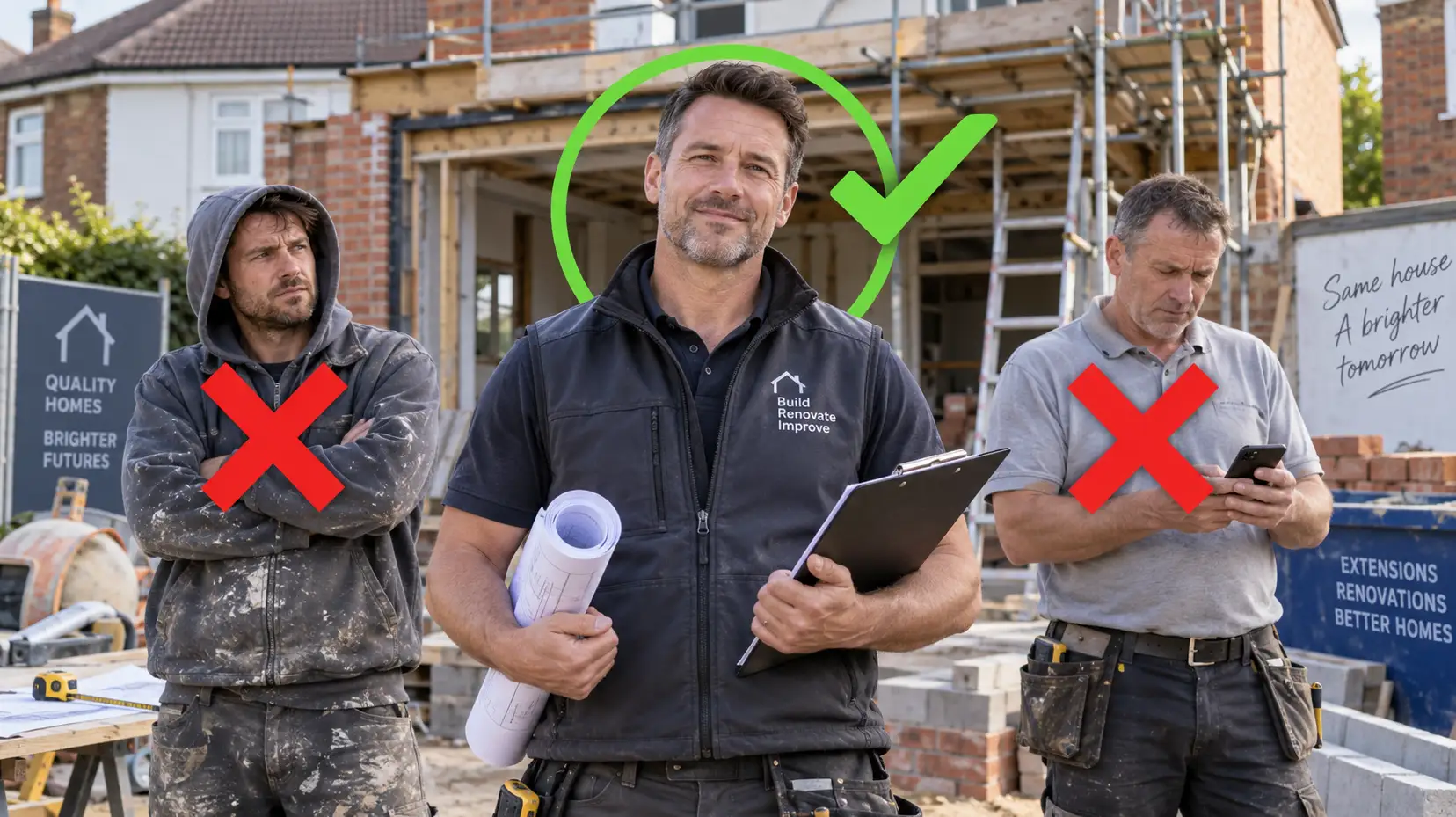
Three builders walk round the same house and come back with quotes of £28,000, £41,000 and £52,000. The instinctive reading — one honest trader, one reasonable one, and one taking the mickey — is very often wrong. More commonly, what’s actually happened is that three different people have priced three different, only loosely related ideas of what the job involves, because nobody gave them a sufficiently clear brief to price the same thing. Choosing a builder well starts well before any quote arrives, and it’s rarely about finding the smallest number.
The brief has to exist before the comparison can be fair
Builders can only price accurately what’s actually been defined. Where a homeowner’s brief consists of a rough conversation and a Pinterest board, each builder fills the gaps with their own assumptions — about specification, about what’s included, about how much of the existing structure survives — and the resulting quotes end up incomparable, however similar the final numbers look side by side. Having drawings, a clear specification, and a defined scope before approaching builders isn’t bureaucratic overkill; it’s what makes it possible to compare like with like at all. Where a full design hasn’t been finalised, being as specific as possible about scope, materials and finish level still narrows the gap considerably.
For larger renovations, it can help to issue exactly the same drawings, specification and list of questions to every builder being asked to price. If one builder is assuming engineered timber flooring, another laminate and a third hasn’t included flooring at all, the totals aren’t competing prices for the same job.
Quote or estimate: the difference genuinely matters
These words get used loosely on-site and in text messages, but the underlying distinction is a real one worth understanding. A quote, in the ordinary sense used in UK consumer guidance, is generally a fixed price for a defined scope. Once accepted, it forms part of the agreement, and genuine changes should be handled as separately agreed variations rather than simply appearing as unexplained increases on the final invoice.
An estimate is different: it’s a considered approximation rather than a fixed commitment, so the eventual price can change as the true cost becomes clearer. Where no fixed price has been agreed, consumer law still doesn’t give a trader an unlimited right to charge whatever they choose.
In practice, it’s worth asking directly, before work starts, whether you’re being given a quote or an estimate, what assumptions sit behind it, and in what circumstances the price can change. Citizens Advice provides current guidance on quotes, estimates and home-improvement contracts.
Comparing quotes properly
The single most useful habit when quotes come in is reading them line by line rather than jumping to the total. Check what each one actually includes: labour, materials, VAT treatment, waste removal, scaffolding, structural steel and any associated engineering costs, plumbing and electrical work, plastering, decoration, fixtures, making good to existing surfaces, and — importantly — what’s marked as an exclusion or an allowance for work or products that haven’t yet been fully specified.
Two quotes with wildly different bottom lines sometimes turn out to be pricing genuinely different amounts of work; the only way to know is to compare the detail, not just the headline figure.
Compare builders on more than the total
| Compare | Builder A | Builder B | Builder C |
|---|---|---|---|
| Fixed quote or estimate? | |||
| VAT included? | |||
| Same drawings and specification priced? | |||
| Major exclusions clearly listed? | |||
| Allowances / provisional sums identified? | |||
| Scaffolding, skips and waste included? | |||
| Electrical and plumbing work included? | |||
| Decoration and making good included? | |||
| Expected programme stated? | |||
| Payment stages stated? | |||
| Recent comparable project checked? | |||
| Insurance verified? | |||
| Who runs the project day to day? |
Filling in a simple comparison like this often explains a large price difference before anyone has to decide whether one builder is “too expensive”.
Getting past “ask for three references”
That advice isn’t wrong, but it’s thin. More revealing than a reference list is asking to see, or at least discuss in detail, a recent, genuinely comparable project — similar scope, similar age of property, similar complexity — and, where possible, speaking directly to that previous client rather than relying on a written testimonial supplied by the builder.
It’s worth asking that previous client specific questions beyond “were you happy”:
- Did the builder broadly start and finish when expected?
- How were unexpected problems handled?
- Were additional costs explained and agreed before the work was done?
- Was communication still good once the project became difficult?
- Did subcontractors arrive when expected?
- Was the site left reasonably secure and organised?
- Did Building Control, snagging or certification create problems at the end?
- Knowing what you know now, would you use the same builder again?
A builder’s competence in a straightforward run of good weeks tells you less than how they behaved when something went wrong or the brief needed to change mid-project.
Online reviews can help, but they shouldn’t replace this work. Government consumer guidance recommends looking at how recommendation sites verify reviews and comparing information across more than one source rather than relying on a single rating. The GOV.UK guidance on trader recommendation sites is useful here.
Financial warning signs, kept in proportion
Some patterns are worth genuine caution, without treating every instance as proof of dishonesty: an unusually large upfront payment relative to the value of work actually being done in the early stages; insistence on cash only, with no useful paper trail; vague or unclear treatment of VAT; a written scope so thin it barely describes what’s being built; real pressure to sign and pay immediately, with little time to consider; or payment schedules that consistently run well ahead of the work actually completed.
None of these individually proves a problem — plenty of reputable builders reasonably ask for a deposit to secure materials or a start date, for instance — but a cluster of them together, especially combined with reluctance to put anything in writing, is worth taking seriously as a reason to pause rather than proceed.
If VAT is being charged and you want to verify the registration details, HMRC provides an official UK VAT number checker.
Be particularly cautious about paying substantial sums simply to “hold the slot” without a clear written agreement explaining what the payment is for, whether any of it is refundable, and what happens if the proposed start date changes.
Put it in writing
A written agreement should cover: the defined scope of work; the price and the basis on which it’s calculated; the payment schedule and what triggers each payment; an expected start date and realistic programme; how variations will be handled; who’s responsible for sourcing which materials; site access and general responsibilities during the project; how delays will be dealt with; what happens to waste; insurance; and how disagreements will be handled if they arise.
For a small job, a clear written agreement may be relatively simple. For a substantial renovation involving tens of thousands of pounds, several trades and months of work, a proper domestic building contract is a much stronger foundation than a collection of quotations, text messages and verbal promises.
The contract also doesn’t remove your underlying consumer rights. Under the Consumer Rights Act 2015, a trader supplying a service to a consumer must perform that service with reasonable care and skill.
Depending on how and where the agreement was made, a consumer may also have cancellation rights — commonly including a 14-day cooling-off period for certain contracts made at home or at a distance. There are rules around asking work to begin during that period, so don’t assume either that every building contract can be cancelled freely for 14 days or that no cancellation rights exist at all. Citizens Advice’s guidance above explains the practical position.
Structuring payments around progress
Linking payment stages to genuine, identifiable progress — rather than to a fixed calendar unconnected to how much work has actually been completed — tends to reduce risk on both sides: the homeowner isn’t left having paid heavily for work not yet done, and the builder isn’t left financing a large chunk of the project out of pocket while waiting for payment.
There’s no single universal payment schedule that fits every project size and every trade relationship, but the underlying principle, payment broadly tracking completed work rather than running well ahead or well behind it, is worth applying consciously rather than accepting whatever schedule is proposed without examining it.
Where significant materials have to be ordered early, it can be perfectly reasonable for the payment profile to reflect that. What matters is understanding what the money is actually funding and documenting it.
A payment schedule is stronger when each stage can be objectively identified — for example, completion of structural work or first fix — rather than simply “second payment after four weeks”, regardless of what has happened on site.
Variations deserve real attention
This is where a genuinely large share of renovation disputes actually begin, and it’s worth taking seriously rather than treating as a minor administrative point. “While you’re here, could you also…” is one of the most natural sentences in renovation, and also one of the most reliable routes to a disputed final invoice.
The sensible habit, wherever practically possible, is to define the change clearly, get it priced before it’s carried out, and record the agreement in writing — even briefly, by text or email — rather than relying on a verbal exchange on-site that both parties remember slightly differently by the time the bill arrives.
And the price of a variation isn’t necessarily just the obvious extra item. Moving a doorway may alter electrics, plastering, skirting, flooring and decorating as well as the carpentry itself. A useful variation record therefore notes:
- what is changing;
- the agreed additional or reduced cost;
- whether VAT is included;
- any effect on the completion date; and
- who authorised it.
This isn’t about distrust; it’s about making sure that a reasonable, sensible on-the-spot decision doesn’t turn into a genuine disagreement purely because nobody wrote down what was actually agreed.
Insurance, competence and what a trade body membership does and doesn’t tell you
It’s worth checking what insurance a builder actually carries rather than simply asking “are you insured?” Public liability insurance is normally a sensible minimum to look for because it covers claims involving injury to members of the public or damage to property. If the builder employs people, employers’ liability insurance will generally be legally required, subject to limited exemptions. Where the contractor is also providing professional design or technical advice, professional indemnity cover may be relevant; on larger projects, contractors’ all-risks cover is another question worth asking.
Citizens Advice recommends checking the trader’s insurance and seeing the policy details, including whether the cover will remain in force for the duration of the work.
For specific trades within the project, check the actual registration rather than accepting a logo on a website or van. Gas work must be carried out by an appropriately registered Gas Safe engineer. Certain categories of Building Regulations work can be self-certified by installers registered with an authorised scheme; the government maintains information on self-certification and competent person schemes.
Membership of a recognised trade body can be a genuinely useful signal of accountability, but it’s worth being realistic about what it does and doesn’t guarantee — it doesn’t guarantee flawless workmanship on every project, and it shouldn’t substitute entirely for checking a builder’s actual recent work and asking how they’ve handled problems in the past.
Where a builder claims a particular trade-body or registration status, verify it directly on the organisation’s own register rather than treating the badge itself as proof.
Who’s actually running the project?
On anything beyond a fairly small job, it’s worth establishing explicitly who is actually coordinating the project day to day — the main contractor, the builder personally, an architect or designer, a separate project manager, or, in some cases, the homeowner themselves by default because nobody else has clearly taken on that role.
This matters because a project with an unclear coordinator tends to develop gaps precisely where different trades’ work meets — the electrician assuming the plumber has already moved a pipe, the plasterer arriving before the first-fix electrics are actually finished — and someone needs to own the job of making sure that doesn’t happen.
For work subject to Building Regulations, there are also formal dutyholder roles around the design and construction phases. Those responsibilities are covered in our dedicated article on what homeowners should check when a builder says they’re “handling Building Regs”; the important point here is that project coordination, contractual responsibility and Building Regulations dutyholder roles should be clear rather than assumed to be the same thing automatically.
Before you appoint the builder
By the point you’re ready to say yes, you should ideally be able to answer these questions:
- What exactly are they pricing?
- Is the price a quote or an estimate?
- What is specifically excluded?
- Which figures are allowances rather than fixed costs?
- Have you spoken to a recent client from a genuinely comparable project?
- Have insurance and relevant trade registrations been verified?
- Who will run the job day to day?
- What triggers each payment?
- How will variations be priced and agreed?
- What paperwork and certificates should you receive at the end?
If several of those still have vague answers, the decision probably isn’t ready to be made simply because a start date is available.
The point this all builds toward
Choosing a builder well isn’t about finding the smallest number on a page. It’s about comparing genuinely equivalent scope, assessing real competence and communication rather than just a testimonial page, agreeing sensible commercial terms in writing, and — perhaps most importantly — understanding in advance how the inevitable changes and surprises of a renovation will actually be handled when they arise, rather than discovering the answer to that question for the first time in the middle of a dispute.

