

Talk to people who have renovated a house about what their project actually cost against what they originally budgeted, and a common pattern emerges: the gap can be significant — not necessarily because the builder charged more than agreed, but because the original number simply never covered everything the finished house needed. Understanding why this happens so consistently is more useful than any single “average renovation cost” figure, because it’s the difference between budgeting realistically from the outset and discovering the gap the hard way, mid-project.
Why a single cost-per-square-metre figure won’t tell you much
Search for UK renovation costs and the range on offer is genuinely enormous, because two renovations of the same size can involve fundamentally different work. A cosmetic refresh — new kitchen and bathroom, decoration, some flooring, existing layout kept — sits in a completely different cost category from a full structural renovation involving rewiring, replumbing, a new heating system, layout changes, roof or damp repairs and higher-specification finishes, even on an identical footprint.
Condition matters enormously too: an unloved 1930s semi with original wiring and water ingress behind the plaster can cost meaningfully more to renovate than a well-maintained equivalent, even before any cosmetic choices are made. Geography, access, specification, contractor availability and the amount of bespoke work can all move the number further.
Professional construction-cost services such as BCIS maintain dedicated alterations and refurbishment pricing data precisely because existing-building work cannot sensibly be reduced to one universal homeowner figure. Treat any generic online £/m² figure as a rough comparison tool at most, not as the number on which to base a committed project budget.
Grouping the budget helps more than a single total
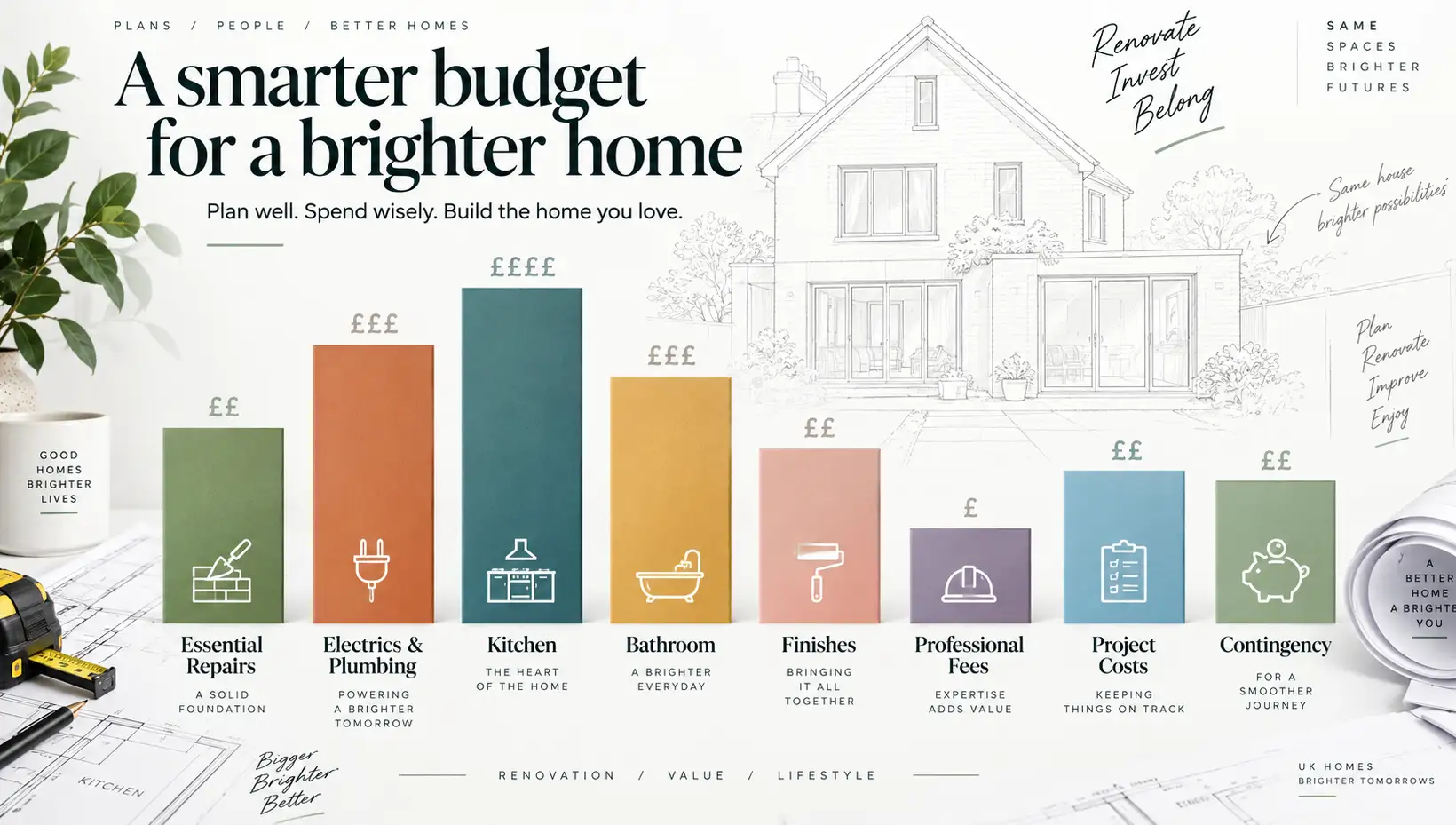
It’s more useful to think about a renovation budget in categories, since different projects draw on these to very different degrees:
Essential building work — structural repairs, roof condition, damp or water ingress, drainage. This is the work that has to happen regardless of what the finished house looks like, and it’s the category most likely to be underestimated on an older or previously neglected property.
Services — electrics, plumbing, heating and ventilation. Often largely invisible in the finished result, these can become major costs on a full renovation, particularly where systems need replacing rather than simply extending or altering.
Rooms — kitchens and bathrooms are often among the largest discretionary spends and the areas homeowners tend to price most confidently, since they’re the parts with visible products and showroom price tags attached.
Fabric and finishes — windows, plastering, flooring, decorating, internal doors and joinery.
Professional and regulatory costs — surveys, design fees, structural engineering, Building Regulations and, where relevant, planning costs.
Project costs — skips, scaffolding, temporary works, storage, site security and, where the household isn’t living in the property throughout, temporary accommodation.
Owner-supplied items — appliances, light fittings, sanitaryware, kitchens, flooring or other products being bought directly rather than supplied through the main building contract.
Not every renovation touches every category to the same degree — a cosmetic refresh may barely touch the first two at all, while a full structural overhaul can find the first two categories dwarfing the spending that produces the most visible transformation.
The visible-versus-invisible problem
This is worth treating as the single most important idea in this whole article. Homeowners naturally price the things they can see and touch — kitchen units, taps, flooring, paint colours, tile choices. It’s much harder to instinctively price the things a finished renovation doesn’t show: rewiring, plumbing runs, drainage alterations, the plaster repair needed once old wiring has been chased out, groundwork and preparation, waste removal, temporary support, making good, and the sheer amount of labour that goes into work nobody ever photographs for a before-and-after post.
On many renovations, particularly older or previously neglected properties, this “invisible” work can consume a substantial share of the budget precisely because it has to happen first and it has to happen properly, whether or not anyone will ever see it once the walls are closed up.
One useful discipline is therefore to build the budget from the building outward, rather than from the finishes inward. Start with what the property needs to be sound, safe, weather-tight and properly serviced; then establish what remains for kitchens, bathrooms and finishes.
A builder’s quote is not the same number as your total renovation cost
This trips up a huge number of people, and it’s worth stating plainly: a £40,000 builder’s quote for a defined package of building work is not necessarily the same thing as a £40,000 total renovation cost.
Depending on how the project is being procured, a building quote may exclude kitchen units, sanitaryware, appliances, flooring, decoration, professional fees, specialist reports and products you’re expected to purchase directly. None of this is necessarily hidden or dishonest — a contractor can only sensibly price the scope they’ve actually been asked to provide.
The mistake is treating the builder’s number as the whole project budget rather than one substantial component of it.
There’s also an important distinction between a quote and an estimate. A quotation is normally an agreed price for a defined scope, subject to the contract and any subsequently agreed changes; an estimate is a best assessment of likely cost and carries more uncertainty. Citizens Advice provides useful consumer guidance on quotes, estimates and changes to building-work prices.
Before treating a quote as “the budget”, check this
| Question | Why it matters |
|---|---|
| Is VAT included? | A price that looks cheaper may simply be stated before VAT |
| Exactly what labour is included? | Decorating, flooring, specialist trades or making good may sit outside the quotation |
| Which materials are included? | “Supply and fit” is very different from labour-only installation |
| What are you expected to buy directly? | Kitchens, appliances, sanitaryware, tiles and light fittings can create a substantial separate spend |
| Are scaffolding, skips and waste disposal included? | Site costs are easy to overlook because they aren’t part of the finished house |
| Are professional and statutory fees included? | Architects, engineers, surveys and Building Control normally sit outside a builder’s quotation |
| Are any figures allowances or provisional sums rather than fixed prices? | The final cost can move once the exact work or product is known |
| What happens if the design changes? | Variations need a clear method for agreeing additional cost and time |
RICS likewise recommends agreeing how changes will be made and how their cost and programme implications will be dealt with before work starts, rather than improvising once construction is under way. Its home extensions and improvements guidance is a useful wider checklist.
Don’t forget VAT
For most ordinary renovation work to existing houses and flats, builders and similar trades normally charge VAT at the standard rate where they are VAT-registered. There are specific exceptions and reduced-rating rules — including certain qualifying residential conversions and some work to homes that have been empty for the required period — so it isn’t safe to assume every renovation is taxed identically.
HMRC’s current VAT guidance for work on houses and flats explains the main rules.
The practical budgeting point is simpler: never compare two building prices until you know whether both include VAT on the same basis.
Why contingency isn’t pessimism
Setting aside genuine financial headroom beyond the quoted or budgeted figure is sensible on almost any renovation, and particularly important on older properties, where opening up walls, floors and ceilings can reveal problems nobody could reasonably have priced accurately in advance.
There’s no single, universally correct contingency percentage that applies to every project regardless of its age, condition and scope. A recently built house receiving mostly cosmetic work has a very different risk profile from a neglected period property about to be stripped back to brick.
The sensible approach is to size the reserve to the amount of genuine uncertainty in the project rather than adopting a generic percentage and assuming it will hold.
More importantly, contingency isn’t the same thing as money for things you’ve already decided to buy.
Three different pots that are often confused
| Budget pot | What it’s for | Example |
|---|---|---|
| Known cost | Work or products already defined and priced | An accepted electrical quotation |
| Allowance | Something you know you’ll need but haven’t finally specified or priced | The kitchen, tiles or an unresolved piece of drainage work |
| Contingency | Genuine unforeseen conditions or risks | Defective concealed timber discovered after opening up |
If the kitchen hasn’t been chosen yet, its expected cost isn’t contingency — it’s an allowance. If you’ve decided halfway through the project that you now want bespoke wardrobes, that isn’t contingency either — it’s additional scope.
Keeping those three pots separate makes it much easier to see whether the project is genuinely encountering unforeseen problems or whether the budget is simply being spent on decisions that were never included in the first place.
How scope creep quietly inflates the number
Renovation budgets very rarely blow up in one dramatic moment. They tend to creep upward through a long series of individually reasonable-sounding decisions made once the project is already underway: a few extra sockets here, better lighting there, upgraded tiles, some bespoke joinery, an additional bathroom that wasn’t originally planned, a smart-home system, better internal doors, a higher specification kitchen than originally budgeted.
Each of these, taken alone, is a small and often genuinely worthwhile improvement. Taken together, across a full renovation, they can add a substantial amount to the final bill without ever feeling, at any single decision point, like an extravagant choice.
Being aware that this pattern exists — and periodically checking the running total against the original budget rather than only reviewing it at the end — is one of the more effective ways to keep it in check.
A useful rule is that a variation isn’t just the extra item itself. Moving a doorway, for example, might change electrics, plastering, skirting, decorating and flooring as well as the carpenter’s work. The meaningful question isn’t “how much is the new door?” but “what is the total cost and programme effect of making this change now?”
Keep a simple variation log
For anything beyond a very small project, record each requested change with:
- what is changing;
- why it’s changing;
- the additional or reduced cost;
- whether the price includes VAT;
- any effect on the programme;
- who approved it; and
- the revised expected total project cost.
That small discipline makes scope creep visible while there’s still time to make choices, rather than presenting the homeowner with one unpleasant arithmetic exercise at the end.
Buying a property that needs work
A property listed £50,000 below a comparable renovated equivalent nearby isn’t automatically a bargain — it depends entirely on what the required work actually costs and how long it takes. If bringing the property up to a comparable standard costs more than the apparent purchase discount once professional fees, finance, accommodation and the risk of hidden work are included, the arithmetic looks very different.
And cost isn’t the only consideration. Money tied up during construction, mortgage or bridging costs where relevant, rent or temporary accommodation, storage and the practical effect of a long project all have value even though none becomes part of the finished kitchen.
This isn’t a case against buying a property that needs work; it’s a case for pricing the actual work as carefully as the purchase price itself before deciding whether the discount is real.
A simple comparison is:
Purchase price + renovation + professional/project costs + financing/temporary-living costs + risk allowance
against
the realistic value of buying an equivalent property already in the condition you want.
That doesn’t tell you whether to buy — renovation can create a home that simply isn’t available ready-made — but it exposes the true financial comparison.
When the budget can’t stretch to everything
Very few renovation budgets comfortably cover every improvement a household would ideally like, and deciding what genuinely deserves the available money — rather than simply what feels most exciting to choose first — is a real skill. Our companion article on which improvements are actually worth the money goes into this decision properly; the point relevant here is simply that budgeting and prioritising are two separate exercises, and it’s worth doing the first honestly before assuming the second will sort itself out.
One useful dividing line is between work that’s expensive to revisit and work that’s easy to upgrade later. Hidden wiring, plumbing, drainage, structural alterations and insulation are painful to revisit once a house is finished. A premium light fitting, more expensive tap or upgraded freestanding appliance can often be changed later without reopening the building.
When money is tight, that distinction can be more useful than asking which visible finish delivers the greatest immediate impact.
What to take from this
Renovation budgets don’t go wrong only because building work is expensive. They go wrong because the original figure, however carefully it felt calculated at the time, often failed to include the full scope of what the finished house actually needed — the invisible services work, the professional fees, the finishes and fittings sitting outside the building quote, the genuine risk of what an older property might reveal once opened up, and the steady accumulation of small, reasonable-sounding upgrades along the way.
Building the budget around all of that from the start, rather than discovering it piece by piece as the project runs, is what actually keeps a renovation on track.

