

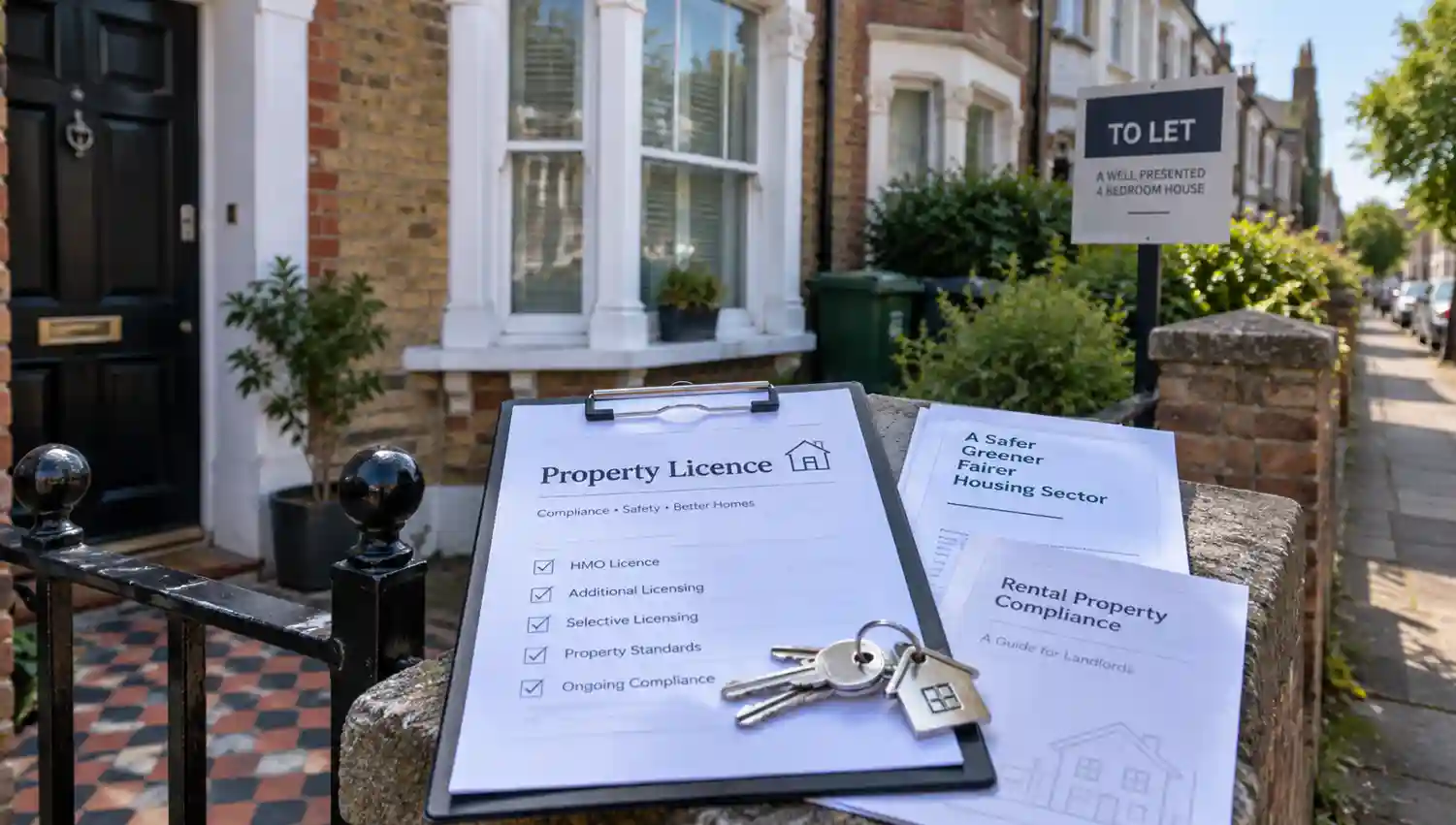
“I don’t need a licence, it’s not a big shared house” is one of the most common assumptions in private renting, and it’s wrong often enough to be genuinely worth challenging directly. Licensing in England doesn’t just cover large HMOs. It can cover a single-let, single-family flat, purely because of which local authority area it happens to sit in. Getting this wrong isn’t a paperwork slip — operating an unlicensed property that needed a licence carries real financial exposure.
Three separate systems, not one
England runs three distinct licensing regimes: mandatory HMO licensing, additional HMO licensing and selective licensing.
They answer different questions, and a property can fall under none or one of them depending on its occupation, building type and location. Where schemes overlap geographically, a property already requiring the relevant HMO licence does not normally also need a separate selective licence for the same letting.
Which licensing route should you check first?
| Property arrangement | First licensing question |
|---|---|
| 5+ occupiers from 2+ households sharing facilities | Does mandatory HMO licensing apply? |
| 3–4 occupiers from more than one household | Is it an HMO covered by local additional licensing? |
| Certain converted buildings / Section 257 HMOs | Does the council’s additional scheme include this building type? |
| Single tenant, couple or one family | Does the address fall inside a selective licensing area? |
That is only a starting point — technical HMO definitions and local scheme wording still matter.
Mandatory HMO licensing: the one most landlords have heard of
A property normally requires a mandatory HMO licence if it’s occupied by five or more people forming two or more separate households and meets the relevant HMO tests, commonly because facilities such as a kitchen, bathroom or toilet are shared.
This applies regardless of how many storeys the building has — the old rule limiting mandatory licensing to larger three-storey HMOs was removed in 2018.
The government’s HMO guidance explains the basic national threshold.
It’s worth distinguishing being an HMO from being an HMO that requires mandatory licensing. A three- or four-person shared house can already be an HMO while sitting below the national five-person mandatory licensing threshold.
Certain converted buildings and self-contained flats can meet different HMO definitions, but that does not automatically place the whole building within mandatory licensing. Section 257 converted blocks, for example, may instead be brought into scope by an additional licensing scheme.
Additional licensing: HMOs a national scheme doesn’t reach
A local authority can choose to extend licensing requirements to HMOs that the mandatory scheme doesn’t cover — commonly properties with three or four occupiers from two or more households.
Councils can also use additional licensing to cover other HMO types within the terms of the particular designation, including some converted buildings.
This is entirely dependent on the local scheme, applies only within the area the council has formally designated, and needs to be checked property by property rather than assumed from the building’s general type.
This is precisely why a landlord letting a modest three-person house-share can find themselves needing a licence in one council area and not in another.
Selective licensing: the one that surprises single-let landlords
This is the licensing type most likely to catch out a landlord who’s never let anything resembling an HMO.
Under Part 3 of the Housing Act 2004, a local authority can designate a specific area where privately rented properties within the scheme’s scope need a licence even though they are not HMOs.
A single tenant renting an entire one-bedroom flat, or a family renting a conventional house, can therefore need a licence purely because of where the property sits.
Councils can introduce selective licensing where statutory conditions are met, including matters such as low housing demand, anti-social behaviour, poor housing conditions, deprivation, migration or crime.
A selective licensing designation can run for up to five years.
How to actually find out if your property is covered
This is the single most useful thing this article can tell you: check your specific local authority’s licensing pages for your specific address, every time you’re unsure, rather than relying on general assumptions about the property type.
You can identify the relevant authority through the government’s Find your local council service, then check that council’s current licensing pages and any address or postcode tool it provides.
Things worth confirming specifically:
- whether a scheme currently covers the address;
- which type of scheme it is;
- when it started and when it expires;
- what conditions attach to the licence; and
- whether an exemption genuinely applies.
Selective and additional licensing schemes are time-limited. A property that didn’t need a licence when you bought or first let it can come into scope later because the council introduces a new designation.
What licence conditions actually require
Licence conditions vary between councils and schemes, so treat any general list as illustrative rather than exhaustive for your specific property.
Mandatory HMO licences carry statutory conditions, and councils can impose additional lawful conditions. Additional and selective schemes can also contain conditions relevant to the way the property is managed.
Common areas include safety documentation, occupancy limits, management arrangements, waste, anti-social behaviour management, inspections and record keeping.
Don’t assume your licence mirrors a landlord friend’s licence from a different council or even a different scheme in the same authority. Read the actual conditions issued for your property.
Licensing and planning permission are different questions entirely
A genuinely common point of confusion: holding an HMO licence doesn’t mean planning permission has been granted, and having planning permission doesn’t mean a licence is in place.
These sit under different legislation, assessed for different purposes.
Licensing is concerned principally with the occupation, management and condition of the rented property. Planning is concerned with whether that particular use of the building is permitted.
A property can need licensing, planning permission, both or neither depending on its circumstances — particularly relevant where a conventional dwelling is being changed into shared accommodation.
This deserves its own dedicated treatment rather than a partial planning guide here.
What operating unlicensed actually costs
Letting a property that requires a licence without holding one can be a criminal offence.
For relevant licensing offences committed from 1 May 2026, a local authority can impose a civil financial penalty of up to £40,000 as an alternative to prosecution. Prosecution can itself result in an unlimited fine.
There is also potential exposure to a Rent Repayment Order. For qualifying offences committed from 1 May 2026, a tenant can apply to the First-tier Tribunal for repayment of up to two years’ relevant rent, with the Tribunal deciding whether to make the order and in what amount.
The government’s Rent Repayment Order guidance explains the current regime.
None of this means every licensing oversight automatically produces the maximum penalty. But “I didn’t realise this address needed one” is a genuinely expensive assumption to get wrong.
Local licensing and the new national register are separate
One extra distinction becomes important from December 2026.
England’s new Register your rental property service begins rolling out on 15 December 2026. That national registration requirement is separate from local HMO, additional or selective licensing.
A landlord may ultimately need both:
- national registration; and
- the appropriate local property licence.
Having one does not automatically satisfy the other.
The government’s registration announcement sets out the rollout.
Beyond England
Wales operates a different structure. Immediate landlords must register through Rent Smart Wales, while landlords or agents carrying out specified letting or management work need the appropriate licence. Wales also has separate HMO licensing through local authorities.
Scotland requires every private landlord to register with the relevant local authority and has a separate HMO licensing regime, generally capturing properties occupied by three or more unrelated people who share facilities.
Northern Ireland runs its own landlord registration scheme and separate HMO licensing through local councils.
None of England’s mandatory/additional/selective structure should simply be applied to another UK nation.
Where local detail genuinely matters
Because licensing genuinely is hyper-local — sometimes covering one neighbourhood and not the next — there’s a real case for future coverage of specific, significant licensing schemes where a council introduces something substantial and newsworthy, rather than generic council-by-council pages created purely to capture search traffic.
Where a major scheme launch or expansion genuinely affects a large number of landlords and tenants, that’s worth covering on its own merits. A thin page for every council in England, regardless of whether there’s anything distinctive to say, isn’t.
This article provides general information about property licensing in England as it stood at the time of writing and does not constitute legal advice. Licensing requirements are address-specific and change regularly — always verify directly against your local authority’s current licensing pages before assuming a property’s status either way.

