

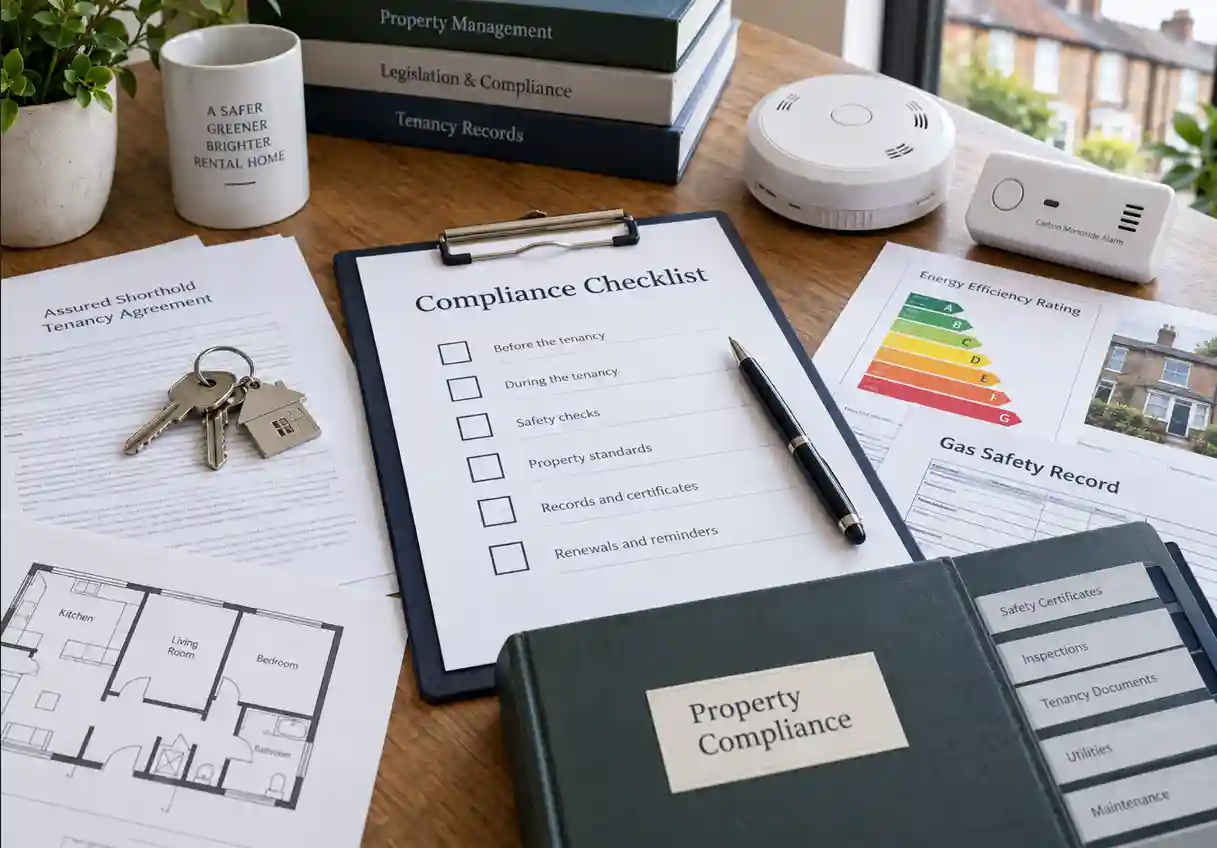
Landlord compliance doesn’t fail because any single rule is complicated. It tends to fail because the obligations arrive at different points in the letting process, from different pieces of legislation, and nobody’s mapped the whole journey in one place. This article is that map — not an exhaustive legal manual, but a structure for understanding what applies when, with links through to the detail where it genuinely matters.
This is an England-focused article. Wales, Scotland and Northern Ireland each run meaningfully different compliance frameworks, noted briefly at the end — treating this as a UK-wide checklist would do landlords outside England a real disservice.
The compliance journey at a glance
| Stage | Main things to check |
|---|---|
| Before marketing | EPC/MEES position, licensing, mortgage or lease restrictions |
| Choosing a tenant | Right to Rent, discrimination rules, stated rent, holding deposit |
| Before agreement / move-in | Written tenancy information, deposit process, gas/electrical records, alarms |
| During the tenancy | Repairs, safety renewals, rent increases, pet requests, licence conditions |
| When circumstances change | Tenant changes, sale, new licensing schemes, regulatory changes |
The value of the table isn’t that every obligation fits neatly into one box. It’s that compliance has a timeline — and missing the timing is often what causes the problem.
Before you market or let the property
Before a property goes anywhere near a listing, several things need to be in place at different points.
For most homes that require an Energy Performance Certificate, you need a valid EPC or must at least have commissioned one before marketing begins. Where the Minimum Energy Efficiency Standards apply, the property currently needs to achieve at least an E rating to be let lawfully unless a valid exemption applies.
The government’s domestic MEES guidance explains the current position.
If the property has relevant gas appliances or flues, a valid gas safety check needs to be current and the new tenant must receive the record before moving in. Electrical safety requires the fixed electrical installation to be inspected and tested at least every five years, or sooner if the previous report specifies.
Smoke alarms need to be fitted on every storey containing a room used as living accommodation, and carbon monoxide alarms are required in rooms used as living accommodation containing a fixed combustion appliance, except a gas cooker. The prescribed alarms must be checked and working on the day a new tenancy begins.
Depending on the property and its location, licensing may also apply before you can legally let at all — mandatory HMO licensing for larger shared properties, or additional or selective licensing schemes introduced by individual councils.
This is genuinely easy to miss because it can depend on your specific council and address, not simply on the property’s general type.
If you have a mortgage or a lease with restrictions on letting, checking those sits here too, before you commit to anything with a prospective tenant.
Before accepting a tenant
Once you’re taking applications, a different set of duties kicks in.
If the property is in England, you must carry out the required Right to Rent checks on relevant adult occupiers before the tenancy starts, regardless of nationality.
You’re also barred from discriminating against applicants because they receive benefits or have children, subject to the limited statutory exceptions that can apply in particular circumstances.
Rent must be advertised as a specific figure, not a range, and you can’t invite, encourage or accept offers above that stated rent.
If you’re taking a holding deposit, it’s capped at one week’s rent for the tenancy as a whole, and there are strict rules about when it must be returned, applied to the tenancy or can lawfully be retained.
At the start of the tenancy
This is where documentation becomes critical, because several of these steps can affect your position later if something goes wrong.
You need to protect any tenancy deposit in an approved scheme within 30 days of receiving it and give the required prescribed information within the same period.
Since 1 May 2026, getting this wrong can affect the court’s ability to grant possession on most Section 8 grounds until the deposit position has been dealt with properly, although there are exceptions including Grounds 7A and 14.
For a new tenancy created on or after 1 May 2026, specified written information about the tenancy must be given to the tenant before the tenancy agreement is signed or otherwise agreed.
This can be included in the agreement itself or provided separately. The government’s written-information guidance explains the current requirement.
That is different from the Renters’ Rights Act Information Sheet used mainly as a transitional requirement for older tenancies after the reforms began.
The current gas safety record and electrical report need to be provided at the appropriate point before occupation. Smoke and carbon monoxide alarms must be tested on the first day of the new tenancy; documenting that test on the inventory or check-in record is sensible evidence.
Meter readings and a proper inventory or check-in record aren’t legal prerequisites in the same way as deposit protection or safety requirements, but they’re among the most useful things you can create to avoid disputes later.
During the tenancy
Ongoing compliance is where things quietly lapse if nobody’s tracking them.
Gas safety checks need renewing every 12 months, with the updated record given to the tenant within 28 days. Electrical installations need inspecting at least every five years, or earlier if the report requires, and any remedial work identified by the report needs dealing with within the relevant deadline.
Faulty smoke or carbon monoxide alarms need repairing or replacing once you’re informed of the problem and the alarm is found to be faulty.
Rent can normally be increased only once in a 12-month period, not during the first year of the tenancy, using the formal Section 13 process with the required notice.
If a tenant makes a written request to keep a pet, that now triggers a formal response process and timetable rather than being something to ignore or deal with through a blanket “no pets” policy.
If the property is licensed, keeping that licence current and complying with its conditions is an ongoing duty, not a one-off box ticked at the start.
And throughout, keeping clear, dated records of repairs, communications and inspections is less a legal requirement in its own right and more the thing that makes every other obligation defensible if it’s ever questioned.
When circumstances change
A handful of situations reset parts of this compliance picture.
A new tenant joining or replacing someone on a joint tenancy generally means treating the change properly rather than informally — updating the tenancy and deposit records where required rather than simply swapping names between housemates.
Selling the property with a tenant in place transfers the landlord role to the new owner, but the tenancy itself doesn’t disappear because ownership changes.
A new licensing scheme introduced by your council can bring an already-let property into scope for the first time, requiring an application even though nothing about how you’re running the tenancy has changed.
And new regulation can shift requirements for tenancies already running, not just new ones.
What’s already in force, and what’s still coming
It’s worth being precise about this, because conflating “confirmed policy” with “current law” is a genuinely common and costly mistake.
Already in force: the abolition of Section 21 and the move to assured periodic tenancies, revised Section 8 possession grounds, the formalised rent-increase regime, rent-bidding restrictions, rent-in-advance restrictions, benefits and children discrimination protections, and the statutory pet-request process.
Starting later in 2026: the new national Register your rental property service will begin on 15 December 2026, starting in the West Midlands before rolling out region by region across England over the following 12 months.
When an area is called forward, landlords there will have three months to register. All landlords actively letting property are expected to have registered by 14 November 2027.
The government’s registration announcement sets out the rollout.
Confirmed but not yet operational: mandatory membership of the new Private Rented Sector Landlord Ombudsman is still expected around 2028, while extension of Awaab’s Law-style fixed repair timescales to private renting remains subject to further implementation and does not yet have a confirmed private-sector commencement date.
Further ahead: the higher private-rental energy-efficiency standard is due from 1 October 2030, while the reformed Decent Homes Standard is scheduled to become enforceable in the private rented sector from 2035.
Treating future duties as though they already apply is a mistake. So is assuming they’re far enough away to ignore when you’re planning major expenditure or long-term ownership.
Using an agent doesn’t make this someone else’s problem
Instructing a letting or managing agent changes who handles much of the day-to-day administration.
It does not mean every statutory responsibility automatically transfers to the agent in the same way. Depending on the particular rule, duties can fall on the landlord, the agent or both.
The useful principle is therefore simple: agree who is responsible for each task, and make sure you can see that the important work has actually been done.
Beyond England
Wales operates its own framework under the Renting Homes (Wales) Act 2016, alongside landlord registration and licensing through Rent Smart Wales.
Scotland requires private landlord registration, applies its own Repairing Standard and has run a grounds-based private tenancy system since 2017.
Northern Ireland operates a separate landlord registration scheme, tenancy-deposit rules and fitness standards.
None of the England-specific detail above should simply be copied into a landlord checklist for those three nations.
This article provides a general compliance overview for landlords in England as at 9 September 2026 and does not constitute legal advice. Landlord obligations are detailed and frequently updated, and some requirements depend on the property, tenancy type and local licensing scheme.applies to your property.

