

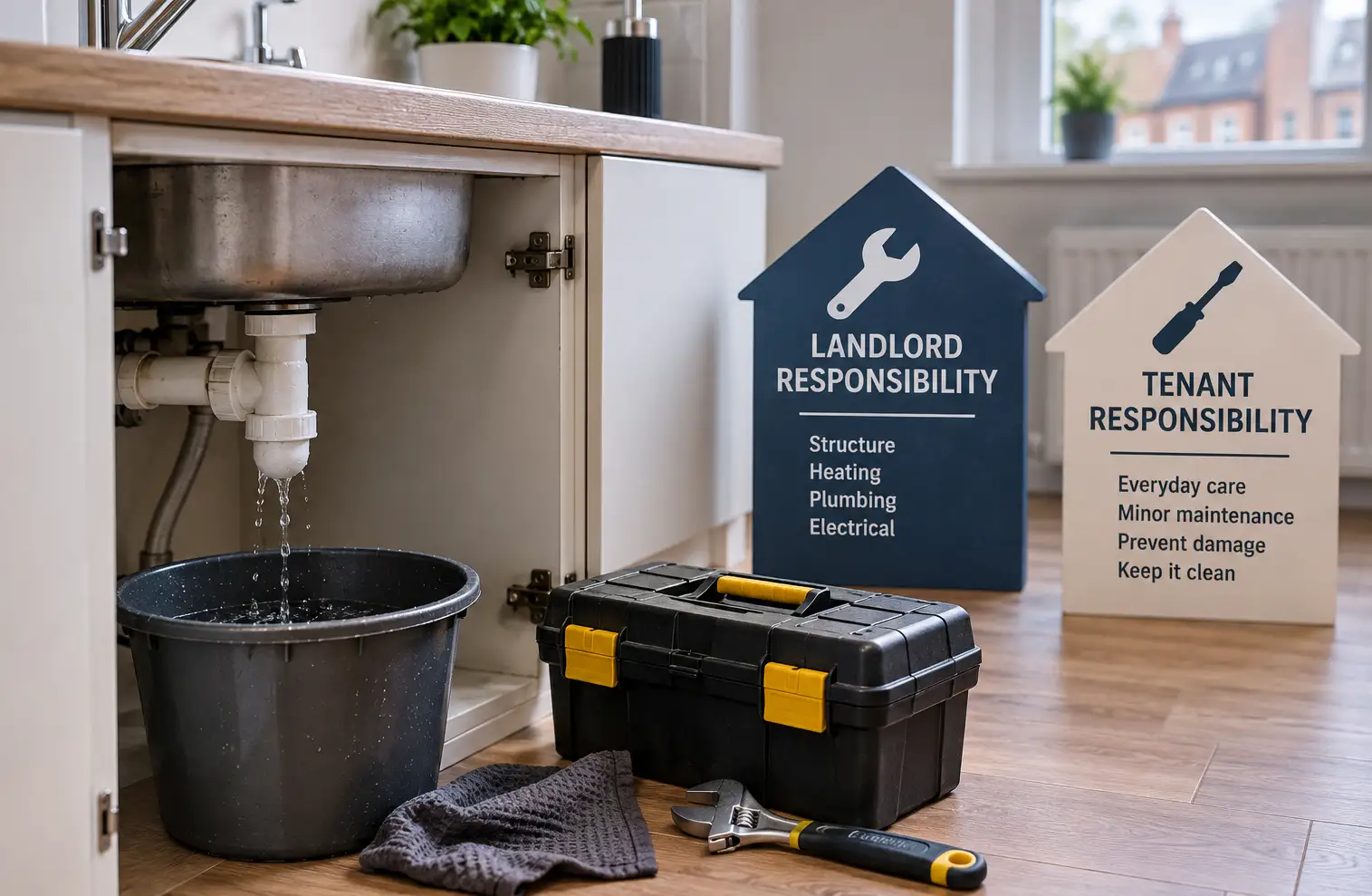
A tap won’t turn off. A door won’t close properly. The boiler’s making a noise it didn’t used to make. The instinctive question — is this my problem or my landlord’s? — usually has a clearer answer than it first appears, because English law draws the line in a fairly consistent place.
The complication is that what has broken is only half the question. What caused it, whether it forms part of the property itself, and what the tenancy agreement says can all change who ends up responsible.
The core legal duty
The starting point is Section 11 of the Landlord and Tenant Act 1985.
For most ordinary residential tenancies, the landlord must keep in repair:
- the structure and exterior of the property;
- drains, gutters and external pipes;
- installations supplying water, gas and electricity;
- basins, sinks, baths, toilets and other sanitation installations;
- space-heating systems; and
- water-heating systems.
That puts problems such as a leaking roof, defective external wall, broken boiler, leaking pipe, failed radiator or faulty electrical wiring firmly within the landlord’s normal repair territory.
These duties are implied into the tenancy by law. A landlord cannot simply write “tenant responsible for boiler repairs” into the agreement and use that clause to escape a statutory responsibility.
GOV.UK’s current private-renting repairs guidance gives the practical government summary of these duties.
Repair isn’t the only standard the landlord has to meet
Section 11 is important, but it is not the complete picture.
A rented home in England must also be fit for human habitation at the beginning of the tenancy and throughout it. That is a broader standard concerned with whether the home is reasonably safe and healthy to occupy.
A property can therefore present a serious landlord problem even where the issue does not fit neatly into a simple “broken pipe or broken boiler” repair category.
Excessive cold, serious damp, dangerous electrical conditions, structural instability, inadequate ventilation and other serious hazards can all become relevant to whether a home is fit to live in.
The government’s guide to the Homes (Fitness for Human Habitation) Act explains this separate protection.
That does not mean a landlord becomes responsible for damage the tenant actually caused. It means repair responsibility should not be judged by Section 11 alone when the condition of the home itself creates a serious health or safety problem.
Why the cause matters as much as the fault
The same part of a property can sit on either side of the line depending on what happened to it.
A boiler that fails through age or an internal fault is normally the landlord’s responsibility. It is part of the heating installation.
A sink that stops draining because the pipework has failed is normally a landlord repair.
But if that same sink is blocked because cooking fat, wipes or inappropriate material has repeatedly been put down it, the tenant may be responsible for the cost of clearing the blockage.
A leaking roof is normally structural and therefore the landlord’s problem.
An internal door damaged because somebody kicked it, slammed it hard enough to break the hinges or struck it while moving furniture is different. That is potentially tenant-caused damage rather than deterioration the landlord is required to absorb.
This is why “Who repairs it?” and “Who caused it?” are often two separate questions.
Three questions usually tell you which side of the line you’re on
When something goes wrong, ask these in order:
1. Is it part of the structure, exterior, heating, hot water, sanitation or essential supply installations?
If yes, the starting assumption is usually landlord responsibility.
2. Was the problem caused by ordinary age, failure or deterioration — or by something the tenant, household or visitors did?
Tenant-caused damage can shift the cost back towards the tenant even where the damaged item would normally be maintained by the landlord.
3. Is it something outside the statutory repair list, such as a washing machine or freestanding appliance?
If so, the tenancy agreement becomes much more important.
Those three questions will not solve every unusual case, but they deal with a surprisingly large proportion of everyday repair disputes.
What normally falls to the landlord
Beyond the obvious roof-and-boiler examples, landlord responsibility will commonly include:
Windows and external doors.
Frames, external doors and other structural elements are normally part of the landlord’s repair responsibility. If a lock or door becomes defective through ordinary failure rather than tenant damage, that will usually point towards the landlord too.
Pipes and drainage.
Defective pipework and drainage installations fall within the landlord’s repair duties. A blockage caused by misuse is a different matter.
Electrical installations.
Wiring, sockets and the fixed electrical installation are the landlord’s responsibility, alongside separate electrical-safety duties.
Heating and hot water.
Boilers, radiators, water tanks and other fixed heating or hot-water installations are landlord responsibilities.
Problems caused by a repair the landlord carries out.
A landlord cannot repair one problem, damage something else in the process and simply leave that new damage behind.
Some pest problems.
Responsibility depends heavily on cause. If rats are entering through a structural hole the landlord should repair, or an infestation is connected to a condition that makes the home unfit, landlord responsibility becomes much stronger. An infestation caused by the occupier’s own living conditions can produce a different answer.
Common areas can also create landlord duties, particularly where the landlord retains control of them or they form part of the facilities the tenant is entitled to use. But this is more fact-specific than the repair duty inside the individual rented home.
What normally falls to the tenant
Tenants are expected to look after the property in what housing law traditionally describes as a “tenant-like manner”.
That does not mean carrying out the landlord’s plumbing, electrical or structural work.
It means taking the ordinary care a reasonable occupier would take.
Examples include:
- changing ordinary light bulbs;
- replacing batteries in alarms where appropriate rather than replacing defective alarms themselves;
- keeping the property reasonably clean;
- taking reasonable steps to avoid preventable damage;
- looking after a garden where the agreement makes routine garden maintenance the tenant’s responsibility;
- reporting problems rather than allowing them to become substantially worse; and
- paying for damage genuinely caused by the tenant, their household or visitors.
GOV.UK’s tenant responsibilities guidance similarly distinguishes taking reasonable care of the home from carrying out repairs that legally belong to the landlord.
Normal wear and tear is not tenant damage. A carpet wearing with age, minor deterioration from ordinary occupation or fittings naturally reaching the end of their useful life should not be treated the same way as negligence or deliberate damage.
Appliances are where the tenancy agreement matters most
A washing machine, fridge, dishwasher or freestanding cooker can cause confusion because being supplied by the landlord does not automatically put every such appliance inside Section 11.
Section 11 covers installations supplying water, gas and electricity. It does not generally turn every appliance that uses those supplies into a statutory landlord repair.
So if the landlord provided a washing machine and it breaks, check the tenancy agreement.
The agreement may expressly say the landlord will repair or replace supplied appliances. If it does, that contractual promise matters.
If the tenant brought the appliance themselves, responsibility is normally straightforwardly theirs.
Safety is a separate issue again. A landlord still has safety duties relating to equipment they provide, particularly gas and electrical safety. An appliance does not have to fall within Section 11 for the landlord to have responsibilities concerning whether it is safe to use.
That distinction — repair responsibility versus safety responsibility — is worth keeping clear.
Condensation, damp and mould rarely fit into one sentence
Condensation is one of the worst areas for simplistic “landlord versus tenant” answers.
Sometimes the building is the underlying problem: inadequate ventilation, penetrating damp, defective heating, water ingress, insulation problems or another structural cause.
Sometimes how the property is used contributes.
Often it is a combination.
That means “you caused condensation” should not be used as a shortcut that prevents the underlying condition of the property being investigated.
Damp and mould responsibility is significant enough to deserve its own treatment in our Damp, Mould & Condensation section rather than being reduced to a single rule here.
Report problems properly
For many ordinary repair claims, the landlord needs to know that something is wrong before they can reasonably be expected to put it right.
So report repairs promptly.
Email is useful because it creates a dated record. Describe:
- what the problem is;
- when you first noticed it;
- whether it is getting worse;
- whether it affects heating, water, electricity or safety; and
- any immediate damage it is causing.
Photographs or a short video can be useful where the problem is visible.
You do not need to write a legal submission. “The boiler stopped producing hot water this morning and is showing error code X” is much more useful than waiting a fortnight and later trying to reconstruct when the problem began.
The landlord also needs a reasonable opportunity to inspect and repair the fault. Tenants should provide reasonable access for genuine repairs, subject to the normal access and notice rules.
Don’t automatically fix it yourself and deduct the bill from the rent
When a landlord is slow to act, it is tempting to call a contractor, pay the invoice and subtract it from the next rent payment.
That can create a second dispute on top of the first one.
There are circumstances in which tenants have successfully used procedures sometimes described as “repair and deduct”, but the process is legally risky if the correct steps have not been followed.
Similarly, simply stopping rent because repairs are outstanding can create rent arrears and potentially put the tenancy at risk.
The safer default is to keep paying the rent, preserve the evidence, escalate the repair properly and get housing advice before using rent as leverage or commissioning substantial work at the landlord’s expense.
Responsibility and timescale are different questions
Knowing who is responsible does not necessarily tell you how quickly the repair must be completed.
A failed heating system in winter, exposed electrical wiring and a sticking internal cupboard door clearly do not carry the same urgency.
The law generally requires repairs to be dealt with within a reasonable time after the landlord has been made aware of them, and what counts as reasonable depends heavily on seriousness and circumstances.
Repair timescales therefore deserve their own treatment rather than being buried inside an article about responsibility.
Likewise, this article is not intended to diagnose individual structural defects, electrical faults, pest problems or damp. Those belong in the relevant Property Problems guides.
The position outside England
This article is about England.
In Wales, the Renting Homes (Wales) Act 2016 now provides its own repair and fitness framework. Landlords have duties covering the structure and exterior, service installations and fitness for human habitation, but the legal terminology and enforcement process are Welsh rather than simply an extension of England’s system.
In Scotland, private landlords are governed by the Repairing Standard under the Housing (Scotland) Act 2006. It covers the condition of the building, installations and various fixtures, fittings and appliances provided as part of the tenancy, with disputes capable of going to the First-tier Tribunal for Scotland.
In Northern Ireland, private landlords also carry statutory repair and fitness responsibilities, including the structure and exterior, heating and hot water systems, sanitation and various landlord-provided installations and equipment.
The broad principle travels well — landlords generally deal with the property and its essential systems; tenants deal with reasonable everyday care and damage they cause — but the detailed law should always be checked for the nation where the property actually is.
This article provides general information about repair responsibility in private rented homes in England as it stood in September 2026 and does not constitute legal advice. Responsibility can depend on the cause of the problem, the tenancy terms and the particular circumstances. If you are facing a serious repair dispute, consider seeking advice from Shelter, Citizens Advice, your local council or a solicitor.

