

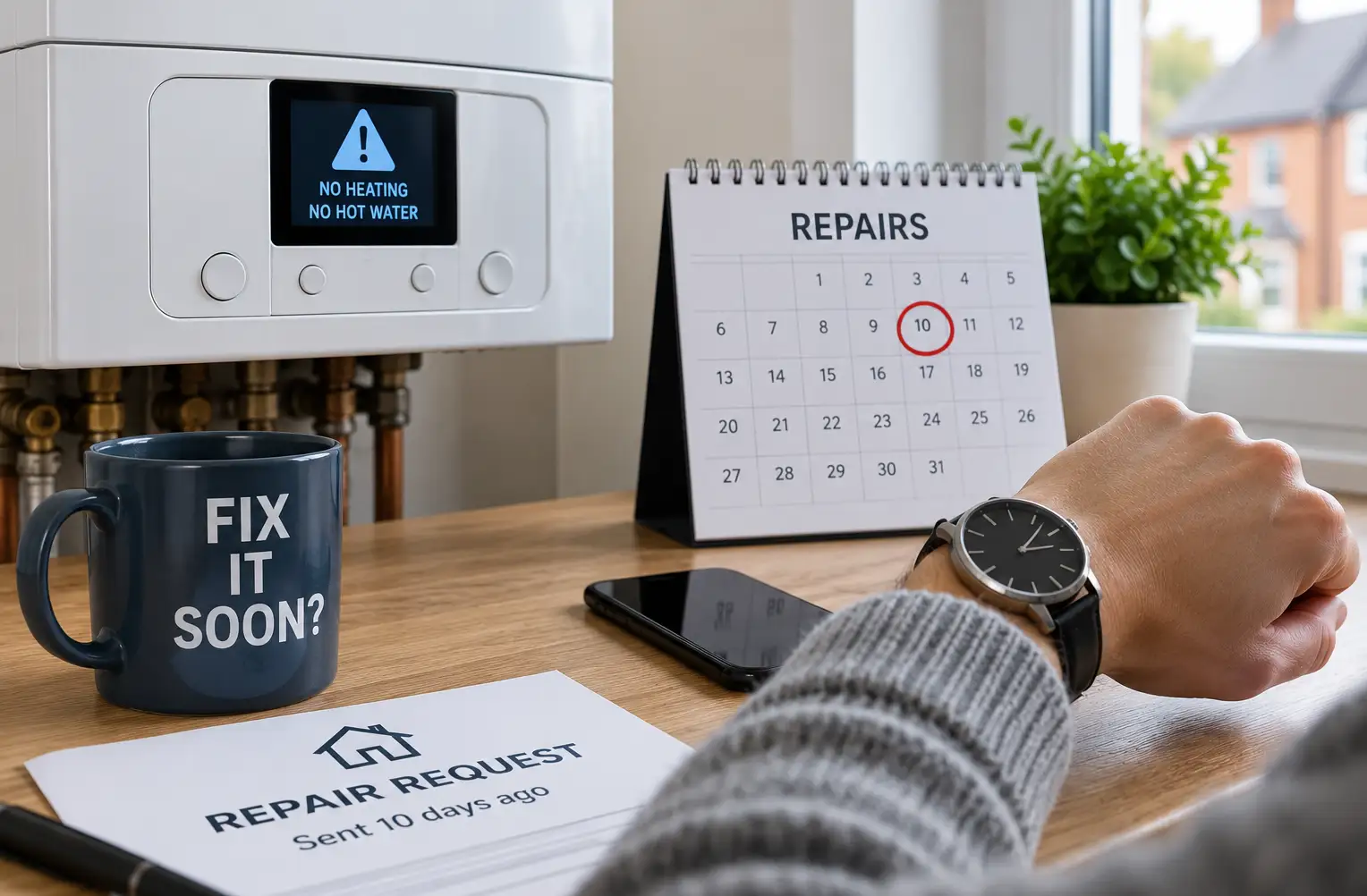
Ten days after reporting a broken boiler, a tenant is entitled to wonder whether that is normal or a sign something is being ignored.
The honest, slightly unsatisfying answer is: it depends — not because the law is vague for the sake of it, but because a genuinely reasonable timescale for a dangerous electrical fault and a genuinely reasonable timescale for a sticking cupboard door are never going to be the same number.
That difference is built into the law rather than being a gap in it.
There is no single private-renting repair countdown
For private rented homes in England, there is no one universal statutory timetable saying every repair must be completed within a set number of days.
The legal standard is usually expressed as reasonable time after the landlord has notice of the problem. What counts as reasonable depends on the nature of the defect, how serious it is, what risk it creates, how far it affects use of the home, and what practical steps are genuinely needed to investigate and fix it.
That is different from the position in social housing. Under Awaab’s Law, fixed timeframes now apply in England to emergency hazards and significant damp and mould hazards in the social rented sector. That system is a useful contrast, but it is not the general timing rule for ordinary private landlords.
Awaab’s Law guidance for social housing tenants
For private renters, the more relevant starting point remains the ordinary repairs framework and the landlord’s duty to deal with disrepair and unsafe conditions.
GOV.UK’s repairs guide for private renters
A useful way to judge the likely timescale
A good practical test is to stop asking, “How many days is the law?” and instead ask, “How serious is the problem?”
That does most of the work.
Immediate danger
A gas leak, exposed live wiring, serious flooding, a major structural danger or another emergency risk should trigger action essentially straight away. These are not ordinary scheduling issues. Any delay beyond what is genuinely unavoidable becomes difficult to justify very quickly.
Urgent loss of essential living conditions
No heating in winter, no hot water, a major uncontrolled leak, or a broken external door or lock affecting security is not necessarily the same as an immediate life-threatening emergency, but it still calls for priority treatment. In ordinary circumstances, tenants would expect visible action within days rather than weeks.
Important but non-emergency repairs
A partial plumbing fault, a faulty extractor fan in a bathroom, a damaged internal door, a broken window handle or a toilet that remains usable but is not working properly will usually justify reasonably prompt action, but not necessarily same-day attendance. A short delay for parts, contractor availability or inspection is not automatically unreasonable.
Routine maintenance and minor faults
A sticking cupboard, loose internal handle, cosmetic plaster crack or similar lower-impact issue can normally take longer without the delay itself being unreasonable, provided the problem is acknowledged and not simply forgotten.
Cosmetic issues
Scuffed paintwork, worn but functional fittings and other low-urgency matters sit at the bottom of the queue unless they connect to a wider disrepair issue.
None of that is a statutory timetable. It is a practical way of understanding how the idea of reasonableness usually works in real life.
Response is not the same thing as completion
One of the easiest misunderstandings in repair disputes is assuming that a repair is either “done quickly” or “not done”.
In reality, a landlord acting reasonably may still need time to complete the job.
There is a meaningful difference between:
- acknowledging the problem;
- arranging access or inspection;
- diagnosing the cause;
- instructing a contractor;
- ordering parts; and
- actually finishing the repair.
A landlord who responds promptly, arranges inspection, explains the likely timescale and keeps the tenant updated is in a much stronger position than one who simply goes silent.
So a repair that takes three weeks is not necessarily unreasonable if there has been clear action throughout. A repair that is still unresolved after ten days may already be unreasonable if the issue is serious and nothing meaningful has happened.
What usually makes a delay look unreasonable
If you are unsure whether a repair has crossed from delay into neglect, a few warning signs matter more than the calendar alone.
A delay starts to look less reasonable where:
- the landlord or agent does not acknowledge the report at all;
- there is no inspection arranged for a serious issue;
- appointments are repeatedly missed or cancelled without explanation;
- the problem is clearly getting worse but the landlord still treats it as routine;
- no temporary safety measure is offered where one is plainly needed; or
- the landlord gives no estimated next step or timeframe.
That matters because a reasonable landlord does not have to perform miracles, but they do need to behave as though the problem is actually being managed.
The condition of the home matters, not just the repair label
Some problems are serious not because the individual repair sounds dramatic, but because of what the delay is doing to the home.
A persistent damp or mould issue, repeated water ingress, a long-running ventilation problem or a fault leaving the home too cold may engage the landlord’s broader duty to keep the property fit for human habitation, not just their ordinary repair duty.
The government’s guide to the Homes (Fitness for Human Habitation) Act 2018 is useful on that wider standard.
So while this article is mainly about timescale, the seriousness of the underlying condition can make a “slow repair” a much bigger legal issue than it first appears.
Building a simple timeline helps more than people expect
If a repair is dragging, keep a basic record.
This does not need to be elaborate. A simple dated list is enough. Record:
- when you first reported the problem;
- how you reported it;
- photographs or videos taken at the time;
- every follow-up message sent or received;
- any contractor or agent visits;
- what explanation, if any, was given for delay; and
- how the problem is affecting daily use of the home.
That does two things. It helps you judge for yourself whether the delay is truly unreasonable, and it gives you something solid if you later need to escalate.
When it is sensible to escalate
If a serious repair is not being addressed, or a landlord has effectively stopped engaging, it is reasonable to move beyond informal chasing.
The usual order is:
- report the problem clearly in writing;
- follow up if there is no meaningful response;
- make a more formal written complaint if the delay continues; and
- contact the local council’s environmental health team if the condition may involve a serious hazard.
GOV.UK states that the council must take action if it believes the problems could harm you or cause a nuisance to others.
A housing advice service or solicitor may then help you decide whether the next step is a formal legal route.
What generally is not the right instinctive response is simply stopping rent because repairs are late. A delayed repair does not automatically entitle a tenant to withhold rent, and doing so can create rent arrears and a second problem on top of the first.
Timing, compensation and enforcement are separate questions
A repair can be the landlord’s responsibility, and the delay can be unreasonable, without this article needing to do all the work of explaining compensation claims, court action or every enforcement route.
Those are related questions, but they are not the same question.
This article is mainly about recognising when a repair timescale still looks ordinary and when it starts to move into unacceptable delay.
The position outside England
This article is about England.
In Wales, repair duties sit within the Renting Homes framework and the occupation contract regime, with similar underlying ideas but a different statutory structure.
In Scotland, landlord repair timing is assessed within the separate Repairing Standard framework, with disputes capable of going to the First-tier Tribunal for Scotland.
In Northern Ireland, private rented housing also operates under its own repair and fitness framework.
So the general idea of prioritising serious hazards quickly is common across the UK, but the exact legal route and terminology should be checked for the nation where the property is located.
The practical answer, stated plainly
There is no single magic number for private rented repairs in England.
But there is still a meaningful standard.
A dangerous or essential-services problem should be treated urgently. A non-urgent fault can take longer. And the line between a reasonable delay and an unreasonable one is usually not mysterious once you look at the seriousness of the issue, the steps the landlord has actually taken, and whether the process is visibly moving.
That is usually what tenants are really trying to work out.
This article provides general information about repair timescales in private rented homes in England as it stood in September 2026 and does not constitute legal advice. If a repair affects your health or safety and is not being addressed, consider contacting your local council’s environmental health team or a housing advice service promptly.

