

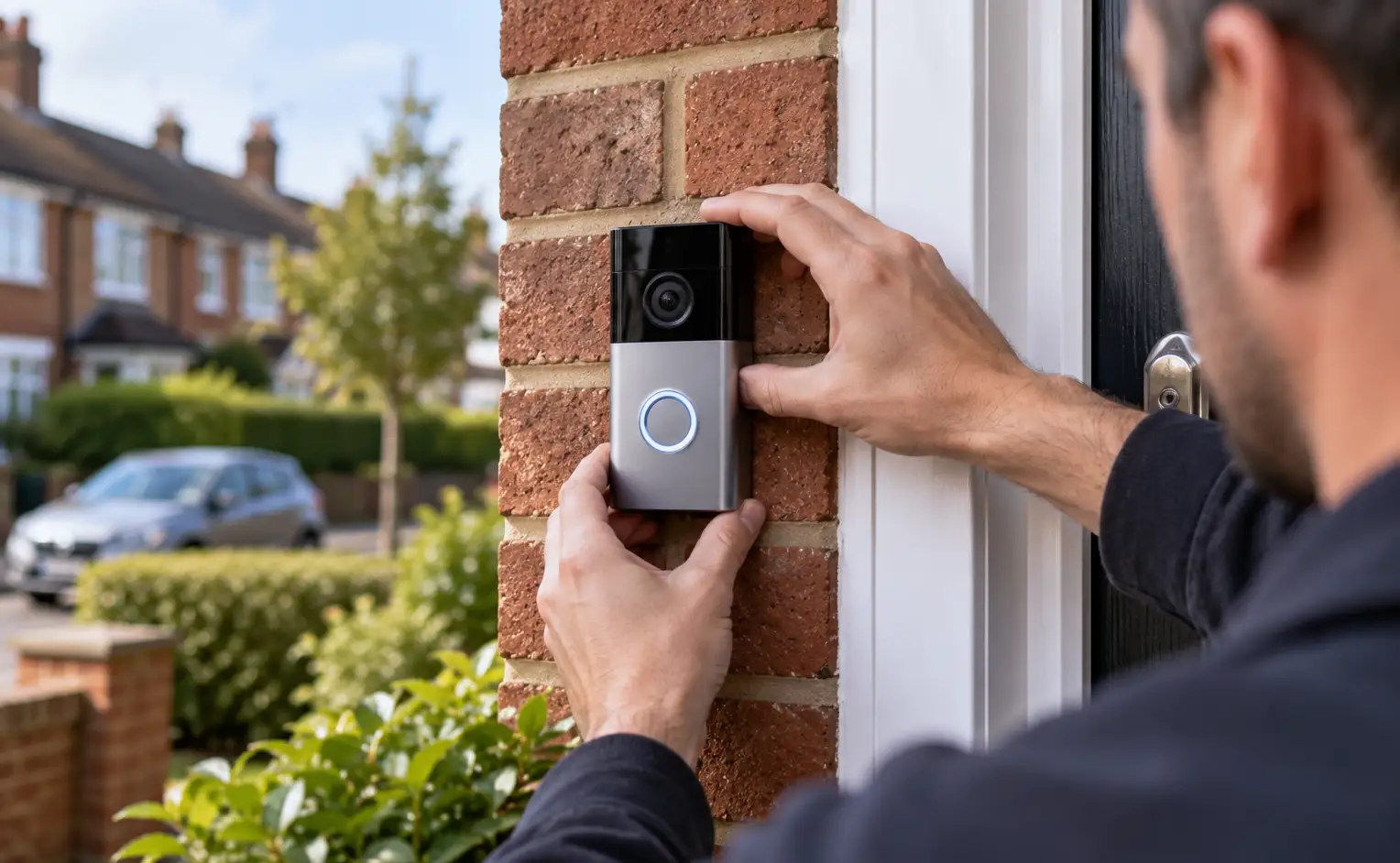
You’ve just fitted a camera above the front door, or a doorbell that shows you who’s outside before you answer. It felt like a straightforward decision at the time — a reasonable, ordinary step to feel safer in your own home. It’s only afterwards that the questions start: is this actually pointing where I think it’s pointing, and am I supposed to be doing anything differently because of it?
The answer is less complicated than the language of data protection law sometimes makes it sound, but there are a few things worth getting right. A video doorbell that catches a small section of pavement as somebody approaches your front door is one thing. A camera that records most of your neighbour’s garden, keeps the footage indefinitely and lets you share it with whoever you like is another.
The equipment might be identical. What changes the legal position is what you’re recording, why you’re recording it and what happens to the images and sound afterwards.
This is the camera owner’s side of the question, and it deserves a different answer from the one we’d give somebody concerned about being filmed by next door. If you’ve installed CCTV for ordinary home security, the objective isn’t to make the process unnecessarily bureaucratic. It’s to protect your property without accidentally collecting more information about other people’s lives than you need.
Most of the decisions that matter are made when you position the camera and configure its settings. The problems tend to emerge later, when an unnecessarily wide view becomes a neighbourly dispute, an old recording is shared publicly or somebody asks for footage that the owner has never considered how to provide.
The boundary that changes the rules
If your camera records only within the boundaries of your own private domestic property, and you’re using it purely for personal or household purposes, the domestic purposes exemption will generally keep that activity outside UK data protection law.
A camera watching your back garden, for instance, doesn’t ordinarily require formal data protection arrangements simply because it records your family using the space. There is no general requirement to register an ordinary domestic system with the Information Commissioner’s Office, put up CCTV signs around a private garden or produce a formal privacy notice for footage that remains within the household exemption.
The position changes when your system captures identifiable people beyond your private property. A video doorbell may show pedestrians walking past, a camera protecting your driveway might include part of next door’s garden, or equipment outside a flat could record people using a communal hallway.
In those circumstances, UK data protection law can apply to the recording, and the person operating the system may become what the law calls a data controller.
The Information Commissioner’s Office guidance on home CCTV explains the distinction. Importantly, bringing data protection law into the picture doesn’t mean your camera has suddenly become unlawful.
That would be a rather impractical rule on many British streets. A terraced-house video doorbell may have no realistic way of recording somebody approaching the front entrance without also showing a little pavement. The law recognises that protecting your home can provide a legitimate reason for recording a limited amount of space beyond the boundary, provided the intrusion is proportionate.
The difficulty comes when the camera captures considerably more than its security purpose requires.
Imagine a homeowner installing CCTV above the garage to protect a parked car. The view includes the vehicle and the driveway entrance, but also shows the neighbour’s kitchen window. The camera might be doing its intended job perfectly well, yet that extra piece of the image contributes very little to protecting the car.
A small adjustment could remove the window without making the camera any less useful. If the owner leaves the system recording it simply because the wide-angle lens happens to include it, the justification becomes harder to explain.
A related misconception is that the legal position depends entirely on whether the system saves a recording. Viewing identifiable people through a live camera feed can also involve processing their personal information. Continuous recording, motion-triggered clips and live viewing may operate differently, but none should automatically be assumed to fall outside data protection law simply because the images aren’t permanently stored.
There is also a difference between a camera installed at a home and one used for genuinely domestic purposes. Equipment operating substantially for business surveillance, for example, shouldn’t automatically be treated as ordinary household CCTV merely because it’s mounted on a residential building.
For most homeowners, though, the practical distinction is simple enough. Within your private domestic boundary, the rules are generally straightforward. Beyond it, you need to be able to explain why the recording is necessary and take reasonable care over how the information is handled.
What your camera sees matters more than what it’s capable of seeing
One of the easiest mistakes is allowing the equipment to decide the coverage.
A manufacturer advertises a wide-angle lens, motion tracking and night vision. You install the camera in a convenient position, open the app and find that it shows an impressive amount of the surrounding area. It feels like better security, because more of the street or garden is visible.
But a wider view isn’t automatically a more appropriate one.
A camera intended to protect the front door usually needs to show the entrance and the approach to it. One protecting a side gate may need a relatively narrow view of that part of the property. Monitoring the car on your driveway doesn’t necessarily require recording what happens on the opposite side of the road.
The Government’s guidance on responsible domestic CCTV use encourages homeowners to minimise intrusion and avoid capturing more information than necessary. That is a useful principle when choosing the camera’s position, but it matters just as much after the equipment is installed.
The recorded image can be surprisingly different from what the camera appears to cover when you’re standing beneath it. A lens that seems to face your own driveway might show much more of the neighbouring property than expected, while another might look intrusive from outside but have a relatively narrow functional view.
Open the app and examine what is actually captured, including the edges of the frame. Check a saved clip as well as the live image, because recording settings don’t always behave in the way their names suggest.
This is where privacy masking can be particularly useful.
Suppose your camera needs to watch the side entrance, but a corner of the image includes your neighbour’s patio. Many systems allow that area to be permanently obscured or excluded through a privacy mask, leaving the security coverage you need while removing an unnecessary view of somebody else’s private space.
Motion zones are not necessarily the same thing. A motion-detection zone generally determines which areas trigger alerts or recording. Narrowing it may stop passing pedestrians from repeatedly activating your doorbell, but the resulting video might still contain the entire original image once another movement triggers the camera.
That’s a distinction worth checking rather than assuming the two settings are interchangeable. If the intention is to avoid recording a neighbour’s window, reducing the alerts generated by activity there may not solve the problem.
Some cameras also track movement automatically, panning or zooming to follow whatever activates them. That can be useful within your own boundary, but a system that follows someone walking around next door’s garden may capture substantially more personal information than an ordinary fixed view.
It doesn’t mean every motion-tracking installation is deliberately intrusive. The setting may simply have been enabled by default. Nevertheless, the owner is responsible for considering what the equipment actually does, not merely what they originally intended it to do.
The microphone deserves the same attention as the lens, perhaps more.
Many video doorbells and security cameras can record sound automatically. Being able to speak to a visitor standing at your front door may be useful, but the microphone might also capture conversations taking place on the pavement or in a neighbouring garden.
A camera recording a person walking past is quite different from one collecting what they’re saying to somebody else. Audio can be considerably more intrusive than the corresponding images, especially where conversations have nothing to do with the owner’s security.
Before leaving the microphone enabled, consider what purpose it serves. If audio is useful only when somebody presses the doorbell, there may be no good reason for broader sound recording. If video alone adequately protects the area you’re concerned about, disabling unnecessary audio may avoid a problem that has nothing to do with the camera’s physical position.
The important thing is not to use every capability simply because you’ve paid for it. A security system should be configured around what you’re trying to protect, rather than treating the full extent of its technical reach as something you’re automatically entitled to record.
The responsibilities don’t end when the camera is installed
Once your system captures identifiable people outside your private boundary, the way you handle the footage becomes part of the legal picture.
You won’t ordinarily need written consent from every neighbour, visitor or delivery driver. A homeowner may rely on legitimate interests, such as protecting their family, vehicles or property from crime, as the lawful basis for proportionate recording.
But a genuine security concern doesn’t settle everything. The recording still needs to be appropriate to that purpose, and the interests of the people being captured must be considered.
Transparency is one of the simpler responsibilities. Where data protection law applies, the ICO expects people to know that CCTV is operating, for example through suitable signage. An ordinary house doesn’t need to look like a commercial surveillance site, but a clear notice can help visitors and others understand that they may be recorded.
Letting immediate neighbours know about a new installation can also be sensible, particularly where a shared access or part of another property is unavoidably included. You don’t necessarily need their permission, but being willing to explain what the system records may prevent suspicion developing around a camera that was installed for entirely innocent reasons.
Footage retention is where apparently harmless settings can become a problem.
There is no universal legal rule requiring home CCTV to keep recordings for exactly thirty days, or any other fixed period. Some cloud services retain clips automatically for a period chosen by the manufacturer or subscription provider, but that setting isn’t necessarily the one that best suits your circumstances.
The relevant question is how long the recordings are genuinely needed for the purpose for which they were collected.
A homeowner may reasonably want footage to remain available long enough to discover and respond to a security incident. That doesn’t automatically justify keeping every routine recording of passers-by and neighbouring properties indefinitely.
Automatic deletion can make this much easier. Once you’ve chosen an appropriate retention period, the system can remove ordinary clips without requiring you to review them individually. If a particular recording shows a suspected burglary or another incident, there may be a legitimate reason to preserve that clip separately.
The complication is that footage often escapes the camera’s normal storage arrangements.
A clip downloaded to a phone, sent to another household member or saved in a cloud folder may remain there long after the original recording has been deleted. Over time, a homeowner can accumulate a surprisingly large collection of videos that no longer serve any useful security purpose.
You don’t need an elaborate information-management system to avoid that. You do need to know where your recordings are stored, who can access them and whether copies you no longer need are being retained unnecessarily.
Account security matters for the same reason. A camera that avoids overlooking the neighbour’s windows can still create a privacy problem if the recordings are accessible through an inadequately protected account.
Using a strong, unique password, enabling multi-factor authentication where available and keeping the camera software updated are ordinary security precautions, but they have an additional purpose here: protecting personal information about other people as well as your own household.
Shared access deserves a little thought too. You may want another family member to view the doorbell, but there is little reason for old devices, former household members or accounts that nobody uses to retain access indefinitely. Exported recordings should be protected as carefully as the footage held in the camera’s normal storage.
These precautions aren’t especially burdensome, and most can be dealt with in the system’s settings. The objective is simply to prevent a camera installed for security from becoming another way in which private information is unnecessarily exposed.
The footage you share can cause more trouble than the footage you record
This is probably the easiest way to turn a perfectly reasonable home-security installation into a dispute that could have been avoided.
Imagine your video doorbell records somebody taking a parcel from your doorstep. The recording is clear, and you’re understandably angry. You’ve installed the camera precisely because you wanted evidence if something like this happened.
Preserving the footage and providing it to the police in connection with a suspected crime can be entirely appropriate. Posting an identifiable clip to a public Facebook group with an accusation about the person shown is a different decision.
The original purpose was to protect your property and obtain evidence of an incident. Publicly distributing the recording introduces a new audience and potentially a new use of the person’s personal information. It can also invite mistaken identification, hostile comments and further circulation of footage that may never be fully under your control again.
Even where your frustration is justified, owning the camera doesn’t automatically entitle you to publish whatever it records.
The Government’s domestic CCTV guidance warns against using recordings for purposes unrelated to the security reason for which the system was installed, including inappropriate sharing on social media.
That doesn’t mean footage can never be shared lawfully. Providing relevant evidence to the police is different from circulating it widely for public judgement, and the purpose and circumstances of any disclosure matter.
The same issue arises when CCTV captures a disagreement with a neighbour.
You might record somebody parking across your entrance, arguing at your front door or behaving in a way you consider unreasonable. Keeping the relevant evidence may be sensible, particularly if the incident is part of a continuing dispute. Uploading the clip to a neighbourhood group to demonstrate that you’re in the right can create an entirely new argument about privacy and the use of personal information.
A recording that began as evidence of an irritating encounter can quickly become content that people copy, comment on and share without knowing the wider circumstances.
Before distributing identifiable footage, it’s worth asking what you’re trying to achieve and whether the recipient genuinely needs to see it. Reporting a suspected offence through the appropriate channels is one thing. Inviting strangers to identify or condemn somebody is another.
For ordinary homeowners, that distinction is considerably more useful than trying to memorise every possible rule about sharing. The fact that footage was lawfully recorded for security doesn’t mean every subsequent use of it will be justified.
When somebody asks what you’ve recorded
Most homeowners won’t receive many formal requests about their CCTV. But if your system captures identifiable people beyond your property boundary, you should know what to do if someone asks to see footage, objects to being recorded or wants a recording deleted.
The worst response is often the simplest one: insisting that because the camera is attached to your own house, nobody else has any rights concerning the footage.
Where data protection law applies, the people recorded may have rights over their personal information.
A subject access request can entitle someone to receive personal information about themselves contained in your recordings, subject to the applicable legal conditions. The normal response period is one calendar month, although particular circumstances can allow for extensions or other qualifications.
That doesn’t necessarily mean handing over every unedited recording from a particular day. Other people may appear in the footage, and their privacy must also be considered. Depending on the circumstances, providing relevant information may involve identifying appropriate clips and taking reasonable steps to protect other people’s personal information.
There is also a right to request erasure in applicable circumstances. Someone might ask you to delete unnecessary footage of their garden, for example, while you may have a legitimate reason to preserve a particular recording that contains evidence of an incident. The legal right isn’t absolute, and neither is your freedom to retain everything simply because it came from your camera.
Objections to being recorded require a similar distinction.
Suppose your neighbour writes to say that the camera over your side entrance captures their patio every time they use it. They ask you to stop recording that area because it has little obvious connection with protecting your property.
That doesn’t automatically mean you must remove the camera. But if you’re relying on legitimate interests to process their personal information, you need to consider the objection and whether there are sufficient grounds to continue that recording.
Where a privacy mask would preserve your security coverage while excluding their patio, that may be an entirely reasonable solution. Refusing even to consider it, simply because the camera belongs to you, is a less convincing position.
A doorbell that incidentally captures a limited section of public pavement presents a different case. The security purpose may remain proportionate despite an objection, provided the operator has properly considered the circumstances and can justify the recording.
Most disagreements are unlikely to require detailed correspondence if the camera owner is prepared to explain the system and make sensible adjustments. But where a formal request is made, don’t ignore it or assume that ordinary domestic security equipment is automatically exempt from every data protection obligation.
The ICO’s guidance provides the relevant starting point if you’re unsure how to respond. Where the request is complicated or a neighbour dispute has become serious, obtaining appropriate advice may be preferable to making assumptions about what the law requires.
The same principle applies whether somebody is asking for a copy of footage, objecting to an unnecessarily intrusive view or requesting deletion. Understand what they’re actually asking for, consider the legal position and respond rather than treating the request as an attack on your right to protect your home.
A camera that was appropriate when installed might not stay that way
There is one final problem with the idea that home CCTV is something you install once and then forget about.
The surroundings change, and so do the circumstances that originally justified the camera.
A system installed after a spate of thefts may have been configured to record a relatively wide area. Several years later, the homeowner may no longer need the same coverage. A new fence, growing vegetation or changes to a neighbouring property can also alter what the camera captures, particularly if the device has been repositioned.
Replacing an older camera with a newer wide-angle model may make the difference even more noticeable. The equipment looks much the same from outside, but the image includes areas that weren’t visible before.
Occasionally reopening the live view, checking the saved footage and reviewing the recording settings is therefore worthwhile. The exercise needn’t take long, and it may reveal that a privacy mask has been removed, the microphone is enabled when it isn’t needed or the cloud-storage period has changed.
Properties with shared areas need particular care. A camera outside a flat may necessarily capture part of a communal hallway, while one overlooking a shared driveway could record movements associated with several households. Limited surveillance may still be justified by a genuine security concern, but shared space isn’t the same as an area exclusively within your own domestic boundary.
There may also be property restrictions separate from data protection law. A leaseholder or tenant might need permission to attach equipment to an external wall or install CCTV covering communal parts of a building. Complying with privacy rules doesn’t automatically give someone authority to alter parts of a property they don’t own.
Business or professional uses raise different considerations again. A camera installed at a residential address doesn’t necessarily qualify as purely domestic surveillance if its actual purpose is to monitor business activities, workers or other people in a non-household context.
These are useful boundaries to recognise, but they shouldn’t distract from the much simpler position facing most homeowners.
Home CCTV is an ordinary and often sensible security measure. Problems arise when the system records more of other people’s lives than the security purpose reasonably requires, or when the footage is retained, accessed and shared as though it has no privacy implications once captured.
The answer is rarely to stop using cameras altogether. It’s to make deliberate decisions about the areas you record, the settings you enable and what you do with the information afterwards.
A doorbell showing who’s approaching your entrance is one thing. A camera unnecessarily monitoring next door’s windows, keeping years of footage or turning neighbourly arguments into public videos is quite another.
The fact that both devices are sold as home-security equipment doesn’t make their use equally reasonable.
You bought the camera to protect your home. The sensible approach is to make sure it does exactly that — without recording more of everybody else’s than it needs to.
This article provides general property and data protection information and does not constitute legal, cybersecurity or other professional advice. The responsibilities associated with domestic CCTV depend on what the system captures, its purpose, whether the domestic purposes exemption applies and how recordings are handled. Data protection rights are subject to legal conditions and exceptions, and additional requirements may apply to business, landlord, workplace or other non-domestic surveillance. Refer to current official guidance and seek appropriate professional advice where necessary.

