

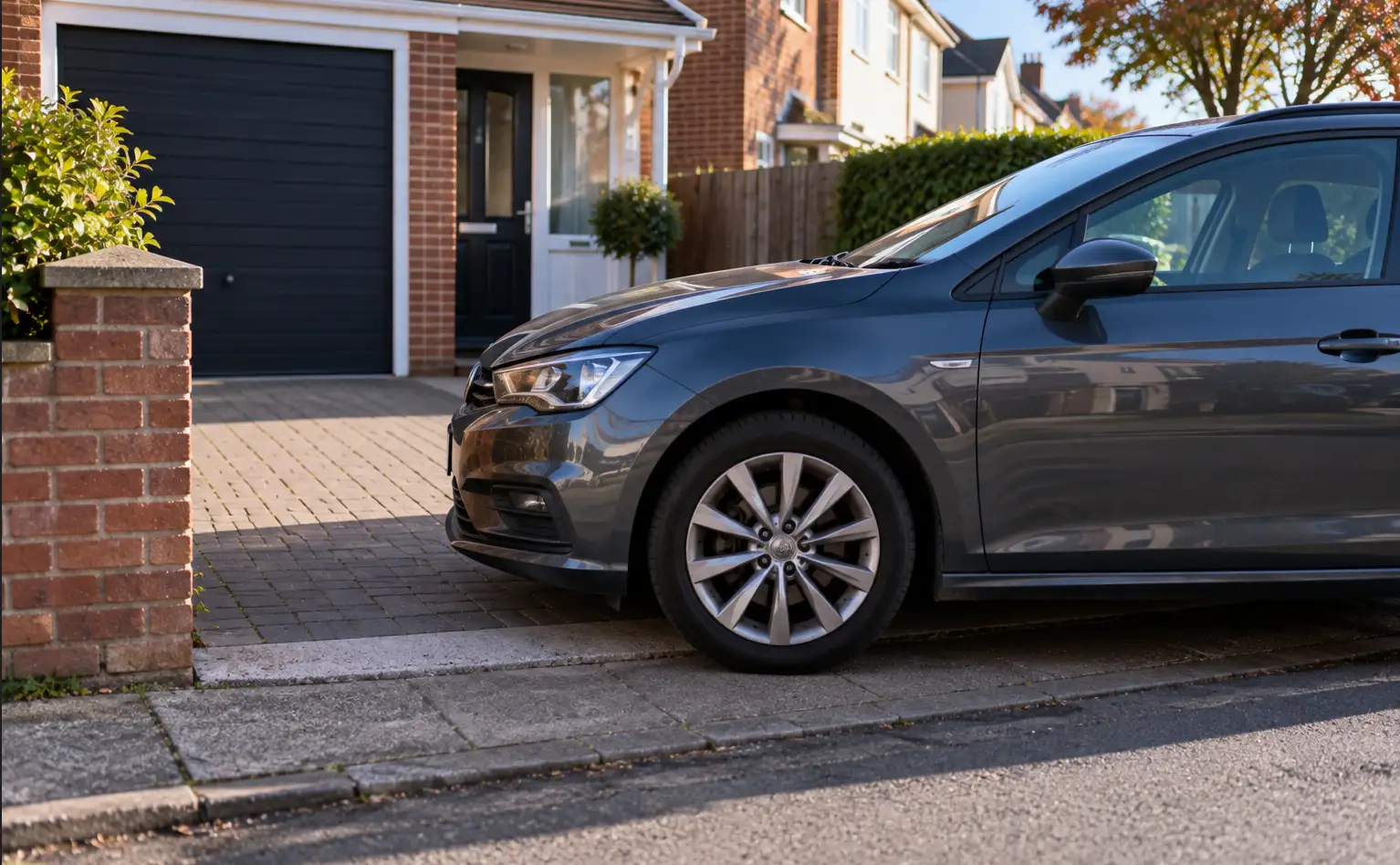
There’s a specific kind of frustration reserved for standing at your own front door, keys in hand, looking at a car that isn’t yours parked squarely across the one way in or out of your own driveway. Unlike the general “can they park outside my house” question, this one has a much clearer legal answer — because a dropped kerb, unlike an ordinary stretch of road, can have specific statutory protection.
The complication is that a parking offence and getting the car moved are two different things. The council might be able to issue a penalty charge notice, but that doesn’t necessarily free your driveway. And if you’re in Scotland or Northern Ireland, the rules aren’t simply the England-and-Wales provisions under another name.
Understanding those distinctions is what determines who you should contact, what evidence you’ll need and what you can realistically expect to happen.
The core distinction: dropped kerb versus ordinary road
A dropped kerb — the lowered section of pavement that allows a vehicle to cross from the road onto a driveway — exists specifically to provide access. In England and Wales, Section 86 of the Traffic Management Act 2004 prohibits parking alongside certain dropped or raised footways in a special enforcement area, subject to statutory exceptions.
The protection isn’t restricted to driveways. The legislation covers footways, cycle tracks and verges lowered to allow vehicles to enter or leave the carriageway, as well as crossings designed to help pedestrians and cyclists. The relevant parking prohibition doesn’t depend on yellow lines or special signs being painted outside the property.
That makes it quite different from somebody parking legally along the ordinary kerb outside your house. On an unrestricted public road, the fact that you own the adjoining property doesn’t ordinarily give you a right to reserve that space. But where a vehicle is parked across a qualifying dropped crossover, there can be a specific parking contravention even if the driver hasn’t breached any ordinary waiting restriction.
The precise position of the vehicle matters. A typical crossover has a fully lowered section across the entrance and sloping transition sections at either end. Councils commonly assess whether any part of a parked vehicle is alongside the fully lowered section rather than simply extending towards one of the angled sections.
That’s why the difference between a bumper overhanging the flat dropped section and a vehicle merely parked close to the beginning of a taper can matter. You don’t necessarily need the entire driveway to be blocked before a contravention can occur, but neither should you assume that any car positioned close to the entrance can automatically be ticketed.
The Highway Code’s rules on waiting and parking also advise drivers not to park in front of an entrance to a property and not to leave a vehicle causing unnecessary obstruction.
There are limits to the dropped-kerb prohibition, however. Section 86 operates within the applicable enforcement framework, and it contains exceptions. These include vehicles parked within specifically authorised parking places, certain emergency uses, qualifying loading or unloading, specified works and brief stops for passengers to board or alight.
The loading exception is narrower than a general right to stop across somebody’s drive while making deliveries. The statutory conditions require the activity to be necessary at that location and the vehicle to remain only as long as required, up to a maximum of 20 minutes.
For somebody finding a neighbour’s car across their driveway every evening, these exceptions won’t usually explain ordinary long-term parking. But they are important because the law doesn’t say that every vehicle beside every dropped kerb is automatically committing an offence.
Who deals with it: usually the council, not the police
This is where a lot of confused advice circulates online.
In many parts of England and Wales, parking across a qualifying dropped kerb is dealt with through civil parking enforcement. The local council or relevant enforcement authority may be able to issue a Penalty Charge Notice where the statutory prohibition applies and none of the exceptions is available.
But you should not assume every council operates the same reporting or enforcement procedure.
Some local authorities require a complaint from the occupier of the affected property. Others may ask the resident to confirm that they haven’t given the driver permission to park there, register the crossover with the parking service or be available when a civil enforcement officer attends. In areas where the relevant civil enforcement powers aren’t in operation, the police may remain the appropriate authority for an obstruction.
The most useful starting point is therefore your council’s website, specifically its procedure for reporting a blocked driveway or dropped-kerb parking.
There’s also a distinction that becomes particularly important when you’re the one trapped.
If you arrive home and cannot drive onto an empty driveway, the problem will generally be treated as a dropped-kerb parking complaint where the council has the relevant civil enforcement powers. Contacting the parking enforcement team is usually more productive than asking the police to move a car simply because it prevents you entering your property.
If your car is already on the driveway and another vehicle prevents you driving out, the situation can also raise an actual highway obstruction issue. The police may be able to assist, depending on the circumstances and the local force’s procedures.
The Metropolitan Police’s parking guidance makes this practical distinction clear: a vehicle preventing access onto a driveway is ordinarily directed towards the council, while one preventing a vehicle leaving the property may justify police involvement.
That doesn’t guarantee an immediate police attendance or removal. Police forces and councils apply their own operational policies, and the availability of an officer or vehicle-removal powers can affect the response.
For a genuine non-emergency obstruction that has trapped your car, contact the appropriate local service and explain specifically that you cannot drive off your property. Where police assistance is appropriate, use 101 or the force’s online reporting arrangements. If there’s an immediate danger to life or a serious emergency, use 999.
If you can safely identify the driver, a polite request to move the car may resolve matters considerably faster than waiting for enforcement. But you aren’t obliged to confront somebody where there’s already hostility or a risk of intimidation.
And there’s a frustrating practical reality worth understanding: a penalty charge notice doesn’t necessarily remove the obstruction.
A civil enforcement officer may attend, establish a contravention and issue a ticket while the vehicle remains exactly where it was. Some authorities have vehicle-removal powers, but a parking ticket isn’t a promise that a tow truck will follow.
If you’re trapped, make that clear when reporting the problem. The immediate need to restore access is different from asking for a parking offence to be penalised after the fact.
An important complication: is your dropped kerb actually authorised?
This catches homeowners out, particularly where a front garden has been converted into parking without the appropriate highway arrangements being made.
A properly constructed vehicle crossover normally requires permission from the relevant highway authority. The national GOV.UK guidance on applying for a dropped kerb explains the process, with applications determined locally.
Some properties have driveways that look perfectly usable from the road but don’t have an authorised vehicle crossing. Others sit beside lowered kerbs installed for pedestrians, wheelchair users, pushchairs or cyclists rather than to provide access for cars.
Those distinctions need care.
A pedestrian dropped kerb is protected in its own right under Section 86 where the statutory conditions apply. It isn’t somehow less important than a private driveway crossing. Indeed, obstructing a pedestrian crossing point can create accessibility problems affecting people who have no alternative way to cross the street safely.
But the presence of a pedestrian dropped kerb outside your property doesn’t automatically entitle you to drive across the pavement and treat it as your private vehicle entrance.
If you believe the crossover serving your driveway was never authorised, or you’re unsure whether it was constructed for vehicle access, ask the highway authority to confirm its status.
That is a different question from whether a vehicle is unlawfully parked across a protected pedestrian crossing, and the two shouldn’t be confused.
An unauthorised driveway doesn’t automatically make all dropped-kerb parking lawful, but it can complicate a complaint specifically based on your claimed right to drive across the footway into the property.
It’s also worth checking the road itself. A privately managed road or parking court may operate under different property rights or parking arrangements. And an unadopted road isn’t necessarily free from public highway rights merely because it isn’t maintained at public expense.
If the legal status of the access is uncertain, getting that established is more useful than repeatedly making complaints which the authority may be unable to enforce in the way you expect.
What the council will actually need from you
Most dropped-kerb complaints are relatively straightforward once the right enforcement team is involved, but evidence makes a difference.
If a vehicle is blocking your driveway and you can safely take photographs before it moves, capture the registration number, the full vehicle, the entrance to your driveway and enough of the kerb to show exactly where the car is positioned.
Don’t photograph only the number plate or the back of the vehicle. The important evidence is the relationship between the car and the lowered section of pavement. Include enough of the surrounding road to establish the location clearly.
Record the date and time, and explain whether you were unable to drive onto the property, unable to leave it or simply found access more difficult.
Councils may ask for the registration number, vehicle description and precise address. For residential driveways, they may also require confirmation from the occupier that permission to park across the entrance wasn’t given.
That’s because Section 86 contains an important residential-consent exception, discussed below. A vehicle parked across a private residential crossover with the occupier’s consent can be in a different legal position from one left there without permission.
Many councils use reactive enforcement for residential dropped kerbs rather than patrolling every driveway. That means the driver may have left before an officer arrives. If the same person repeatedly blocks the entrance, maintain a simple log of incidents and provide the previous reference numbers when reporting further occurrences.
Repeated incidents may help establish the pattern and allow the council to consider whether a different patrol approach or another measure would be appropriate, although it cannot guarantee an officer will attend every time.
There’s also a practical deterrent worth asking about if the problem is persistent: an access protection marking, often called a white H-bar.
This is the elongated white marking sometimes painted on the road across a driveway entrance. Its purpose is to make the access more obvious and discourage parking across it.
H-bars are generally advisory rather than separately enforceable. The marking doesn’t create a new parking offence merely because somebody parks across it. Equally, you don’t necessarily need one for the underlying dropped-kerb restriction to apply.
Cheshire East Council’s guidance on H-bar markings explains their advisory status and the circumstances in which the council may install them.
Some authorities charge for these markings, and eligibility varies. They can be useful as a visual reminder, particularly where an access isn’t obvious to unfamiliar drivers, but they’re no substitute for proper enforcement when somebody persistently disregards a legally protected crossover.
What not to do
When a vehicle is preventing you using your own driveway, it’s tempting to take matters into your own hands. That’s usually where a relatively straightforward parking issue risks becoming a much more complicated legal dispute.
Don’t attempt to move the vehicle yourself. The fact that somebody has parked unlawfully doesn’t give you an unrestricted right to push, tow or otherwise interfere with their car. Damage caused while attempting to move it may expose you to liability, regardless of who was originally in the wrong.
Don’t clamp the vehicle. In England and Wales, Section 54 of the Protection of Freedoms Act 2012 generally prohibits immobilising a motor vehicle or restricting its movement without lawful authority in the circumstances covered by the provision. A homeowner doesn’t acquire lawful clamping powers merely because somebody has blocked the driveway.
Don’t block the driver in as retaliation. Parking another car across theirs or deliberately preventing them leaving may create a separate obstruction problem, escalate the dispute and complicate any genuine complaint you have.
Don’t arrange an improvised private tow. Removing a vehicle from the public highway is a matter for those with appropriate legal authority. A private recovery contractor isn’t automatically entitled to remove somebody else’s car simply because you request it.
And if the obstruction appears deliberate, don’t allow the argument about the parking position to become a confrontation. Repeated deliberate blocking, particularly where accompanied by threats or intimidation, may be relevant to a wider neighbour dispute. Keep evidence of the whole pattern rather than responding in a way that could create a problem of your own.
The strongest position is usually the simplest: photograph the actual obstruction, report it through the appropriate channel and preserve the records if it continues.
Parking on your driveway itself, not just across the entrance
If somebody has parked entirely on your private driveway rather than across the entrance from the road, the legal position changes.
Unauthorised parking on private residential land is generally a matter of trespass, not an ordinary dropped-kerb parking contravention. The council’s civil parking powers usually won’t provide a straightforward way of dealing with a vehicle sitting wholly on your private property.
That can produce a particularly frustrating situation. Somebody has parked somewhere they have no permission to be, yet the homeowner still cannot simply clamp the car, arrange a tow or assume the police will treat the incident as a criminal parking offence.
Police guidance generally describes unauthorised parking on an ordinary private residential driveway as a civil matter unless there are additional circumstances involving a potential crime or another relevant police power.
If you can safely identify the driver, asking them to move is the most practical first step. Where this happens repeatedly, photographs, dates and written records become useful evidence if legal advice about trespass or an injunction is eventually needed.
The position may be different on a larger private estate or managed parking area where an established private parking scheme operates. But that doesn’t mean an individual homeowner can immediately introduce clamping or removal simply because a stranger has parked on their driveway.
If the same person persistently occupies your land without permission, legal advice may be appropriate. The available remedies depend on the property rights, the conduct involved and the practical outcome you’re trying to secure.
Can I park across my own dropped kerb?
Often, yes — but there are important exceptions.
In England and Wales, Section 86 of the Traffic Management Act 2004 contains an exception where a vehicle is parked outside residential premises by, or with the consent of, the occupier.
That means an occupier can ordinarily park across their own residential vehicle crossover, or permit a visitor to do so, where the statutory exception applies.
The significant point is that the exception refers to the occupier, not simply whoever owns the property. A tenant occupying the home may therefore be relevant to the consent question even though the property belongs to a landlord.
However, the exception has two important limitations.
First, consent given for reward is expressly excluded. You can’t treat the unrestricted public road across your dropped kerb as a private parking space that can simply be rented out to other motorists.
Second, the exception doesn’t apply to a shared driveway. One household cannot rely on its own residential consent to override the separate rights of another property using the same access.
Nor does occupier consent automatically override some other parking restriction applying at the same location. A separate enforceable waiting restriction or another applicable legal prohibition still needs to be considered.
So the simple statement that you can always park across your own dropped kerb isn’t quite accurate. For an ordinary individual residential crossover, the consent exception is genuinely useful. But it doesn’t turn the public road into private land, and it shouldn’t be assumed to apply to every shared or otherwise restricted entrance.
Shared dropped kerbs and driveways
Where one lowered crossover serves two or more properties, the position becomes more complicated because the access isn’t there for the exclusive convenience of a single household.
Section 86 expressly excludes shared driveways from the ordinary residential-consent exception. Even agreement between neighbours shouldn’t simply be assumed to create a statutory exemption that the legislation excludes.
There may also be separate property rights involved.
One household might own the driveway while another has a legal right of way over it. Several properties might share ownership or responsibility for a private access. A driveway might connect to a public-road crossover that serves more than one home, or the disputed vehicle might actually be parked on private shared land rather than the highway.
Those situations cannot all be resolved by looking at the dropped kerb alone.
If somebody is obstructing the part of the access on the public highway, ask the parking authority how it deals with shared residential crossovers. If the obstruction is on private shared land, the relevant title documents, easements and rights of access may become more important than the civil parking rules.
Councils may also have particular evidence or reporting requirements for shared driveways. Some will need enough information to establish which properties are affected and whether the vehicle is genuinely obstructing access.
The practical point is that a shared driveway is not simply an ordinary private crossover with two homeowners using it. The statutory parking exception is different, and private access rights can create another layer of legal obligations.
Property Front Page’s separate guidance on shared driveways covers how ownership and rights of access can be established where the dispute concerns the underlying property arrangements rather than a vehicle parked on the public road.
The rules are different in Scotland and Northern Ireland
This is one of the most important reasons not to rely on generic advice claiming that parking across a dropped kerb is treated identically throughout the UK.
Scotland introduced national prohibitions on pavement parking, double parking and parking at certain dropped footways under the Transport (Scotland) Act 2019, with enforcement beginning in December 2023.
But its national dropped-footway prohibition is focused on pedestrian and cyclist crossing points, rather than ordinary driveway entrances.
Transport Scotland’s explanation of the parking prohibitions sets out the framework, while Section 57 of the 2019 Act expressly excludes dropped footways provided for access to a driveway or garage from that particular national prohibition.
That is a significant difference from Section 86 in England and Wales.
It doesn’t mean a motorist in Scotland has an unrestricted right to block somebody’s driveway. A vehicle may still be causing unlawful obstruction or breaching another local parking restriction, and police or local-authority powers may be relevant depending on the circumstances.
But a Scottish homeowner shouldn’t assume the council can issue the same dropped-kerb penalty charge notice that might be available for a residential crossover in England or Wales.
Northern Ireland operates under another legal and enforcement framework.
The Department for Infrastructure is responsible for enforcing most decriminalised parking restrictions, while the Police Service of Northern Ireland retains responsibility for dangerous and obstructive parking.
Official nidirect guidance on parking enforcement makes that distinction clear. A vehicle obstructing access in Northern Ireland should therefore be assessed under the relevant local parking or obstruction provisions rather than Section 86 of the Traffic Management Act 2004.
For somebody blocked in or out of their driveway, the practical first step is to identify the appropriate authority for the particular obstruction. The right answer may differ not only between the four UK nations, but also according to the enforcement arrangements applying to the road itself.
That’s why the same photograph of a car across a lowered kerb can lead to a different legal assessment depending on where the property is situated.
A neighbour parked legally in the ordinary space outside your house is usually exercising the same opportunity to use the public road as anyone else. A vehicle parked across a qualifying dropped kerb is a different proposition.
But even here, the useful answer isn’t simply that nobody can ever park across a driveway entrance.
In England and Wales, the statutory prohibition depends on the applicable enforcement framework and contains important exceptions. An individual residential occupier may be able to consent to parking across their own crossover, while the shared-driveway and payment restrictions change that position. Scotland has deliberately excluded driveway entrances from its newer national dropped-footway prohibition, and Northern Ireland operates its own system.
For the homeowner standing at the front door with a car blocking the way, the immediate priorities are more practical than theoretical: establish whether you’re blocked in or out, record the vehicle’s position, and contact the authority that can actually deal with the obstruction.
And remember that issuing a parking ticket and getting your driveway cleared aren’t necessarily the same outcome. If you cannot get your own car out, explain that specifically rather than simply reporting a vehicle across a dropped kerb.
Knowing the precise rule won’t make inconsiderate parking any less infuriating. But it can prevent you from wasting time with the wrong authority — or taking action yourself that creates a bigger problem than the original obstruction.
Important: This article provides general property and parking information, not legal or other professional advice for individual circumstances. Enforcement depends on the road’s status, the purpose and legal status of the dropped kerb, local authority powers, statutory exceptions, shared-access rights and the applicable UK jurisdiction. If access is repeatedly obstructed or the parking forms part of threatening or intimidating behaviour, preserve dated evidence and seek appropriate enforcement or legal advice. In an immediate emergency, contact the relevant emergency service.

