

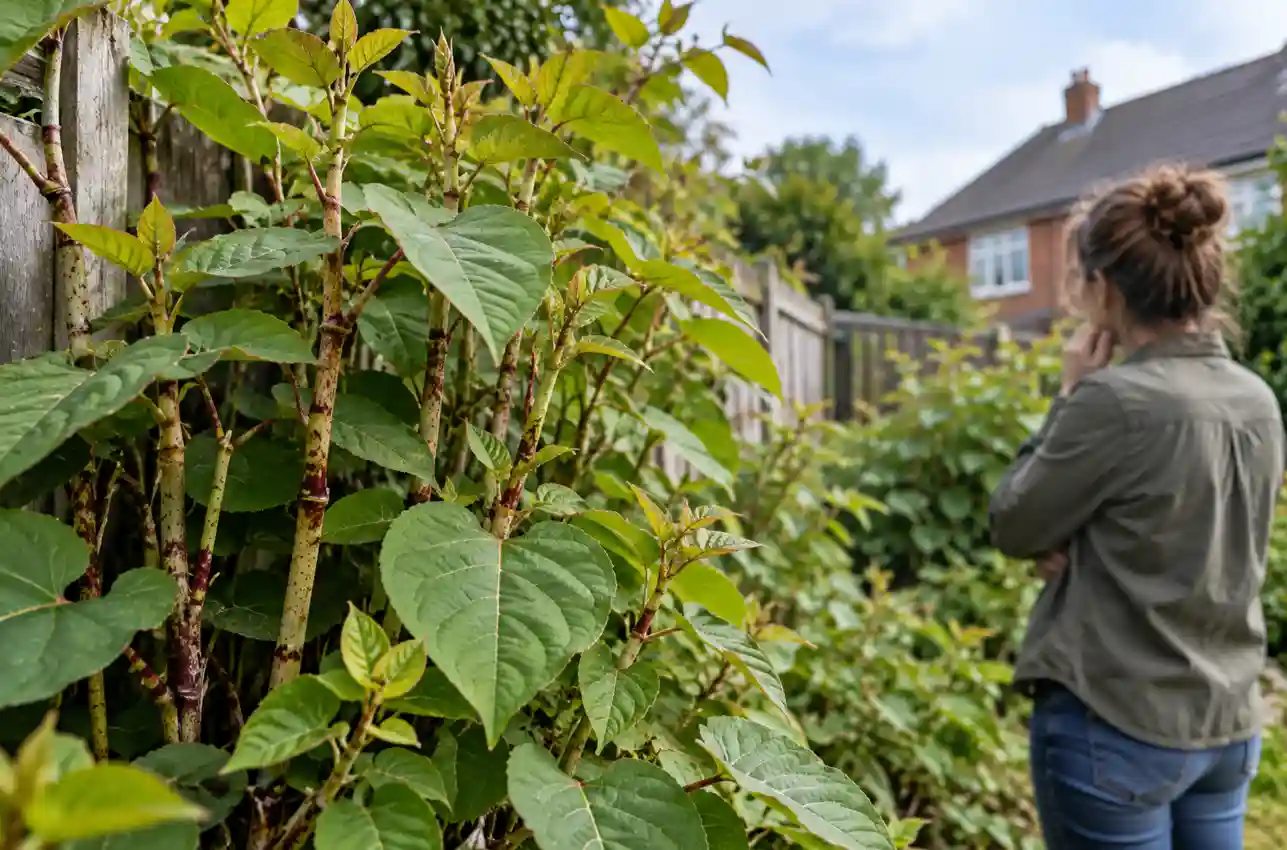
Japanese knotweed has acquired a reputation that often outpaces the evidence: foundation-cracking, mortgage-killing and almost impossible to live with once it appears. It is a genuine invasive plant and it needs proper management, but the more extreme claims about what it does to houses are outdated. Current RICS guidance says substantial structures on sound foundations are unlikely to suffer structural damage from Japanese knotweed, although established growth can still affect garden walls, lightweight structures, paths, drains and other hard landscaping.
So the first response should be neither panic nor a spade. If you suspect Japanese knotweed, avoid strimming, mowing, flailing, digging it up or moving soil around until you know what you are dealing with. Disturbing the plant can spread viable fragments and turn a relatively contained problem into a larger one.
This article focuses mainly on England and Wales. Scotland and Northern Ireland have separate invasive-species legislation and procedures, so their rules should not simply be assumed to match.
First: make sure it really is Japanese knotweed
Japanese knotweed changes considerably through the seasons, which is one reason it gets misidentified. Typical features include hollow bamboo-like stems, often marked with reddish-purple speckles, leaves growing alternately along distinctive zig-zagging stems and clusters of small creamy-white flowers later in the growing season. The visible stems die back during winter while the underground rhizome system remains alive.
Several harmless garden plants can look surprisingly similar, so if you are uncertain, photograph the plant and obtain a reliable identification before treating or disturbing it. This matters particularly if you are selling, buying, planning building work or considering a claim against a neighbour, because a suspicion should not automatically lead to expensive excavation or a legal dispute.
For England, the current GOV.UK Japanese knotweed guidance covers identification, treatment and disposal. Homeowners in Wales can use the separate Welsh Government Japanese knotweed guidance.
Having Japanese knotweed in your garden is not itself illegal
This distinction is easily lost. In England and Wales, simply having Japanese knotweed growing on your land is not itself a criminal offence, and there is no general requirement to eradicate it merely because it exists.
The important restriction comes from section 14 of the Wildlife and Countryside Act 1981, which makes it an offence to plant Japanese knotweed or otherwise cause it to grow in the wild. That is why careless handling matters: strimming, flailing, digging or moving contaminated material can spread viable fragments, and current government guidance says landowners must prevent knotweed on their property from spreading off their land and can be prosecuted for causing it to spread into the wild.
There is an important distinction, however, between the criminal legislation and knotweed spreading directly into a neighbour’s private garden. An ordinary boundary dispute is not automatically a Wildlife and Countryside Act prosecution simply because rhizomes have crossed beneath a fence. Private nuisance and the behaviour of the adjoining landowner can become much more relevant.
If the knotweed is next door — or has already crossed the boundary
If the plant is still confined to neighbouring land, do not begin by threatening court proceedings. First establish whether it really is Japanese knotweed and roughly where it is growing. If it appears close enough to the boundary to create a realistic risk of spread, tell the neighbour in writing, keep the message factual and ask whether they have had the plant identified and whether they intend to manage it.
That gives them an opportunity to deal with the problem and creates a dated record that they were made aware of it if the infestation later reaches your land. In any later dispute, what the neighbouring owner knew, when they knew it and what they then did may matter considerably more than who first became irritated by the plant.
Councils also have some potential powers in England and Wales under the Anti-social Behaviour, Crime and Policing Act 2014. Community Protection Notices are not knotweed-specific, but they can potentially be used where unreasonable, persistent or continuing conduct — including failure to control an invasive plant in appropriate circumstances — has a detrimental effect on the quality of life of people in the locality. This is not an automatic council enforcement route whenever knotweed appears over a fence, and identification, communication and evidence remain the more sensible starting point in most residential cases.
If the knotweed has already crossed onto your land, the legal position becomes more significant, but compensation still does not follow automatically. Two cases help explain why.
In Network Rail Infrastructure Ltd v Williams and Waistell [2018] EWCA Civ 1514, Japanese knotweed was growing on Network Rail land beside two homes in South Wales and rhizomes had spread onto the neighbouring properties. The Court of Appeal rejected the idea that the mere presence of knotweed on adjoining land created an actionable nuisance simply because its proximity might make a property less attractive to buyers. Actual encroachment and interference with the owners’ use and enjoyment of their land were materially different considerations.
That does not produce a simple rule that “knotweed crossed the boundary, therefore the neighbour pays”. The later Supreme Court decision in Davies v Bridgend County Borough Council [2024] UKSC 15 shows why timing, fault and causation still matter. Knotweed had encroached from council land before the period in which the council was subsequently found to have breached its duty by failing to implement a reasonable treatment programme. The Supreme Court rejected the claimant’s particular diminution-in-value claim because the loss relied upon had already arisen before that actionable breach and therefore had not been caused by it.
For a homeowner, the useful sequence is therefore encroachment, knowledge and fault, causation, then loss. It is not enough to say that knotweed came from next door and assume every resulting reduction in value must be recoverable.
If encroachment has happened, preserve evidence before making major changes to the site. Photograph visible growth and its position relative to the boundary, and if a specialist inspects it, ask them to record the apparent extent and any evidence concerning its likely origin. Do not start excavating along the boundary simply to prove that rhizomes are present. The sensible objective is to solve the plant problem while preserving enough evidence to resolve responsibility if that later becomes necessary.
Treatment and disposal: why digging first can make things worse
Japanese knotweed should not be handled like ordinary garden waste. Viable pieces of stem and rhizome can generate new growth, while soil containing plant material may itself need careful management. That is why putting suspected knotweed into the council garden-waste bin, adding it to an ordinary compost heap, moving contaminated soil to another part of the property or dumping it elsewhere can turn a localised infestation into a larger problem.
Current government guidance contains specific rules covering treatment, on-site handling, burial and off-site disposal. Where contaminated plant material or soil is taken away, waste controls can apply and an appropriately authorised waste route may be necessary. The correct approach depends on the material involved and what treatment is proposed.
For many domestic infestations, management means controlling the plant over several growing seasons rather than immediately excavating every rhizome. GOV.UK guidance says chemical treatment will usually need to be repeated and that Japanese knotweed generally takes at least three years to treat. Rhizomes can remain dormant underground for many years and may regrow if affected ground is later disturbed.
That does not mean every homeowner faces years of obvious knotweed in the garden. It means there is a difference between suppressing visible growth, achieving long-term control and physically removing contaminated ground. Excavation can sometimes be justified — particularly where building work needs access to affected soil — but it is not automatically the best response to an ordinary residential infestation, and removing even a relatively small visible stand can generate a much larger volume of soil requiring management.
For a property transaction, development project or significant neighbour dispute, a written specialist management plan is therefore far more useful than an informal assurance that somebody has “sprayed it”.
Japanese knotweed is less destructive to houses than its reputation suggests
This is one of the most important changes in professional understanding. The current RICS Japanese knotweed professional standard reflects research showing that the popular image of knotweed forcing its way destructively through sound house foundations is misleading.
Substantial structures on sound foundations are unlikely to suffer structural damage simply because Japanese knotweed is present nearby. The plant is more likely to exploit existing weaknesses and can create problems for lightweight structures, retaining and boundary walls, paths, patios, drains and other hard landscaping. A large infestation can also materially reduce use of the garden, while treatment can become disruptive and expensive where contaminated soil has to be disturbed.
None of that makes knotweed harmless. It does mean that finding it several metres from a house should not automatically be interpreted as an impending foundation failure.
The old seven-metre mortgage rule has gone
This is another area where outdated advice remains widespread. RICS’s previous assessment approach placed considerable emphasis on Japanese knotweed within seven metres of a residential property, which helped create the enduring idea that anything within that radius was automatically a major mortgage problem.
The 2022 RICS professional standard replaced that with an impact-based system. Surveyors and valuers now use four management categories:
- Category A — Action: Japanese knotweed is causing visible material damage to a significant structure.
- Category B — Action: there is no such material structural damage, but the knotweed is likely to prevent use of or restrict access to amenity space.
- Category C — Manage: knotweed is present on the property but is not causing material damage to significant structures or materially restricting amenity.
- Category D — Report: knotweed is visible on adjoining land within three metres of the property’s boundary.
The distinction has practical consequences. RICS says that for Categories A and B, most lenders are expected to require specialist inspection and recommended work under a Japanese Knotweed Management Plan, commonly with an insurance-backed guarantee. Category C is treated as lower impact, and RICS says remediation should not ordinarily be required as a condition of a mortgage advance solely because of that category. Category D records relevant adjoining growth and the potential for future spread while recognising that treatment of somebody else’s land is generally outside the borrower’s control.
Individual lenders can still apply their own criteria, so no article can promise that a particular lender will accept a particular property. But the professional framework is now substantially more proportionate than the old assumption that “knotweed within seven metres means no mortgage”.
Selling a property: do not guess on the TA6
For residential sales in England and Wales, the Law Society’s current TA6 property information form specifically addresses Japanese knotweed. The TA6 sixth-edition explanatory notes make an important point: a seller may not always be able to know confidently that the property is free from knotweed because rhizomes can remain below ground without visible growth.
That is why sellers should not answer the knotweed questions casually from memory or assumption. If knotweed has been identified, surveyed or treated, disclose the information accurately and provide any relevant inspection report or management-plan documentation. If you genuinely do not know, follow the current form and explanatory guidance rather than giving a definitive negative answer merely because nothing is visible on the day you complete it.
An inaccurate property-information response can create a more serious sale problem than an infestation that has been identified, documented and properly managed.
If you are buying a property with knotweed
A mention of Japanese knotweed in a survey does not automatically mean you should walk away. The more useful response is to establish where the infestation is, whether it is on the property or adjoining land, what RICS management category applies, whether there is evidence of encroachment, what treatment has already been carried out, whether a specialist management plan exists and what your proposed lender requires.
Price, garden size, future development plans and the extent and location of the infestation can all materially affect the decision. A property with a small identified infestation under competent management can be a very different proposition from one where substantial growth has been ignored for years and is spreading across neighbouring land.
This is one of the areas where the word “knotweed” is less useful than the actual facts.
Tenants and leaseholders should report it rather than start digging
If you rent the property, tell the landlord or managing agent in writing and avoid digging, spraying or disposing of the plant without agreement. Responsibility can depend on the tenancy and on who is responsible for the garden or other affected land, while treatment can have implications for the landlord’s property, future sale, insurance and neighbouring owners.
Leaseholders should likewise check the lease and how responsibility for the relevant land is divided. Knotweed growing in a private garden demised to one flat can raise different management questions from an infestation in communal landscaping maintained by a freeholder or management company.
The important point is not to assume that discovering the plant gives an occupier permission to undertake invasive ground works.
Scotland and Northern Ireland need separate treatment
The practical principles remain recognisable across the UK: identify the plant properly, avoid spreading it, preserve evidence where responsibility may be disputed and manage contaminated material carefully. The legislation and property-sale procedures, however, are not identical.
Scotland operates its own non-native-species regime, and the Scottish Government’s Non-native Species Code of Practice explains how the Scottish rules apply to non-native plants including Japanese knotweed.
Northern Ireland also has separate wildlife and invasive-species legislation. The Department of Agriculture, Environment and Rural Affairs explains that invasive plants listed under Northern Ireland’s wildlife legislation require particular care to prevent further spread; its guidance on species protected and controlled by law provides the official starting point.
Conveyancing documentation also differs from the Law Society TA6 system used in England and Wales. A homeowner in Glasgow or Belfast should therefore not take the England-and-Wales statutory references or sale procedure in this article and assume they apply word for word.
What to do now
If you have just discovered what may be Japanese knotweed, the most useful order is:
- Get the plant reliably identified.
- Do not mow, strim, flail, dig or move potentially contaminated soil while you are uncertain.
- Establish whether the infestation is on your land, next door or on both sides of the boundary.
- Photograph its position and keep dated records.
- If it is yours, obtain appropriate advice on a management plan rather than improvising treatment.
- If it appears to be coming from next door, notify the owner calmly and in writing.
- If encroachment is disputed or significant money is involved, get appropriate specialist evidence before excavation destroys useful evidence.
- If you are selling or buying, deal with it openly and establish the current RICS category and your lender’s requirements.
Japanese knotweed deserves attention, but it does not deserve mythology. For most homeowners, the real risks are not that a plant will suddenly destroy a sound house; they are allowing an infestation to spread, disturbing contaminated ground carelessly, failing to document a neighbour problem, creating avoidable difficulties during a sale or paying for the wrong treatment because panic took over before the plant was properly assessed.
Identify it. Establish where it is and, where relevant, where it came from. Control the spread and keep the paperwork. That is a far better response than assuming the property has become unsellable the moment the first red-speckled stem appears.
Important: This article provides general property information, not legal, financial, surveying or other professional advice for your individual circumstances. Japanese knotweed issues can depend on the location and extent of the infestation, its history, the applicable jurisdiction, proposed building work and any losses being claimed. If a significant property transaction, neighbour dispute or legal claim is involved, take appropriate specialist and legal advice before deciding how to proceed.

