

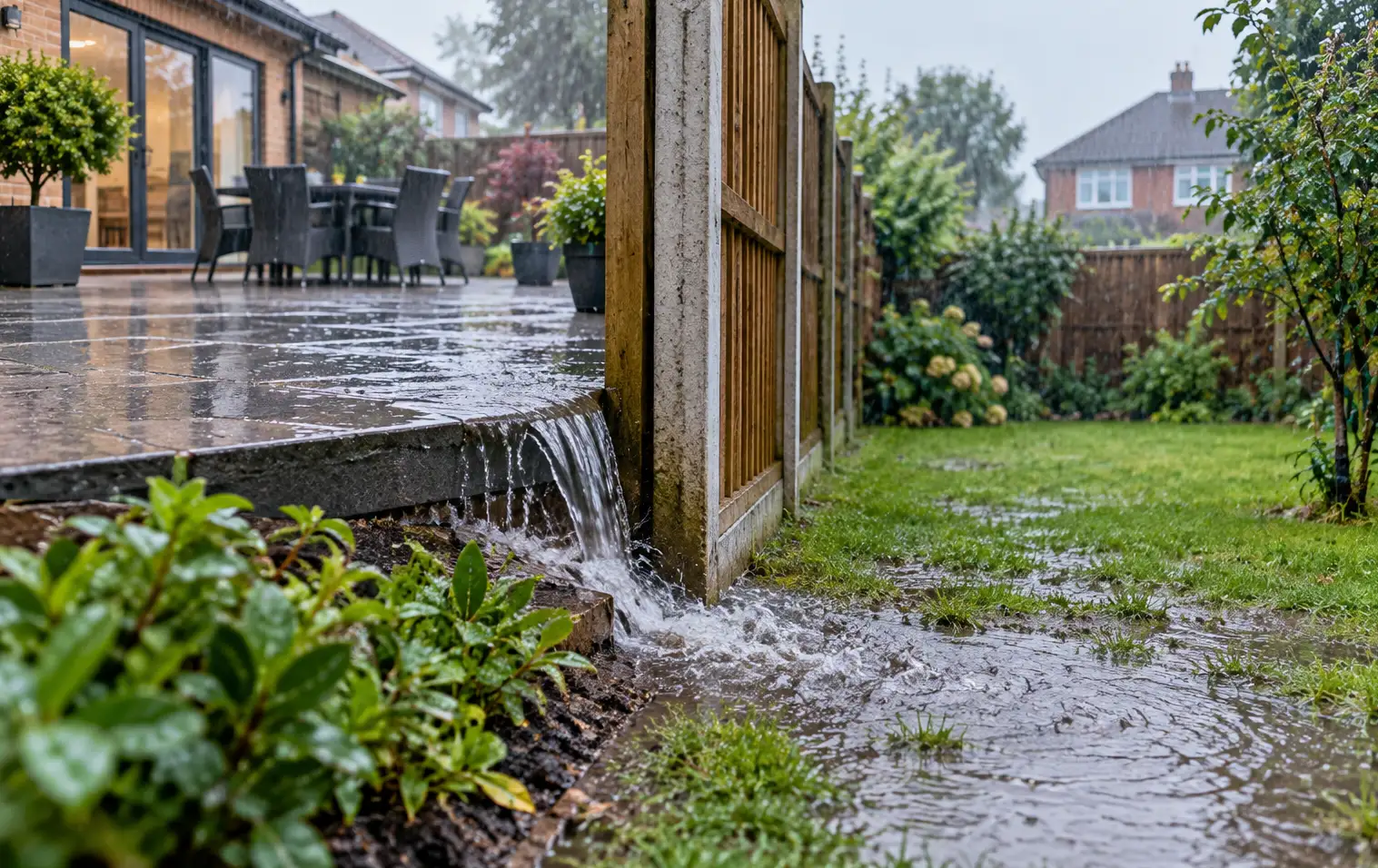
Two gardens, one boundary fence, and after every heavy downpour, a wet patch appears along your side that wasn’t there five years ago. Somewhere in between, the neighbour laid a new patio. Is that a coincidence, or is that the cause — and does it actually matter which, legally?
It matters a great deal. This is one of the few areas of garden law where the answer genuinely turns on what changed, not just on what’s happening now.
Water has always moved between neighbouring properties, particularly where one garden sits higher than the other. Usually, nobody thinks much about it until something changes: a lawn is paved over, a garden is raised, a drain is moved, and suddenly the same rainfall leaves one side of the fence considerably wetter than it used to be. The difficulty is that a suspicious sequence of events isn’t necessarily proof that the neighbour caused the problem, and even proving where the water came from doesn’t automatically settle who is legally responsible.
That distinction can mean the difference between finding a practical drainage solution and spending thousands of pounds pursuing a dispute that never had a sound legal basis.
When water flows naturally — and when somebody changes its course
English common law has never treated water running downhill as automatically being anybody’s fault. If your garden has always been lower than the property next door, and rainwater has followed the natural slope for as long as anyone can remember, the mere fact that it crosses the boundary doesn’t ordinarily make the neighbour liable.
There is a practical reason for this. Rain doesn’t respect fences, and gardens rarely sit on perfectly level ground. During prolonged wet weather, even land that normally drains well can become saturated, leaving surface water with nowhere to go except towards the lowest point.
Devon County Council’s guidance on living with water explains the broad principle: property owners generally have to accept naturally occurring surface-water flows from higher land and may pass that water onwards naturally, provided they don’t create a nuisance.
That doesn’t mean a homeowner must simply tolerate every worsening drainage problem because their garden happens to sit downhill. The position becomes more complicated when someone changes how water moves across their land, and the new patio in the opening example is exactly the sort of alteration that deserves closer attention.
Imagine the neighbouring garden was once mainly lawn and flowerbeds. Rain soaked into the ground or spread gradually across the surface, and only a relatively small amount reached your boundary. Then the owner installed a large impermeable patio, raised part of the garden and laid the paving so that it sloped towards your fence. Water that previously soaked into the soil may now travel rapidly across the hard surface and collect in one place.
That is not the same as ordinary rainwater following the original contours of the land.
The government’s guidance on permeable surfacing explains how replacing grass and soil with impermeable paving can increase run-off, and how permeable materials, planted areas and suitable drainage can reduce it. Although written primarily for front gardens, the technical principles also apply to patios elsewhere around a house.
A properly designed patio can manage its own rainwater without affecting the neighbours. One that concentrates water towards the boundary, however, may create a problem that didn’t previously exist. The same can happen where somebody raises ground levels, changes the direction of a downpipe or installs drainage that discharges near the adjoining property.
That doesn’t automatically make the alteration unlawful, nor does every increase in run-off establish a private nuisance. But it changes what needs investigating. The issue is no longer merely that your garden sits lower; it is whether the work next door has materially worsened the water reaching it, and whether the resulting interference is serious enough to justify a remedy.
The patio may be the obvious suspect — but is it the cause?
This is where neighbour disputes can go badly wrong. A patio appears, flooding follows, and the owner of the affected garden understandably concludes that the two must be connected. Sometimes they are. Sometimes the water is arriving by a much less obvious route.
Rain can move through the soil, follow an old field drain, collect behind a retaining wall or surface some distance from where it first entered the ground. A blocked underground pipe can create a wet patch that looks as though it originated directly across the fence. Even changes elsewhere in a row of gardens may affect where water eventually emerges.
If your garden remained relatively dry for years and began flooding shortly after substantial landscaping next door, that timing is certainly relevant. It gives you a sensible reason to investigate, but a date on a photograph and the sight of new paving don’t by themselves prove a causal connection.
What helps most is evidence of the water moving. Photographs taken the morning after a storm establish that the garden was flooded; video taken safely while rainwater is running across the neighbour’s paving and entering at a particular point can be much more revealing. A record of several rainfall events, rather than one exceptional downpour, may show whether there is a consistent pattern.
It’s worth keeping older photographs too, particularly where they show the levels and condition of the adjoining gardens before work began. If the neighbour’s patio was previously a lawn, or a raised bed has appeared along the fence, that information may help explain what changed. The extent of the effect also matters: a patch of grass remaining wet for an extra afternoon is one thing, while repeated flooding that damages planting, lifts paving or reaches the house is quite another.
Where the water crosses the boundary visibly, an inspection may quickly identify the likely cause. But if it appears from beneath the soil or near a retaining structure, a drainage engineer or appropriately experienced chartered surveyor may be needed to trace its route. That can be money well spent where the alternative is arguing with a neighbour and commissioning remedial works based on a guess.
The aim isn’t to assemble an impressive file of photographs for a courtroom. It’s to understand the water well enough to stop it causing damage. The same evidence that supports a legal claim, if one becomes necessary, can also reveal that the real problem is a blocked drain or failed pipe rather than the neighbour’s new patio.
When the neighbour may have to put it right
If a neighbour has altered their land in a way that causes substantial and unreasonable interference with yours, the common law of private nuisance may become relevant. That could include drainage works or landscaping that concentrate water onto adjoining property, even where causing the damage was never the neighbour’s intention.
The law doesn’t treat every additional trickle as a nuisance. A homeowner may have to accept some inconvenience from the ordinary use of surrounding land, and the seriousness, persistence and consequences of the interference all matter. But regularly directing substantial water towards another property is a different proposition from allowing rain to follow the natural slope.
There is a less obvious difficulty when the hazard was not created by the neighbour at all. Suppose the drainage problem existed naturally, but it has become increasingly serious and the owner of the adjoining land has been warned that it threatens neighbouring property. Does the fact that nature caused it mean they have no responsibility to consider what can reasonably be done?
Not necessarily.
The Court of Appeal addressed the wider principle in Leakey v National Trust, a case concerning a naturally unstable hillside that threatened neighbouring houses. It wasn’t a patio or garden-drainage dispute, but the judgment established that a land occupier who knows, or ought reasonably to know, of a natural hazard may have a duty to take reasonable steps to prevent or reduce foreseeable harm to neighbouring property.
That is a measured obligation, not a requirement to undertake whatever expensive engineering work the affected neighbour demands. What is reasonable depends on the danger, the action available, the practical costs and the circumstances of the landowner. The Supreme Court has subsequently recognised that qualified approach to known natural hazards in its discussion of private nuisance in Davies v Bridgend County Borough Council.
For the two households divided by a fence, the useful distinction is between a neighbour who has changed the water’s route and one whose land has a naturally occurring problem. Either situation may require consideration, but the evidence and legal questions will differ. Establishing that a patio increased the run-off doesn’t by itself establish legal liability; equally, showing that flooding originated naturally doesn’t automatically end every possible claim.
Where a serious problem is continuing, it also matters whether the neighbour has been told about it and how they have responded. A reasonable request to investigate the source is a considerably better starting point than assuming they must immediately pay for whatever drainage scheme you have in mind.
Getting the water stopped before the dispute gets worse
Most homeowners in this position don’t want compensation or a court case. They want to use their garden again without finding another pool of water after every downpour.
That makes a straightforward conversation worth having, particularly when the flooding appeared after visible work next door. The neighbour may have no idea what happens on your side of the fence. Showing them photographs of the water’s route, explaining when the problem began and asking whether the new drainage can be checked may be enough to start resolving it.
Where the patio is responsible, the remedy may be less dramatic than anyone fears. A different fall on part of the paving, a suitable drainage channel, a permeable area or changes to a downpipe may prevent water from being concentrated towards the boundary. On other sites, dealing with the problem properly may require substantial investigation and carefully designed drainage.
The important thing is not to choose the solution before establishing the cause. A soakaway might work on one property and fail on another because of clay soil, high groundwater or its proximity to buildings. Nor is installing a wall along the fence necessarily sensible. Blocking a natural drainage route or forcing the water towards another neighbour may replace one problem with a different one.
Welsh Government guidance on drains and sewers similarly explains the need to manage rainwater from paved areas and avoid increasing flood risk elsewhere. It also advises against allowing rainwater from downpipes to cause damage or flow onto neighbouring property. The specific design will depend on the ground conditions, not simply which household is unhappy with the result.
If discussions get nowhere, put your concerns in writing, setting out what has happened, when it began and what investigation or corrective action you’re requesting. Keep the language factual. A letter explaining that flooding has repeatedly followed the same route since the garden was altered is more useful than an accusation that the neighbour has deliberately sent water your way.
Where responsibility remains disputed, the next sensible investment may be an independent drainage report rather than legal correspondence alone. If that establishes a convincing connection between the work next door and damage to your property, a solicitor experienced in property disputes can advise on a formal request for remedial action and whether a nuisance claim is worth pursuing.
Compensation for damage already suffered and preventing further flooding are separate objectives. Depending on the facts, a legal claim may seek damages for recoverable losses, an injunction requiring the nuisance to stop, or both. Neither remedy follows automatically from proving that water crossed the boundary, and litigation costs can easily become disproportionate to a relatively minor garden problem.
Sometimes the most commercially sensible outcome for both households is an agreed drainage solution rather than a dispute over fault. That is particularly true where a modest alteration could prevent years of arguments, even if the parties disagree about precisely how the problem began.
When the council or insurer needs to know
The position becomes more urgent if water is reaching the house, damaging a retaining wall or repeatedly flooding an outbuilding. At that point, protecting the property shouldn’t wait for the neighbour to accept responsibility.
Photograph the conditions from a safe position, notify your buildings insurer where the damage may be covered and obtain appropriate advice about stopping it getting worse. Emergency protective work may be necessary, but substantial excavation or improvised drainage can create new problems if the source and route of the water remain uncertain.
A rented property’s occupier should notify the landlord or managing agent promptly and in writing, particularly where structural work or permanent drainage alterations may be required. A tenant can still discuss what they’ve observed with the neighbour, but shouldn’t normally commission extensive changes to the property without the landlord’s agreement.
The local authority may also have a role, although it isn’t a general referee for private garden disputes. Lead Local Flood Authorities deal with wider local flood risk, including surface water and groundwater, and may investigate significant events where appropriate. The government’s flood investigation guidance explains the investigation function in England.
Where several properties, roads or public drainage systems are affected, that involvement may be valuable. If the issue is confined to water from one privately owned patio entering one adjoining garden, however, the council may regard it primarily as a civil dispute. Planning or drainage conditions associated with recent works are still worth checking where relevant, but planning permission — or the absence of a need for it — does not by itself determine private nuisance liability.
The position can also differ if the water comes from a leaking public sewer, highway drain or a watercourse rather than ordinary garden run-off. Those circumstances may involve different organisations and legal responsibilities, which is another reason to establish the actual source before deciding whom to pursue.
Where that leaves the two neighbours
Return to the original wet patch beside the boundary fence. If the garden has always received naturally flowing rainwater from the higher land, the neighbour isn’t automatically responsible simply because their property is uphill. And if the flooding has become worse since the patio was installed, the timing alone still doesn’t prove that the patio caused it.
But if the work has redirected or concentrated water in a way that is now materially interfering with your property, that’s a problem with a different explanation and potentially a different legal outcome.
What matters is establishing the route the water takes and what changed it. That may lead to a straightforward agreement about drainage, a professional investigation or, where serious interference continues and responsibility can be established, a formal claim. The earlier that is understood, the less likely both households are to spend money trying to fix the wrong problem.
Two gardens can sit alongside one another for years without anyone giving much thought to where the rain goes. It’s only when one of them suddenly starts flooding that the question becomes important.
And when it does, the most useful thing to establish isn’t simply whose side of the fence the water came from. It’s why it started arriving there in the first place.
Important: This article provides general property information and is not legal, drainage, surveying or other professional advice. Responsibility for surface-water flooding depends on the source of the water, historic land conditions, changes to drainage, the nature of any interference and the law applicable to the property. The legal discussion focuses principally on England and Wales; Scotland and Northern Ireland have separate legal frameworks. Where flooding is damaging a building, substantial losses are involved or liability is disputed, obtain appropriate drainage and legal advice before undertaking major work or pursuing formal action.

