

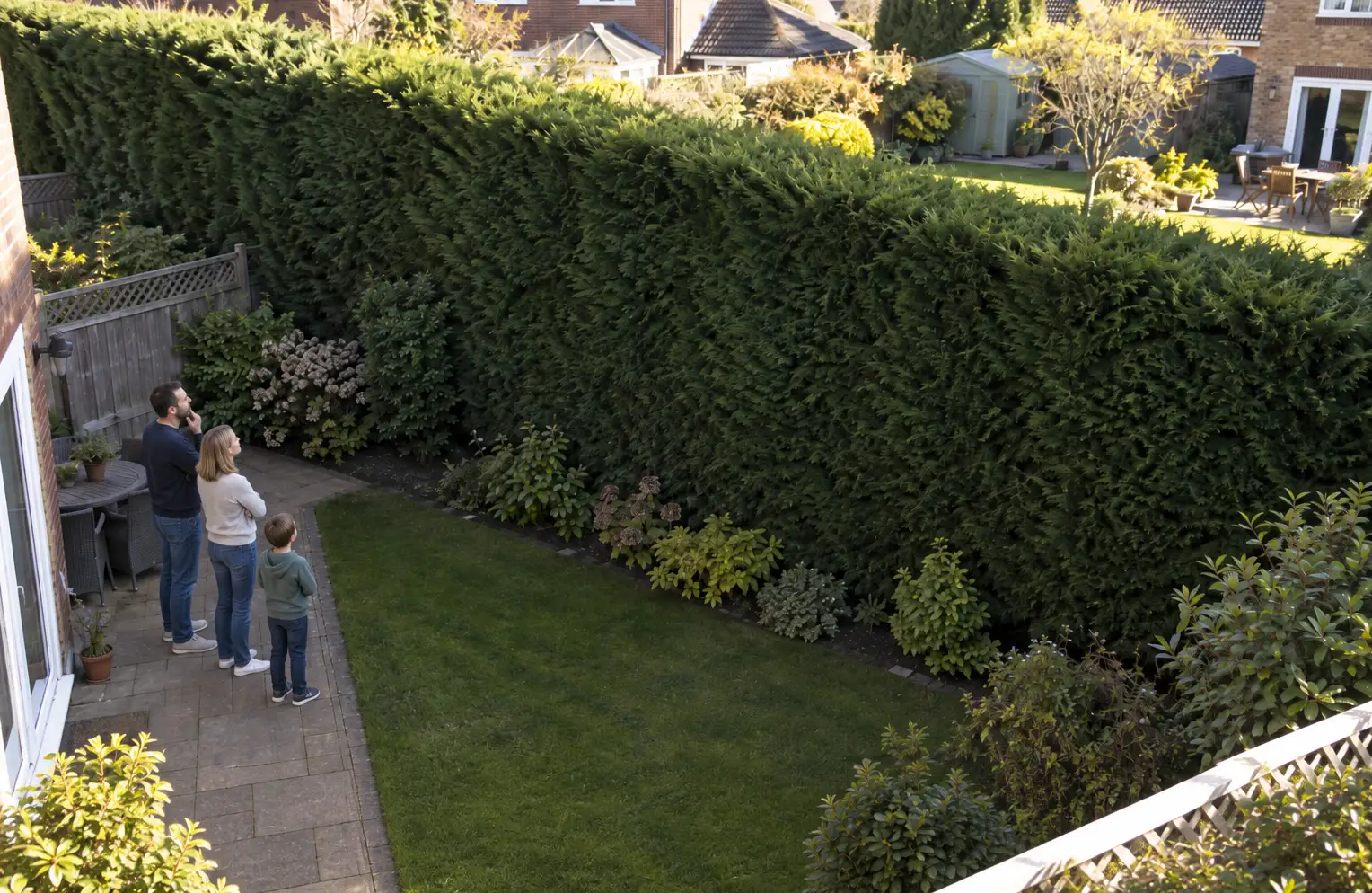
Two metres gets quoted constantly in relation to hedges, and it’s not quite the rule most people think it is. It isn’t a legal ceiling that every hedge must be kept under. It’s one of the conditions that can make a formal council complaint possible — a very different thing from a maximum height nobody’s allowed to exceed.
A hedge can be considerably taller than two metres without the council requiring its owner to cut it back. Equally, one that has been allowed to grow unchecked can darken rooms, deprive a garden of its afternoon sunshine and leave the household next door wondering how much longer they have to put up with it. There is a legal route for dealing with that situation, but it depends on more than simply measuring the hedge and asking the council to enforce a limit.
The type of hedge matters, as does its position and the effect it is having on the neighbouring property. So does what you have already done to resolve the problem. And while all four UK nations have legislation dealing with high hedges, there are differences that could determine whether a complaint succeeds at all.
What actually counts as a high hedge?
In England and Wales, Part 8 of the Anti-social Behaviour Act 2003 gives councils powers to deal with complaints about hedges that adversely affect someone’s reasonable enjoyment of their home or garden. The statutory definition is quite specific: the hedge must form a barrier to light or access, consist wholly or mainly of a line of two or more evergreen or semi-evergreen trees or shrubs, and rise above two metres. Gaps between individual plants don’t automatically disqualify it, provided the overall hedge still forms a substantial barrier.
Leylandii is the classic culprit, but the law isn’t restricted to one species. Laurel and certain privet hedges can qualify, along with other evergreen or semi-evergreen varieties. A privet hedge that loses all its leaves in winter may fall outside the definition, however, as can a row of ordinary deciduous trees that becomes heavily overgrown during summer.
A single specimen tree, however enormous, doesn’t qualify either. The legislation was created specifically for hedges, not individual trees, so a neighbour’s towering oak or solitary conifer cannot be brought within this complaints procedure simply because it blocks your light. The hedge must also grow on land owned or occupied by someone else, although it doesn’t necessarily have to stand immediately alongside your boundary.
Importantly, meeting the definition doesn’t automatically mean that the hedge is unreasonable. A three-metre hedge might be perfectly acceptable in one location yet cause serious problems in another. The council’s task is to decide whether its height is adversely affecting the reasonable enjoyment of the neighbouring home or garden, not merely whether it has exceeded a particular measurement.
The distinction also explains why some disputes that appear obvious to the people involved fall outside the legislation altogether. If the problem is a single tree or a hedge that doesn’t meet the relevant definition, however frustrating the loss of light may be, this particular council complaints procedure cannot provide the answer.
The council doesn’t just chop it down to size
Suppose your neighbour’s Leylandii hedge has reached five metres and now casts a substantial shadow across your kitchen and much of the garden. You have asked for it to be reduced, but your neighbour refuses, arguing that the hedge provides privacy and has been there for years.
You might reasonably expect that a successful complaint would mean the council ordering it back to two metres. In reality, the council has to decide what reduction would fairly address the problem, taking account of both properties and their surroundings. It might require a substantial cut, a relatively modest one or, if the adverse effect isn’t considered serious enough, no action at all.
Where a complaint is upheld, the council can issue a remedial notice specifying what must be done to the hedge and how it should be maintained afterwards. But in England and Wales the legislation prevents that notice from requiring the hedge to be reduced below two metres, removed altogether or treated in a way that would cause its death or destruction. The owner can voluntarily agree to a greater reduction, but the council cannot compel it through this procedure.
A five-metre hedge might therefore be ordered down to three metres if that is considered sufficient. Another hedge of similar height, standing much closer to an affected house, may require a greater reduction. Much depends on the distance from the hedge to the windows, the direction of the light, the size of the garden and how much of the property is being overshadowed.
There is a useful distinction between direct sunshine and ordinary daylight here. A hedge can make a room noticeably darker even when it isn’t blocking direct sunlight through the window, and an area of garden may suffer substantial loss of light depending on the hedge’s height and orientation.
The government’s Hedge Height and Light Loss guidance, produced by the Building Research Establishment, provides a method for estimating whether an evergreen hedge is likely to block too much light from gardens and main-room windows. It can also help estimate a height at which the loss of light becomes excessive. The calculations aren’t legally binding and cannot account for every circumstance, but they give householders a more objective starting point than simply arguing about how oppressive the hedge feels.
That can be helpful to both neighbours. Someone considering a complaint can get a clearer idea of whether the problem is likely to justify intervention, while a hedge owner may be more willing to discuss a reduction when shown how its height affects the property next door. The council must still balance those findings against other considerations, including privacy, the hedge’s contribution to the surroundings and the interests of both households.
The official government guidance on high-hedge complaints makes clear that two metres will only be an appropriate remedial height in some cases. The aim is a reasonable solution to an unreasonable obstruction, not a guaranteed return to every hour of sunlight the property once enjoyed.
You have to try to sort it out yourselves first
The high-hedges procedure is intended to be a last resort, not the opening move in a disagreement over garden maintenance. In England and Wales, councils can decline to proceed with complaints where the person bringing them hasn’t taken reasonable steps to resolve matters informally, or where the complaint is considered frivolous or vexatious.
That makes the first conversation more important than it might seem. Someone who has lived alongside a growing hedge for years may genuinely be unaware of how much light it is taking away from the property next door. Rather than opening with a demand that it must be cut to two metres, explaining that the kitchen has become noticeably darker or that the patio no longer gets the afternoon sun gives the neighbour a clearer reason to consider doing something about it.
A practical proposal is often more productive than an argument about rights. You might suggest reducing the hedge to an agreed height and keeping it regularly maintained, allowing your neighbour to retain some privacy without the hedge continuing to dominate your garden. If the conversation achieves nothing, a polite letter or email creates a record of what has been requested. Mediation may also help where both households are willing to take part, particularly if relations have already become strained.
Not every neighbour will cooperate. Some refuse to discuss the hedge, while others agree to cut it back and then do nothing. In those circumstances, keeping copies of correspondence and a record of reasonable attempts to reach an agreement may be enough to demonstrate why council intervention has become necessary. You aren’t expected to continue making the same unsuccessful request indefinitely.
Photographs can strengthen your account, particularly where they show the hedge in relation to affected windows or garden areas. Images taken at different times may help illustrate the problem, although seasonal changes and weather mean they won’t necessarily prove the extent of lost light on their own. The important thing is to document the effect on your property, not merely establish that the hedge is tall.
There is a wider reason for making a genuine effort before taking formal action. Even a successful council complaint can leave relations between neighbouring households considerably worse than they were before. A negotiated reduction may achieve much the same practical result at lower cost and without turning the hedge into a lasting source of resentment.
What happens if your neighbour refuses?
If informal efforts have failed, the complaint goes to the local authority covering the land on which the hedge stands. The council will explain what information it needs, how to apply and what the complaint will cost.
There is no single national fee across England. Individual councils set their own charges, often running to several hundred pounds, while the Welsh Government’s high-hedge guidance specifies a maximum council fee of £320. Paying doesn’t guarantee a favourable decision, and success won’t necessarily mean reimbursement. In England, government guidance indicates that successful complainants don’t usually receive their fee back, although councils have discretion to offer refunds.
Once a qualifying complaint is accepted, the council will normally ask for the hedge owner’s account and arrange a site inspection. The officer may consider the hedge’s height, how far it stands from the affected windows, the size and layout of the garden and the degree to which it obstructs light. The hedge owner is entitled to explain why they believe it should remain, perhaps because it screens neighbouring windows or provides valuable privacy.
The council must weigh those interests rather than simply choose between two opposing preferences. If the height is having an unreasonable adverse effect, it can require work to reduce that effect and prevent it recurring. The remedial notice sets out the work required, a period for carrying it out and any continuing maintenance needed. That last element is particularly valuable: cutting an overgrown hedge once achieves little if it simply returns to its former height over the following years.
Anyone expecting an immediate resolution should also bear in mind that there is no fixed statutory deadline for councils in England to determine high-hedge complaints. Investigations can take time, and even where action is ordered, the notice may allow weeks or months for the necessary work, including time to address practical or wildlife considerations.
A remedial notice has legal force. Failure to comply can lead to prosecution, and councils in England and Wales have powers to enter the land, arrange the required work and recover reasonable expenses from the owner or occupier. Those powers belong to the authority, however. A successful complaint doesn’t give you permission to enter your neighbour’s garden and cut the hedge yourself.
Both parties may also have rights of appeal against relevant council decisions. In England, the normal deadline is 28 days, with appeals handled through the Planning Inspectorate. Its official high-hedge appeals guidance explains which decisions can be challenged. Wales has a separate appeals system involving the Welsh Ministers, also subject to a 28-day deadline.
The distinction between an unsuccessful complaint and one the council refuses to accept is worth noting. In England, an eligible complainant can generally appeal a decision not to issue a remedial notice, but there is no equivalent statutory appeal against a council’s decision to reject a complaint as invalid. Anyone facing that situation should check the council’s reasons and the appropriate complaints or legal review route rather than assume the ordinary high-hedge appeal procedure applies.
What about roots, branches and people who rent?
Not every dispute involving a neighbour’s greenery belongs within the high-hedges system. The legislation is concerned with the effects of a hedge’s height, not damage caused by its roots or ordinary disagreements over vegetation crossing a boundary.
If roots are lifting paving, damaging a wall or affecting drains, the appropriate route is different. Root damage is excluded from the high-hedge complaints process in England and Wales, with similar exclusions in Scotland and Northern Ireland. Depending on the circumstances, the problem may raise questions about nuisance, negligence, insurance or the need for specialist evidence establishing what has caused the damage.
Overhanging branches are another separate issue. There are circumstances in which an adjoining property occupier can cut back branches extending across a boundary, subject to legal restrictions and any applicable tree protection. But that limited right doesn’t amount to permission to reduce a neighbour’s hedge to whatever height seems reasonable. Tree preservation orders and conservation-area controls can also affect what work is allowed.
The position is different for someone renting the affected home. Being a tenant doesn’t automatically prevent you from bringing a high-hedge complaint. In England and Wales, the legislation allows an owner or occupier of the affected domestic property to complain, and the Scottish and Northern Irish systems similarly recognise qualifying owners or occupiers.
That matters because a tenant who has lost much of the natural light in their home or garden may be able to pursue the council procedure without relying entirely on the landlord. It can still be sensible to discuss the problem with the landlord first, particularly where a negotiated solution or access to relevant property information may help.
Scotland and Northern Ireland have different rules
Although the general principle of council intervention applies across the UK, Scotland has one difference that could fundamentally change the outcome of a complaint.
Under the High Hedges (Scotland) Act 2013, a qualifying hedge consists wholly or mainly of a row of two or more trees or shrubs, rises above two metres and forms a barrier to light. Unlike the definition in England and Wales, it doesn’t have to be evergreen or semi-evergreen. A row of deciduous trees can therefore qualify in Scotland where an equivalent arrangement might fall outside the statutory complaints procedure further south.
For someone whose garden is overshadowed by several large broadleaf trees, that could determine whether the council can become involved. The Scottish legislation still excludes single trees that don’t form part of a hedge, as well as complaints concerned solely with roots or overhanging branches.
The Scottish Government’s guidance explains that informal efforts must be made before applying to the council. Applications usually cost hundreds of pounds, with individual authorities setting their own fees and some offering reductions or exemptions. If a complaint is justified, the council can issue a high hedge notice requiring work to be carried out. Both sides may have appeal rights, normally subject to a 28-day deadline.
Northern Ireland operates under the High Hedges Act (Northern Ireland) 2011, with a definition closer to England and Wales. The hedge must consist wholly or mainly of a line of two or more evergreen or semi-evergreen trees or shrubs, rise above two metres and adversely affect the reasonable enjoyment of domestic property through the effect of its height.
The procedure similarly expects neighbours to attempt an informal solution before approaching the council, but the treatment of complaint fees differs. According to nidirect’s official guidance, the maximum fee is £360 and is refunded where the complaint is found justified and remedial action is taken.
These aren’t merely administrative variations. The same row of trees might qualify for council intervention in Scotland but not in England, while a successful complainant in Northern Ireland may recover a fee that someone in England would usually lose. Anyone considering formal action should therefore use the rules and guidance applicable to their own part of the UK rather than rely on general advice about a supposed national two-metre limit.
Before you pay the fee
A high-hedge complaint can be worthwhile where a neighbour’s greenery has become a substantial problem and reasonable efforts to resolve it have failed. But it is important to understand what the process can realistically achieve.
The law doesn’t give homeowners an automatic right to an unobstructed view, uninterrupted sunshine or a hedge maintained at exactly two metres. Even when a complaint succeeds, the council may decide that a smaller reduction than the complainant wants is sufficient, and the investigation itself can take time.
Before paying, it is worth establishing whether the hedge meets the legal definition where you live, whether its height is causing a significant adverse effect you can explain and demonstrate, and whether you’ve made a genuine attempt to resolve matters with your neighbour. The council’s current fee and refund policy are also worth checking, particularly where the likely outcome is uncertain.
Sometimes an agreement to reduce the hedge and maintain it at a sensible height will achieve more than a formal dispute, especially when the two households have to continue living alongside one another. But where the loss of light is substantial and the hedge owner refuses to engage, the complaints process provides a route to an enforceable remedy.
The crucial point is that the council isn’t there to enforce a universal two-metre limit. It is there to decide whether the hedge has become an unreasonable obstruction and, if so, what fairly needs to be done about it. Understanding that distinction from the outset gives you a much better chance of choosing the right course of action.
Important: This article provides general information about high-hedge disputes and is not legal, surveying or other professional advice. Legislation, council fees, enforcement arrangements and appeal procedures differ across England, Wales, Scotland and Northern Ireland. Individual disputes depend on the circumstances and applicable law. Check current guidance for your local authority and seek appropriate professional advice where significant property damage, legal rights or an ongoing dispute are involved.

