

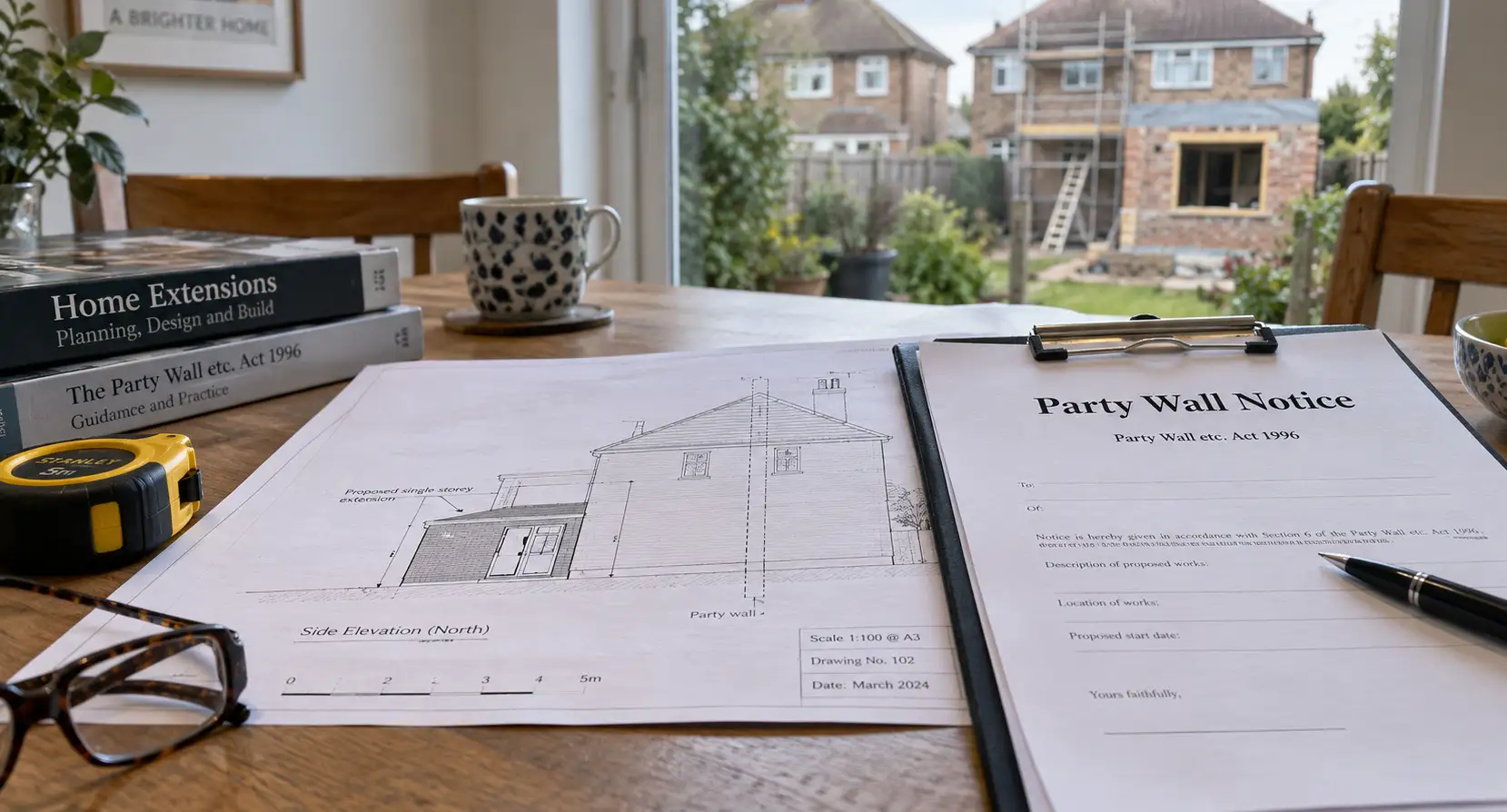
A party wall is not simply any wall between two properties, and the Party Wall etc. Act 1996 does not apply every time your neighbour carries out building work.
It applies to particular types of work in England and Wales: certain work to existing party walls and party structures, construction at the boundary between properties, and some excavations close to neighbouring buildings.
That distinction matters because each route has its own notice requirements — and because a wall can be a party wall even when it stands entirely on one owner’s land.
What actually counts as a party wall?
The Party Wall etc. Act 1996 recognises two main types.
The first is a wall that stands on land belonging to different owners. It may form part of one building, separate two buildings or exist as a freestanding masonry boundary wall.
The second is less obvious: a wall can also be a party wall when it stands entirely on one owner’s land but is used by two owners to separate their buildings.
For example, one house may have been built first with an external wall just inside its boundary. If the adjoining house was later built directly against that wall rather than with a separate wall of its own, the part used to separate the two buildings can become a party wall for the purposes of the Act.
So “party wall” does not necessarily mean each neighbour owns half the thickness of the wall. HM Government’s Party Wall Act explanatory booklet specifically warns against thinking of party walls that simplistically.
A party fence wall is not a wooden fence
The terminology becomes confusing because the Act also uses the expression party fence wall.
This means a wall that:
- is not part of a building;
- stands on land belonging to different owners; and
- separates their land.
A brick or stone garden wall straddling the boundary can therefore be a party fence wall.
A timber fence cannot.
Nor does an ordinary hedge become a party fence wall simply because it sits on the boundary.
This is one reason a neighbour replacing a wooden garden fence does not automatically trigger the Party Wall Act, although separate questions about ownership, boundaries and access can still arise.
A party structure is broader again
The Act also uses the term party structure.
This includes a party wall, but can also include a floor, partition or other structure separating buildings or separately accessed parts of buildings.
That makes the Act relevant to some flats and converted buildings, not just semi-detached and terraced houses.
A floor separating one flat from another can therefore fall within the party-structure provisions even though there is no vertical wall between the two owners.
There are three main ways building work enters the Act
For homeowners, most Party Wall Act situations fall into one of three groups.
1. A new wall at the boundary
Section 1 deals with new walls at what the Act calls the line of junction — essentially the boundary between land in different ownership.
If your neighbour proposes to build a new wall wholly on their own land but right up against the boundary, they must normally give at least one month’s notice before starting.
Your consent is not required merely because the wall is close to the boundary.
If, however, they want the new wall to stand astride the boundary, with part of it physically on your land, they need your written consent.
You have 14 days in which to consent to that proposal.
If you do not give written consent, the Act does not allow surveyors to impose the wall across your land. Your neighbour must instead build it wholly on their own side of the boundary.
This is an important exception to the frequently heard statement that “you cannot stop Party Wall work”. A neighbour does not have a statutory right to put a new wall astride your boundary without your agreement.
2. Work to an existing party wall or party structure
Section 2 gives a building owner various rights to carry out particular work to an existing party wall or party structure.
Common examples include:
- cutting into a party wall to insert beams;
- raising or rebuilding a party wall;
- underpinning or thickening it;
- cutting away projections;
- removing a chimney breast from a party wall; and
- certain other structural alterations.
The formal party structure notice for this work is served under section 3 of the Act and must generally be given at least two months before the work is intended to start.
Not every job involving a shared wall requires notice. Government guidance identifies minor work such as ordinary plastering, putting up shelves or replacing electrical sockets as examples that would not normally trigger the Act.
The question is therefore what the proposed work actually does to the party structure, not simply whether somebody happens to be working near it.
3. Excavating close to a neighbouring building
Section 6 catches some work even where nothing will touch the party wall.
Notice is required where excavation or foundation work is:
- within 3 metres of part of a neighbouring building or structure and will extend deeper than the bottom of its foundations; or
- within 6 metres where the excavation will reach below a line drawn downwards at 45 degrees from the bottom of the neighbour’s foundations towards the excavation.
These are often called the 3-metre and 6-metre rules.
They are sometimes misunderstood as saying that every foundation within three or six metres requires notice. That is wrong.
The depth and geometry of the foundations matter as well as the distance.
A section 6 notice must be served at least one month before the excavation is intended to begin. Unlike an ordinary party structure notice, it must also be accompanied by plans and sections showing the location and depth of the proposed excavation or foundations and the location of the proposed building or structure. The notice must say whether the building owner proposes to underpin or otherwise safeguard the neighbouring foundations.
What happens after notice is served?
The answer depends slightly on which notice has been served.
For work to an existing party structure, or qualifying excavation under section 6, the adjoining owner can consent in writing.
If they refuse consent — or do not respond within 14 days — a dispute is treated as having arisen under the Act.
The owners must then use the statutory surveyor procedure unless they reach agreement.
They can jointly appoint one Agreed Surveyor, or each appoint their own surveyor. Where two surveyors are appointed, they also select a third surveyor who can become involved if necessary.
The surveyor or surveyors then produce a Party Wall Award.
The award can deal with matters such as:
- what work may be carried out;
- how and when it is done;
- measures needed to protect the adjoining property;
- access where the Act provides a right to it;
- making good or compensating for relevant damage; and
- responsibility for reasonable costs.
The surveyors are not employed to act as advocates for whichever owner appointed them. Their role under the Act is to resolve the dispute impartially.
A new wall wholly on your neighbour’s land works slightly differently
There is an important procedural distinction that is easily missed.
If your neighbour serves a section 1 notice saying they intend to build a new wall wholly on their own land up to the boundary, your failure to respond does not automatically prevent them proceeding.
Government guidance says that, unless a dispute arises, the wall can be built after the one-month notice period has expired.
An acknowledgement is not essential simply for a wall wholly on the building owner’s land.
By contrast, if the proposal is for the wall to sit astride the boundary, your written consent is essential. No written consent within 14 days means the proposed wall must stay on their land.
Treating every Party Wall notice as though silence has exactly the same consequence is therefore inaccurate.
Can work begin before the notice period expires?
Potentially, but only by agreement.
The statutory periods are:
| Work | Normal minimum notice |
|---|---|
| New wall at the boundary | 1 month |
| Notifiable work to existing party structure | 2 months |
| Qualifying excavation | 1 month |
An adjoining owner can agree in writing to work beginning earlier.
Notices should not be served indefinitely in advance either. Government guidance says Party Wall notices cease to be effective if the relevant work has not begun within 12 months.
A schedule of condition is useful — but it isn’t compulsory
A schedule of condition records the state of the adjoining property before work begins, usually with written notes and photographs.
It can be extremely useful if cracks or other damage are alleged later because both sides have a record of what was already there.
But the government’s guidance is clear: a schedule of condition is not a statutory requirement of the Party Wall Act.
It is common and sensible professional practice, particularly where an award is required, but it should not be presented as something the Act itself always demands.
The neighbour normally cannot veto lawful work
For most work covered by sections 2 and 6, refusing consent does not give the adjoining owner a permanent veto.
Instead, refusal or failure to respond triggers the surveyor procedure so that the work can be regulated under an award.
The adjoining owner’s protection is principally about how the work is carried out and how their property is safeguarded, rather than whether they personally like the project.
There are important limits, however.
The Act does not allow surveyors to determine where a disputed property boundary lies, and it does not allow a new wall to be built astride the boundary without the adjoining owner’s written consent.
Nor does compliance with the Act override easements, restrictive covenants or other private property rights that may apply.
Planning permission doesn’t answer the Party Wall question
Planning permission, building regulations and Party Wall Act compliance are separate regimes.
A council can grant planning permission for an extension even though part of the construction process requires Party Wall notice.
Equally, serving a Party Wall notice does not give somebody planning permission for development that requires it.
The government expressly warns homeowners that planning permission and building-regulations approval do not remove the need to comply with the Party Wall Act where it applies.
So if your neighbour says:
“The council has already approved it.”
that does not answer whether notice should have been served.
Who pays the surveyors?
The draft rule people often hear is that the person doing the building work always pays.
That is usually, but not invariably, the outcome.
The general principle under section 11 is that the building owner bears the expense where the work is being undertaken solely for their benefit. Government guidance says this will usually include the reasonable costs of preparing an award, including an adjoining owner’s reasonable surveyor’s fees.
There are exceptions.
Costs can be apportioned where, for example:
- work is required because a shared structure is defective or needs repair;
- both owners benefit from particular work; or
- the adjoining owner asks for additional work for their own benefit.
If the parties cannot agree, responsibility for costs can be dealt with through the Party Wall Award.
The Act refers to reasonable surveyor costs. It does not give an adjoining owner an unrestricted right to run up any professional fee they choose and automatically pass the bill next door.
What if no notice is served?
The Act does not contain its own council-run enforcement regime for missing notices.
A local planning authority does not enforce your private Party Wall rights merely because it approved the development.
If work that should have been notified begins without the required notice, government guidance says an adjoining owner may seek an injunction through the courts to stop the work or pursue other legal remedies.
That does not mean every missed notice should lead immediately to litigation. But if substantial notifiable work is imminent or already under way and you believe the Act has been ignored, it is worth dealing with the issue promptly rather than waiting until the building work is complete.
The Act only applies in England and Wales
The Party Wall etc. Act 1996 applies throughout England and Wales.
It does not apply in Scotland or Northern Ireland, and neither jurisdiction has an equivalent statutory party-wall regime using the same notice periods, surveyor appointments and Party Wall Awards. RICS guidance on party walls confirms that territorial distinction.
That does not mean neighbours in Scotland or Northern Ireland can ignore each other’s property rights or damage shared structures. Different property, building and neighbour-law rules apply.
The practical point is simply not to import the England-and-Wales Party Wall procedure into another jurisdiction.
When should your neighbour serve notice?
The most useful test is not simply whether there is a shared wall.
Ask what work is actually proposed.
Notice may be required if your neighbour intends to:
- build a new wall at the boundary;
- carry out one of the Act’s specified works to an existing party wall or party structure; or
- excavate close enough and deep enough to satisfy the section 6 tests.
If none of those applies, there may be no Party Wall notice requirement at all.
And receiving a notice is not the same thing as your neighbour asking permission for their whole extension. In most cases it is the statutory process for protecting both properties while work that the Act permits is carried out.
The important exception is worth remembering:
your neighbour can usually build up to their boundary on their own land, but they cannot use the Party Wall Act to force you to accept a new wall standing partly on yours.
Important: This article provides general property information, not legal, financial, surveying or other professional advice for your individual circumstances. Whether the Party Wall etc. Act 1996 applies depends on the precise work proposed, the buildings involved, ownership and the relevant measurements. If substantial work is imminent, a notice is disputed or property rights and significant money are at risk, take appropriate professional advice before proceeding.

