

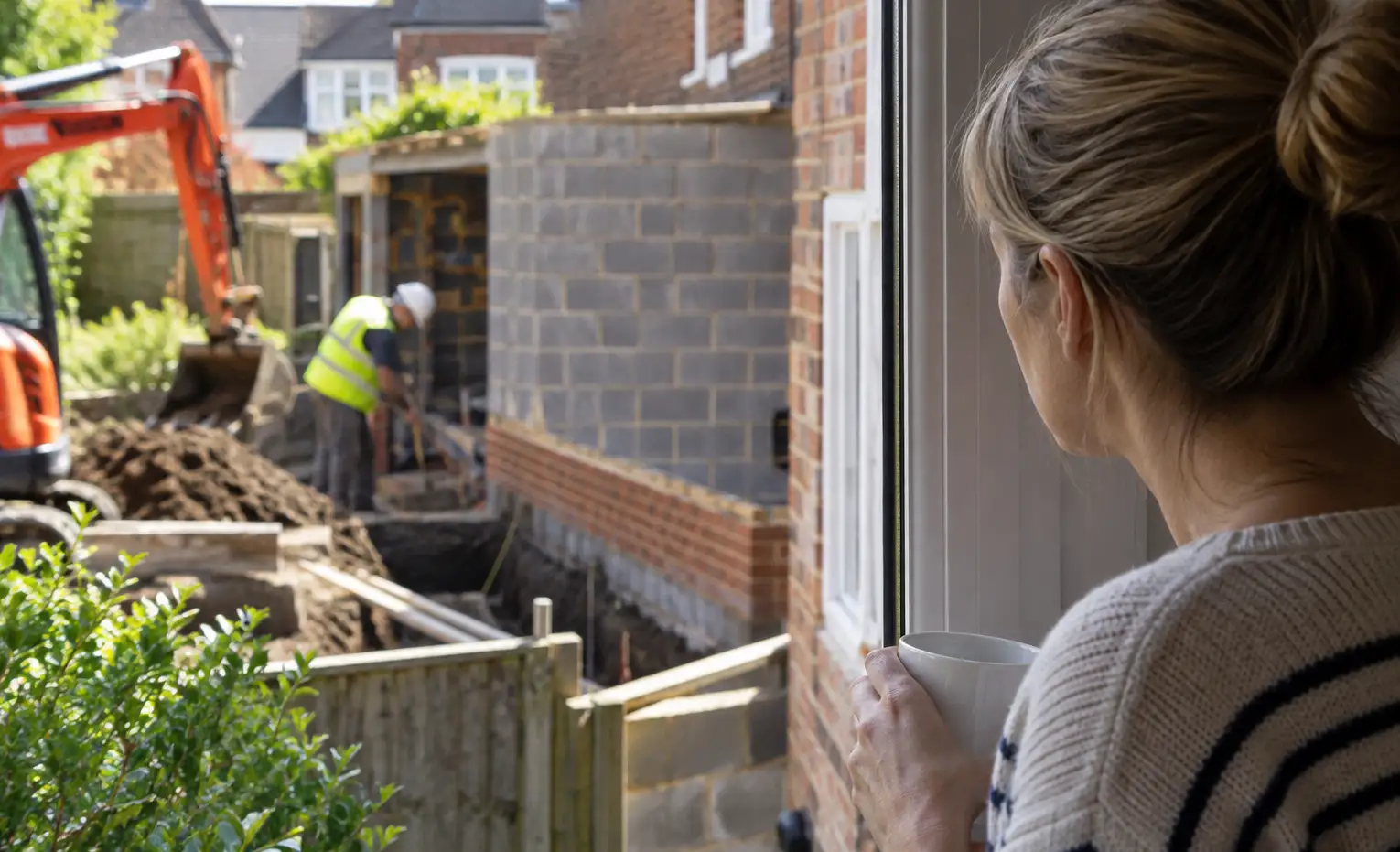
There’s a specific kind of alarm that comes with hearing digging start next door and realising nothing was ever put through your letterbox about it. No notice, no schedule of condition, no warning that anyone was about to excavate three feet from your foundations. It’s a genuinely urgent situation, and the right response depends on acting quickly rather than waiting to see how it develops. The first thing to establish, though, is whether the work actually required a Party Wall notice in the first place — because not everything a neighbour builds close to your house falls within the Act.
This article covers England and Wales, where the Party Wall etc. Act 1996 applies. Scotland and Northern Ireland have no equivalent statutory party-wall procedure, so disputes over building work affecting neighbouring property are dealt with under their own legal systems instead. Where significant work is already under way and property rights or structural safety are at risk, the appropriate professional advice may be needed considerably sooner than most homeowners expect.
The Act has no police force, but it does have a court
The Party Wall etc. Act 1996 contains no criminal enforcement mechanism of its own — nobody gets fined directly for skipping the notice stage. What it does provide is a framework for certain work involving existing party walls, new walls at boundaries and excavation close to neighbouring buildings. The important qualification is that the work must actually fall within the Act. A neighbour laying a patio or digging foundations that don’t meet the statutory requirements may have no obligation to serve notice, even if the work is surprisingly close to your property. Underpinning a party wall or excavating below the level of nearby foundations can be a different matter, and the Government’s guidance on work requiring Party Wall notification explains the circumstances in which the statutory procedure applies.
Where qualifying work starts without the required notice, the position becomes more serious. The Government’s Party Wall Act explanatory booklet confirms that the Act doesn’t provide its own enforcement procedure for failing to serve notice, but an adjoining owner may seek a court injunction to stop the work or pursue other legal remedies. That’s a real and usable option, not a theoretical one, although an injunction isn’t automatically granted because somebody failed to serve paperwork. The court will consider the circumstances, and making an application can involve substantial legal costs and potentially an undertaking in damages. It’s worth knowing the remedy exists, particularly while excavation or structural alterations are still taking place, without assuming that every missing notice justifies an immediate trip to court.
There’s also a more recent complication that makes obtaining the right advice especially important. In Power v Shah [2023] EWCA Civ 239, the Court of Appeal considered what happened when building work had proceeded without the required Party Wall notice and the adjoining owners attempted to invoke the Act’s dispute-resolution machinery themselves. The court held that the resulting surveyors’ award was invalid. The necessary statutory notice hadn’t been served by the building owner, so the adjoining owners couldn’t simply create jurisdiction under section 10 by appointing surveyors of their own. That doesn’t prevent a party wall surveyor from providing valuable technical advice, inspecting the property or explaining whether the Act should have applied. It does mean that appointing one after unnotified work has started isn’t necessarily a route to obtaining a binding Party Wall Award.
Serving notice now doesn’t erase what’s already happened
A neighbour who realises they’ve skipped the process sometimes tries to serve notice retrospectively, as though that resets the clock. It doesn’t, not cleanly. The notice periods exist to give you time to respond, obtain advice and, where necessary, have the statutory surveyor procedure completed before the relevant work begins. A schedule of condition is also commonly prepared so that the neighbouring property’s existing cracks and defects can be recorded, although it is prudent professional practice rather than a separate statutory requirement in its own right. None of that preparation can be carried out beforehand once the work has already started.
A late notice can still be a genuinely useful step towards getting matters onto a proper footing, particularly where substantial notifiable work remains to be done. The sensible approach may be for the building owner to stop the relevant work, obtain advice and serve the appropriate notice before continuing through the required procedure. What the notice cannot do is turn back time and automatically authorise work already completed without it. Nor does it necessarily give surveyors retrospective authority to determine a dispute about work finished before the statutory machinery was engaged. The distinction matters because the homeowner whose property may have been affected shouldn’t assume that a document delivered after the excavator has left somehow resolves everything that happened beforehand.
If damage has already occurred, the absence of a Party Wall Award doesn’t leave you without legal rights. Depending on the facts, claims may arise through negligence, nuisance, trespass or other property-law principles, even where the statutory surveyor procedure cannot be invoked retrospectively. Equally, damage appearing during neighbouring construction doesn’t automatically establish who caused it or who must pay. The condition of the building beforehand, what work was undertaken and the relationship between that work and the damage may all need investigating. This is why evidence gathered before more construction takes place is often more useful than an argument about compensation after the contractor has finished.
The council isn’t the right first call — with one exception
Because the Party Wall Act is a private, civil matter between neighbours, the local council’s planning or building control department doesn’t enforce its notice requirements. A failure to serve notice isn’t, in itself, a planning breach, and reporting it to planning enforcement will not normally produce an order requiring the builder to stop. Planning permission, building-regulations approval and Party Wall obligations are separate legal matters. A neighbour can have perfectly valid approval for an extension and still have failed to follow the procedure required for excavating close to your foundations.
The exception is where the building work has genuinely created a structural danger. A wall at risk of collapse, excavation visibly undermining a building or structural alterations leaving part of a property dangerously unsupported can justify contacting the local authority’s building-control or dangerous-structures service. Sections 77 and 78 of the Building Act 1984 provide powers to deal with dangerous buildings and structures, including emergency intervention where the risk cannot wait for the ordinary procedure. If there’s an immediate threat to life, emergency services should be contacted. That is a safety issue, however, not enforcement of the missing Party Wall notice, and the council’s involvement doesn’t automatically settle any subsequent dispute over damage or responsibility.
What to actually do, in order
Document your property immediately, before any more work happens. Photograph and, ideally, video the walls, ceilings, external masonry and other parts of the building most likely to be affected, paying particular attention to existing cracks around windows and doors, junctions between walls and ceilings, paving near the excavation and any boundary or retaining walls. Take wider photographs that establish where each defect is, not just close-ups that may later be difficult to identify, and keep the original files with their dates intact. This is effectively an informal record of condition, and while it isn’t as robust as a professional schedule prepared by a surveyor, it’s considerably better than nothing if the neighbour’s work is subsequently blamed for damage. An old crack can become worse during construction, but proving the difference is much easier when there’s a reliable record of what was already there.
Get in touch with an experienced party wall surveyor promptly, even before approaching your neighbour if the situation feels tense or you’re uncertain what work is actually being carried out. The first question is whether the construction appears to fall within the Act at all. A surveyor can help identify whether excavation depths, proximity to your building or work to a shared structure make notice necessary, and whether further investigations or protective measures would be sensible. That professional advice is different from a formal appointment under section 10, particularly following Power v Shah. If significant notifiable work is continuing and the neighbour refuses to engage, a solicitor experienced in property disputes may need to advise on whether an injunction or another legal remedy is appropriate. A firm, professionally worded approach can sometimes resolve the immediate problem without litigation, but where foundations are already being excavated, speed may matter more than allowing several rounds of correspondence to pass.
It’s worth establishing exactly what work is being done before assuming the neighbour has deliberately ignored the law. Ask, preferably in writing, whether a notice was served, what stage construction has reached, whether further excavation or work to a party structure is planned, and who is advising the building owner. There may be a misunderstanding about whether notice was necessary, a notice may have been served on another relevant owner, or the design may have changed after work began. None of those possibilities means the situation should be ignored, but understanding the explanation can make a considerable difference to what happens next. The immediate objective is to find out what is happening and prevent avoidable damage, not to win an argument with the contractor standing beside the trench.
Think carefully before refusing all access. Under the Act’s formal procedure, a building owner can have statutory rights of entry for qualifying work, but those rights don’t arise merely because a contractor has started building or says access is necessary. Section 8 of the Party Wall etc. Act 1996 provides rights of entry for work carried out in pursuance of the Act, normally subject to at least fourteen days’ notice except in an emergency. Where the necessary statutory process hasn’t been followed, the neighbour shouldn’t simply assume those rights are available. You’re not automatically obliged to let contractors onto your property just because they’ve asked, but an outright refusal of a sensible request to inspect or protect a structure can also make the situation harder to resolve. If access would genuinely help prevent damage, it may be possible to agree it voluntarily with appropriate safeguards. That’s the sort of judgement call worth discussing with a professional rather than deciding alone under pressure.
If new cracking or movement has already appeared, record it before repairing or redecorating anything. Where structural damage is suspected, an independent engineer may need to assess whether the property is safe and whether temporary measures are necessary. Don’t rush to agree a cash payment with the builder or accept a casual promise to make good the damage before the cause and extent have been properly established. A professional opinion can be particularly important where the neighbour’s work has involved excavation or alterations to a shared load-bearing structure, because an apparently minor crack may have a different significance depending on what has happened to the foundations or support beneath it.
Speed matters more than almost anything else here
The earlier this gets raised — ideally before excavation goes any deeper or a wall is altered any further — the more options remain open. Once the work is complete, you’re generally left investigating whether damage was caused and what remedy may be available, rather than preventing the risky work in the first place. That’s a harder, slower and usually more expensive conversation to have, particularly where the property’s previous condition was never properly recorded.
The distinction between surveyor and solicitor becomes important at precisely this point. When proper notice has been served before work starts, the Party Wall Act provides a specialist procedure designed to resolve many disputes without ordinary court proceedings. Where a building owner starts notifiable work without notice and refuses to engage with the Act, the adjoining owner cannot simply recreate that procedure unilaterally afterwards. Power v Shah makes that limitation clear, and it is one of the strongest reasons to seek advice early rather than assuming a surveyor can produce a retrospective award once everything is finished.
For homeowners in Scotland and Northern Ireland, the position is different from the outset. The Party Wall Act doesn’t apply in either jurisdiction, and RICS confirms that there is no equivalent statutory party-wall process. Property rights, building standards and the law governing damage to neighbouring land still matter, but the available procedures and remedies depend on the jurisdiction. Where significant work is threatening a property, obtaining advice from a solicitor or appropriately qualified professional practising locally is more useful than trying to rely on the England-and-Wales notice system.
For everyone else, the practical lesson is much the same: establish whether notice was actually required, preserve the condition of your property while the evidence is still available, and get the right professional involved before construction reaches the point where stopping or changing it becomes much more difficult. The absence of a notice doesn’t automatically make every neighbour’s building project unlawful, but where the Act genuinely applies, waiting until the work is complete can leave you with fewer practical choices and a far more expensive dispute. What you do while the foundations are still being dug may matter considerably more than what you argue about afterwards.
Important: This article provides general property information, not legal, financial, surveying or other professional advice for individual circumstances. Whether a Party Wall notice was required and what remedies are available depend on the precise work, its stage, ownership, structural conditions and other facts. If significant work is continuing, damage has appeared or court action may be necessary, obtain appropriate professional advice promptly.

