

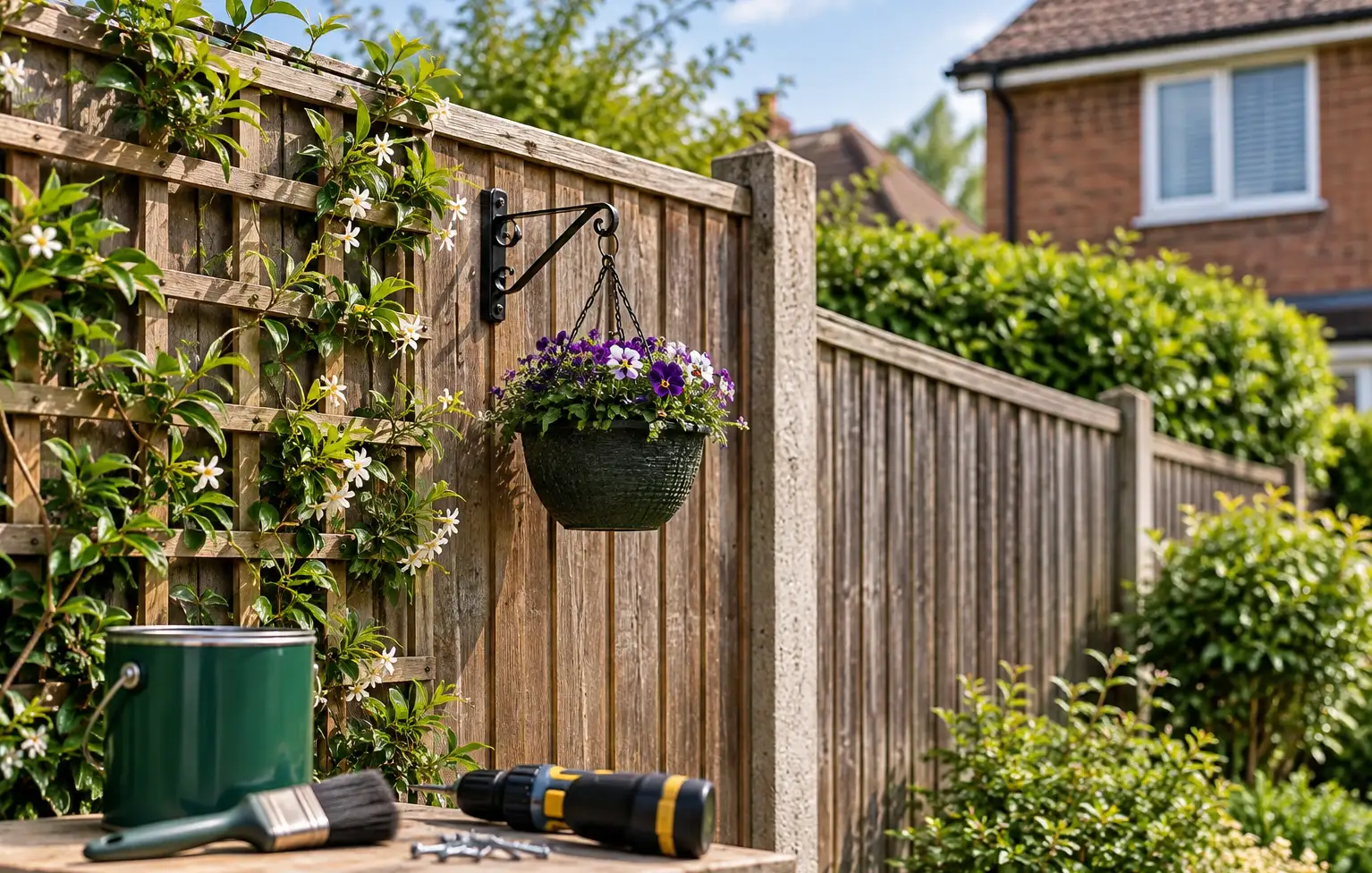
“It faces my garden, so surely I can do what I like with my side of it.”
It is an understandable assumption, but it is not a safe one. A fence does not become partly yours simply because one face looks into your garden. If the fence belongs to your neighbour, you should not paint it, drill into it, screw trellis or brackets to it, or otherwise alter it without their permission.
The first difficulty is often establishing who actually owns or is responsible for the fence. HM Land Registry warns that familiar rules of thumb — such as assuming the fence belongs to the property on the side with the posts and rails — have no legal foundation. The title register and filed deeds may help, but sometimes they do not give a definite answer at all.
This article covers England and Wales. Scotland and Northern Ireland have different land-registration and property-law systems.
Facing your garden does not make the fence yours to alter
If the fence is your neighbour’s, the fact that you can see and reach one face of it from your own land does not give you a right to change it.
That means you should obtain permission before:
- painting or staining it;
- drilling or screwing into it;
- attaching trellis, hooks, brackets, lights or planters;
- fixing plant supports to it;
- replacing panels or posts; or
- making another alteration to the structure.
Unauthorised alteration or damage can expose you to a civil dispute over interference with another person’s property and the cost of putting matters right. The practical risk is usually much more mundane than dramatic legal action: a neighbour objects, demands that an attachment is removed or that the fence is restored, and a small garden issue becomes an expensive boundary argument.
That is why permission matters even where you think the change improves the fence.
First make sure you actually know who owns it
This is the part many neighbours skip.
HM Land Registry’s current boundary guidance says there is no legal basis for assumptions about ownership based on how a wall or fence is constructed. It also makes clear that a covenant to maintain a fence does not, by itself, necessarily establish ownership.
The register may contain information taken from older deeds, and those deeds may use T marks or wording dealing with ownership, maintenance or repair. But a T mark only has significance in context: the wording of the relevant deed needs to be read with it. HM Land Registry does not generally treat an unexplained T mark on a deed plan as having special legal force.
Just as importantly, the absence of a T mark does not prove that the fence is jointly owned.
If the documents do not settle ownership or responsibility, HM Land Registry’s guidance says the feature is generally best regarded as a party boundary and alterations or replacement should be agreed with the adjoining owner.
So before relying on “my fence” or “their fence”, check the title register, any relevant transfer or conveyance and any filed plan or deed that deals with the boundary.
Trellis needs two separate checks
Trellis creates a particular trap because there are two questions, not one.
The first is ownership. If the fence is not yours, fixing trellis to it normally requires the owner’s agreement just as drilling in a bracket or altering a panel would.
The second is planning.
In England, national permitted-development rules generally allow a gate, fence, wall or other means of enclosure up to 1 metre high when next to a highway used by vehicles, including the footpath of such a highway, and up to 2 metres high elsewhere. Altering an existing fence so that its height exceeds the permitted limit can require planning permission. The Planning Portal’s fence guidance sets out the national rules and their main exceptions.
Wales applies closely comparable national limits: over 1 metre next to a highway used by vehicles, or its footpath, and over 2 metres elsewhere will generally require planning permission when erecting or adding to a fence, wall or gate. The Welsh Government’s guidance also notes exceptions including listed buildings, planning conditions and Article 4 directions.
A fixed trellis topper is not a way of ignoring those height limits. If adding it increases the overall height of the enclosure beyond the relevant permitted-development limit, planning permission may be needed.
So a 2-metre fence with another section of fixed trellis added above it is not automatically permitted simply because the upper section is open lattice rather than solid timber.
If the fence is yours
If the fence is clearly yours, your neighbour’s permission is not normally required simply because its other face is visible from their garden.
You can generally paint, stain or attach things to your own fence, provided you do not enter your neighbour’s land without permission or interfere with property that belongs to them.
Adding height or changing the structure can still raise other issues. Planning permission may be required, and lease terms, restrictive covenants, planning conditions, Article 4 directions or listed-building controls can sometimes restrict what an owner may do.
Ownership therefore answers the neighbour-consent question; it does not override planning or other property restrictions.
What if the fence is shared or ownership is unclear?
Do not treat the absence of a single-owner marking as proof that a fence is jointly owned.
Where the deeds actually establish joint rights or responsibilities, neither neighbour should assume an unrestricted right to alter the feature unilaterally.
Where ownership cannot be established at all, the sensible position is similar: discuss the proposed change and obtain agreement before altering or replacing the fence. That is also HM Land Registry’s practical recommendation for uncertain party boundaries.
This matters most when the change affects more than routine maintenance: raising the height, attaching a substantial trellis, replacing a shared structure, changing its appearance significantly or doing work that could affect its strength.
What about climbing plants?
You do not need your neighbour’s permission merely to grow plants on your own land. The problem arises when you use their fence as part of the installation or allow the planting to damage or interfere with it.
If the fence belongs to your neighbour, avoid fastening wires, eyes, clips or other supports directly to it without agreement. A vigorous climber can also become surprisingly heavy, so a plant that eventually pulls at panels or posts creates a very different situation from one growing on a freestanding support in your own garden.
If you want climbers but your neighbour does not want anything fixed to the fence, install your own support wholly within your land and leave enough room to maintain it without relying on the neighbouring structure.
Asking is usually easier than arguing about the law
For most households, the best solution is not complicated.
If you want to paint a neighbour’s fence, ask. If you want to attach trellis, explain what you intend to fix, how high it will be and who will maintain it. Where the change is substantial or permanent, record the agreement in a text message, email or other writing so there is less scope for disagreement later.
If the answer is no, do not simply do the work anyway because it faces your garden.
You can often achieve the same result with freestanding screening, your own posts and trellis, planting or another structure positioned entirely within your property. That removes the need to alter the neighbour’s fence, although planning rules, covenants and other restrictions can still apply to whatever you build on your side.
The useful rule is simple: work out who owns the fence first, and get permission before altering anything that is not yours.
Important: This article provides general property information, not legal, financial, surveying or other professional advice for your individual circumstances. Boundary ownership and responsibility can depend on the deeds, the history of the properties and the facts on the ground. If significant property rights or money are at risk, or a neighbour dispute is developing, take appropriate professional advice before proceeding.

