

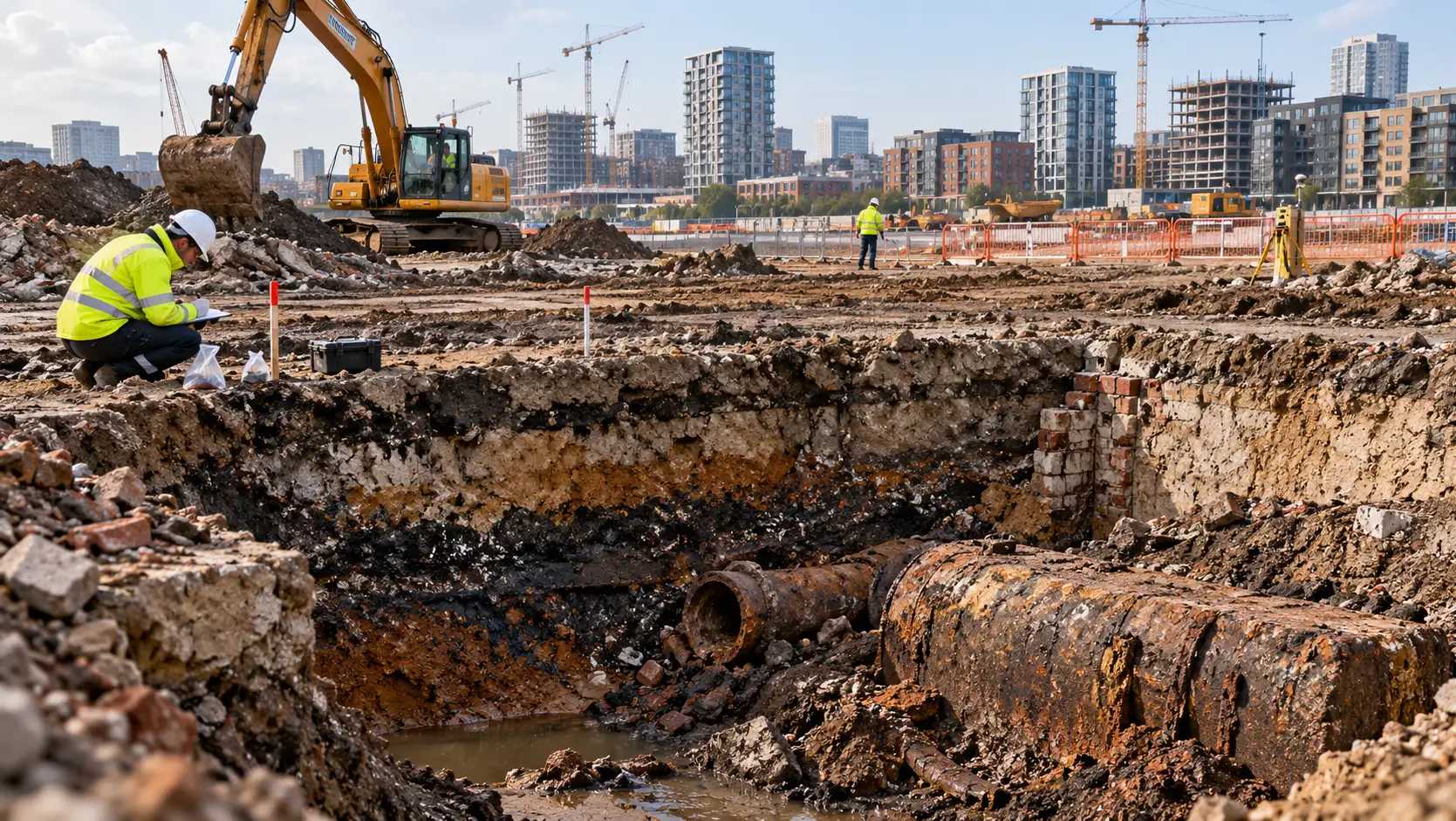
A developer can know, with reasonable confidence, that a former industrial site is likely to be contaminated before they have any idea what putting it right will actually cost. A Phase 1 desk-based assessment can identify that a site has a history of use likely to have left contamination behind — a former gasworks, a scrapyard, a dry cleaner’s, a filling station — without coming close to establishing whether the eventual remediation bill will be a manageable line item in the scheme’s contingency or a cost that changes whether the site is viable to develop at all. That gap between knowing a problem may exist and knowing what it costs is not an edge case in brownfield development. It is close to the central commercial problem the entire sector has to solve, transaction after transaction, sometimes before intrusive investigation has produced anything approaching a definitive answer.
This article addresses contamination risk allocation as a commercial and transactional problem, not as a technical remediation guide, and deals principally with the position in England. The underlying statutory responsibilities, planning requirements and environmental procedures differ across the UK, although Land Remediation Relief operates through UK corporation tax legislation. Developers with interests in Scotland, Wales or Northern Ireland should check the relevant environmental and planning regimes rather than assuming uniformity.
Why the uncertainty is structural, not a failure of due diligence
The reason this problem cannot always be diligenced away before exchange is that the tools available at the pre-acquisition stage are inherently limited in what they can establish. A Phase 1 assessment — reviewing historical land use, environmental records and site walkover observations — identifies potential contamination sources, pathways and receptors, but it cannot quantify remediation cost with confidence because that depends on the nature, extent, concentration and distribution of contamination, the proposed end use and the remediation methods ultimately required. A Phase 2 intrusive investigation, involving trial pits, boreholes and laboratory testing of soil and groundwater samples, gets considerably closer to a real answer, but even this may leave uncertainty where contamination is unevenly distributed, groundwater conditions are complex or further investigation becomes necessary as the design develops. The Environment Agency’s land contamination risk-management framework requires uncertainties and limitations to be identified rather than implying that sampling can remove them entirely.
A full intrusive investigation is itself expensive, time-consuming and — critically for a competitive land transaction — not always something a vendor will permit before a sale has been agreed, particularly where several parties are bidding for the same site. The consequence is that a genuine commercial decision often has to be made — agreeing a price, committing to exchange or securing development finance — at precisely the point where the buyer knows there is a real risk without knowing its magnitude. This is not a reason to avoid contaminated sites; brownfield development is a core part of how England delivers housing and commercial floorspace on previously used land, and government guidance recognises contamination as relevant to acquisition, sale, transfer, valuation, insurance and funding as well as remediation itself. The practical question is how the uncertainty itself gets priced, financed and allocated between buyer and seller, rather than pretending it can always be eliminated before a deal is done.
There is an additional commercial calculation that can be missed in the pressure to complete a transaction: how much is it worth spending to reduce the uncertainty before committing substantially more capital? A buyer might be reluctant to fund intrusive work on land it does not yet control, while a seller may resist investigations that delay the sale or reveal a problem to future bidders if the current purchaser withdraws. Yet a limited investigation targeted at the suspected sources of greatest risk may establish enough to narrow the potential cost range, even if it cannot produce a final remediation design. The commercial value of further investigation is therefore not simply that it produces a more accurate remediation estimate, but that it could change the price, the transaction structure, the lender’s appetite or the decision to proceed at all. A period of exclusivity that allows targeted investigation can sometimes be more valuable than securing a superficially attractive purchase price without enough evidence to support it, though that advantage has to be weighed against the cost of the investigation and the risk that the seller will not agree to delay.
Mechanisms for allocating a risk nobody can yet quantify
A range of commercial and legal structures exist to bridge the gap between an unquantified risk and a transaction both parties are willing to complete, and none of them is universally superior — each allocates the uncertainty differently between buyer and seller, and the right choice depends heavily on the specific site, the parties’ respective risk appetites, and how much time and cost further investigation would add to the transaction timetable.
A straightforward price reduction, agreed on the basis of a reasonable estimate or range of possible remediation costs, transfers much of the commercial risk to the buyer in exchange for a lower purchase price — simple to execute, but it leaves the buyer exposed if the eventual cost exceeds the range assumed at the point of pricing. Conditional acquisition, structured so that completion depends on further investigation confirming the scope of the problem within agreed parameters, allows a more informed decision before the buyer is fully committed, at the cost of transaction certainty and the time required to complete the investigation — time a competitive bidding process does not always allow. Retentions and escrow arrangements hold back part of the purchase price, or place funds with a third party, pending confirmation of remediation cost or completion of works, giving the buyer a measure of financial protection without necessarily requiring the seller to accept an unlimited future liability. Indemnities and warranties can shift defined contractual risks to the seller, though their practical value depends heavily on what losses are actually covered, the conditions for making a claim, any financial limits, and the seller’s continuing ability to pay. Environmental insurance can supplement these protections in suitable circumstances, but the presence of known contamination does not mean every remediation cost or future discovery is insurable; the precise insured risk, exclusions, limits and policy conditions determine what protection has actually been purchased. Price-adjustment mechanisms with caps and floors, and cost-sharing arrangements between buyer and seller, offer intermediate structures that divide the risk rather than allocating it entirely to one party. And walking away from the transaction, however commercially unsatisfying after time has been invested, remains the correct outcome where the uncertainty is too great, or too poorly bounded, for any of these arrangements to bridge sensibly.
The important distinction is between allocating responsibility for a cost and making sure the money will actually be available to meet it. A seller indemnity from a company with substantial continuing assets may be valuable; the same promise from a special-purpose vehicle that distributes the sale proceeds and is subsequently wound up can be considerably less reassuring. An escrow arrangement offers more immediate security but only up to the amount retained and for as long as the funds remain available. A cost-sharing mechanism can appear equitable until the parties disagree over whether a particular expense resulted from unexpected contamination, a change in development specification or a remediation method chosen for the buyer’s convenience. Those distinctions require care in defining the contamination being covered, establishing independent evidence of the costs, specifying how disputes are resolved and determining when the financial protection expires. A promise to reimburse a loss is not the same thing as cash available to complete the works when a contractor needs paying.
There is a further difficulty where the contractual protection is based on the remediation cost estimated at exchange, but the development subsequently changes. A buyer might acquire a site for an industrial scheme and later pursue a residential development with private gardens, or change the building layout in a way that requires excavation in an area previously expected to remain undisturbed. That can produce additional remediation expenditure without necessarily establishing that the seller’s original information was wrong. A well-structured agreement must therefore address whether the seller is protecting the buyer against an undisclosed condition, a defined cost overrun, a specified environmental liability or some combination of these. If the agreement does not distinguish unforeseen ground conditions from changes arising from the purchaser’s development choices, the parties may discover that the most expensive disagreement concerns not the contamination itself but the wording of the protection they negotiated.
That becomes particularly relevant to development finance. A buyer who accepts a reduced price and the full residual risk may still find that the development lender is unwilling to fund on the assumptions used to justify the acquisition. The lender may require further investigation, an acceptable remediation strategy, additional contingency, a suitable contractual protection or evidence that the buyer has the resources to manage a substantial overrun. A seller’s proposed discount might therefore be commercially adequate for an equity-funded purchaser with considerable capacity to absorb uncertainty, but insufficient for a developer whose scheme depends on meeting financing conditions before the site can progress. The transaction must work not just between buyer and seller, but for the parties whose capital will ultimately fund construction.
Who controls remediation, and what that trade-off actually costs
A question that receives less attention than pricing, but matters just as much commercially, is who actually carries out the remediation once terms are agreed — because this is not simply a matter of who pays, but of who controls how the work is done and how it integrates with the wider development.
If the seller remediates before completion or transfer, the buyer may gain greater cost certainty, since the price can be agreed against a defined scope of completed work rather than an estimate of future cost. What the buyer gives up is control: the remediation standard achieved, the methodology used and the programme followed are all determined by a party whose incentive may be to complete the work adequately and at minimum cost, not necessarily to the standard or sequencing that best suits the buyer’s specific development programme. A buyer relying on seller-led remediation therefore needs more than an assurance that the site has been cleaned up. The scope of works, intended end use, verification evidence and any outstanding monitoring or maintenance requirements need to be suitable for the development that follows. A site remediated competently for one use may require further measures for another, particularly where a more sensitive use introduces risks that did not exist under the previous occupation.
If the buyer remediates after acquisition, the position reverses: the buyer controls how remediation is sequenced and integrated with the wider construction programme, which can be a significant advantage where demolition, foundations, service installation and ground works are closely linked, but the buyer also carries whatever cost exposure has not been effectively transferred under the transaction documents. That includes the possibility that excavation reveals a more extensive problem than anything identified pre-acquisition, that a proposed method proves unsuitable in practice or that a remediation programme cannot be completed on the timescale assumed. Neither approach is inherently correct, and the decision usually turns on how much the buyer values programme control against cost certainty, and on how the proposed contractual terms deal with unforeseen conditions.
There is a distinction between finishing the physical remediation works and having the evidence needed to demonstrate that the site is suitable for its intended use. The Environment Agency’s remediation and verification guidance requires remediation objectives to be supported by verification evidence and identifies circumstances where long-term monitoring and maintenance remain necessary. That can leave a purchaser with continuing practical obligations even after a contractor has completed the main works, particularly where the chosen solution contains or isolates contamination rather than removing it completely. Land-use restrictions, monitoring requirements and the management of contamination left safely in place may remain relevant long after the construction work has finished. A site can be adequately remediated for its intended use yet still carry obligations that affect how readily the completed development can be financed, sold or altered. For an investor or developer, that makes the quality and completeness of the final environmental records, and responsibility for any continuing obligations, part of the asset’s future marketability rather than an administrative detail to be resolved at the end.
The physical treatment of contaminated material also matters to the commercial bargain. Removing material from site can involve transport, testing, waste classification, treatment and disposal charges, while retaining or treating suitable material on site may sometimes be more efficient. The CL Definition of Waste: Development Industry Code of Practice provides a recognised framework under which appropriate excavated material can be reused when its conditions are met, rather than automatically being managed as waste. This does not mean contaminated soil can simply be moved around a development to avoid disposal costs; the material must be suitable for its intended use, the relevant environmental safeguards must be satisfied and the proposed approach must be properly documented. But a scheme whose ground strategy is integrated with the design may have a different remediation cost from one that assumes wholesale excavation and off-site disposal, even where the underlying contamination is similar. That can make control of the remediation methodology a material part of the land’s value.
Where this differs from ordinary development appraisal
Standard development appraisal — the mechanics of translating scheme costs and revenues into a residual land value — is covered in depth elsewhere and is not repeated here. What deserves attention specifically in the contamination context is how genuine cost uncertainty, rather than a simple known cost line, should be treated within that appraisal framework. A responsible approach typically goes beyond a single-point contingency allowance and considers a credible range of downside scenarios, sometimes with probability weighting where the evidence supports it, reflecting the realistic spread of what remediation might cost rather than a single best estimate that could just as easily prove optimistic as pessimistic. Programme delay deserves explicit treatment in its own right, because contamination that proves more extensive than expected rarely just costs more directly — it can also delay the programme, adding financing carry costs on top of the remediation expense, a compounding effect that a simple cost contingency may understate considerably if the delay risk is not modelled separately.
The difference between a remediation-cost estimate and a risk-adjusted land valuation is especially important where the scheme has limited headroom. A relatively modest increase in remediation expenditure can have a disproportionate effect on the residual land value once construction, finance and the developer’s required return have been allowed for, particularly if the remaining surplus is already thin. The RICS explanation of the residual valuation method emphasises sensitivity to development-cost assumptions, and contamination adds a further difficulty because the most uncertain cost may not be known until substantial expenditure has already been committed. A seller may understandably focus on the expected cost of making the land suitable for use, but a purchaser’s valuation also has to reflect the possibility that the chosen development becomes less viable, is delayed or requires redesign because the true ground conditions differ from the assumptions on which the land price was negotiated.
There is a difference, too, between a contingency that is commercially affordable and a downside risk that could overwhelm the scheme. The buyer must distinguish the cost that is expected, the additional expenditure that could reasonably arise and the financial consequences of a less probable but much more damaging outcome. Simply adding a percentage to the estimated remediation bill does not establish that the purchaser has enough equity to finance the works, that a lender will tolerate the resulting delay or that the scheme will remain viable if the problem is substantially worse than anticipated. Where the cost risk is poorly bounded, a conditional acquisition or a further period of investigation may be worth more than another nominal price reduction, because the buyer’s ability to proceed depends on retaining control of the downside rather than merely improving the central estimate.
The cost and availability of disposing of contaminated material off-site, the circumstances in which material can be treated or reused, and the possibility that the remediation strategy itself may need to change during construction all deserve explicit allowance rather than being buried inside a generic contingency. The appropriate scheme design is part of this analysis too. Contamination risk is partly dependent on what the developer intends to build: a residential scheme with private gardens may create different exposure pathways and remediation requirements from an industrial or commercial development, although the relevant planning and environmental standards still have to be met in either case. Redesigning a scheme to reduce the remediation burden may improve its costs while also reducing the development value it can deliver. It is the effect on the scheme as a whole, not merely the cheapest available clean-up method, that determines the rational land price.
Liability is not automatic, and should not be assumed
It would be a serious oversimplification to state that any single party automatically bears environmental liability for a contaminated site, and government guidance is careful to avoid that framing. Under Part 2A of the Environmental Protection Act 1990, the regime for land meeting the statutory definition of contaminated land in England, the enforcing authority generally looks first to the party who caused or knowingly permitted the relevant contamination — a Class A appropriate person. Where no such party can be found after reasonable inquiry, a current owner or occupier may, subject to the statutory rules and exclusions, become a Class B appropriate person for relevant remediation, although the treatment of controlled-water pollution has important differences. The contaminated land statutory guidance establishes a more detailed process for identifying and allocating responsibility than either “the current owner always pays” or “the original polluter always pays.” The outcome depends on the contamination linkages involved, historic responsibility, applicable exclusions and the particular regulatory circumstances.
For developers, however, the Part 2A liability regime is only part of the position. Land affected by contamination does not automatically meet the statutory definition of contaminated land, and much brownfield remediation takes place through the planning system rather than formal Part 2A enforcement. Government planning guidance on land affected by contamination makes clear that responsibility for securing a safe development rests with the developer and/or landowner. The Part 2A contaminated-land regime is not the same as the planning system’s requirement to make a proposed development safe. Contractual allocation of cost does not, by itself, remove the developer’s responsibility to deliver a safe development or satisfy the relevant planning and environmental requirements. A developer might therefore have a contractual right to recover specified remediation costs from the seller while still needing to organise and fund the works in time to proceed with construction, possibly pursuing reimbursement afterwards. That difference between liability under environmental law, responsibility for meeting planning requirements and the contractual allocation of costs is fundamental to understanding what a contamination indemnity actually achieves.
Land Remediation Relief: a supporting factor, not a reason to buy
Enhanced tax relief for qualifying remediation expenditure has existed for some time, and can materially improve the economics of a contaminated-land development where the company and the expenditure meet the statutory requirements. The existing framework allows an additional 50% deduction for qualifying revenue expenditure, on top of the normal 100% deduction, and a 150% deduction for qualifying capital expenditure under the relevant rules. Loss-making companies may be able to surrender qualifying losses for a payable tax credit at 16%, subject to the statutory calculation and claim requirements. Those figures are not interchangeable ways of describing a cash payment on every remediation bill, and the value and timing of a claim depend on the company’s circumstances. HMRC’s qualifying-expenditure guidance also imposes important restrictions, including exclusions for subsidised expenditure and landfill tax. Capital expenditure eligible for capital allowances is not also eligible for this relief, and the polluter-pays principle restricts relief where the claimant or other relevant parties with an interest in the land caused the contamination.
At the time of writing, HM Treasury’s consultation on reforming Land Remediation Relief, launched on 13 July 2026, has closed to responses on 21 September 2026. It examined several potential changes: allowing more developers to obtain relief in the year qualifying expenditure is incurred rather than waiting until the relevant cost is recognised for tax purposes, which could improve cash flow for schemes where expenditure is carried in work in progress until completed properties are sold; aligning aspects of eligibility more closely with planning and environmental requirements; and revisiting the current test requiring qualifying long-term derelict land to have been continuously derelict since 1 April 1998. Those proposals were not enacted changes as of 13 October 2026, and the consultation indicated that the Government intended to set out its conclusions at Budget 2026. Under the existing framework, HMRC’s guidance on timing explains that relief for qualifying revenue expenditure follows when that expenditure is deducted in calculating taxable profits under the applicable accounting treatment, which can mean relief arising considerably later than the cash cost of remediation.
The more useful question this relief raises is not how generous its headline rates appear, but whether a tax benefit subject to qualification, timing and the claimant’s tax position can meaningfully influence an acquisition decision made when the contamination cost itself is still uncertain. A developer relying on the full anticipated benefit in its land appraisal without first establishing eligibility may be overstating the return available from a marginal scheme. The relief can improve the economics of development that is otherwise viable, and in some cases may influence whether a scheme proceeds, but it does not remove the need to price the underlying risk or establish who has the financial capacity to meet the remediation cost when it falls due. A future tax benefit is not the same thing as cash available to fund a groundworks contractor today.
The real problem is the unknown, not the contamination
The developer who handles contaminated land well is rarely the one with the most optimistic view of remediation cost, or the most pessimistic. It is the one who structures the transaction to reflect what genuinely cannot yet be known, rather than forcing a single confident number into an appraisal before the ground has actually been tested — because the central acquisition problem on a contaminated site is very rarely the contamination itself. It is the uncertainty over how much making the land suitable for its intended use will cost, how that uncertainty affects the development’s value and financing, and who ultimately bears the financial consequences if the assumptions prove wrong. Getting that allocation right is a transactional and structuring problem as much as an environmental one, and the cheapest-looking site is not necessarily the one whose risks have been most intelligently priced.
This article provides general information and commercial analysis concerning contaminated development land, primarily in England. It does not constitute legal, planning, environmental, tax, valuation or investment advice. Environmental responsibilities, the availability of tax relief and the allocation of contractual risk depend on the particular site, transaction, development proposal and applicable law. Developers, landowners and investors should obtain appropriate legal, environmental, tax and valuation advice before committing to a contaminated-land transaction.

