

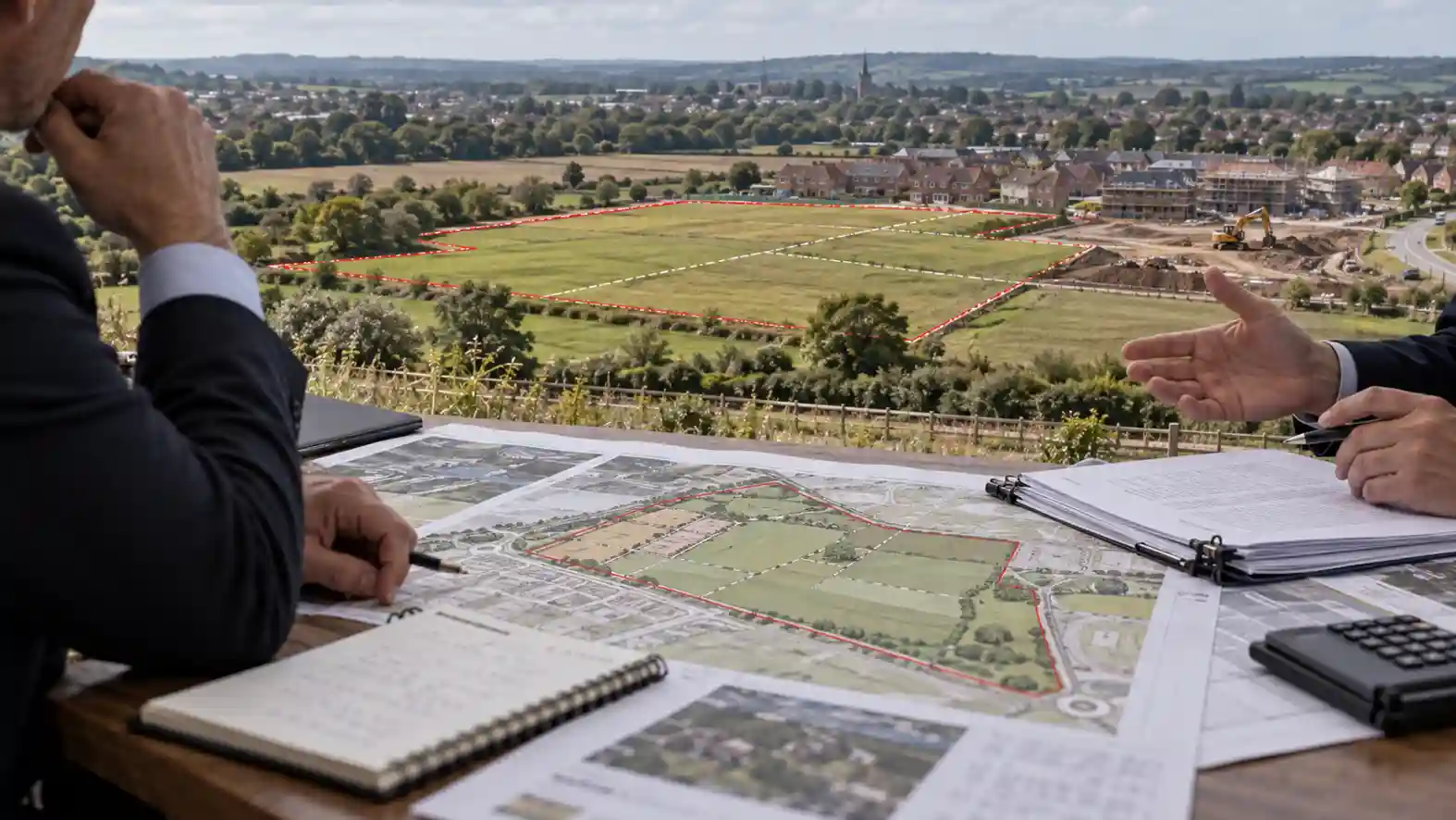
A landowner and a regeneration authority can spend months negotiating a voluntary sale while both sides already know, without needing to say it aloud, what happens if the negotiation fails. That background knowledge is not a footnote to the negotiation. It shapes the opening position, the pace, and often the eventual price — which means the practical significance of compulsory purchase power frequently arrives long before, and sometimes entirely instead of, any actual compulsory acquisition. Recent reform to how hope value can be treated in compensation can change that background calculation, but not for every scheme and not simply because an authority says it has the power to acquire. What matters is whether it could actually secure a compulsory purchase order on terms that would exclude development value otherwise payable to the owner.
The principal discussion here concerns England. The hope-value direction framework also extends to Wales, where Welsh Ministers exercise relevant confirming functions and implementation arrangements must be checked separately. Scotland and Northern Ireland have different compulsory purchase systems and are outside the scope of this article.
What changed, and what did not
Two separate pieces of legislation matter, and conflating them would produce a misleading account of what an acquiring authority can now do. The Levelling-up and Regeneration Act 2023 created a targeted power for a compulsory purchase order (CPO) to include a direction under section 14A of the Land Compensation Act 1961, so that compensation for the land’s market value is assessed without certain value arising from the prospect of future planning permission. That can include value attributed to a possible alternative development or to a Certificate of Appropriate Alternative Development. An existing planning permission remains capable of being reflected in the valuation. The government’s explanation of the hope-value direction power is explicit that this is not an automatic consequence of compulsory purchase.
Nor is it a power available to every public body for every regeneration scheme. It applies through specified acquisition powers, including those exercised by certain local authorities, Homes England, development corporations and other eligible bodies. For development or regeneration acquisitions, the qualifying scheme must facilitate affordable or social housing; other eligible powers concern specified NHS and educational purposes. Affordable housing need not constitute the whole development. The authority must explain, in a Statement of Commitments, what it intends to deliver and why excluding hope value is justified in the public interest. The normal justification for compulsory purchase and the additional case for the direction both matter. A CPO without that direction remains subject to the ordinary compensation rules, including relevant independent development potential.
The Planning and Infrastructure Act 2025 made a further set of changes, with the relevant section 113 amendments operating in England by February 2026. It extended the same section 14A direction mechanism to qualifying CPOs made by local authorities on behalf of parish or town councils for affordable or social housing; the Act also refers to community councils in Wales, where commencement needs to be checked separately. It did not simply widen an older, automatic valuation assumption under section 14. It also clarified that where a direction applies, the treatment of hope value carries through to market-value elements of related compensation and loss payments, rather than being confined to one calculation of the land taken. The 2025 Act also removed the bar on an acquiring authority confirming an order containing a direction where the confirmation decision is properly remitted to it, including in appropriate unopposed cases. Separate procedural changes address electronic notices and faster possession in tightly defined situations. They do not turn compulsory purchase into an immediate or unchallengeable transaction, and the commencement position of particular provisions can differ in Wales.
The distinction is commercially significant. The 2023 power created the possibility of excluding hope value where a defined public-interest case is made; the 2025 Act widened and clarified aspects of its application and streamlined some procedures. Neither enacted a general rule that every landowner facing compulsory purchase receives existing-use value alone. In particular, an existing consent can still carry value, and potential claims for other heads of compensation remain subject to their own rules. The question facing an owner is not merely whether compulsory purchase has been mentioned, but precisely which power the authority could use, for what project and on what valuation basis.
Existing use, hope value, and where they diverge
The distinction between the different kinds of value is easy to obscure in a negotiation and fundamental to its outcome. Existing-use value is what the land is worth for its present lawful use. A permission already granted may give it a different value. Hope value is the further amount a buyer might pay because there is a prospect of obtaining a more valuable permission in future, even though none has yet been granted. The ordinary compensation code can recognise that prospect in the world without the acquiring scheme. It has long excluded any increase or decrease in value created by the scheme itself under the separate no-scheme principle. The new direction power can remove qualifying hope value that might otherwise have existed independently of the authority’s scheme; it should not be confused with the long-standing rule against paying for uplift created by the scheme being delivered.
That difference creates a practical fork in an owner’s valuation case. Evidence of an existing permission, a realistic alternative planning prospect or demand for the land without the authority’s project can matter considerably under ordinary compensation rules. A confirmed section 14A direction can remove the latter prospective element even when it is independent of the scheme, while an existing permission may still support value. And even where the direction is effective, compensation is not reduced to a universal flat rate: the actual interest acquired, any existing consent and other properly recoverable heads of loss still require assessment. The government’s guidance on compensation for business owners and occupiers distinguishes land value from such matters as disturbance, rather than treating every loss as one undifferentiated land-price claim.
Negotiating in the shadow of a power that may never be used
The central analytical point is this: a credible statutory fallback can change voluntary negotiation even when it is never exercised. The direction does not itself impose a statutory price on a sale agreed voluntarily; the parties remain free to negotiate. But a landowner with a viable alternative development prospect may approach that negotiation differently if the acquiring authority could realistically obtain a CPO containing a hope-value direction. Simply mentioning the reform gives an authority no entitlement to buy at existing-use value. The prospect only has weight to the extent that the particular acquisition power, the scheme’s qualifying public benefits, the supporting evidence and the prospects of confirmation make the threatened route credible. A private developer negotiating an ordinary commercial acquisition does not acquire the direction power merely by participating in a regeneration partnership; any CPO fallback has to rest on the powers and public-interest case of an eligible acquiring authority.
The balance does not straightforwardly favour the acquiring authority in every case. Authorities generally have reasons to prefer a negotiated purchase to the expense, time and uncertainty of a contested CPO. A scheme relying on outside funding, an intricate land assembly or a demanding delivery programme may be particularly sensitive to delay. A landowner may have credible arguments about whether the site is genuinely required, whether alternatives have been considered, whether the public benefits warrant removing hope value and what the land would be worth independently of the scheme. Objections to an order and a statutory challenge to its confirmation are different from a later dispute over compensation before the Upper Tribunal (Lands Chamber); none is a costless or automatic route to a better price. They nevertheless matter because the authority’s ability to carry its fallback through is part of what both sides are weighing at the negotiating table.
There is a further restraint on the acquiring authority that is easy to overlook. Its Statement of Commitments is not merely a marketing document used to secure a cheaper acquisition. Where a direction is confirmed, an eligible former owner may seek a further direction for additional compensation if the authority has not materially fulfilled its commitments, ten years have elapsed since the CPO became operative or delivery within that period is no longer realistic, and the original direction would not have been confirmed in light of what the authority actually did. There is a statutory application procedure and time limit; an altered project does not automatically trigger a repayment. It does mean the authority’s promised public benefits have a continuing relevance after acquisition, and their deliverability should be tested rather than treated as a formality. The government’s compulsory purchase guidance updated in June 2026 sets out the documentation and decision-making context in which that case must be made.
The contested policy question, argued from both sides
This is a genuinely disputed area of policy, and the fair account requires both positions. The government’s argument is that the ability to exclude certain prospective development value, when justified in the public interest, can make affordable housing, health or education schemes viable that would otherwise absorb too much of the available funding in land acquisition. It can also reduce the leverage of an owner whose parcel is essential to assembling a larger site. That is a case about delivering public benefits at a manageable cost, not proof that every hope-value claim was unreasonable or that every authority-led scheme has been made more viable by the reform.
Landowners and property professionals raise a different concern: hope value can represent real market demand for development that might have proceeded without the public scheme, rather than a windfall created by it. Removing that value from compensation can therefore depart from the ordinary expectation of market-value equivalence and change incentives to bring land forward voluntarily. RICS argued in its response to the original reform proposals that any improvement in scheme viability had to be weighed against the reduction in what an owner receives, and questioned the evidence that hope-value disputes were a major obstacle to delivery. The Country Land and Business Association also opposed extending the power in 2025, providing a more recent landowner perspective. Public authorities may reasonably regard the resulting savings as a route to more development; affected owners may reasonably regard them as a transfer of value they would otherwise have possessed. Neither argument should be presented as an established outcome of a reform whose wider practical effects on voluntary transactions have not yet been quantified here.
Why the shadow matters more than the trigger
The economic significance of a compulsory purchase power does not always depend on whether an order is ultimately made. Its credibility can change what each party regards as a realistic negotiated settlement, especially on a difficult multi-owner scheme where delay has a cost for everyone. That remains an analytical account of bargaining incentives, not a claim that the reforms have been shown to reduce agreed prices across the market. But the shadow has limits. An authority with no qualifying scheme, no sound public-interest case for a direction or little prospect of carrying a CPO through is in a different position from one that has assembled the evidence and is prepared to proceed. So is an owner with an existing permission, independent development prospects or grounds to question what the authority proposes to deliver. For a landowner or developer, understanding those distinctions before agreeing heads of terms is not a technical exercise reserved for a future tribunal. It is part of understanding the price, timetable and negotiating leverage of the transaction itself.
This article provides general information and analysis about compulsory purchase and land compensation, principally in England, and is not legal, valuation, planning, financial, tax or investment advice. The application and commencement of relevant legislation may differ in Wales; Scotland and Northern Ireland have separate regimes. Compensation and negotiating rights depend on the statutory powers, individual land interests, scheme and circumstances. Obtain advice from a suitably experienced compulsory purchase solicitor and chartered surveyor before agreeing terms or challenging an acquisition.

