

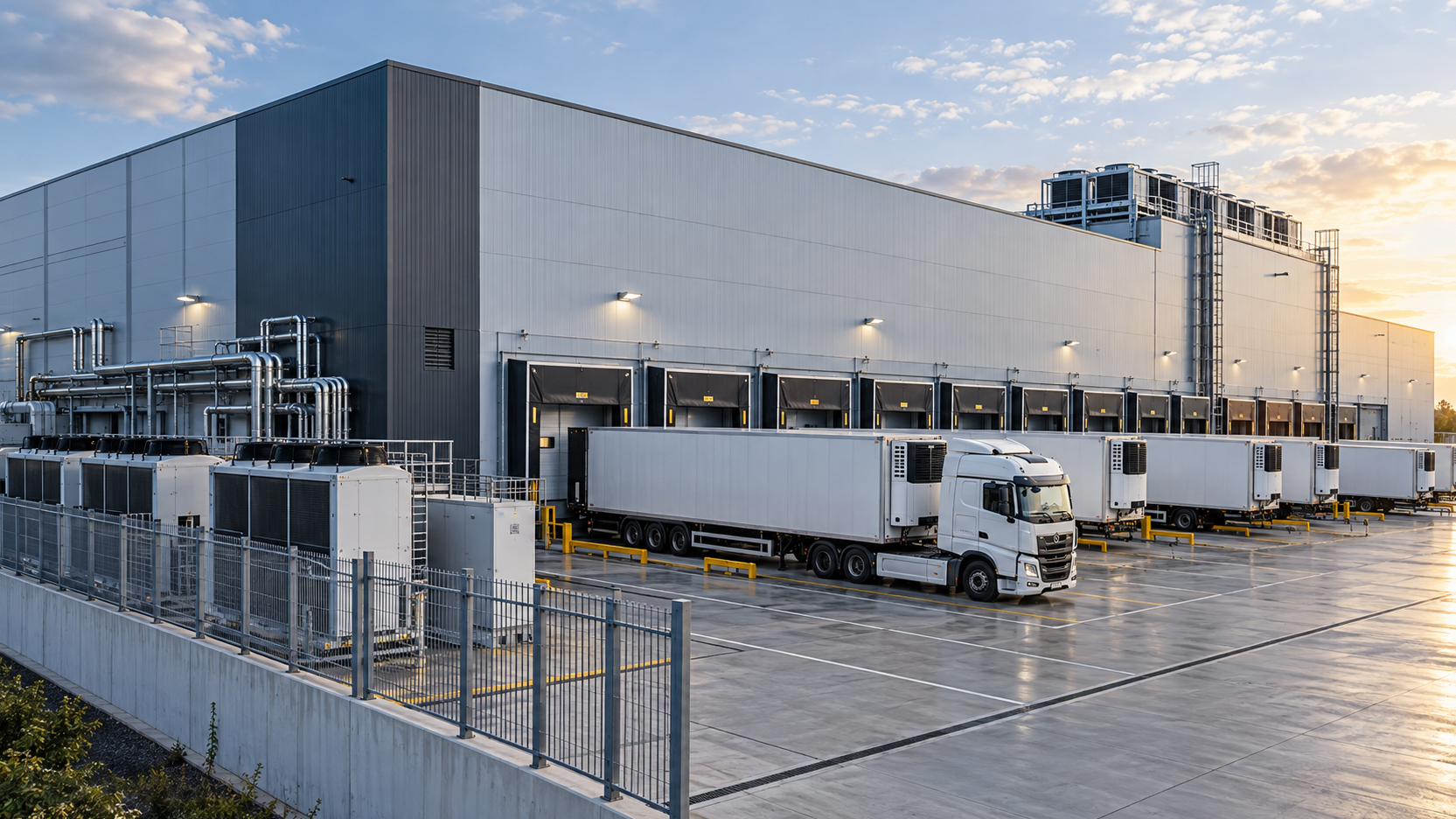
A supermarket chain needing an extra 100,000 sq ft of frozen and chilled distribution capacity cannot solve the problem the way a parcel operator would. It cannot necessarily take a standard speculative shed, sign a short lease, and install some refrigeration units before the first delivery arrives. The building it needs barely resembles the building next door on the same industrial estate, even though both would appear identically in a floorspace return. That difference — routinely collapsed into “warehousing” in casual market commentary — is the reason cold storage now behaves as its own distinct property market rather than a specialist corner of the industrial sector.
Why refrigeration cannot simply be retrofitted
The instinct to think of cold storage as a warehouse with chillers bolted on misunderstands what the building actually has to do. A conventional logistics shed is, structurally, a large insulated box designed to keep weather out and provide clear span floor space. A modern cold store may have to maintain multiple, often very different, temperature zones — deep-frozen at around minus 18 to minus 25 degrees, chilled at just above freezing, and sometimes ambient or blast-freezing zones within the same facility — continuously, for years, with the failure of that system potentially representing a total loss of stock rather than a maintenance inconvenience.
That requirement drives a genuinely different specification. The building envelope needs a far higher standard of insulation across floor, wall and roof than a standard industrial unit, because thermal bridging or a poorly sealed envelope in a cold store translates directly into energy cost and condensation risk rather than simply reduced comfort. Refrigeration plant is not an add-on; it is core building infrastructure, typically requiring dedicated plant areas, resilience through backup systems, and — because a prolonged refrigeration failure can destroy an entire stockholding — a level of redundancy that a conventional warehouse’s electrical and mechanical systems may not need. Floor construction has to prevent the ground beneath deep-freeze areas from freezing and expanding, a problem known as frost heave that can damage the slab and supporting structure. Dock configuration needs to manage the transition between temperature zones and the outside world without compromising the cold chain during loading — a detail that sounds minor until it is the reason a shipment fails a food-safety audit. Converting an existing warehouse is possible, but the extent of the work depends on its original design: inadequate electrical capacity, an unsuitable floor or an envelope that cannot economically be upgraded may make adaptation considerably less straightforward than the building’s appearance suggests.
The capital cost gap, and why it changes who can build
Industry research published by CBRE in April 2025 puts the build cost of a large automated cold store at approximately two-and-a-half to three times that of a standard industrial development, with the economics of extensive automation generally requiring considerable scale — around 50,000 pallets or more according to CBRE’s assessment. That combination of higher unit cost and a higher minimum viable scale for automation is precisely why an occupier with a modest, specific cold-chain requirement cannot simply commission a smaller bespoke automated facility on the same economics as a general logistics user would: the capital intensity of cold storage rewards scale in a way conventional warehousing does not, which concentrates major development and operation among specialist businesses with the balance sheet and expertise to run large, automated, energy-intensive facilities rather than generalist developers dabbling at the margin.
For property investors, the consequences extend beyond the initial construction bill. A conventional logistics building may have a reasonably broad pool of potential replacement occupiers, but the value of a cold store is more closely bound to the specification of its refrigeration systems, the availability and cost of electrical power, its operating efficiency and the requirements of a narrower occupational market. Who owns the refrigeration plant, who must maintain or replace it under the lease, and whether the facility could be economically adapted for another occupier become material investment questions. A building can remain structurally sound while the specialist infrastructure that supports its income requires substantial reinvestment. Equally, a modern and efficient facility with secure long-term occupation may be difficult for competitors to replicate, giving its specialist characteristics commercial value rather than simply representing additional risk. The distinction extends into business rates. The Valuation Office Agency’s 2026 guidance for stand-alone cold stores in England and Wales applies additions of 25% for frozen chambers and 15% for chilled chambers when deriving certain business-rates assessments from local warehouse rental levels, alongside age and obsolescence adjustments. Those are valuation rules for business rates, not evidence that a landlord can automatically command the same percentage uplift in market rent; large temperature-controlled distribution centres also have a separate rating approach.
An ageing stock, and a market only now catching up
The scale of the replacement challenge facing the UK cold-chain sector is significant. CBRE estimated UK third-party logistics cold storage capacity at around 3.4 million pallets in April 2025, describing the UK as Europe’s largest such market by capacity — but a large share of that stock is old. Its research estimated that roughly 40% of the stock in its UK third-party cold-store dataset was between 20 and 30 years old, and a further 30% was at least 30 years old, much of it designed under specifications, energy standards and automation assumptions from a different era of retail and food logistics. Smaller, older facilities can face particular obsolescence risks, both because they may be less able to accommodate modern automation and because their operating costs may compare poorly against newer, larger competitors. That does not mean age alone makes a store redundant: the condition of the insulation, refrigeration plant and operational layout, and the scope for refurbishment, matter just as much.
Energy performance is one reason this cannot be judged from floor area or building age alone. The Cold Chain Federation’s energy benchmarking programme uses annual electricity and refrigerated-volume data from around 450 participating stores and separates chilled from frozen operations when comparing performance. For an investor assessing two apparently similar assets, that is a more meaningful starting point than assuming the newer building must be cheaper to run. The development response identified by CBRE was real but modest relative to the ageing base. In April 2025 it reported that just under 92,000 new pallets of capacity were scheduled for delivery during 2025/26, with a further roughly 457,700 pallets identified at pre-planning stage. Those were projections, not verified completions, but they illustrated the scale of proposed investment. The shift towards very large sites is visible beyond that forecast: in May 2026, NewCold reported around 184,000 pallet positions at its Corby complex, a reminder of how far the capacity of individual automated sites can now exceed that of an older regional cold store. The schemes in CBRE’s 2025 pipeline were largely build-to-suit rather than speculative: the capital intensity and specification risk make a large automated cold store an even harder building to commit to without an established occupier or operating requirement than a conventional big box shed.
Automation is changing the economics of cold storage
One of the more striking figures to emerge from CBRE’s 2025 industry analysis was the automation gap between existing and planned cold storage. Only around 5% of existing UK third-party cold-storage facilities in its research operated significant automation, yet automation was expected to feature in roughly 91% of the new stock then under development. That is a marked difference between the existing estate and the pipeline, and it reflects a straightforward economic logic specific to this sector: labour in sub-zero and chilled environments is demanding, with protective clothing, warming breaks and other safety measures necessary according to the working conditions. The Health and Safety Executive’s guidance on chilled and frozen workplaces makes clear that these environments require appropriate risk assessment and controls. Reducing manual pallet movement in those conditions can make automation particularly attractive, alongside the potential to improve storage density and operating efficiency. It also reinforces the scale threshold noted earlier — extensive automation of this kind is generally more economical in the larger facilities becoming prominent in new development.
Demand: not only supermarkets
Retail grocery, and specifically the growth of frozen and chilled food sales, remains a major demand driver — UK retail frozen food sales were recorded at around £8.5 billion for the year to March 2024, up roughly 12% on the previous year, a trend commentators linked partly to cost-of-living pressures pushing households towards frozen alternatives and partly to the appeal of longer shelf life and reduced food waste. But cold-chain demand extends well beyond supermarket distribution. Pharmaceutical storage and distribution, where temperature control can be a regulatory requirement rather than a commercial preference, represents a distinct and often higher-specification segment of demand. The Medicines and Healthcare products Regulatory Agency’s good distribution practice requirements illustrate why temperature management, monitoring and product integrity matter in those supply chains. Specialist food import and export operations, manufacturers of perishable goods and businesses requiring reliable regional chilled distribution also contribute to demand for modern, well-located, temperature-controlled capacity.
A regulatory transition adding further complexity
Cold storage occupiers and developers are also navigating a refrigerant transition that has no equivalent in most conventional ambient warehousing. Older HCFC refrigerants, including R22, have been prohibited for use in servicing and maintaining equipment since 2015, although existing equipment containing ozone-depleting substances can continue operating in certain circumstances, as explained in the Government’s guidance on ozone-depleting substances. A separate, longer-running phase-down of high-global-warming-potential HFC refrigerants has been operating since 2015, encouraging investment in lower-impact alternatives, including ammonia and carbon dioxide systems. Ammonia offers efficiency advantages but introduces its own toxicity, flammability and safety-management considerations that add design and operational complexity relative to some of the refrigerants it replaces.
The regulatory direction is established, but the precise timetable matters. In May 2026, following consultation on a more ambitious HFC phase-down, the Government confirmed that it would not legislate during 2026 to alter the existing Great Britain phase-down steps applying from January 2027. Northern Ireland operates under a different F-gas regulatory framework. For an occupier or investor assessing an older cold store, the refrigerant system in use is therefore a material due diligence question, because restrictions on servicing, the availability of replacement refrigerants and the future cost of compliance may make plant replacement necessary well before the rest of the building would otherwise need reinvestment.
How a cold store actually differs from a conventional shed
| Feature | Conventional logistics shed | Modern cold store |
|---|---|---|
| Primary function of envelope | Weatherproofing, insulation and clear-span space | High-performance thermal barrier and condensation control |
| Refrigeration/plant | Not normally core infrastructure | Essential to operation and business continuity |
| New automated development scale | Varies widely | Around 50,000 pallets or more for the automation economics identified by CBRE |
| Build cost relative to standard shed | Baseline | Roughly 2.5–3 times for the large automated facilities in CBRE’s research |
| Automation in new-build stock | Increasing across logistics | CBRE expected around 91% of its 2025 development pipeline to be automated |
| Refrigerant/regulatory exposure | Limited in standard ambient storage | Restrictions on ozone-depleting substances and high-GWP F-gases |
A specialist market, not a warehouse variant
None of this means every business that occasionally needs chilled storage requires a purpose-built automated facility — smaller-scale, mixed-temperature space still has a role, particularly for regional distribution and businesses without the volume to justify the capital intensity described here. But the direction for the sector’s core, high-volume capacity is clear. Cold storage is increasingly being built, financed and operated as a distinct specialist segment of the industrial property market, with its own capital requirements, its own obsolescence timeline, its own regulatory pressures and its own automation trajectory — one that happens to sit on the same industrial estates as conventional logistics sheds, but has stopped, in any meaningful sense, being the same kind of building.
This article provides general information and market analysis, not property investment, valuation, engineering or legal advice. Construction costs and operational requirements vary between facilities, while regulatory obligations depend on the equipment, its use and the relevant jurisdiction. Developers, investors and occupiers should obtain appropriate professional and technical advice before making property or capital-investment decisions.

