

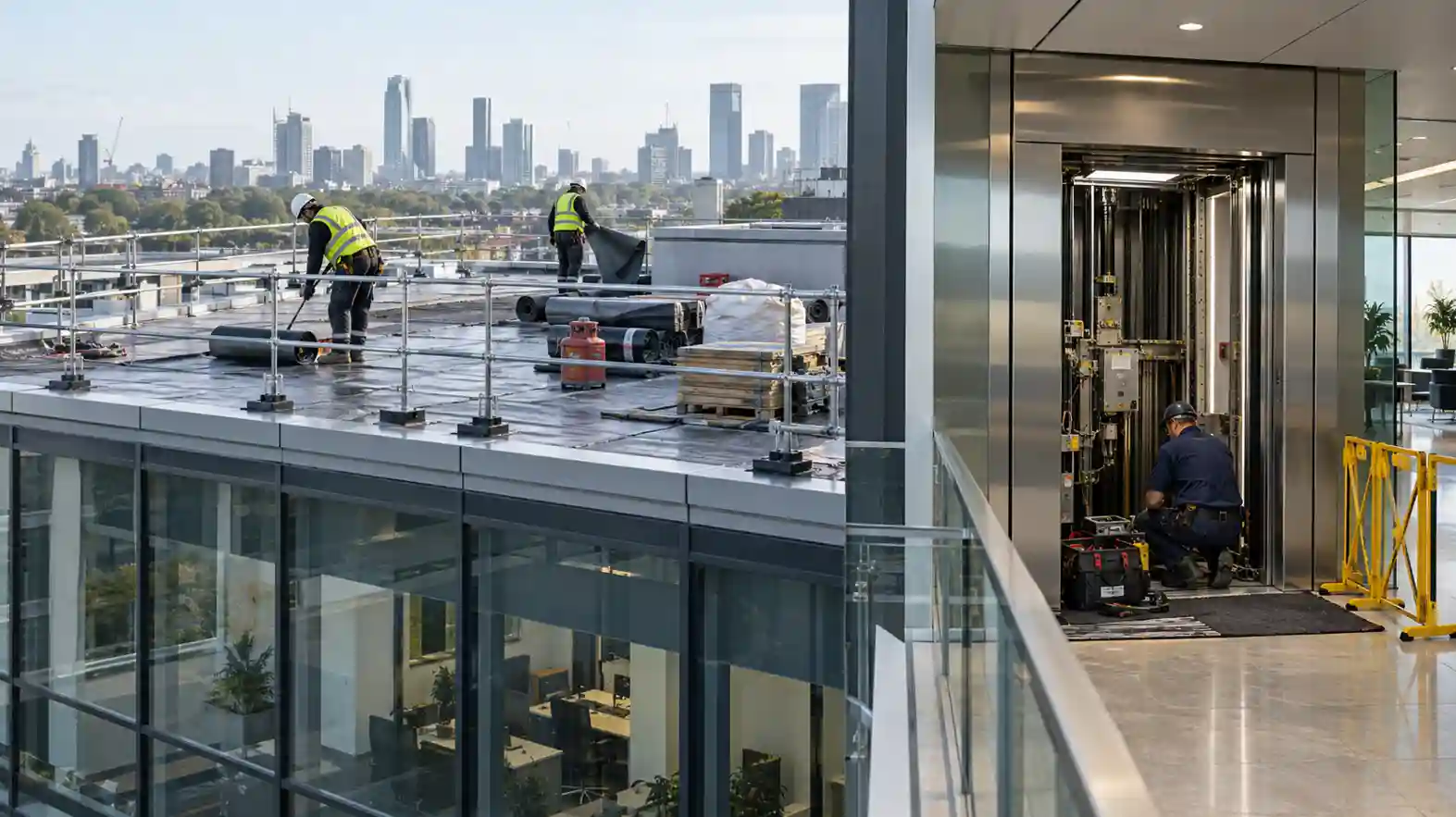
An eighteen-month tenant receives a service charge demand for a share of a roof replacement that will keep the building watertight for the next quarter of a century. The roof genuinely needed replacing — nobody disputes that the old covering was failing and expensive to keep patching. What the tenant disputes, reasonably, is why its contribution should be calculated as if it will still be occupying the building in year twenty of the new roof’s life, when its lease will have ended long before the investment has delivered most of its value. This is not a service charge dispute in the everyday sense of a landlord padding a budget. It is a genuine allocation problem, and it sits at the point where routine building maintenance stops and landlord capital investment begins — a boundary considerably less clear in practice than most leases pretend it is.
The recovery principle, and why it does not resolve the hard cases
The basic principle governing commercial service charge recovery sounds simple: a landlord should recover no more than the proper cost of services the lease entitles it to recover, without treating the service charge as a source of additional profit. That principle is reflected in RICS’s Service charges in commercial property professional standard, whose second edition took effect on 31 December 2025. It is a useful discipline against overcharging. It does almost nothing, however, to resolve the harder question this article is about: not whether the landlord genuinely spent the money, but whether the work should be charged to tenants at all, and how a major cost should fall on occupiers whose leases cover very different parts of the building’s life.
The lease itself remains the primary authority. One may allow the recovery of repairs and replacements; another may distinguish them from improvements or impose a cap. No professional standard, however current, rewrites a contractual entitlement, although it does impose requirements on RICS members and regulated firms and can inform the way expenditure is administered and disputed. As Stevens & Bolton’s examination of the revised standard observes, the greater transparency and tighter professional controls do not turn it into legislation. RICS has also clarified transitional arrangements for accounting periods already under way when the standard took effect, expecting the updated requirements to be fully adopted for service charge years ending on 31 December 2026 and beyond.
Repair, replacement, and the line that keeps moving
The starting distinction many leases draw is between repair — putting right what has failed or deteriorated — and improvement, which enhances the landlord’s asset rather than simply maintaining what occupiers already pay to use. In practice, the line moves because major works rarely sit cleanly inside either category. A new roof may provide better insulation than the old one; a replacement lift will almost certainly be more reliable and efficient; a modern heating system may use much less energy than equipment installed decades earlier. None of those advantages, on its own, necessarily makes a necessary replacement an unrecoverable improvement.
Modern equivalent replacement is the clearest example. When ageing plant fails, replacing it with the original model may be impossible, uneconomic or incompatible with current requirements. The RICS standard’s treatment of replacement and enhancement recognises that replacing worn-out equipment with its modern equivalent generally falls within repair rather than improvement. Betterment beyond that equivalent — choosing materially more capacity, an enhanced specification or work intended substantially to reposition the building — is where the case for recovering the entire project cost becomes weaker. The sensible comparison is not between the failing installation and an imaginary identical replacement, but between the reasonable cost of restoring the existing function and the additional cost of the option the landlord has chosen.
Energy-efficiency works make this distinction particularly difficult. A more efficient installation may lower tenants’ energy or maintenance bills while also improving the owner’s investment and the property’s future lettability. RICS does not rule out recovery of enhancement costs in every circumstance: it asks for evidence of alternatives, a cost-benefit case measured over tenants’ lease terms and proper communication and agreement, always subject to the contractual position. RICS commentary on EPCs and energy improvements likewise recognises that recovery depends on lease wording. The same programme can therefore contain a defensible replacement cost and a separate investment element, even when a single contractor delivers both.
The problem with long-life works and short remaining leases
Even where a piece of work is properly classified as recoverable, a second and genuinely harder allocation question follows: over what period should the money be collected, and how much should fall on an occupier whose remaining lease term is short relative to the useful life of the work?
Consider a landlord replacing ageing heating and ventilation plant or a lift system at substantial cost. The equipment may remain in service for twenty or twenty-five years, far longer than an individual occupier’s lease. Charging a tenant with eighteen months left its full apportioned share in the year of installation can feel like requiring that business to prepay for benefits that later tenants will enjoy. But the opposite arrangement is no easier if the landlord must finance the works now and future occupiers have not agreed to contribute. There is no general legal rule allowing a tenant to reduce an otherwise valid service charge merely by dividing the cost according to the years left on its lease. That uncomfortable difference between contractual liability and economic fairness is why the original lease negotiations, and the funding arrangements subsequently agreed, matter so much.
A sinking fund built up over the expected life of a roof or major plant item can moderate that problem, while a reserve fund generally addresses shorter-term or recurring expenditure and the uneven annual charges it causes. Depreciation charging is a different mechanism again: under the RICS approach, it must not be charged for the same item alongside sinking or reserve fund contributions. These are not three descriptions for money a landlord can collect whenever a large bill is approaching. A lease must permit the relevant charge, or the parties must establish a suitable separate agreement. Nor is agreeing to pay an already incurred bill over several years the same as building a fund in anticipation of replacing an asset.
The difficulty is greatest in buildings where equipment reaches the end of its life without a fund having been established. RICS now provides voluntary forms for agreeing to fund future works, retain money already collected for deferred works, or spread an incurred cost through a payment plan. The distinction matters because the landlord cannot retrospectively create a contractual sinking fund simply by describing its budget as forward funding. Void units also have to be accounted for: where a property is partly empty, the landlord should bear the appropriate share attributable to those premises, including contributions to properly constituted funds, rather than distributing the empty units’ burden across the remaining tenants. A building with extensive vacancy may therefore be facing a substantial capital requirement precisely when its rental income is weakest.
When maintaining the building becomes investing in the asset
The intellectual centre of the problem is a question worth asking of any major landlord-instructed work: does it restore or continue a function the tenant is already paying to receive, or enhance the underlying asset in ways that will principally benefit whoever owns or occupies it years later? Genuine repair and modern-equivalent replacement sit on the maintenance side of that line, however impressive the replacement looks beside the failed equipment. A landlord using the failure as the occasion to extend the building’s capabilities, raise its specification before reletting or undertake part of a wider repositioning may be doing something closer to capital investment — work it is entitled to commission but not necessarily entitled to fund entirely through occupiers’ service charges.
The dividing line is rarely visible on a contractor’s invoice. A project can address accumulated disrepair, necessary replacement and an optional upgrade in the same programme; it may also include work made more expensive by years of deferred maintenance. RICS excludes expenditure arising from landlord or manager negligence from service charge recovery as a matter of professional practice, though a costly replacement alone does not prove negligence. For a landlord assessing the return on a refurbishment, the distinction matters as much as it does to a tenant considering the demand. Any element properly borne by the owner remains a cost of investing in the property, rather than disappearing because it was undertaken during a service-charge-funded project.
What happens if the works are unfinished at lease end
The long-life-works problem has a mirror image when a tenant’s lease ends partway through a programme for which contributions have already been collected. Money in a properly established sinking fund may remain attached to the future replacement of the building’s equipment when an individual tenant leaves, according to the fund’s terms. An unspent reserve is not necessarily treated the same way. The RICS standard, referring to the decisions in Brown’s Operating System Services and Friends Life, identifies the generally accepted position that unspent reserve contributions are tenants’ money and may be repayable on expiry or earlier determination of the lease. The particular lease and fund arrangements remain decisive, but it is too broad to suggest that all advance contributions can simply be retained for whoever occupies the property next.
The courts have had to grapple with precisely this timing problem. In Friends Life Management Services v A&A Express Building (2014), the High Court considered major works carried out after a tenant had exercised its break clause and the calculation of its final service charge under that lease. The landlord could not simply attribute later expenditure to the departing tenant because the works had been contemplated while the tenancy existed. That does not settle every dispute over advance funds, but it shows why a balance collected for future works, an actual liability incurred during occupation and expenditure arising after the lease has ended must not be treated as interchangeable.
There is an accounting version of the same difficulty. Money budgeted for work that has not started is not an accrual for expenditure already incurred; the RICS standard distinguishes genuine liabilities for services supplied from provisions for future projects. If an anticipated replacement is deferred, amounts previously collected need to be credited or retained under an appropriate permitted or agreed arrangement, rather than left in the accounts as though the contractor has already completed the work. Service charge monies must be held in discrete or virtual accounts, with appropriate interest credited, while the standard recommends trust arrangements for sinking and reserve funds. A dilapidations claim at lease end may introduce yet another dispute where the departing occupier is asked to meet a repairing obligation overlapping with a service-charge-funded project. Records of what was charged, completed and paid for during the tenancy become more valuable than an attempt to reconstruct the history after it has ended.
Transparency is what prevents disputes
None of these allocation questions is resolved by transparency alone, but it is much easier to examine a landlord’s proposed works before a large bill has been incurred than to reconstruct the justification afterwards. The current RICS standard requires service charge budgets, with explanatory commentary, at least one month before the accounting year and approved year-end accounts within four months afterwards, subject to the requirements for explaining unavoidable delays. It also requires an apportionment matrix identifying the basis on which costs are divided between units. For major replacement works, the useful supporting information goes further: condition reports, the alternatives considered, the reason for the chosen specification, the treatment of any enhancement and an explanation of whether funding will come from existing reserves, a new agreement or an immediate recoverable demand.
A tenant receiving that information early can question what belongs to repair and what amounts to improvement, examine the proposed allocation and take specialist advice while there is still scope to discuss the works and payment arrangements. A landlord has an equally strong interest in establishing and documenting the basis of recovery before committing to expenditure that may later prove irrecoverable. Disputing a demand does not generally entitle an occupier to withhold service charges properly payable under its lease, though the precise position depends on the facts and terms. The more useful conversation is one held before the invoice lands, while the work, its benefits and the way its cost is shared can still be explained. That is a considerably better position for both parties than a dispute conducted after the money has been demanded and the working relationship has already suffered.
This article provides general information and analysis about commercial property service charges and leasing, not legal, financial, tax, valuation or investment advice. Recovery of major works costs depends on the wording of individual leases, any separate agreements, the circumstances and the applicable jurisdiction. The RICS professional standard does not automatically override contractual rights or obligations. Obtain specialist advice before making or challenging substantial service charge demands.

