

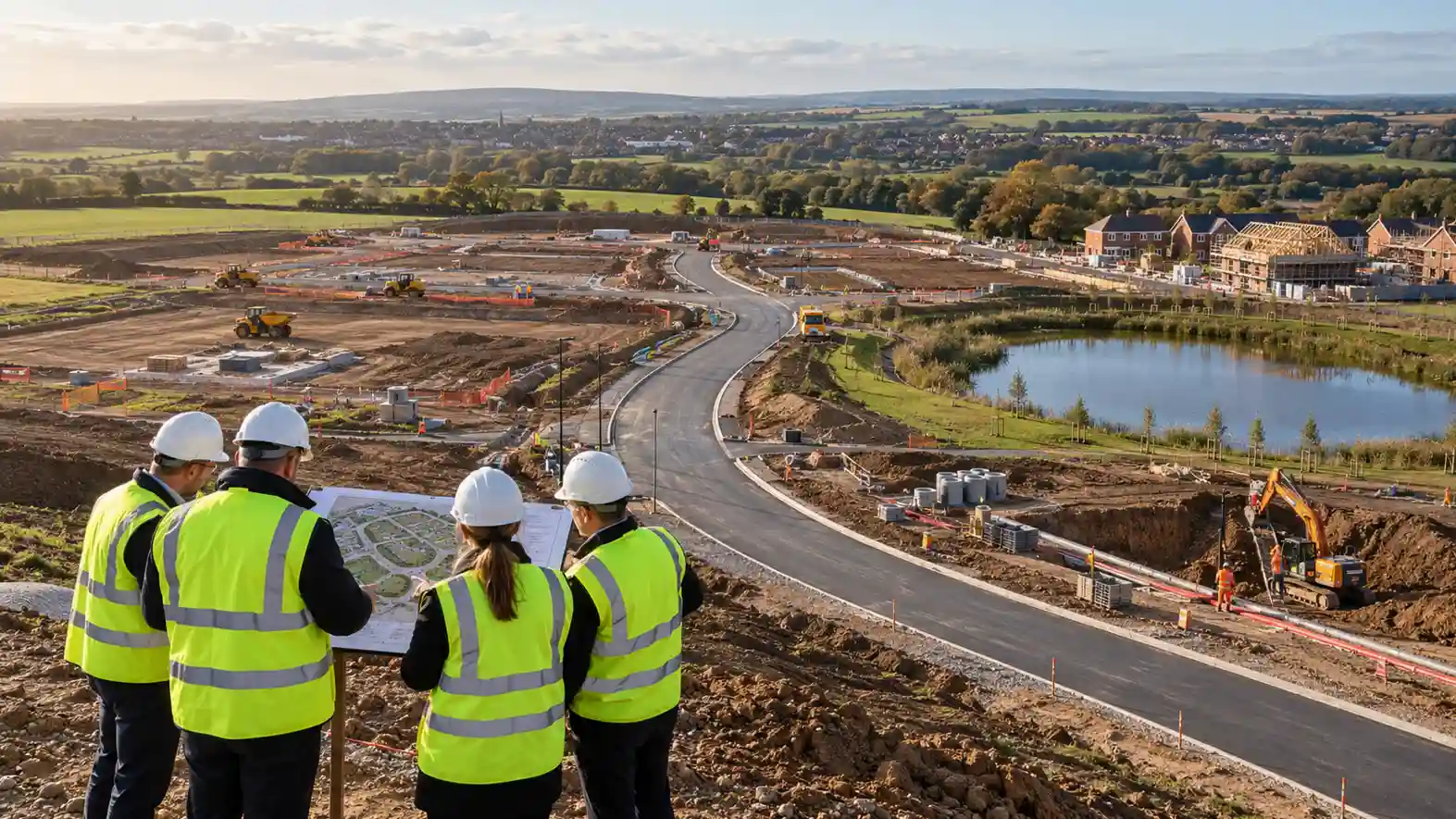
Before a housebuilder’s sales team can put a show home on a strategic site, somebody has usually spent several years, and substantial sums of money, on land that produces no saleable product at all. Fragmented ownership has to be assembled into a sufficiently controllable interest. A masterplan has to establish a planning framework across the whole site, not just one phase of it. Primary roads, drainage, utilities and often a new school have to be designed, funded and delivered in a sequence that makes individual housing parcels possible. None of that is necessarily the business a conventional housebuilder is best placed to undertake, and increasingly, it is a separate business in its own right.
A different economic model, not a bigger version of the same one
The distinction worth establishing early is that a master developer and a plot developer are not doing the same job at different scales. A plot developer wants a defined, serviced parcel with planning clarity, manageable construction risk, and the ability to turn capital over reasonably quickly — build, sell, move to the next site. That is a sound and well-understood business model, but on a large strategic scheme it depends on somebody else having already undertaken the unglamorous, capital-intensive work of making the land developable in the first place. Some major housebuilders do undertake both roles, but that does not make the underlying economics the same.
A master developer takes on a fundamentally different risk profile: strategic land risk before consent is secured, infrastructure risk in funding roads, utilities and community facilities years before they generate a return, coordination risk in sequencing multiple housebuilders, tenures and phases across a single masterplan, and placemaking responsibility that extends well beyond any individual builder’s plot boundary. The return on that risk, when it comes, arrives later and depends on the site’s long-term success as a place, not just on the sale of individual homes. It is a model that requires patient capital and the capacity to absorb substantial expenditure before a meaningful income stream begins, which is precisely why relatively few organisations are structured and incentivised to take it on.
Creating value by making land deliverable for others
The insight easiest to miss, particularly from outside the industry, is that a master developer does not typically build most of the finished homes on a large strategic site at all. Its value is created earlier and differently, through a broadly repeatable sequence: assembling and controlling land across multiple ownerships, securing planning and masterplan certainty for the site as a whole, delivering the primary infrastructure that makes individual parcels buildable, and then selling or partnering on those serviced parcels with housebuilders, registered providers, build-to-rent investors or other end developers. The work can continue long after the first parcels are sold, with responsibility for coordinating later phases, community facilities, public spaces and the wider standards that hold the development together.
The commercial arrangements behind those parcel transactions are more varied than a straightforward land sale. Some serviced plots are sold outright for an agreed sum, while others are transferred under agreements providing for deferred payments, participation in house-sale proceeds or joint-venture returns. Urban&Civic describes serviced-land agreements under which housebuilders can commit relatively little capital upfront while the master developer participates in the proceeds of individual home sales. That allows the housebuilder to concentrate more of its money on constructing and selling homes, while the master developer retains an interest in the site’s continuing development value. It also extends the period over which some of the master developer’s return is received.
That last step, capital recycling, is what allows a master developer to operate at genuinely large scale without needing to fund an entire multi-thousand-home scheme from its initial balance sheet. Receipts from one phase help finance the next phase’s infrastructure and land preparation, alongside whatever debt, equity or public investment the project requires. The commercial logic is straightforward to state and genuinely difficult to execute: a masterplanned, infrastructure-enabled parcel is worth substantially more to a housebuilder than raw, unserviced land with fragmented ownership and no planning certainty. The difference between the value of raw land and that of a serviced parcel is where the master developer’s return is created, but it is not all profit. Land acquisition, planning, infrastructure, financing and the obligations attached to the wider development must be paid for before that value can be fully realised.
The timing of those payments is one of the model’s least forgiving features. A strategic site can be viable over its full development life while facing an acute cash requirement in its early phases, when the roads and utilities needed to unlock later parcels have to be delivered before those parcels can generate receipts. Schools and other community facilities can create particularly uneven expenditure, because they may need to be constructed or funded well ahead of the homes that ultimately justify them. A scheme can remain viable over its full lifetime and still become difficult to finance when a school or spine road has to be paid for before the next parcels can be sold. If housebuilders then acquire land more slowly than expected, or plot values soften, the master developer may be carrying infrastructure and financing obligations for considerably longer than the original appraisal allowed.
Why this model is becoming more important now
The scale of what large strategic sites now require, and the difficulty of financing infrastructure before housing receipts arrive, is a large part of why England’s housing delivery system is putting greater emphasis on master-development capacity. The Homes England and National Housing Bank investment prospectus published in March 2026 sets out up to £46 billion of support over the next decade. That includes at least £27 billion of Social and Affordable Homes Programme grant through Homes England, around £3 billion for land, infrastructure and viability support, and up to £16 billion available through National Housing Bank debt, equity and guarantees. The Bank became operational on 1 April 2026, with the ambition of attracting more than £50 billion of additional private investment. The £46 billion is not funding reserved for master developers. It is a broader housing and regeneration investment platform, within which the provision of land and infrastructure is one of several priorities.
Within that framework, Homes England has set out three land-related approaches that speak directly to the distinction between preparing a site and building the homes upon it. Land Assembly involves acquiring key sites and investing in the infrastructure needed to unlock development where viability or market failures would otherwise prevent it. Enhanced Strategic Land Assembly goes further, positioning Homes England as a direct master developer on complex sites, acquiring the full land interest and taking responsibility for procuring the primary infrastructure. Enhanced Master Planning and Collaboration takes a partnership approach, in which Homes England holds a share of the land interest alongside other landowners or investors and shares the upfront costs. These are different ways of allocating ownership, capital and development risk, rather than simply different funding labels.
The National Housing Bank’s infrastructure lending, which can extend to terms of up to fifteen years, reflects the unusually long period over which major site preparation costs may need to be financed. But public finance is not the only route, nor is the expansion of master-development capacity a wholly new development. Specialist private developers and institutional investors have been working through these problems for years, sometimes with public-sector funding and sometimes without it. The significance of the new policy framework is that it explicitly recognises a shortage of capacity to undertake the site-wide work that makes housing delivery possible, rather than assuming that every housebuilder can or should absorb it as part of its normal development business.
The potential benefit also extends to smaller housebuilders. A firm capable of building and selling a modest phase of homes may have neither the capital nor the appetite to acquire a substantial strategic site, secure its overall planning consent and fund the infrastructure that serves several thousand dwellings. Access to a serviced parcel within a coordinated masterplan allows that firm to participate in a larger development without taking on the financial exposure of the entire project. That does not guarantee faster housing delivery, which remains dependent on market demand, available builders and the range of homes being offered, but it allows risks to be allocated differently from a scheme dependent on one developer doing everything.
Following a site from raw land to serviced plots
It is worth tracing what this actually looks like on a large strategic site, because the sequence explains why the risk sits where it does. At the outset, land may be held across several ownerships, have no planning consent beyond perhaps an allocation in a local plan, and generate no development income whatsoever. The master developer’s first task is establishing sufficient control over enough of the site to make a coherent masterplan possible, whether through outright acquisition, option agreements, promotion arrangements or a partnership structure that aligns the landowners behind a single planning strategy. Even that preliminary stage can take years where ownership boundaries, access rights or competing landowner expectations make assembly difficult.
The masterplanning and planning process addresses the site as a whole rather than parcel by parcel — a materially different undertaking from seeking permission for a single housebuilder’s scheme, because the wider infrastructure strategy, phasing, housing mix and community facilities have to work together even while individual parcels may be developed years apart. Outline consent can establish the overall development framework, with detailed permissions following for separate phases. Land agreements, infrastructure works and the construction of individual housing phases can overlap, provided the necessary planning obligations and delivery arrangements allow it. A site does not have to be fully serviced across its entire area before the first housebuilder begins work, but the infrastructure necessary for each phase must be sufficiently certain to support its delivery.
Once the relevant access, services and planning framework are in place, individual parcels become much more attractive to plot developers. They offer defined land, a clearer route to construction and a reduced exposure to the costs and uncertainty of the wider site. Transactions can then proceed through outright sales, staged payments or development agreements, with capital and receipts flowing back through the larger project. Urban&Civic’s Houlton development near Rugby provides a practical example of the scale involved: a masterplanned community incorporating thousands of homes, schools, employment space, local centres and substantial open space, with individual housing phases proceeding within a common infrastructure and placemaking framework.
The financial results of established land businesses show why the distinction between different transaction models matters. Harworth’s March 2026 full-year results recorded 1,112 freehold residential plot sales and another 725 plots through planning promotion agreements in 2025, the latter producing fee income rather than equivalent freehold disposal receipts. The company also reported that completed sales were, on average, approximately 4% below their June 2025 book values. Harworth combines different land and development models, but its results illustrate how the value realised from land can depend on both the commercial arrangement and the market into which the plots are eventually sold. A master developer that has already committed substantial sums to infrastructure is particularly exposed when those receipts arrive more slowly, or at lower values, than expected.
Multi-owner sites and the cost-sharing problem
One further complexity deserves acknowledgement, even though it merits its own dedicated treatment elsewhere rather than full exploration here: on a large strategic site held across multiple landowners, infrastructure and development value are rarely distributed evenly across the land. One landowner’s parcel might happen to contain the designated school, the main spine road, the flood attenuation basin or the strategic open space — infrastructure that carries little or no direct housing development value of its own but is essential to the scheme as a whole — while another landowner’s parcel contains the high-value housing plots that infrastructure exists to serve.
Equalisation agreements, infrastructure cost-sharing arrangements and value-pooling mechanisms exist precisely to prevent this geographic accident from producing wildly different outcomes for landowners whose holdings happen to sit in different parts of the same masterplan. Without some agreed mechanism for sharing costs and value, the owner whose land carries essential infrastructure may bear a disproportionate cost while others benefit from the development it enables. The Local Government Association’s guidance on strategic-site delivery identifies unresolved equalisation arrangements as a cause of delay to planning agreements and implementation, while Savills’ July 2026 assessment of larger development sites highlights the importance of collaboration between owners whose land has very different roles within a scheme. The arrangements can take several forms, and there is no single compulsory formula for distributing the costs or resulting uplift.
Getting that structure right, or wrong, has a direct bearing on whether a multi-owner site can actually be assembled and brought forward at all. A disagreement over the land required for a school, the funding of a road crossing several ownerships or the division of future sale proceeds can hold up a development long before any contractor is ready to start work. The issue is not simply how landowners divide the eventual profit. It is whether they can establish the legal and financial arrangements that allow the wider site to operate as one development in the first place.
The hardest part happens before anyone notices
The practical conclusion for anyone assessing a large strategic site is that the conventional development appraisal — build cost, sale value, land residual — captures only the part of the process that happens after much of the genuinely hard work is complete. The years of land assembly, the masterplanning and consenting of an entire site rather than a single scheme, and the upfront commitment to infrastructure that may generate no return until parcels can be sold against it, are where a strategic site’s fate is actually decided.
That is also where the specific skills, patience and capital structure of a master developer — whether a private specialist, an institutional partner or Homes England acting directly — matter most. Recognising the distinction between making a large site developable and constructing the homes upon it is not academic; it determines who should be involved, at what stage, and on what terms, long before the first show home is ever built.
This article provides general information and analysis about strategic land development, principally in England, and does not constitute legal, planning, environmental, tax, valuation, financial or investment advice. Development arrangements, planning obligations, landownership structures and funding availability depend on the individual site and jurisdiction. Obtain appropriate professional advice before making significant land acquisition, development or investment decisions.

