

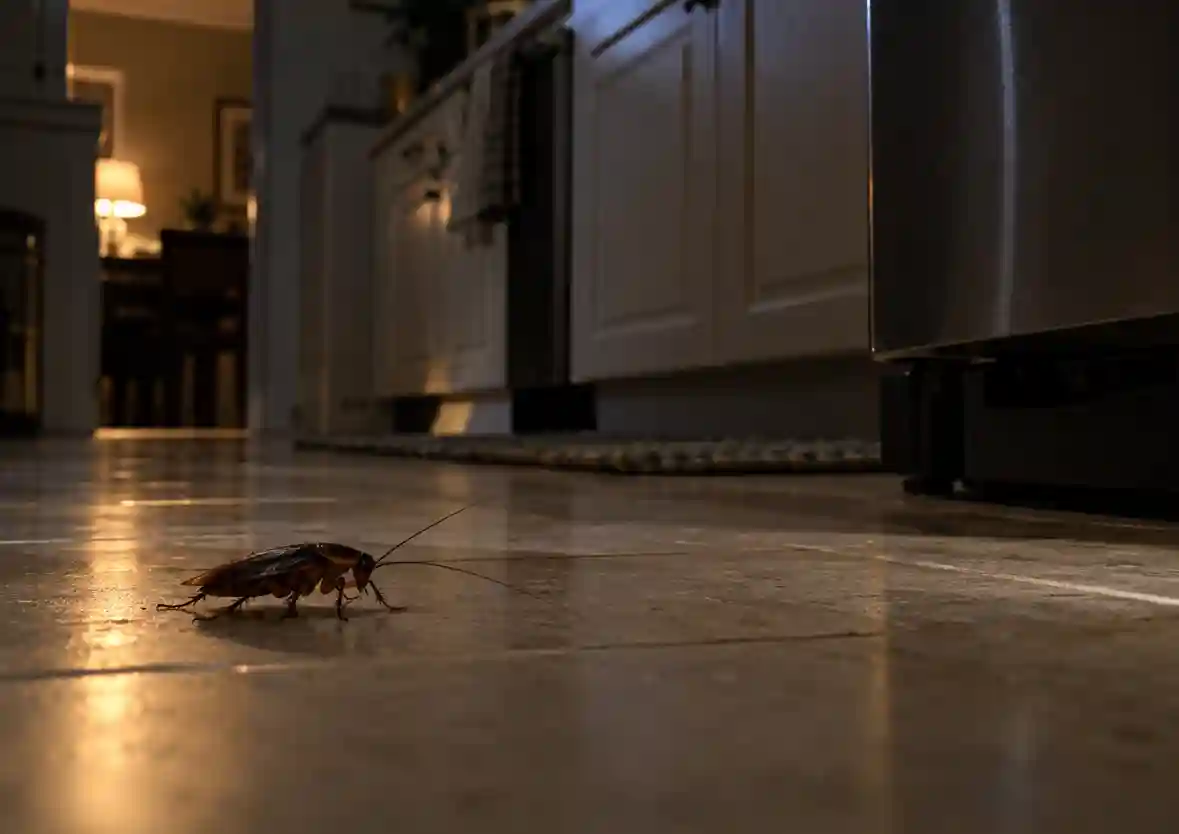
One cockroach, spotted crossing a kitchen floor at night, prompts an immediate and uncomfortable question: is that one insect that has somehow found its way inside, or evidence of others hidden somewhere close by?
One sighting cannot answer that on its own. Cockroaches are predominantly nocturnal and spend much of their time concealed, so an indoor sighting is worth taking seriously, but it is not a headcount. The more useful question is what comes with it: further sightings in the same area, small nymphs as well as adults, droppings, shed skins, egg cases or repeated captures on monitoring traps all make an established population considerably more plausible than a single insect with no other evidence.
That distinction matters because cockroach control goes wrong in both directions. Dismissing one insect because the kitchen looks spotless can allow a genuine problem to develop unnoticed; assuming one sighting means hundreds are behind the fridge can lead to indiscriminate spraying before anyone has established what species it is, where it came from or whether the property is actually supporting a breeding population.
A clean kitchen doesn’t rule this out
This needs saying plainly before anything else, because the assumption otherwise causes real and unfair distress. Cockroaches can enter genuinely well-kept properties. They may be brought in with goods or second-hand appliances, move through gaps around pipes and other services, or spread through connected parts of flats, converted buildings and mixed-use premises.
Poor food storage and inconsistent cleaning can make an existing infestation much easier to sustain, but they are not a prerequisite for one starting. Treating every sighting as evidence that somebody has failed to keep a clean home or business misunderstands how easily pests can be introduced into a building.
Hygiene still matters once they are there. Crumbs beneath appliances, grease around cooking equipment, uncovered food, refuse and persistent moisture all give cockroaches more resources, which is why a visibly immaculate worktop tells you relatively little about what is happening behind the fridge or beneath fitted units.
The British Pest Control Association’s cockroach guidance identifies droppings, egg cases, shed skins, odour in heavier infestations and damage to food or packaging among the signs worth looking for. It also recommends checking less obvious areas such as beneath refrigerators and around sources of food and water.
For somebody who has seen one cockroach, that is a better starting point than cleaning the same visible surfaces again. Look for evidence around the places the insects are actually likely to use.
The two most common UK pest species tell you where to look
German and Oriental cockroaches are the two species most commonly encountered as pests in UK homes and businesses, although other species can occasionally appear. For the householder, the point of identifying them is not to become an amateur entomologist; it is that the two tend to lead the investigation towards different parts of the property.
German cockroaches are smaller and lighter brown, with two dark stripes behind the head. They strongly favour warm indoor environments and are associated with kitchens and other areas containing heat, humidity, food and water. The spaces behind refrigerators, ovens and dishwashers, around warm motors, pipe runs and fitted units are therefore much more useful places to investigate than the middle of an open room.
Oriental cockroaches are larger and much darker. They tolerate cooler conditions and are more commonly associated with damp lower parts of buildings, basements, service areas and drains. A repeated problem involving large dark cockroaches around a cellar or ground-floor drainage area can therefore have a quite different origin from small German cockroaches repeatedly appearing around a warm kitchen appliance.
The distinction matters most when it changes what you do next. Searching the outside bin area because German cockroaches keep appearing behind a fridge may miss the real harbourage; dismantling a warm kitchen because Oriental cockroaches are repeatedly emerging around a basement drain may be equally misdirected.
Lifecycle provides another useful clue without needing to count insects. Cockroaches develop through egg, nymph and adult stages. If monitoring or repeated sightings reveal both adults and much smaller nymphs in the same part of a property, that is stronger evidence that an established population is nearby than one isolated adult with no other signs.
It still does not tell you exactly how many there are. It tells you that the evidence for establishment is becoming harder to dismiss.
What keeps an infestation going — and what brings it back
Cleaning food away is usually the first thing people do, and it is sensible. It is also only one part of the problem.
Cockroaches persist where they can continue to find enough food, moisture, suitable environmental conditions and protected harbourage. In a property, there is a fifth factor that matters just as much: access. An infestation can keep returning because insects are being reintroduced from somewhere outside the room or dwelling that has been treated.
Food can exist in quantities too small to look significant to us. Grease behind cooking equipment, crumbs underneath units, residue around bins and food debris beneath appliances all count. Moisture can be equally easy to miss: a slow leak below a sink, condensation around pipework or another persistent damp source may continue to support activity long after the visible kitchen has been cleaned.
Harbourage is often harder to deal with because it is built into the property. Cockroaches favour narrow, dark and relatively undisturbed spaces. Gaps behind fitted units, broken finishes, service penetrations and voids around pipes can allow insects to spend most of their time somewhere an occupant never sees.
Then there is movement from elsewhere. In a flat, cockroaches can move through service routes and connected voids from another dwelling. In a mixed-use building, a residential unit may sit beside or above food premises, refuse storage or another source of infestation. Deliveries and second-hand appliances can introduce insects into otherwise unaffected properties.
That changes the meaning of “I cleaned everything and they’re still coming back”. The remaining problem may be food or water that has not been found, harbourage that treatment has not reached, later stages of the same population emerging after the adults disappeared — or fresh insects entering from somewhere else.
Permanent proofing can form part of the answer, but sealing every visible crack before anyone has established the movement routes is not necessarily the cleverest first response. Remove accessible food and water opportunities, reduce clutter and obvious hiding places, but let the investigation establish where cockroaches are actually harbouring and moving before turning the building into a frantic sealing exercise.
Monitoring is not the same as treatment
Sticky monitoring traps have a useful role precisely because so much cockroach activity happens out of sight. Positioned in appropriate areas, they can confirm continuing activity, show where catches are concentrated and, particularly after treatment, help establish whether the trend is moving in the right direction.
What they do not provide is a reliable census of the infestation.
A trap containing ten cockroaches does not mean there are ten cockroaches in the property, just as an empty trap placed in the wrong position does not prove there are none. Catch rates depend on placement, pest movement, nearby harbourage and other conditions. Their value is comparative: where are insects being caught, are some locations consistently more active, and are catches declining after control work?
BPCA specifically describes sticky traps as a monitoring tool rather than a means of controlling cockroaches. That distinction matters because trapping the insects that happen to wander across a monitoring board leaves the harbourage, egg cases and whatever is sustaining the population largely untouched.
Monitoring is particularly useful for understanding the complaint that treatment “worked and then they came back”. Adult activity may drop quickly while egg cases remain. Young insects may appear later. One harbourage may have been treated while another was missed. Or a successfully treated flat may simply be recolonised from an untreated neighbouring unit.
Those are different failures, but they look exactly the same to the occupant: the cockroaches disappeared and then reappeared.
That is why a few quiet days are encouraging but not, by themselves, proof that the problem is finished.
What effective control actually looks like
The strongest cockroach treatments are rarely built around one dramatic intervention. They start by establishing what insect is present, where activity is concentrated and what in the property is allowing the population to survive.
That is also a useful way of judging the professional service being offered.
A competent pest controller dealing with an established or suspected cockroach problem should normally want to know where and when insects have been seen, whether there are signs elsewhere, what species is involved, where likely food and moisture sources sit, which appliances or voids provide harbourage and whether the building connects to other potentially affected areas. Monitoring and follow-up matter because the objective is not merely to kill the insects visible on the first visit; it is to establish whether the infestation is actually declining and eventually gone.
BPCA describes professional cockroach control as a systematic, integrated process beginning with a survey of the premises and likely harbourage before an appropriate treatment is chosen. That is materially different from walking through the door, spraying visible skirting boards and leaving without trying to establish where the insects are living.
Targeted baits, gels, powders or other professional treatments may form part of the programme, but the chemical is only one component. Food and refuse management reduce competing food sources; leaks and persistent moisture should be corrected where practical; accessible grease and contamination need cleaning; and appropriate proofing can reduce harbourage or movement routes once those routes are understood.
If professional treatment is underway, follow the contractor’s preparation and aftercare instructions rather than improvising a second treatment on top of it. Do not move bait points, clean away treatment or start applying additional aerosol insecticides around treated areas unless the pest controller has told you to. A coordinated programme is easier to assess than several overlapping treatments whose effects nobody can separate.
For anybody considering DIY control, the legal and safety boundary is straightforward. The Health and Safety Executive’s guidance on using biocides says members of the public should use only products intended for general public use and should follow the label carefully. Products restricted to professional users should not be used by householders.
That means no improvised mixtures, no assumption that doubling an application will double its effectiveness and no professional-only pesticide acquired through an inappropriate route. Where the extent or source is uncertain, GOV.UK’s pest-control guidance points householders towards local-authority services where available and professional pest controllers.
The useful question before paying for treatment is therefore not simply “what product will you use?” It is how will you establish where the infestation is, what else in or around the property is sustaining it, and how will we know afterwards that the treatment has worked?
That answer tells you considerably more about the proposed service than the name of the insecticide.
Flats, rented homes and food premises change the problem
Cockroaches do not recognise the legal boundary of a tenancy, lease or commercial unit. Pipes, ducts, risers, ceiling and floor voids and other services can connect areas that appear completely separate to the people occupying them.
That is why treatment confined to one flat can fail even when the occupant follows every instruction. If cockroaches remain established in another unit or communal void, the treated property can simply be re-entered. Repeated activity after apparently successful treatment should therefore raise the question of whether the problem extends beyond the individual dwelling rather than automatically restarting the same treatment inside it.
For tenants, the useful response is early reporting rather than trying to establish legal liability from a sighting. Photograph the insect if practical, note where and when it was seen and retain evidence of repeat activity. Landlords and managing agents, in turn, should investigate rather than assuming that a clean-looking room proves there is no problem or that the sighting automatically establishes who caused it. The legal question of responsibility depends on circumstances and belongs in PFP’s dedicated rented-property pest coverage rather than being guessed at here.
In a block or mixed-use building, the investigation may need to extend to common service routes or neighbouring units. Treating the same kitchen three times while ignoring activity in an adjoining riser is not integrated control; it is repeated local treatment of a potentially wider problem.
Food premises have an additional reason to escalate quickly. Kitchens, cafés, takeaways, hotels and other food businesses combine deliveries, food, moisture, warmth, equipment voids and waste in a way that can support cockroaches particularly well, while the consequences of pest activity extend into food-safety management. GOV.UK confirms that local-authority food inspections consider the physical condition of premises, including pest control, alongside cleanliness and hygiene systems. GOV.UK — what food-hygiene inspectors check
For a food business, waiting for the second or third sighting before taking the first one seriously is therefore a poor strategy. The pest concern needs prompt investigation within the business’s existing food-safety and pest-management arrangements rather than a one-off spray at closing time.
Persistence has a cause, not just a symptom
Cockroaches acquire their reputation for being impossible to eliminate because the visible insect is only the part of the problem somebody happens to see. Adults may disappear while later stages remain. Treatment may reach one harbourage but not another. A leaking pipe may still supply moisture. A neighbouring unit may remain infested. Deliveries or equipment may reintroduce insects after the original population has been controlled.
That does not make them unbeatable. It means persistence needs explaining.
The useful sequence is to establish what species is present and whether the evidence points towards an established population, identify where activity is concentrated, remove the food and moisture opportunities that can reasonably be removed, find the harbourage and access routes that matter, use a treatment appropriate to the infestation and then monitor long enough to establish whether activity has actually stopped.
If cockroaches return after that, the right question is not automatically “what stronger product should we use next?”
It is what did the first investigation miss, or where are they coming from now?
That is the distinction between repeatedly killing visible insects and actually controlling the infestation.
This article provides general property information, not legal, medical, food-safety or pest-control advice for individual circumstances. Established or repeatedly recurring cockroach infestations are generally best assessed by a competent pest-control professional. If using a household insecticidal product, use only one intended for general public use and for the pest and situation concerned, and follow the label instructions completely. Do not use professional-only pest-control products yourself.

