

Planning permission does not freeze every practical decision made on a project. A window may need moving once the structural design develops. A specified roof covering can become unavailable. A builder may uncover something on site that changes how a detail has to work. Or the homeowner may simply decide, before it is built, that part of the approved design could be better.
None of that automatically means starting the planning process again.
But an approved scheme does not come with a general right to build something different from the drawings and sort the paperwork out afterwards. In England, the route depends less on whether a change looks physically “small” or “large” than on what part of the planning permission actually needs changing.
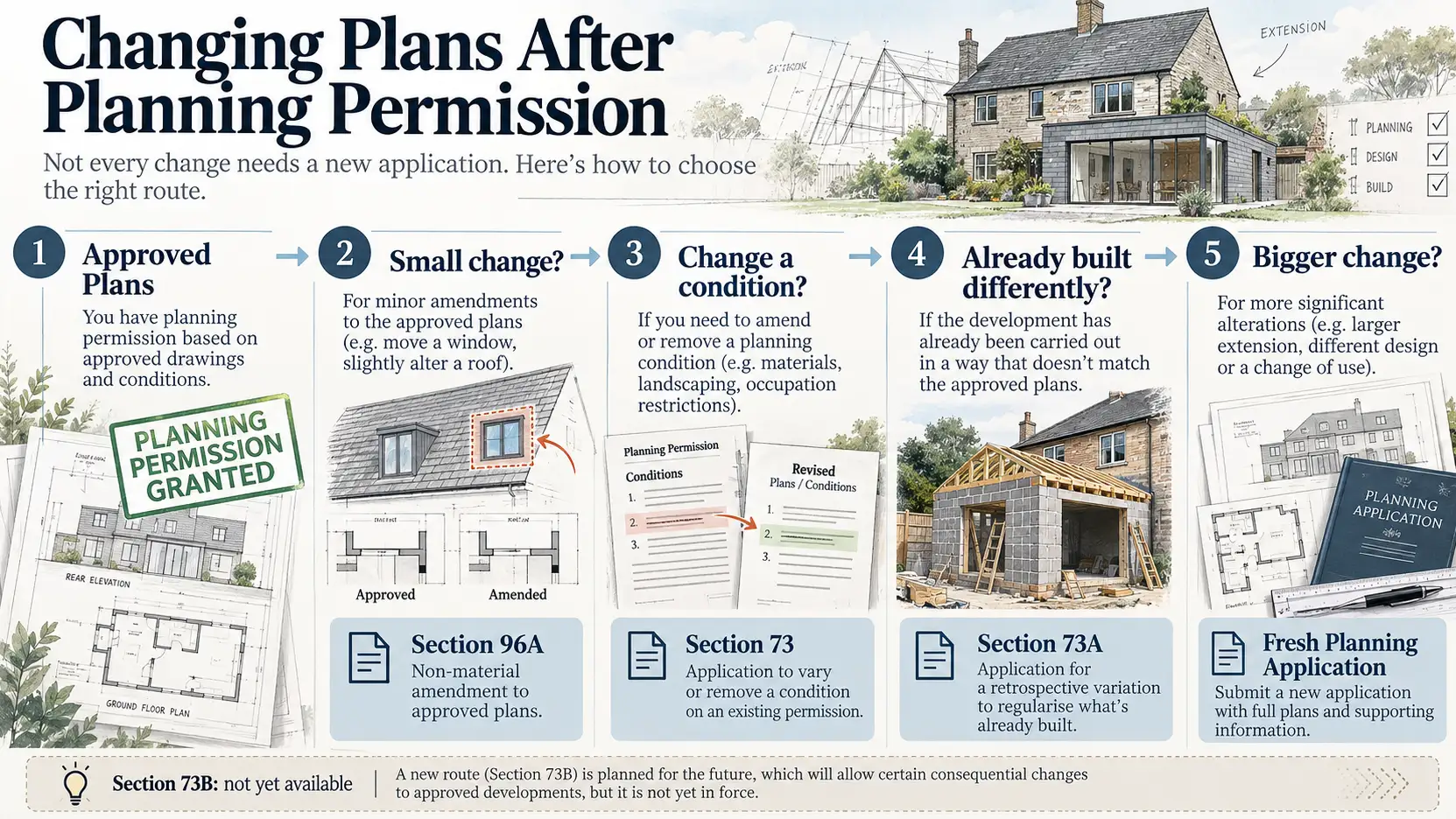
For a genuinely non-material change there is section 96A. Where a condition needs varying, section 73 may allow considerably more than the familiar phrase “minor material amendment” suggests. If the existing permission cannot lawfully accommodate the revised proposal through those routes, a fresh planning application may be necessary. If the changed work has already been carried out, the retrospective position can be different again.
There is also section 73B, a new route Parliament has created for some material variations which are not substantially different from an existing permission. But as at September 2026 it still cannot be used.
The useful skill is therefore not asking whether the alteration feels minor. It is understanding what the change does to the permission you already have.
Genuinely non-material changes: section 96A
For a change which does not materially alter the permission, section 96A of the Town and Country Planning Act 1990 provides the lightest formal amendment route.
There is deliberately no national measurement defining “non-material”. Moving a window by 200mm is not automatically acceptable. Changing one external material is not automatically acceptable. A shift that is insignificant on one scheme may have obvious planning consequences on another because of overlooking, appearance, heritage, neighbouring amenity or the way the original proposal was assessed.
The local planning authority makes that judgement in the context of the permission as a whole. Government guidance is explicit that there is no statutory definition of a non-material amendment. Government guidance on amending planning permissions
There are two less obvious features of section 96A worth knowing.
First, the authority must consider the proposed change together with earlier non-material amendments against the permission as originally granted. A project cannot necessarily accumulate a series of individually modest alterations while treating every new application as though the previous ones never happened.
Second, section 96A is not confined to changing conditions. Provided the alteration really is non-material, it can amend the planning permission itself, including its operative wording. That is an important contrast with section 73, which cannot be used to rewrite the development actually granted. The Court of Appeal drew that distinction directly in Test Valley Borough Council v Fiske. Test Valley Borough Council v Fiske, Court of Appeal
A successful section 96A application does not create a completely new planning permission. The original permission remains in force and is read together with the decision approving the amendment.
There is also no ordinary section 78 planning appeal against refusal or non-determination of a section 96A application. If the authority considers the amendment material, the answer is normally to consider another planning route rather than assume the refusal can simply be appealed like an ordinary planning application.
Section 73 can do more than the name “minor material amendment” suggests
Section 73 is commonly described as the route for a “minor material amendment”. That shorthand is useful administratively but can give homeowners the wrong impression about the legal boundary.
Section 73 allows an application for development without complying with one or more conditions attached to an existing planning permission. A common example is a condition requiring the development to be carried out in accordance with listed approved drawings: varying that condition can allow revised drawings to replace the originals.
There is no separate statutory rule saying section 73 can only make a small or minor change to those conditions. Government guidance says there is no statutory limit on the degree of change permissible to conditions, and the Court of Appeal has rejected the idea that section 73 contains an additional prohibition simply because an amendment could be described as substantial or fundamental. Government guidance on section 73 applications
The real limit is different.
Section 73 changes conditions. It cannot contradict or rewrite the operative part of the existing permission — the development the decision notice actually grants.
Imagine permission has been granted for a particular rear extension, with a condition identifying the approved plans. Changes to glazing, roof details, dimensions or layout may potentially be considered through that plans condition, even where they are more significant than an everyday idea of “minor”, provided the resulting permission remains consistent with the development that was actually granted.
But if the revised scheme can no longer truthfully sit beneath the operative description on the original decision notice, section 73 cannot simply rewrite that description to make it fit.
That is the more useful question:
Can the revised project still be authorised as the development already granted, by changing its conditions?
A section 73 approval also has a different legal effect from a section 96A amendment. It creates a new, independent planning permission which sits alongside the original permission. The original is not edited out of existence, which is why keeping the full chain of decision notices and plans matters.
Section 73 cannot be used merely to extend the period in which an unimplemented planning permission must be started. Section 73 itself prevents that route from being used to revive a permission whose commencement period expired before development began. Section 73 of the Town and Country Planning Act 1990
There is another practical wrinkle. If the permission does not contain a relevant condition identifying the approved plans, section 73 cannot simply operate as a free-standing drawing-substitution power. Government guidance says it may be possible first to use section 96A to add a condition listing the approved plans, creating a condition which a later section 73 application can then seek to vary. Whether that is appropriate still depends on the individual permission, but it is a useful route to know exists.
Section 73B is intended to fill a different gap — but it is not available yet
Section 96A can already amend the operative wording of a permission where the change is genuinely non-material.
Section 73 can make material changes through conditions, but it cannot rewrite the development granted in the operative part of the permission.
That leaves an awkward middle ground: a proposed change may be material, and may require changes beyond conditions, while the revised development is still recognisably close to what was already approved.
Section 73B was created to address that problem.
Inserted into the planning legislation by the Levelling-up and Regeneration Act 2023, it is designed to allow a new permission where the local planning authority is satisfied that its effect would not be substantially different from the existing permission. Unlike section 73, the new route is capable in principle of accommodating changes to the development authorised as well as its conditions.
But the important point for anybody changing plans today is that section 73B is still not operational.
Government confirmed in July 2026 that the new route had not yet been implemented, while saying it intended to introduce it later in 2026. As at the end of September, the application procedure has still not been brought into usable effect. Government response on planning fees and section 73B
So section 73B belongs in a current planning discussion, but not in a list of applications a homeowner can submit today.
Which amendment route does what?
| Route | What it is for | Available now? | Effect |
|---|---|---|---|
| Section 96A | A genuinely non-material amendment, including potentially a non-material change to the operative wording | Yes | Amends the existing permission |
| Section 73 | Varying or removing conditions; can accommodate material changes where they remain consistent with the operative grant | Yes | Creates a new permission alongside the original |
| Section 73A | Retrospective planning permission where development or a breach of condition has already occurred | Yes | Provides a retrospective planning route where the statutory requirements are met |
| Section 73B | Future route for a material variation whose effect would not be substantially different from an existing permission | Not yet | Intended to create a new varied permission |
| Fresh planning application | Where the revised proposal cannot lawfully be authorised through the amendment routes | Yes | Creates a new planning permission if granted |
The table is only a route map. It does not create a size test: whether section 96A or section 73 can actually be used still depends on the wording and conditions of the individual permission.
Sometimes a fresh application really is the cleanest answer
A fresh planning application is not reserved for changes beyond some nationally defined size threshold.
The better test is whether the revised proposal can lawfully be authorised using the amendment powers attached to the existing permission.
A physically noticeable change may still be capable of being considered through section 73 if an appropriate condition can be varied and the revised scheme remains consistent with the operative development granted. Equally, a relatively modest alteration can create difficulty if it conflicts directly with a tightly worded description on the decision notice and is too material for section 96A.
Where section 96A cannot deal with the change as non-material, section 73 cannot accommodate it through the conditions, and section 73B is not yet available, the correct route may simply be a new planning application for the project now intended.
That isn’t a failure of the amendment system. It means the revised proposal has moved outside the legal permission already granted and needs to be assessed on its own terms.
The dangerous moment is when the drawing changes on site
The amendment routes are easiest to use while the proposed change still exists on a drawing.
Construction creates pressure to decide quickly. A builder suggests moving a window. A structural detail changes. The specified cladding will take months to arrive and an alternative is available immediately.
The temptation is to decide that the difference is too trivial to bother the planning authority and carry on.
Sometimes it genuinely will be non-material. But the builder, homeowner or designer cannot make that conclusion binding on the local planning authority merely because the alteration looks small from the scaffold.
If the planning permission requires the development to follow approved plans, materially departing from them can breach a planning condition. More generally, building materially different development from that which was permitted can amount to a breach of planning control. Government enforcement guidance confirms that development without the required permission and failure to comply with planning conditions are both potential enforcement matters. Government guidance on planning enforcement
The position also becomes procedurally harder once the work has actually been carried out.
Section 73 is a route concerned with development without compliance with conditions prospectively. Section 73A expressly allows retrospective permission to be sought for development already carried out, including development undertaken without complying with a planning condition. Section 73A of the Town and Country Planning Act 1990
That does not mean every as-built difference automatically requires a section 73A application. A genuinely non-material discrepancy may have a different solution, and the facts of the permission matter. But once material work has already been carried out contrary to an approved condition, a homeowner should not assume an ordinary prospective section 73 application can simply be used as though the change had not happened.
The safest time to establish the correct route is before the affected work is built.
The problem may not appear until somebody else reads the file
An undocumented departure from approved plans can remain unnoticed long after the builders leave.
The problem may emerge when the property is sold and a buyer’s adviser compares the decision notice and approved drawings with the building that actually exists. Or it may surface when another extension is proposed and the architect first has to establish the lawful planning baseline.
Not every discrepancy causes a sale problem, and planning enforcement is not automatic simply because a drawing and a finished detail differ. But resolving uncertainty is much easier when the original designer, builder and planning officer are still involved than years later when nobody can remember why the change was made.
That is why seemingly bureaucratic amendment paperwork has long-term value.
Keep the original permission, every section 96A decision, any section 73 or retrospective permission and the plans belonging to each. Someone who had nothing to do with the project should be able to follow the planning history from the first approval to the building standing on the site.
The question to ask before changing an approved design
The wrong starting question is:
“It’s only a small change, isn’t it?”
A better question is what the alteration changes legally.
If it is genuinely non-material, section 96A may be enough — even if the amendment touches the operative wording of the permission. If the change is material but can be achieved by varying a condition without contradicting the development already granted, section 73 may be available and its scope is wider than the familiar “minor material amendment” label suggests.
Section 73B should eventually create another option for some material variations which are not substantially different from an existing permission, but it is not available yet.
And if none of those routes can lawfully authorise what is now proposed, the answer may simply be a fresh planning application.
The safest point to work that out is while the change is still a line on a drawing.
Once it exists in brick, glass, steel or timber, the planning question has not disappeared. It has simply become harder to resolve.
Important: This article provides general property and planning information, not a formal assessment of a particular planning permission or proposed amendment. The detailed procedures discussed here relate to England and reflect the position in September 2026; other parts of the UK operate different planning systems. Whether a change is non-material, can lawfully be dealt with under section 73, requires retrospective consideration or needs a fresh planning application depends on the wording, conditions, drawings and planning history of the individual permission. Section 73B has been legislated for but is not yet available. Check the current position with the local planning authority or an appropriately qualified planning professional before departing from approved plans.

