

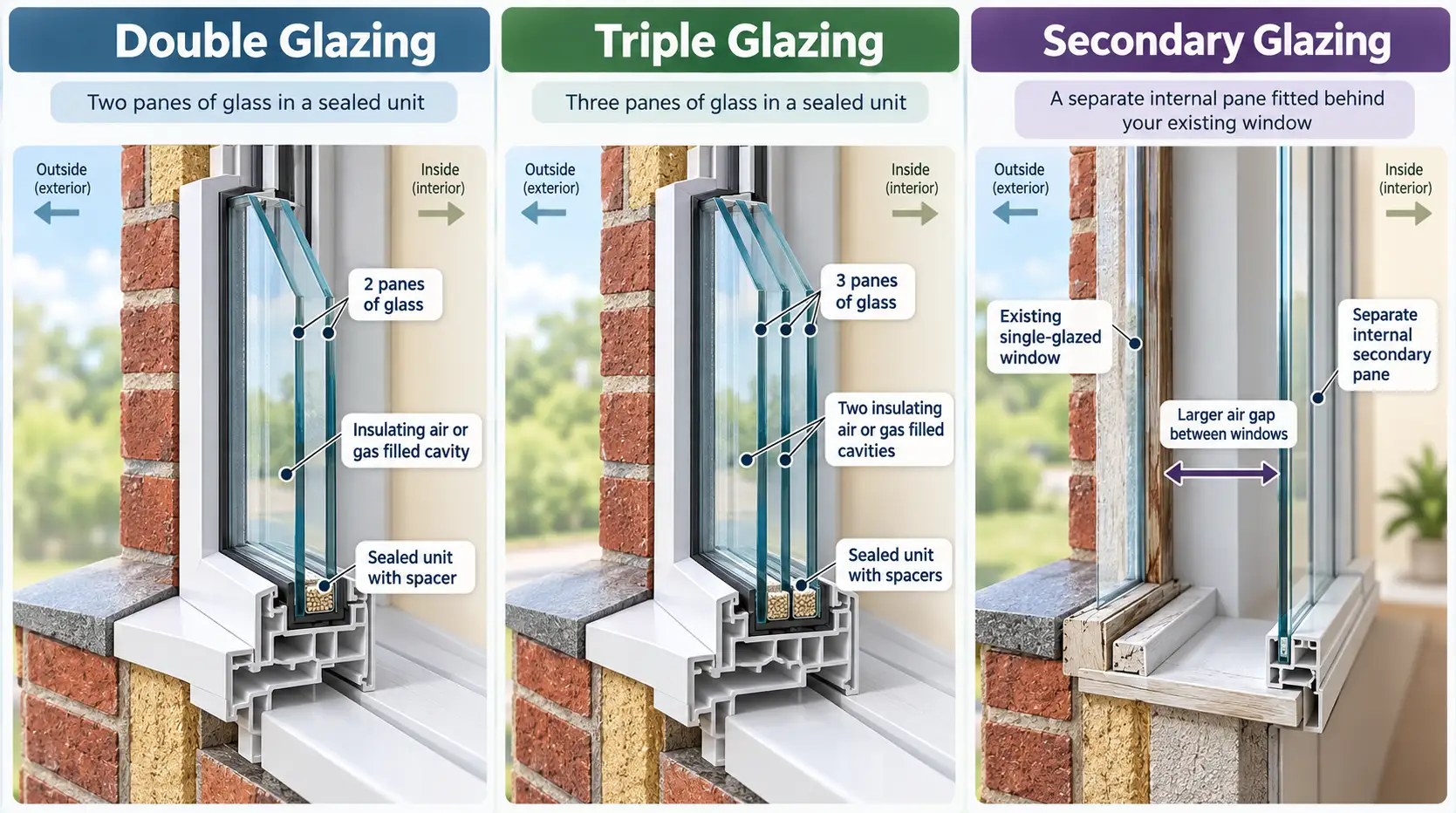
Most people ask this question backwards. They ask which type of glazing is “best”, as though there is a single correct answer sitting at the top of a league table, with triple beating double and double beating secondary. The more useful question is narrower: what, specifically, is wrong with the windows you have now?
A cold room, a draughty room, a noisy room and a condensation-prone room are four different problems, and they do not all point to the same fix. Nor does an old window automatically need replacing simply because a newer one could achieve a better laboratory figure. The condition of the frame, the reason the room is uncomfortable, the building’s character and what the homeowner is trying to achieve all matter.
The underlying glazing principles discussed here apply across the UK. Where planning, listed-building and Building Regulations requirements are mentioned, the detailed references are primarily to England; Wales, Scotland and Northern Ireland operate their own building-control and heritage systems.
Start with the complaint, not the product
If the problem is genuinely heat loss — perhaps a room stays noticeably colder than the rest of the house and the internal surface of the glass feels very cold even without an obvious draught — replacing single glazing or poor older glazing can make a substantial difference to comfort. Modern double and triple glazing reduce heat transfer through the window, and better-performing units also keep the room-side surface of the glass warmer.
That does not necessarily mean replacing every frame. Double or triple-glazed sealed units can sometimes be fitted into suitable existing frames, while in other properties the condition, construction or available glazing depth makes complete window replacement the sensible route. That distinction is worth establishing before comparing quotations because “new glazing” and “new windows” are not always the same job.
If the complaint is draughts specifically — air that can actually be felt moving around a sash, casement or frame — the first question should be where that air is entering. Failed seals, poorly adjusted opening lights, gaps around an old frame or poor installation can all produce discomfort even when the glass itself is reasonably efficient. Conversely, an older timber window in sound condition can sometimes be repaired and discreetly draught-proofed rather than discarded. The Energy Saving Trust’s current windows and doors guidance makes the same broader point: glass, seals, frames and installation all contribute to how well a window performs.
Noise is different again. If traffic, aircraft, trains or a busy night-time street are the reason for considering new windows, simply ordering an extra pane is a poor way to specify the solution. Acoustic performance depends on the type and thickness of the glass, the relationship between the panes, the cavity, the seals and the rest of the window construction.
Condensation also needs diagnosing rather than merely covering up. Moisture on the room side of the glass usually means humid indoor air is meeting a sufficiently cold surface. Better glazing can raise that internal glass temperature and reduce the likelihood of condensation, but it does not remove the moisture being generated inside the home, so ventilation may still be the real weakness. Condensation between panes is a different problem: it normally indicates failure of the sealed glazing unit, and where the frame remains sound the failed unit can often be replaced without replacing the whole window. Condensation on the outside tells a different story again and can occur on efficient glazing because so little indoor heat reaches the external pane.
The point is not to turn every homeowner into a window technician. It is to avoid paying for the most expensive answer before establishing what the question actually is.
Why triple glazing’s reputation for quiet is only half right
The idea that three panes must automatically block substantially more noise than two sounds logical, but pane count by itself tells surprisingly little about acoustic performance.
Triple glazing can perform well acoustically, particularly where the complete unit has been designed for that purpose, but an ordinary triple-glazed unit should not be confused with acoustic glazing. The Glass and Glazing Federation’s guidance on glazing and noise reduction explains that pane thicknesses, gaps, seals and the overall glazing arrangement all affect how much sound is transmitted. It also makes an important practical point: any air gap around the window can seriously undermine the acoustic improvement.
For serious traffic or rail noise, laminated acoustic glass can change the calculation further. Using panes of deliberately different thicknesses can also help because the panes do not respond identically across the same range of frequencies. Both double and triple-glazed units can be designed this way.
A homeowner whose primary complaint is traffic noise should therefore not simply ask how much extra triple glazing costs. They should ask what acoustic specification is being proposed, what glass build-up is being used and what evidence supports the claimed sound reduction of the complete window.
That distinction matters because a well-specified acoustic double-glazed unit can be a better response to a noise problem than an ordinary triple-glazed unit bought simply because it has another pane. Equally, an acoustically engineered triple-glazed system may outperform both. The number of panes is not the specification.
There is another limitation that can be missed entirely in a showroom quotation. Windows may be only one route by which sound enters the property. Roofs, walls, floors and ventilation openings can all transmit noise, so replacing the glazing cannot be assumed to eliminate a serious external-noise problem on its own. The GGF specifically warns that glazing upgrades may be only part of the solution where sound is entering through other parts of the building.
Where secondary glazing earns its place
Secondary glazing is an additional glazed screen fitted inside the existing window rather than a replacement for it. It is sometimes dismissed as the cheaper compromise, yet that misses one of the situations in which it can be particularly effective.
The distance between the existing window and the secondary pane can be much greater than the cavities inside conventional sealed double or triple glazing. That separation can be particularly useful acoustically because the two glazed layers are more effectively decoupled. Historic England’s technical guidance on secondary glazing also reports that carefully designed low-emissivity secondary glazing can reduce heat losses through a window by more than 60%, while allowing the original window to remain in place.
That means a period house beside a busy road may present a very different decision from a modern suburban house with failed older double glazing. Retaining the original outer window and placing a well-sealed secondary system some distance behind it can address noise while preserving the external appearance. Laminated acoustic glass can also be specified in the secondary pane where noise is the priority.
Thermal performance should not therefore be reduced to a simple hierarchy in which secondary glazing automatically sits below double and triple glazing. The result depends heavily on the system, glass, seals, cavity and condition of the original window. A lightweight removable panel and a professionally designed permanent low-E secondary system are both called “secondary glazing”, but they are not equivalent products.
There are practical compromises. Secondary glazing creates another surface inside the room, which affects cleaning, access to the original window and sometimes shutters, blinds or deep reveals. Poorly designed systems can also create condensation within the space between the primary and secondary windows. Those everyday details deserve consideration alongside headline thermal and acoustic figures.
The glass count is not the specification
This is where quotations can become misleading if they are compared only as “double” versus “triple”.
The thermal performance of a window comes from the complete assembly: glass, coatings, cavities, spacer bars, frame, air leakage and installation. Energy Saving Trust notes that the recognised window energy rating assesses the entire window — including frame and glass — and also takes account of heat loss, draughts and solar gain. A U-value is useful, but it is not the whole story.
That gives homeowners a useful question when comparing apparently similar quotations: does the performance figure being quoted describe the whole proposed window, or only part of the glazing specification? An impressive glass figure should not be treated automatically as the performance of the completed installation.
Triple glazing generally has the potential to achieve better thermal performance than otherwise comparable double glazing because it adds another pane and insulated cavity. But the financial decision looks very different depending on what is already fitted. Energy Saving Trust currently estimates that triple glazing is around 20% more expensive than double glazing, while fitting A-rated double glazing throughout an entirely single-glazed semi-detached home could save around £85 a year in Great Britain. Those are national illustrations rather than a personal payback calculation, but they show why replacing genuinely poor single glazing is a different proposition from removing serviceable modern double glazing simply to move one step further up the specification.
If windows already need replacing because frames, seals or mechanisms are failing, the additional cost of moving from a good double-glazed specification to triple glazing can sensibly be considered as part of the replacement decision. If the existing double glazing is sound, the incremental benefit has to justify discarding windows that may still have years of useful life.
Weight matters too. Triple-glazed units are heavier, which affects hinges, opening mechanisms, frames and the practical size of opening lights. A properly designed triple-glazed window accounts for that from the outset; simply treating the third pane as an optional upgrade to any existing arrangement is the wrong way to think about it.
Better windows can expose a ventilation problem
One of the more easily overlooked consequences of replacing old windows is that new ones are usually considerably more airtight.
That is normally desirable. It cuts unwanted draughts and heat loss. But the uncontrolled leakage around older windows may also have been providing part of the home’s background air change, whether intentionally or not. Remove that leakage without considering ventilation and indoor moisture can become more noticeable rather than less.
Current Building Regulations guidance in England requires replacement work not to make the home’s ventilation less satisfactory. The government’s Approved Document F guidance on replacement windows specifically addresses background ventilation and confirms that simply asking the homeowner to waive it is not an acceptable substitute for compliance.
This creates a particularly important trade-off in noisy locations. Background ventilators provide necessary ventilation, but an open ventilation path can also provide a route for sound. Government guidance recognises the issue and recommends noise-attenuating background ventilators where façades face noisy environments, while the GGF likewise notes that acoustic ventilators are available for homes near busy roads and airports.
For someone spending heavily to reduce road or aircraft noise, the ventilation strategy therefore belongs in the same conversation as the glazing. Specifying sophisticated acoustic glass while ignoring how outside air will enter the room can undermine part of the improvement the homeowner thought they were buying.
The same thinking applies to condensation. Replacing draughty windows with much tighter ones may make the glass warmer, but if moisture generation remains high and useful ventilation falls, the underlying humidity problem has not disappeared. This is why glazing, draught-proofing and ventilation should be considered together rather than treated as three unrelated jobs.
The heritage conversation is worth having early
The original fabric of an older property can change the answer completely.
In a listed building, original or historically important windows can be part of the building’s significance in their own right. Replacing them, changing the glass or altering their construction may therefore require listed building consent. That does not mean improved glazing is automatically impossible. Historic England’s current guidance on upgrading historic windows recognises that slim-profile or vacuum double glazing can sometimes be incorporated into existing sashes or casements where the significance and physical construction of the window allow it.
The key question is what would be lost or altered. Original glass, slender glazing bars, historic shutters and the appearance of the frame can all matter. Modern glazing may require greater depth and different detailing, but those effects have to be considered against the significance of the particular building rather than against a blanket rule that modern glazing will always be refused.
Secondary glazing often has an advantage because the original external window remains in place. Historic England says reversible secondary glazing generally does not require listed building consent where it does not damage or materially affect features of special interest, although there are exceptions where the work would interfere with historic frames, shutters, panelling or other significant fabric.
A conservation area is different from a listed building. Simply being inside one does not automatically mean every window replacement needs planning permission. However, an Article 4 direction can remove permitted development rights that would otherwise apply, and local policies can make design and materials particularly important. For that reason, owners of protected or potentially protected buildings are better checking the planning position before pricing a replacement scheme rather than discovering the restriction after windows have been ordered.
Frame condition changes the answer too
None of this is only about the glass.
A twenty-year-old double-glazed window with sound frames and one misted sealed unit does not necessarily need replacing wholesale. Misting or condensation between the panes normally indicates failure of the insulating glass unit’s seal, and Energy Saving Trust notes that the glazing can sometimes be replaced without replacing the complete window.
That is an important counterweight to the sales logic that a failed pane means a failed window. Frames, hinges, gaskets, locks and sealed units age differently, and replacing the defective component can sometimes be the proportionate answer.
The opposite can also be true. Installing high-performance glass into a badly distorted, rotten or poorly sealed frame does not turn the complete window into a high-performance installation. If major frame repair is already necessary, full replacement may become the more rational option.
Before comparing products, it is therefore worth establishing whether the existing window is fundamentally sound, repairable or approaching the end of its useful life. Age alone is a poor diagnosis.
Which route deserves the first look?
| What is actually wrong? | First option worth investigating | Why |
|---|---|---|
| Sound single glazing and substantial heat loss | Modern double glazing, or triple where higher thermal performance is justified | Replacing poorly insulating glazing can materially improve comfort and efficiency |
| Serviceable windows but noticeable draughts | Repair and draught-proofing before wholesale replacement | Air leakage may be the problem rather than the glass |
| Serious road, rail or aircraft noise | Acoustic glazing specification or well-designed secondary glazing | Pane construction, seals, cavity and ventilation paths matter more than pane count alone |
| Original period windows worth retaining | Repair, draught-proofing and secondary glazing | Can preserve historic fabric while improving comfort |
| Misting between double-glazed panes | Replace the failed sealed unit if the frame is sound | Seal failure does not automatically mean the whole window has failed |
| Condensation on the room-facing glass | Check humidity and ventilation as well as glazing | Warmer glass can help, but it does not remove indoor moisture |
| Existing windows already need replacement and thermal performance is the priority | Compare good whole-window double and triple specifications | This is where the additional performance of triple glazing is easiest to assess rationally |
The table is a starting point rather than a product ranking. Two neighbouring houses can have identical-looking windows and still arrive at different answers because one has failed frames, another has valuable original joinery and another sits beside a railway.
Getting the right upgrade signed off
There is one final distinction between choosing the right glazing and completing the work correctly.
In England, replacement windows are controlled building work. An installer registered with an authorised competent person scheme can self-certify qualifying work rather than the homeowner making a separate Building Regulations application, and the homeowner should receive evidence of compliance afterwards. GOV.UK’s competent person scheme guidance explains that the resulting certificate can also become important when the property is later sold.
Building Regulations compliance is separate from planning permission and listed building consent, and the regulatory arrangements differ elsewhere in the UK. A window can therefore satisfy thermal and safety requirements while still being unacceptable from a heritage or planning point of view, or vice versa.
The important decision comes before the paperwork. Double, triple and secondary glazing are not three rungs on the same ladder. They solve overlapping but different problems, and specification matters at least as much as the product name.
If the existing windows are sound, the sensible improvement may be repair and draught-proofing. If heat loss is the dominant problem and the windows already need replacing, high-performance double or triple glazing may make sense. If noise is keeping people awake, the acoustic construction of the complete window — and the other routes by which sound enters the building — matter more than simply adding another pane. And if the original windows are part of what makes the property worth owning in the first place, secondary glazing may be the sophisticated option rather than the compromise.
The best glazing upgrade is the one that fixes the problem the house actually has.
Important: This article provides general property information rather than a personalised assessment of an individual building. Glazing performance depends on the complete window, its installation, ventilation arrangements and the surrounding construction. Owners of listed buildings, properties affected by Article 4 directions or other heritage controls should check the position with the relevant local planning authority before committing to work. Building-control requirements differ across the UK, and a suitably competent installer or building professional should assess the condition of existing windows where the appropriate remedy is uncertain.

