

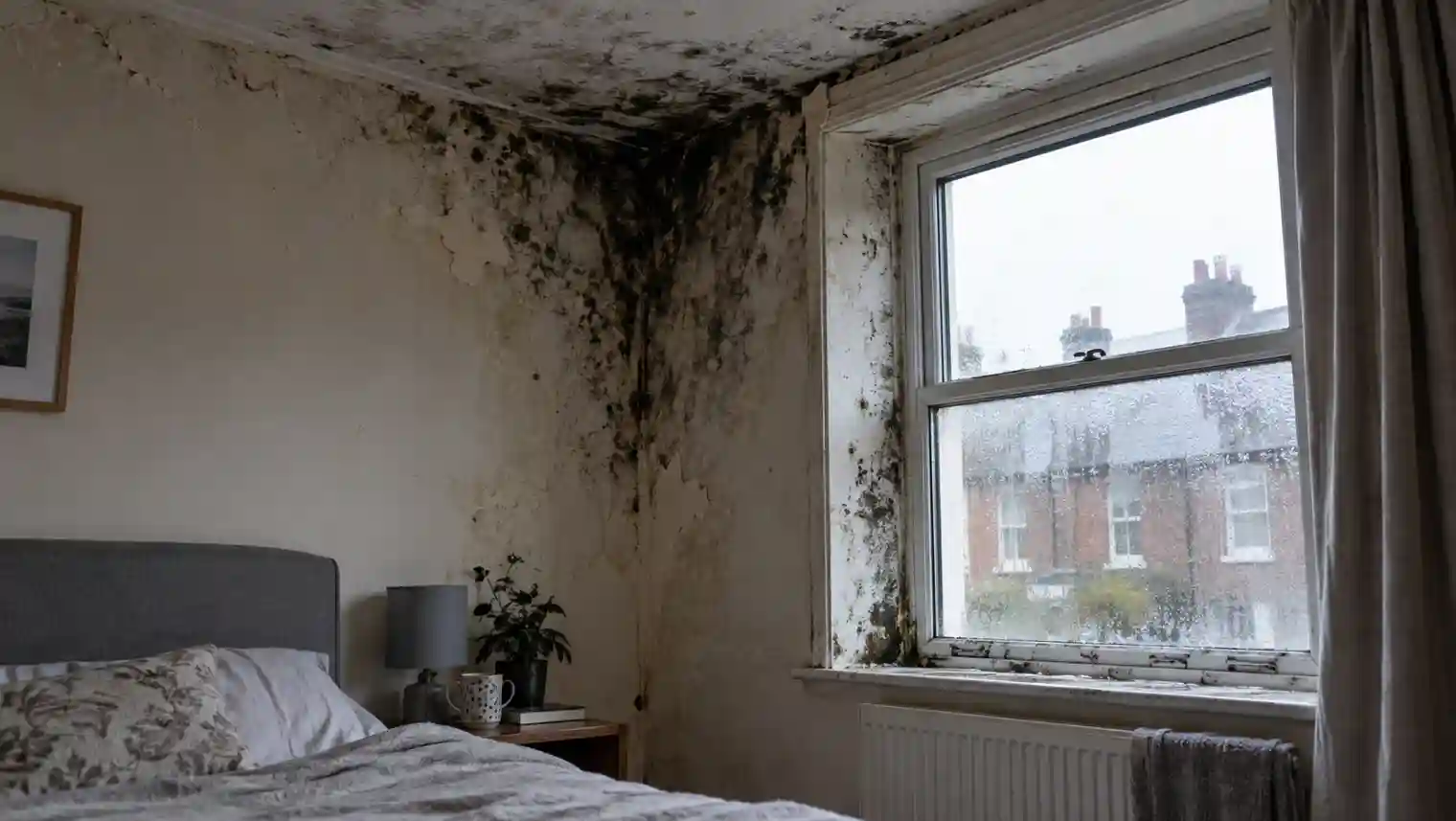
The message arrives on a Tuesday evening: black mould creeping up the bathroom wall again, a photo attached, a slightly weary tone. What a landlord does in the next few days matters more than almost anything else in the tenancy — legally, practically, and in terms of what happens if the problem ever ends up in front of an environmental health officer or a court.
The difficulty is that there is still no single statutory timetable telling every private landlord in England that damp must be inspected within X days and repaired within Y. That does not leave landlords free to choose their own pace. Existing repair and fitness duties already require action within a reasonable time, and what is reasonable can change dramatically with the seriousness of the defect, the risk to the occupants, what the landlord knows about it and what is realistically required to put it right.
For a landlord or managing agent, that makes the quality of the response more important than simply being able to say that a contractor was eventually instructed.
The obligation didn’t start with the photo
Private landlords in England already operate under overlapping repair, fitness and housing-safety duties.
For the tenancies to which it applies, section 11 of the Landlord and Tenant Act 1985 requires the landlord to keep the structure and exterior in repair, including drains, gutters and external pipes, and to keep installations for water, gas, electricity, sanitation, space heating and hot water in repair and proper working order.
The fitness duty goes wider. The Homes (Fitness for Human Habitation) Act 2018 amended the 1985 Act so that relevant rented homes must be fit for human habitation at the beginning of the tenancy and remain so throughout it. Serious damp, inadequate ventilation, water and drainage problems, instability and other hazards can therefore matter even where the dispute cannot be reduced neatly to a broken boiler or leaking gutter.
There is an important distinction between the existence of those duties and the point at which a landlord can reasonably be expected to act on a defect inside the let property. Government guidance says that, in general, the landlord becomes responsible for dealing with a relevant hazard once they have been made aware of it and then has a reasonable period in which to respond. Hazards in relevant common parts can put the landlord in a different position because liability does not depend on the tenant first reporting them.
That makes the route by which a repair report arrives commercially important. A landlord using a letting agent should not operate a system in which a telephone call to a negotiator, an email to the branch or information picked up during an inspection can disappear because the tenant did not also enter the defect into a separate maintenance portal. The useful management question is whether information showing a potentially serious problem reached the landlord’s operation and what happened to it afterwards.
Local authorities sit alongside these private-law duties through the Housing Health and Safety Rating System. England’s HHSRS was substantially revised in June 2026: the previous 29 hazards were consolidated into 21 and the assessment framework and statutory guidance were updated. The current HHSRS operating guidance applies the revised system.
Where a council identifies a Category 1 hazard, it has a duty to take appropriate enforcement action; Category 2 hazards give it a power to act. Since 22 June 2026 there is another consequence landlords need to understand: in qualifying cases a local authority can impose an additional financial penalty of up to £7,000 where a Category 1 hazard exists and it considers that it would have been reasonably practicable for the responsible person to remove it.
Awaab’s Law does not replace any of those obligations, and this is where the present position is sometimes misunderstood.
The fixed statutory response times commonly associated with Awaab’s Law have applied to social housing in England since October 2025. They do not yet apply to ordinary private landlords. The Renters’ Rights Act 2025 created the mechanism for extending comparable requirements into the private rented sector, but the regulations setting the detailed PRS duties and timescales are not yet in force. The government’s current Renters’ Rights implementation roadmap leaves the detailed implementation timetable subject to further work.
The new Decent Homes Standard is further along. The government has confirmed that the reformed standard will apply to the private rented sector from 2035. The New Decent Homes Standard policy statement sets out that timetable.
For now, the practical conclusion is straightforward. There is no private-sector Awaab’s Law stopwatch running when the photograph arrives, but there is already a requirement to deal with relevant disrepair and unfitness within a reasonable time. Treating “Awaab’s Law does not apply yet” as meaning “there is no deadline” badly misunderstands the present position.
What arrives isn’t always what it looks like
The instinct to reply “try opening the window” has become particularly risky.
Condensation can plainly be influenced by how moisture is produced and removed from a home, but current government advice is much firmer than older landlord guidance sometimes suggests. Its guidance on damp and mould in rented housing says it is unreasonable to blame damp and mould on “lifestyle choices”. Cooking, bathing, washing and drying laundry are normal domestic activities. The underlying problem may instead involve the building fabric, inadequate ventilation, inadequate heating, poor energy efficiency or a combination of those factors.
For a landlord, that changes the useful first question from “what is the tenant doing?” to “where is the moisture coming from, and why is the property unable to deal with it?”
The answer might be a failed bathroom extractor, defective gutters, penetrating rain, a leaking pipe, poor insulation around a cold bridge, inadequate heating or ventilation, or several contributing defects rather than one obvious failure. A photograph can establish that mould exists; it rarely establishes why.
Government guidance recommends inspecting the home, identifying and tackling the underlying cause and keeping the tenant informed about what will happen and when. It says landlords should not wait for medical evidence before responding where health concerns have been raised. Simply washing the mould away or painting over it is unlikely to be enough if the condition that produced it remains.
This is also where the repair system around the landlord matters. A tenant may report the problem to a letting agent, the agent may instruct a contractor and the contractor may identify poor extraction, cold bridging or water ingress. If that information ends with the contractor’s invoice and nobody owns the next decision, the management failure can become more significant than the original mould treatment.
Good records therefore need to capture more than the dates on which messages were sent. They should allow somebody looking back at the case to understand what was reported, what was inspected, what the suspected cause was, what work was authorised, what the contractor found, whether further work was recommended and whether the problem actually disappeared.
Current government guidance recommends checking the property again at least six weeks after remedial work to make sure damp and mould have not returned. That follow-up matters because a contractor invoice showing that a wall was treated is not evidence that the defect responsible for the mould was fixed.
Recurring cases should also start to influence how a landlord or agent thinks about the wider property or portfolio. If the same wall has been treated three times, the useful response is no longer another mould wash. If several similar flats develop mould around identical window reveals or repeatedly show the same ventilation failure, what first appeared to be a series of individual maintenance tickets may actually be evidence of a common building or asset-management problem.
The government’s guidance specifically encourages landlords to document and manage reports in a way that allows common issues and trends across housing stock to be identified. That matters whether the portfolio contains three properties or three thousand.
What “urgent” actually means in practice
There is no universal statutory rule saying that every private-rented repair in England must be completed within 24 hours, seven days or 28 days.
Under the present fitness regime, once the landlord has been made aware of a hazard for which they are responsible, they have a reasonable amount of time to deal with it. What counts as reasonable depends on the circumstances and, if the dispute goes that far, can ultimately be judged by a court.
That makes severity more useful than an arbitrary diary rule. A minor defect creating no immediate health or safety risk may reasonably require investigation, parts and a scheduled contractor visit. Active water entering electrical fittings, suspected gas escape, dangerous electrics, serious structural instability or loss of essential heating in cold weather plainly belongs at the other end of the spectrum.
Damp and mould can move up that scale quickly where it is substantial, recurring, spreading into sleeping accommodation or associated with health concerns. Government guidance says damp and mould should always be dealt with promptly and with particular urgency where landlords know that an occupant may be at increased risk of harm.
That includes circumstances involving children, older occupants and people with relevant health vulnerabilities. A landlord does not need to become a clinician or demand medical evidence before taking a report seriously. Where there are concerns that the conditions are affecting health, the official guidance says consideration should also be given to whether suitable alternative accommodation can be offered, with the tenant’s agreement, while the problem is rectified. That will not be necessary or appropriate in every case, but it should be within the decision-making range where the home cannot safely be occupied during investigation or works.
The absence of a statutory PRS Awaab’s Law clock is therefore not a good reason for a professionally managed portfolio to operate without internal timescales of its own.
A landlord or letting agent does not need to pretend those internal standards are law. But it is sensible to decide in advance what the organisation considers an emergency, an urgent health or habitability issue and a routine repair; who owns each report; when lack of contractor availability triggers escalation; and what happens when an appointment is missed or the reported condition deteriorates before attendance.
That discipline becomes particularly useful where several people are involved. A tenant may report to the agent, the agent may seek landlord approval, the landlord may ask for quotes and the contractor may then offer an appointment two weeks away. Without somebody owning the risk rather than merely passing the message onwards, delay can accumulate without anyone consciously deciding that the delay is reasonable.
A professionally managed repair file should therefore be able to explain not just when somebody attended, but why the chosen response matched the seriousness of the information available at the time.
Access can complicate that judgment, but it does not remove the need to manage the problem. For routine inspection and repair, the landlord will normally need to arrange access at reasonable times after giving at least 24 hours’ written notice. Emergencies can justify a different response, but routine access rights should not be treated as permission to arrive unannounced.
Where access is refused or repeatedly rearranged, the useful protection is evidence: clear written requests, sensible proposed appointments, alternatives where possible and a record of why access was required. A landlord cannot repair a defect they are genuinely prevented from reaching, but “the tenant would not let us in” is considerably stronger when supported by a sequence of reasonable attempts than when raised months later from memory.
Where tenant conduct genuinely matters — and where it doesn’t
There are cases where the way a property is occupied is relevant, but the distinction needs more care than the old shorthand about “condensation caused by lifestyle”.
Normal household life produces moisture. People cook, shower, wash clothes and breathe. Government guidance is explicit that those ordinary activities should not be treated as the fundamental cause of damp and mould where the property lacks the fabric, heating, energy efficiency or ventilation needed to cope with them.
That does not make tenant conduct legally irrelevant. Deliberately obstructing functioning ventilation, damaging installations, refusing reasonable access for diagnosis or repair, or other conduct that materially causes or worsens a problem may affect responsibility in an individual case. The fitness legislation itself also contains exceptions where unfitness is wholly or mainly attributable to the tenant’s own behaviour.
But the order of investigation matters. A landlord who starts with blame and then looks for evidence risks missing the defect. A landlord who first checks the fabric, heating, extraction and ventilation can distinguish much more credibly between a problem the building is creating and something genuinely arising from the way it is being used.
That is why current official guidance urges landlords to work with tenants rather than attach blame to normal domestic behaviour. Reasonable advice about using ventilation, heating the home where affordable or reducing avoidable moisture can still be useful where appropriate, but it should sit alongside — not replace — the repair or improvement that the property itself requires.
For landlords and managing agents, that is not simply a softer communications approach. It produces better evidence. If responsibility later becomes disputed, a diagnosis based on inspection, contractor findings and a recorded property history is much more persuasive than an assumption made from photographs or a brief telephone conversation.
The position outside England
The broad principle that rented homes must be habitable and properly repaired exists across the UK, but the legal machinery is different enough that an England-based repair process should not simply be copied across the borders.
In Wales, most rented homes are governed by occupation contracts under the Renting Homes (Wales) Act 2016 rather than the English section 11 regime. Landlords must keep relevant dwellings in repair and ensure they are fit for human habitation throughout the contract. Welsh rules continue to work with 29 matters and circumstances when considering fitness, including damp and mould growth, rather than England’s newly consolidated 21-hazard HHSRS model. The Welsh Government guidance for landlords on fitness for human habitation explains the requirements.
Scotland uses the Repairing Standard. Private landlords must ensure relevant rented homes meet that standard at the start of the tenancy and throughout it, including the Tolerable Standard and requirements concerning the building fabric, water, heating and other installations. Where the landlord does not comply, enforcement can ultimately run through the First-tier Tribunal for Scotland (Housing and Property Chamber). The current Scottish Government statutory guidance for private landlords sets out the standard in detail.
Northern Ireland operates its own fitness and repair framework. Landlords remain responsible for major repairs including the structure and exterior and heating and hot-water installations, while rented accommodation must meet statutory fitness requirements. District-council environmental health officers can become involved where hazards are not addressed. The official nidirect guidance on housing standards in rented accommodation includes damp and mould among the common hazards councils may deal with.
The underlying lesson travels across all four jurisdictions; the legislation and enforcement route do not.
Escalation, briefly
For an English private landlord, the useful point about enforcement is not to memorise every notice a council could serve. It is to understand how an ordinary repair report becomes a regulatory or court problem when the response chain breaks down.
A tenant whose home is unfit can potentially bring a court claim under the fitness provisions of the Landlord and Tenant Act 1985. A court can order works and award damages. Separately, the local authority can inspect under the Housing Act 2004 and use its HHSRS enforcement powers where it identifies hazards. Category 1 findings now also carry the possibility of the additional £7,000 financial penalty introduced in June 2026 where the statutory conditions are met.
Those are separate routes. A tenant taking action does not prevent the council from acting, and a council investigation does not make the landlord’s contractual repair duties disappear.
But the valuable part of the process still happens much earlier than any court claim or enforcement notice. A report arrives. Somebody owns it. The risk is assessed. Information about occupants and vulnerability is considered. Access is arranged. The cause is diagnosed rather than guessed. Contractor findings reach the person capable of authorising the next step. The underlying defect is repaired. The tenant is told what is happening. The result is checked afterwards, and recurrence is treated as information rather than another isolated ticket.
For landlords and agents managing more than one property, those records should also feed backwards. Repeat defects, identical failures across similar homes, recurring contractor recommendations and slow response points in the management chain are all evidence about the portfolio itself. A repairs system that only closes individual jobs but never learns from them is leaving useful information on the table.
Until private-sector Awaab’s Law introduces its own statutory clocks, that is the clearest answer to “how quickly?”: as quickly as the seriousness of the defect and risk reasonably require, within a management system capable of recognising when ordinary maintenance has become a health, habitability or enforcement problem.
That is not paperwork sitting alongside the repair. Properly done, it is part of the repair.
This article provides general property information, not legal, financial, surveying or other professional advice for your individual circumstances. Property disputes and regulatory issues can depend on the facts, documents, location and applicable law. If significant money, property or legal rights are at risk, or you are considering an irreversible course of action, take appropriate professional advice before proceeding.

