

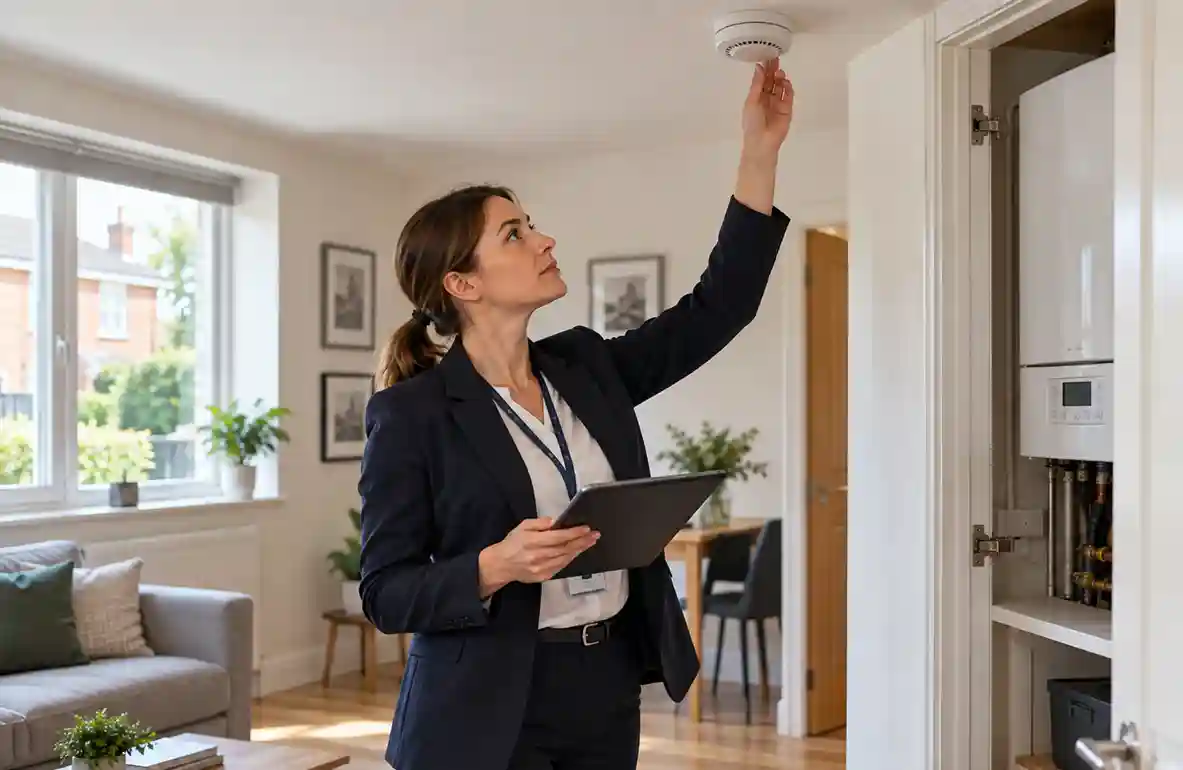
A file of inspection photographs marked “all satisfactory” going back three years tells you almost nothing except that someone, at some point, walked through the property with a phone camera. It doesn’t tell you whether the extractor fan that was struggling in year one has since failed completely, whether a hairline crack has widened, whether a recurring stain is genuinely resolved or merely absent on the day of the visit, or whether an ageing boiler that has been mentioned twice is now becoming a foreseeable capital cost.
An inspection that doesn’t change what happens next isn’t really an inspection — it’s a formality, and formalities don’t protect anything.
For a letting agent or property-management company, the professional value lies in noticing change, deciding what that change means, routing it to the right person and being able to show afterwards why the decision made at the time was reasonable. The report should not merely prove that somebody attended the property. It should help the management team and the landlord decide what needs to happen next.
Start from what you’re actually trying to find
The useful frame is that every inspection is looking for a relatively small number of things: deterioration that will become more expensive if left; safety or habitability concerns that need to leave the normal maintenance queue; defects already raised that have not genuinely been resolved; conditions worth monitoring because the trajectory matters more than the snapshot; foreseeable capital expenditure; and, occasionally, something about the way the property is being occupied that is materially affecting its condition.
Experienced agents already know what damp, cracked sealant and tired fixtures look like. The more valuable skill is recognising what has changed since the last visit and whether that change alters the management decision.
That is why the previous inspection should be part of the preparation rather than something filed away after the event. If cracking was being monitored, return to the same area. If staining followed an earlier leak, establish whether it has remained dry. If a contractor previously said an extractor was approaching failure, confirm whether that observation led anywhere. The check-in inventory provides the starting condition; interim reports should then show the direction of travel.
A good inspection therefore becomes comparative rather than merely descriptive.
There is also an important limit to what the visit is supposed to achieve. The Property Ombudsman’s current Code of Practice for Residential Letting Agents is useful on this point: routine visits are not inventories or surveys. Their value is in identifying significant matters, recording them and making sure appropriate action follows.
That distinction protects the agency as much as the property. A property manager does not need to diagnose structural movement from a crack or determine the cause of an electrical problem. They need to recognise when the finding has moved beyond something that can responsibly be left in the routine inspection file.
Current electrical-safety guidance makes the same practical distinction. The statutory electrical inspection and testing has to be undertaken by a qualified person at the required interval, normally at least every five years, but deterioration seen between those inspections can justify earlier professional investigation. The routine visit does not replace the EICR; it may provide the reason not to wait for the next one.
Gas should be treated similarly. A routine inspection may uncover information that warrants an engineer’s involvement, but it does not turn the inspector into a gas engineer. The Health and Safety Executive’s guidance for landlords and letting agents distinguishes annual gas-safety checks from the wider responsibility for maintenance and follow-up, and also makes an important management point: where an agent takes on safety and maintenance responsibilities, the management arrangements need to make clear who is actually responsible for what.
The professional judgement is therefore not “can I diagnose this?” It is “do I have enough information to continue monitoring this responsibly, or does somebody qualified now need to make the decision?”
Not every property needs the same rhythm
A recently refurbished property occupied by a reliable long-term tenant with little repair history does not present the same management picture as an older conversion with recurring water ingress, a newly acquired property whose behaviour through a full winter is still unknown, or a home inspected shortly after substantial works where latent defects and snagging may only now be emerging.
There is no universal inspection frequency that makes all of those properties equivalent.
Where a licence, management agreement or another requirement dictates a frequency, that requirement needs to be followed. The Property Ombudsman Code also expects the frequency of routine visits to be agreed with the landlord through the Terms of Business. Beyond that, the useful management question is not “how often do we inspect our properties?” but “why does this particular property need its next inspection when we have scheduled it?”
A recurring problem may justify an earlier visit. Major works may justify a specific follow-up rather than waiting for the next routine cycle. A newly onboarded property may deserve closer attention until the agency has enough evidence about its condition and maintenance profile. Equally, repeatedly inspecting a low-risk property simply because the software generated another diary task can consume time without adding much intelligence.
That does not mean a different timetable should be improvised every month. It means inspection frequency should respond to evidence rather than becoming a setting nobody revisits.
The tenant’s position matters too. The property remains their home, and excessive visits can become intrusive. A professional inspection programme is therefore not the one that achieves the highest number of visits; it is the one in which each properly arranged visit produces information worth having.
This is also where broader 2026 management expectations are heading. In its August 2026 analysis of the Renters’ Rights reforms, RICS highlighted the growing importance of evidence trails for residential property managers, including bringing previous issues forward into later inspections and recording the reasons behind management decisions.
The value is in continuity, not frequency for its own sake.
The inspection is only the first half
What separates an inspection that protects an asset from one that generates paperwork is what happens after the report reaches the office.
A finding needs a management outcome attached to it. Some observations genuinely require no action. Some can reasonably be monitored. Routine repairs need to become instructions. Urgent findings need to leave the normal queue. Potential capital items need to reach the landlord early enough for a decision to be made before failure turns the decision into an emergency. And where the significance of something cannot responsibly be established from a routine visit, specialist assessment is itself the correct next action.
The danger is rarely that inspection software lacks enough status labels. It is that those labels conceal the absence of a decision.
“Monitor” is a good example. It can be entirely appropriate, but only if somebody can later explain what is being monitored, why immediate intervention was not considered necessary, what change would trigger action and when the issue will next be reviewed.
A repeated inspection trail can protect the agent where it shows a stable condition being consciously monitored. It can do the opposite where the same defect appears in successive reports and nobody alters the response.
That is an important point for professional firms: an inspection record is not automatically defensive evidence merely because it exists. Three dated photographs showing deterioration can become evidence that the management team knew about a problem for months. The protection comes from the quality of the decisions visible alongside the photographs.
RICS makes essentially that point in its current property-management guidance. Where a manager decides not to act immediately, the reasoning should be recorded because evidence accumulates over time. A later reviewer should be able to understand why monitoring was reasonable then and whether the subsequent information should have changed that decision.
The same principle applies to landlord authority.
Most agents work within agreed repair limits, client approval thresholds and Terms of Business. That is commercially necessary, but it creates a predictable failure point: the inspection identifies a defect, the property manager refers it to the landlord, no answer arrives, the contractor slot disappears and the finding sits in an approval queue until the next complaint.
“Reported to landlord” is not the same management outcome as “resolved”.
Where a significant finding requires client authority, the agency’s process needs to make clear what happens if that authority is delayed or refused. That may mean further escalation, a stronger recommendation, documenting the risk being accepted or acting under whatever emergency or delegated authority the management agreement legitimately provides. The exact solution depends on the contract and circumstances; allowing important issues simply to disappear into an unanswered email does not.
The Property Ombudsman Code is particularly relevant here because it expects significant findings from routine visits to be properly recorded and diligently brought to the attention of the relevant parties, and repair instructions to contractors to make the nature and urgency of the work clear.
That is a better test of inspection quality than whether the PDF was issued on time.
What to actually keep, and why
The record does not need to resemble a building survey. It needs to allow another competent person to reconstruct what the agency knew and what it did with that knowledge.
Photographs matter most when they are genuinely comparable. Twenty general room photographs may establish that the visit took place. Two images of the same crack or recurring stain, taken from a consistent position several months apart, may establish whether the condition changed.
Context matters just as much. “Bathroom wall” tells the next property manager almost nothing. “Staining returned below window following March repair; compare with February image; contractor asked to re-investigate source of ingress” tells them what they need to know.
Recommendations should also survive the hand-off. Who was told? What was recommended? Did the landlord approve it? What did the contractor actually find? Was the repair completed? Did anybody verify that the underlying issue had been resolved?
This is where an inspection report should become a client decision document rather than a photographic archive.
A landlord does not usually need 40 photographs presented with equal prominence. They need to know what changed, what requires a decision now, what can wait, what may turn into future capital expenditure and what has already been dealt with. If the one important recommendation sits halfway through a long report surrounded by rooms marked “satisfactory”, the report can be comprehensive and still be poor management communication.
That matters even more in larger firms because the person carrying out the visit, the property manager communicating with the landlord and the colleague eventually instructing the contractor may all be different people. A good inspection process must survive each of those hand-offs without the significance of the finding being diluted.
RICS’s current professional analysis emphasises time-stamped inspection reports, contractor observations, communications and consistent records because disputes increasingly turn not only on property condition but on what the management team knew, when they knew it and what happened next.
Completion evidence is therefore critical.
“Sent to contractor”, “awaiting landlord approval” and “job raised” describe workflow states, not completed repairs. Even “contractor attended” does not prove the underlying defect was resolved if the contractor found that a different trade, further investigation or additional work was required.
The same discipline should apply where the deliberate decision is to do nothing yet. A history showing that a minor defect remained stable can justify continued monitoring. A history consisting of unrelated photographs from different angles cannot.
Routine inspections should not, however, become scrutiny of the tenant’s private life. The legitimate subject is the condition of the property, landlord-provided fixtures and equipment, safety-relevant observations and matters genuinely affecting its state or permitted use. Personal possessions and ordinary housekeeping are not management issues simply because they appear in the photograph.
Where something relevant to the tenancy is observed, evidence should still come before assumption. A possible unauthorised occupier, prohibited smoking or another apparent breach should be recorded objectively and considered separately from the maintenance purpose of the visit rather than exaggerated into a conclusion on the spot.
There is a commercial advantage to that restraint. Tenants who experience inspections as an examination of the property rather than an examination of themselves are more likely to mention the intermittent extractor, recurring leak or small patch of damp they did not think serious enough to report separately. Those observations may protect the landlord’s asset far more effectively than another set of immaculate room photographs.
Where this sits alongside the legal position
None of this alters the rules governing access. In England, routine access to inspect condition and repair normally requires at least 24 hours’ written notice and must take place at a reasonable time, subject to the wider tenancy and quiet-enjoyment position. Emergencies and access disputes are separate subjects and deserve separate treatment.
Nor does a routine inspection replace any specialist statutory check.
Electrical inspection and testing, gas safety, fire-safety requirements where applicable and other formal compliance obligations retain their own legal regimes. A routine visit may reveal information that means waiting for the next scheduled check is no longer sensible, but the inspection report should never be allowed to masquerade as evidence that the specialist obligation itself has been completed.
That separation should also exist in the agency’s management system. The property file needs to show both the formal compliance calendar and the unresolved condition issues emerging between those formal dates.
A useful test for an inspection programme is this: could you answer, with confidence, whether anything has changed since the previous visit and, if it has, what was done about it?
For a letting management company, there are two further tests worth applying. Could a colleague who has never managed the property before understand the answer from the file? And could the agency explain why the decisions visible in that file were reasonable at the time they were made?
If the answer to all three is yes, the inspection record is protecting the asset and the management position around it.
If all the agency can produce is a folder of photographs, a series of “satisfactory” reports and a chain of recommendations that were forwarded but never closed, it is managing proof that visits occurred rather than proof that the property was managed.
This article provides general property information, not legal, financial, surveying or other professional advice for your individual circumstances. Property disputes and regulatory issues can depend on the facts, documents, location and applicable law. If significant money, property or legal rights are at risk, or you are considering an irreversible course of action, take appropriate professional advice before proceeding.

