

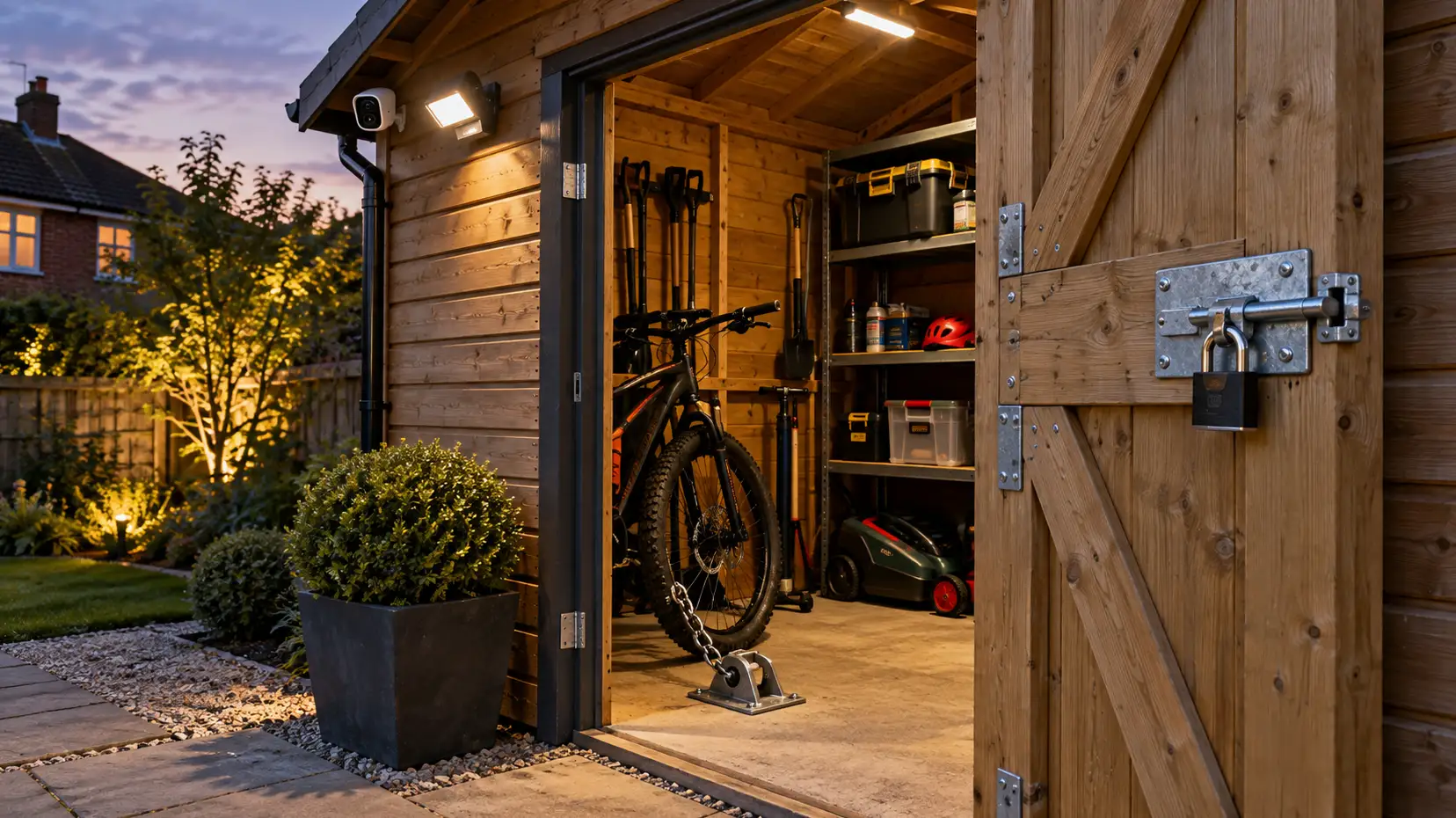
A camera watching a shed with a flimsy door and exposed hinge screws is, in a very real sense, a very good record of the exact moment somebody walked in without much difficulty.
It is an understandable purchase. CCTV feels like the modern, obvious answer to security, particularly when cameras are cheap enough to install almost anywhere. But where obvious physical weaknesses remain, it is usually the wrong place to start because it detects or records the problem without fixing the thing that made entry easy in the first place.
The sensible way to spend money on a shed, garage or outbuilding is in layers. Start with what physically prevents entry, then make the valuable things inside harder to remove, and only after that spend on alarms, lighting and surveillance. A £150 camera cannot compensate for a £3 hasp screwed into weak timber.
Before buying anything, though, work out what the building actually contains and check the insurance position. A shed holding a few hundred pounds of ordinary garden equipment presents a very different spending decision from one containing two expensive e-bikes, professional tools or a motorcycle. Theft from garages and outbuildings can also be subject to separate policy limits and conditions, so there is little sense spending heavily on security without knowing both the value at risk and what the insurer expects. MoneyHelper’s guidance on contents insurance identifies theft from outbuildings as a specific part of cover worth checking.
Start with the building, not the lock
Before deciding which lock to buy, walk around the outbuilding as though you were trying to get into it. Look at the door, frame, hinges, hasp or locking mechanism, windows and the condition of the walls themselves.
Police guidance makes essentially the same point. Sheds and garages often contain valuable, portable property, while exposed screws, removable hinges, vulnerable windows and poor locks can make them considerably easier to attack than the main house. They may also contain tools that can then be used to attack the house itself. Police.uk’s shed and garage security guidance is a useful starting point.
On a typical timber shed, the hinge fixings and hasp deserve particular attention. Ordinary screws accessible from outside can sometimes simply be removed, so security or non-return screws can make sense; depending on the construction, coach bolts passing through the timber can provide a considerably stronger fixing.
The same principle applies to the hasp and staple holding the padlock. A substantial lock attached to thin hardware secured with accessible screws is not a substantial security system. Secured by Design recommends appropriately robust hasps and staples and advises the use of coach bolts or security/non-return screws where suitable. Its guidance on securing sheds and outbuildings is considerably more useful than judging a product from the words “heavy duty” on its packaging.
Windows need the same scrutiny. A beautifully reinforced shed door achieves little if an adjacent window can be forced or broken and the lock reached from inside. Depending on the type of building and how the window is used, internal mesh, grilles or more resistant glazing may be appropriate.
Then consider the structure itself. Rotten timber around a frame, deteriorated panels or lightweight construction can set a practical ceiling on how much it is sensible to spend on increasingly sophisticated door hardware. With a small lightweight shed, also check whether the structure itself is adequately fixed and stable rather than assuming the door is the only part that can be attacked or displaced. Security is only as convincing as the easiest alternative route in.
Spend on tested hardware once there is something solid to attach it to
Once the door, frame and surrounding construction are worth protecting, better locks start to make sense. This is where independent testing tells you considerably more than marketing language.
Sold Secure uses four main grades — Bronze, Silver, Gold and Diamond — to indicate resistance against progressively more demanding threat levels and attack methods, although not every product category is tested all the way to Diamond. Bronze is aimed at an opportunist level of attack, with Silver, Gold and Diamond representing progressively greater resistance. Sold Secure explains its ratings here.
That does not mean every shed needs the highest-rated product available. The appropriate level depends on what is being protected, where it is kept, the strength of the rest of the building and any requirements imposed by an insurer. What the rating does give the buyer is evidence that a product has been tested rather than merely described as “maximum security”.
Secured by Design is the UK police security initiative and operates the Police Preferred Specification accreditation scheme. It is related to, but not synonymous with, Sold Secure. Products may reach Secured by Design standards through recognised independent testing and certification routes, including Sold Secure specifications in relevant categories.
With a padlock-and-hasp arrangement, both parts need to make sense together. A closed-shackle padlock can reduce access to the shackle for cutting or levering, but fitting an expensive rated padlock to weak sheet metal, soft timber or an inadequately secured staple simply moves the easiest point of attack somewhere else.
Garage doors bring another calculation. Secured by Design specifically recommends considering a garage door defender where an existing door is being retained and needs additional resistance against being lifted or forced. Its garage security guidance is useful for distinguishing between improving an existing door and replacing it with a more secure tested doorset.
If the contents are valuable, secure them even after somebody gets inside
Physical security at the door is the first layer, but it does not have to be the last.
If a shed contains a valuable e-bike, a garage holds a motorcycle or a workshop contains expensive portable tools, it is worth asking what happens if somebody gets through the entrance despite the work you have done. Leaving the valuable item free-standing means entry is the only obstacle; anchoring it gives an intruder another problem to solve.
For an outbuilding with an appropriate concrete base, a properly installed ground anchor can provide a fixed point for a security chain. Secured by Design specifically recommends ground anchors for valuable cycles and other equipment but notes that, in a shed, the base needs to be suitable for that fixing. Where no suitable concrete base exists, a purpose-made shed shackle or another security solution designed for the actual construction may be more appropriate than simply fixing an anchor through thin floorboards.
The anchor, chain and lock should be thought of as one security system. Spending heavily on a high-rated chain makes little sense if it is attached to a weak fixing that can be removed from the building.
This is also where the inherent strength of the building should influence the spending order. A lightweight shed containing £5,000 of bicycles may justify more money on properly securing the bicycles themselves than on trying to turn the shed into a miniature strongroom.
Visibility matters too: a window displaying bikes, power tools or a ride-on mower tells somebody what is worth targeting before they attempt to enter. Obscuring the view, repositioning the most valuable property and avoiding leaving easily removable valuables directly beside glazing costs little and can remove some of that advance information.
Recording serial numbers, photographing higher-value property and marking items where practical is also worth doing. It does not physically prevent theft, but it can make identification and proof of ownership easier if property is later recovered.
Add alarms, lighting and cameras once the physical layers make sense
Once the structure, entry points and important contents have credible physical protection, detection and surveillance become much easier to justify because they add capabilities that locks and anchors cannot provide.
A contact or movement alarm can draw attention to attempted entry; lighting can improve visibility on the approach; and CCTV can alert the owner, record what happened and potentially provide evidence. None of those things replaces the job of making the door, window or valuable item physically harder to defeat or remove, which is why they normally belong later in the spending order where obvious physical weaknesses still exist.
A camera overlooking a properly reinforced entrance is therefore an additional security layer. A camera overlooking a shed that can be opened by removing two accessible screws is mostly observing a weakness that could have been fixed first.
Lighting should be positioned intelligently rather than simply made as bright as possible. It needs to illuminate the relevant approach without unnecessarily spilling light into neighbouring homes or gardens. Property Front Page covers intrusive security lighting separately because a security upgrade that creates a neighbour nuisance can simply exchange one property problem for another.
Cameras need similar thought. Where a domestic CCTV system records only within the property boundary, the position is relatively straightforward. If it captures a neighbour’s property, a communal area or public space, data-protection rules apply and the householder has additional responsibilities. The Information Commissioner’s Office recommends positioning domestic cameras to avoid recording beyond the property boundary where possible and explains the obligations in its guidance on home CCTV systems.
The important distinction is that electronics should be doing something the physical security cannot. They should not be compensating for an obviously removable hinge or a door hanging in rotten timber.
The building should change where the money goes
A traditional timber shed has an inherent limit. Better hinge fixings, concealed or resistant screws, a robust hasp and an appropriate padlock can make opportunistic entry considerably harder, but the surrounding timber remains a lighter construction than a masonry garage.
That can make internal security disproportionately valuable. Once the door hardware reaches a sensible standard, somebody storing expensive cycles or machinery may gain more from anchoring those items and keeping them out of sight than from continually buying more sophisticated hardware for the same lightweight door.
A brick or block detached garage shifts the calculation. Once the walls and roof provide a much more substantial enclosure, the vehicle door, personnel door and windows become the obvious areas to inspect. Older up-and-over garage doors can particularly justify additional locking or a defender where full replacement is not proportionate.
An integral garage introduces another issue because entry into the garage may also provide a concealed route towards the house. The connecting door should therefore not be treated as an unimportant internal door simply because it cannot be seen from outside.
Security is not the only concern at that doorway. In England, Approved Document B requires an attached or integral garage to be separated from the dwelling by fire-resisting construction, and where a door connects the two it forms part of that fire-safety arrangement. Approved Document B gives the current statutory guidance. Secured by Design likewise points out that a connecting garage door needs to satisfy both fire and security considerations.
That means a DIY security improvement should not casually compromise the door leaf, frame, seals, glazing or self-closing arrangement where these form part of the required fire protection. Significant alterations to that doorset are one of the points where getting competent advice is more sensible than simply fitting whatever security hardware appears strongest.
A modern garden room or office can sit much closer to a small extension than a traditional shed in terms of what is stored inside. Large glazed doors and windows may be its most exposed element, particularly where the room contains computers, televisions or other electronics. In that situation, tested doors and windows, sensible visibility control and an alarm may deserve more attention than padlocks and hasps simply because the building stands in the garden.
Check the insurance before assuming the security is enough
Outbuilding insurance can radically change the spending decision.
Do not assume that because the main contents of the home are insured, everything stored in every shed, garage or garden room is covered to the same value or under the same conditions. Theft from outbuildings can have its own policy limit, particular categories of property may be restricted or excluded, and policies may impose conditions concerning how the building or the insured item must be secured.
MoneyHelper identifies theft from outbuildings as a specific feature to look for when judging contents insurance rather than something that should automatically be assumed to match the main household limit. That becomes particularly important where a garage or shed contains several expensive bicycles, professional tools, business equipment or other easily portable property.
Read the policy wording and schedule for the actual property. Check the outbuilding theft limit, any single-item limits, whether high-value items need to be declared separately and whether the insurer specifies particular security for the building or for items such as cycles and motorcycles.
The original version of this article referred to a five-lever mortice lock to BS 3621 as though that were a broadly applicable minimum for outbuildings holding valuable property. That is too simple. BS 3621 can be relevant to suitable doors and some insurance arrangements, but the appropriate requirement is whatever the particular policy and type of building actually specify.
If you rent, there is an additional distinction between protecting your possessions and modifying somebody else’s building. Permanent work such as drilling through doors, fixing anchors into the structure, installing grilles or making electrical alterations may require the landlord’s agreement. The landlord’s insurance for the building and the tenant’s insurance for their own contents are separate matters, so both the physical permission and the insurance position are worth checking before substantial work is undertaken.
Spend on the weakest meaningful point first
There is no universal answer saying that everybody should spend the first £100 on a padlock and the second £100 on a camera. The useful answer depends on what is currently weakest and what is actually being protected.
If the door is structurally sound but its exposed hinge screws can be removed from outside, fixing those comes before buying a camera. If the hasp is thin and attached to soft timber, improving the fitting comes before buying a premium padlock. If the building is reasonably secure but contains a valuable bicycle simply leaning against the wall, the next useful spend may be a suitable anchor, chain and lock rather than another external gadget.
If those physical layers are already credible, alarms, appropriate lighting and CCTV become much easier to justify because they are adding detection, warning and evidence rather than substituting for resistance.
There is also a point where spending more on the existing building stops making sense. Very high-end locks and electronic security fitted to a badly deteriorated lightweight shed can become false economy. If the contents are sufficiently valuable, replacing the doorset, upgrading the outbuilding itself or moving the most valuable property somewhere substantially more secure may be the better decision.
The useful principle is to spend in roughly the order an intruder would encounter the security: first make the structure and entry points worth defending, then make the valuable contents harder to remove, and finally add the detection and surveillance layers around them.
That way, the camera is no longer simply recording how easily somebody got in. It is watching a building that has already made getting in — and leaving with the valuable contents — substantially harder.
This article provides general UK security information, not a guarantee against theft or advice on the requirements of a particular insurance policy. Security products, testing standards, insurer conditions and outbuilding construction vary. Check current product certification and your own policy wording before purchase, obtain any necessary landlord permission before altering rented property, and take competent advice before carrying out structural, electrical or fire-door alterations.

