

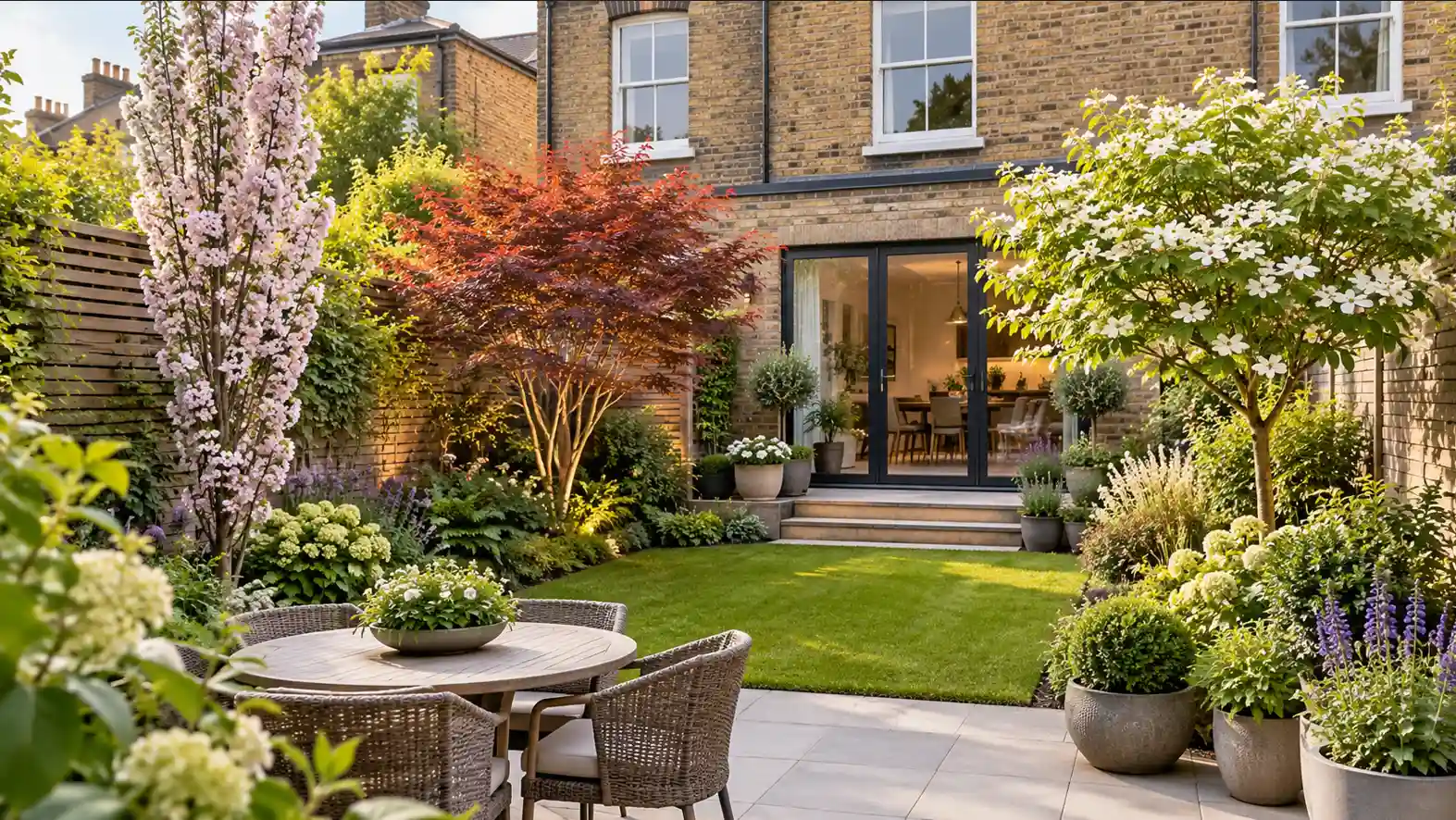
Almost every regretted tree started as a perfectly reasonable-looking specimen in a pot at the garden centre. The label said “ornamental”, the price was fair, and it fitted neatly in the boot of the car. Ten or fifteen years later it may be shading half the garden, crowding the boundary, dropping fruit onto the patio or needing regular pruning simply to keep it within the space that was available from the beginning.
The mistake is rarely that the tree itself is a bad tree. It is choosing it for what it looks like when you buy it rather than what it will be like to live with once it has grown up.
That is the question worth answering first: not “which tree looks best today?” but “which tree will still suit this particular garden once it is mature?”
Work out what you are actually choosing between
Mature height and spread should come before flower colour.
The RHS identifies eventual size as one of the most important considerations when choosing a tree for a smaller garden and recommends plotting the mature canopy on a scale plan before planting. Even trees genuinely recommended for smaller gardens can eventually reach 6–8m or more. RHS guide to trees for smaller gardens
Spread matters just as much as height. A tree that eventually reaches 6m but stays little more than a metre wide can work surprisingly well in a narrow garden. A shorter tree that develops a broad 5m canopy may dominate the same space.
That is also why the cultivar name matters. Buying “an Amelanchier”, “a cherry” or “a rowan” is not precise enough. Two trees from the same broad family can be similar when young and end up occupying very different amounts of garden.
The RHS Award of Garden Merit is a useful quality filter because it identifies plants considered to perform reliably in appropriate UK garden conditions, but an AGM is not a certificate saying the plant is the right size for your plot. A dependable tree that eventually becomes several metres wide is still the wrong tree for a tiny courtyard.
Position matters too. A tree planted against a boundary does not keep its eventual canopy conveniently on your side of the fence. The RHS specifically warns that a tree placed in the corner of a garden may eventually cast much of its shade over the neighbouring property rather than your own.
Before buying, stand where the trunk will actually go and imagine the mature canopy rather than the pot.
Choosing by what you actually need, not by a generic top-ten list
If the garden is genuinely narrow: width is the limiting factor, so look for naturally columnar forms rather than buying a vigorous tree and relying on pruning to hold it in.
Amelanchier alnifolia ‘Obelisk’ illustrates the difference particularly well. The current RHS plant profile gives it an eventual height of around 4–8m but a spread of only about 1–1.5m. It still offers white spring flowers, autumn colour and berries, but puts most of its growth upwards rather than across the garden. RHS profile: Amelanchier alnifolia ‘Obelisk’
Prunus ‘Amanogawa’, the upright flowering cherry, works on the same principle. It is a narrow, columnar tree with pink spring blossom, but “narrow” does not mean miniature: RHS guidance puts its eventual height at around 8m and width at around 3m. That can be excellent beside a lawn or in a narrow border, but still much too large for some tiny courtyards.
If both width and height are tightly restricted, go genuinely smaller rather than assuming an upright habit solves every space problem.
If one tree has to earn its place across several seasons: choose something that offers more than a short burst of blossom.
Amelanchier ‘La Paloma’ is a useful example. It remains much more compact than the commonly recommended Amelanchier lamarckii, reaching roughly 2.5–4m high and wide, while still providing white spring flowers, berries and strong autumn colour.
Dogwoods show even more clearly why the cultivar name matters. Cornus kousa itself can become a substantial tree, but a compact cultivar such as Cornus kousa ‘Galilean’ is currently listed by RHS at only around 1.5–2.5m high and wide. It still provides white summer bracts, pink strawberry-like fruits and red-purple autumn foliage, but on a dramatically smaller plant. RHS profile: Cornus kousa ‘Galilean’
That is exactly why “I like dogwoods” is only the beginning of the buying decision. The precise cultivar can make the difference between something that fits comfortably and something that eventually occupies much of the garden.
If keeping the garden light matters: look at the density and width of the mature canopy rather than simply the tree’s height.
Many Amelanchier have a relatively light, open habit, while upright forms concentrate the canopy into less horizontal space. Deciduous trees also have an obvious advantage over dense evergreens where winter light matters: they can provide useful summer shade while allowing considerably more light through once the leaves fall.
Think about where that shade will actually land. A tree directly south or west of a patio, conservatory or main garden seating area can change how that part of the property feels for much of the day. The same tree on the northern boundary may have a much smaller effect on usable garden light.
A low, spreading crown can sometimes remove more useful light than a taller but narrower tree.
If low maintenance matters: do not confuse “low maintenance” with “nothing ever falls off it”.
Every deciduous tree loses leaves. Flowering trees shed flowers. Fruiting trees may leave berries or fruit behind if birds do not take them first.
The more useful question is whether that particular kind of maintenance will irritate you where the tree is planted.
Fruit dropping onto a lawn or planted border may be irrelevant. The same fruit over pale paving, a driveway or outdoor dining area can become something you resent every year. Position can therefore matter as much as species.
Naturally compact trees also make more sense where low maintenance is the aim than vigorous trees that need repeated pruning to fit the space. Sorbus ‘Autumn Spire’, for example, has an upright form, berries and autumn colour while remaining relatively narrow. The principle is more important than that individual recommendation: choose a tree whose natural size is close to what you actually want, rather than buying a large tree and committing yourself to controlling it indefinitely.
If wildlife is the priority: flowers, fruit, branches and foliage can all contribute something.
A flowering and fruiting tree can provide pollen and nectar for insects, food for birds and mammals, and nesting or shelter opportunities. Native and wildlife-friendly options can be particularly valuable, and the Woodland Trust’s current small-garden guidance includes species chosen for both manageable size and ecological value. Woodland Trust guide to low-maintenance trees for small gardens
But wildlife value does not make mature size irrelevant. A tree that outgrows its position and is repeatedly hacked back — or eventually removed — is not automatically a better wildlife choice than a smaller tree allowed to develop properly.
If space is tight, favour something that genuinely fits and still flowers, fruits or provides cover rather than trying to squeeze the largest wildlife tree available into the smallest garden.
If it is going in a front garden: the tree has to fit the house as well as the plot.
A narrow upright form can work particularly well where space is divided between the house frontage, driveway, pavement and neighbouring boundary. A broad crown can create more difficulty with parking, sightlines and overhang simply because it occupies more horizontal space.
Think beyond the canopy too. Roots, paving, drains and proximity to buildings deserve sensible consideration, but there is no reason to assume that planting any tree near a house automatically creates a structural problem. RHS guidance notes that most trees growing near buildings cause no damage, with subsidence risk depending on factors including tree size and species, distance, foundations and particularly the presence of shrinkable clay soil. RHS guidance on trees near buildings
The sensible response is neither panic nor complacency. Choose a tree proportionate to the site and give its mature canopy and root system somewhere reasonable to develop.
The mistakes that cause regret later
The recurring problem is buying the nursery specimen instead of the mature tree.
A label saying “small tree” is not enough. The RHS itself recommends trees for smaller gardens that may ultimately reach around 8m, which can be perfectly manageable in a modest garden and overwhelming in a tiny urban plot.
Ignoring the cultivar name creates the same problem. Acer griseum, the paperbark maple, is a beautiful ornamental tree with peeling cinnamon-coloured bark and excellent autumn colour, and it often appears in recommendations for smaller gardens. But its mature dimensions can reach roughly 8–12m high and 4–8m wide. That can make perfect sense in the right garden; it does not make it a small courtyard tree.
Ignoring soil is another avoidable mistake. A compact cultivar that wants well-drained neutral-to-acid soil is not low maintenance if it spends its life struggling in unsuitable ground.
And planting a naturally large tree with the intention of “keeping it small” through repeated crown reduction can turn what looked like a cheap garden-centre purchase into years of avoidable maintenance. Where space is genuinely restricted, choosing a naturally compact form is usually a more convincing long-term solution than attempting to manufacture one with pruning.
There is no completely mess-free deciduous ornamental tree either. The useful decision is which seasonal debris you are prepared to live with — leaves, blossom, berries or fruit — and whether the proposed position puts that debris somewhere it matters.
Property Front Page covers what happens when trees later create boundary, damage or safety problems elsewhere in this section. This article is about making the decision that reduces the chance of getting there in the first place.
The best tree for a small garden is therefore not necessarily the smallest tree, the prettiest tree or the one with the longest list of recommendations. It is the tree whose mature height, width, canopy, soil requirements and seasonal habits still make sense for the exact place where you intend to put it.
Choose that tree rather than the one that looks best in the pot, and there is a much better chance you will still be pleased you planted it twenty years from now.
Tree sizes and characteristics in this article are indicative and reflect current horticultural guidance. Ultimate size, growth rate, flowering, fruiting and performance vary with cultivar, soil, exposure, climate and growing conditions. Check the mature height, spread and requirements of the exact cultivar you intend to buy rather than relying on the common name alone.

