

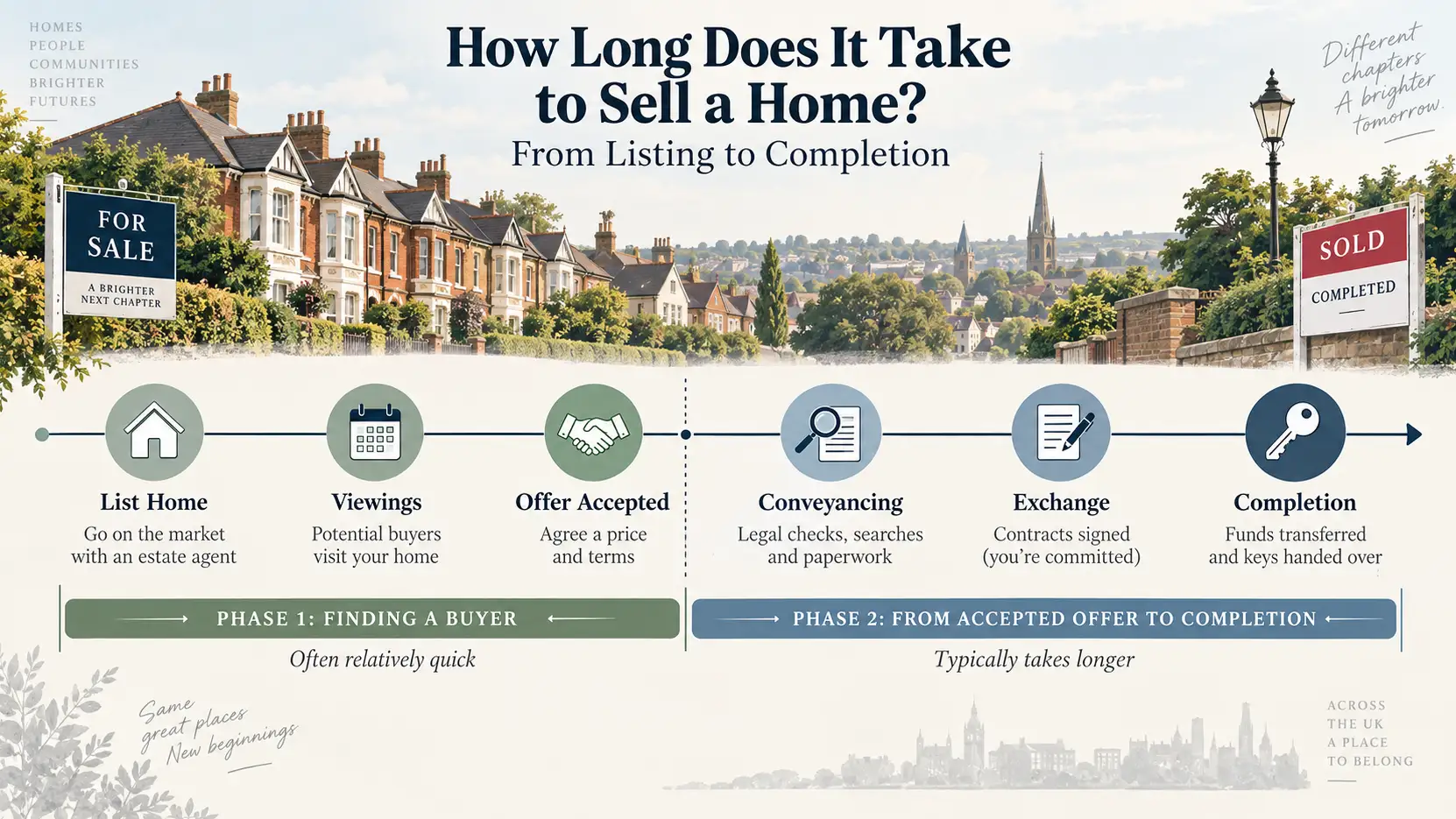
“How long will it take?” is usually one of the first questions a seller asks their agent, and it’s often answered with a single number that quietly hides two quite different processes bolted together. There’s the time it takes to find a buyer, and there’s the time it takes to get that buyer to completion once they’ve agreed to buy. Those two clocks behave differently, they’re affected by different things, and conflating them is one reason sellers can feel as though a sale has ground to a halt several months after accepting an offer, even though a great deal may still be happening between solicitors, lenders and other people elsewhere in the chain.
This article deals principally with England and Wales, where accepting an offer does not make the sale legally binding. That happens later, at exchange of contracts. Northern Ireland has its own process with some similarities, while Scotland works differently enough that its timeline is better considered separately.
Clock one: listing to accepted offer
This is the part of the process most visible to a seller. Viewings happen, feedback comes back, offers arrive or don’t, and changes to price or marketing produce an obvious response. It is also the stage most affected by the property’s asking price, local supply and demand, property type and the strength of the market at the particular price point. A well-presented home can still sit unsold if buyers consider it too expensive relative to the alternatives, while an accurately priced property in a strong local market can move much faster than the national picture suggests.
Current figures underline why sellers should be wary of being promised one universal average. Rightmove’s September 2026 data showed substantial regional variation: homes were taking around 55 days to secure a buyer in the North East, 57 days in the North West, 69 days in Wales and 78 days in London, with many English regions sitting somewhere in the mid-60s to low-70s. Its national measure for August was 64 days. Rightmove — September 2026 House Price Index
That makes something around two months a useful national reference point, but only that. An unusual rural house, an expensive London flat and a conventional family home in a busy local market are not competing for the same buyers, and the figure a seller should pay most attention to is what comparable properties in their own market are actually doing. If similar homes are regularly finding buyers in four weeks and yours has had little serious interest after twelve, the explanation is unlikely to be simply that “property takes time”.
Clock two: accepted offer to completion
This is where a large part of the selling timeline can sit, and it is also where progress becomes much less visible to the seller. Once an offer is accepted, the buyer may still need their formal mortgage offer and survey, searches are ordered, the title is checked, enquiries pass between conveyancers and any chain has to reach the point where every linked transaction can proceed. Until contracts are exchanged in England and Wales, either side can still withdraw.
The amount of time this stage now takes is easy to underestimate. Connells Group reported in May 2026 that homes exchanging contracts in April had spent an average of 104 days under offer before exchange — the first April in its records where the figure had moved beyond 100 days. Its research also showed just how different leasehold transactions can be: the typical leasehold property took 155 days to reach exchange, compared with 97 days for a freehold home. Connells Group — Conveyancing delays push time to exchange past 100 days
Other datasets measure different parts of the journey and can produce still longer numbers. Rightmove, for example, reported an average of 167 days from sale agreed to completion in March 2026. Those figures should not be treated as interchangeable — one measures to exchange, the other to completion and their samples and methodologies differ — but they tell the same useful story for a seller: once you’ve accepted an offer, the remaining process can still be measured in months rather than weeks.
Exchange changes the position significantly. Once contracts are exchanged, buyer and seller are legally committed and a completion date has been agreed. The interval after exchange is usually much shorter, commonly somewhere between one and four weeks, although exchange and completion can take place on the same day where the parties agree.
What actually slows a sale down
A property chain remains one of the most obvious sources of delay because your sale can be perfectly ready while somebody three transactions away is still waiting for a mortgage offer, dealing with survey problems or trying to resolve a legal enquiry. But the number of links is only part of the story. A three-property chain in which everybody has a buyer and is progressing can be in a much stronger position than a shorter chain where somebody further up still has a property to sell. When comparing buyers, it is therefore worth asking not only how long their chain is, but whether it is actually complete.
“The searches are holding everything up” is not as universally useful an explanation as it once sounded either. Turnaround still varies by local authority and search type, and an individual search can certainly delay a particular transaction, but delays are often cumulative instead: enquiries that cannot be answered, missing certificates, mortgage conditions, survey renegotiations, slow responses elsewhere in a chain and information that has to be obtained from third parties.
Leasehold sales deserve particular attention because important information may have to come from a freeholder, managing agent or management company rather than from the seller personally. Service-charge accounts, insurance information, planned major works and other management details can all become part of the buyer’s legal investigation. The much longer leasehold exchange time in the current Connells data is therefore not simply a statistical curiosity; it is a warning to flat sellers not to plan their move on the same timetable as a straightforward freehold house.
The other delay sellers tend not to build into their plans is a sale falling through. Accepting an offer does not bank the time already spent. If a buyer withdraws ten or twelve weeks later, the property may return to the market and at least part of the first clock begins again. Connells’ 2026 research found that 23% of transactions that did fall through were doing so after more than three months, illustrating how much time can disappear when a transaction fails late rather than immediately after the offer.
So how long should a seller actually allow?
There is no single official dataset following every home seamlessly from the day the listing goes live to the day the keys change hands, and that makes very precise “average time to sell” claims less useful than they first appear.
Current evidence suggests that finding a buyer alone can take around two months in many markets, while the legal process after an offer has been accepted can add several further months. But because the available datasets measure different parts of different transactions, it would be misleading simply to add two national averages together and call the result the definitive time it takes to sell a house.
For practical planning, a seller who has flexibility may sensibly allow six months or more rather than building a move around the fastest possible transaction. Allowing greater slack — potentially six to eight months from first marketing where another purchase, school move, job relocation or other fixed commitment depends on the sale — can be prudent rather than pessimistic. Some well-prepared, chain-free freehold sales will complete considerably sooner; complicated leasehold sales, long chains, difficult surveys, slow mortgage processes or collapsed transactions can take much longer.
The important distinction is that this is a planning allowance, not a prediction. The safest assumption is not that one published average will happen to you, but that there needs to be enough flexibility in the timetable if it doesn’t.
What is actually within a seller’s control
Being organised cannot make somebody else’s lender issue a mortgage offer tomorrow, nor can it force the bottom of a property chain to resolve its own problems, but sellers have more influence over both clocks than they sometimes realise.
One of the most useful things a seller can do is begin the legal preparation before a buyer appears. Government guidance for England and Wales recommends choosing a conveyancer shortly before marketing or as soon as the property goes on sale, rather than waiting until an offer has been accepted. That creates time to check the title, gather planning and building-regulation paperwork, locate guarantees and certificates and identify anything unusual before a buyer’s solicitor discovers it several weeks into the transaction.
The Law Society’s current TA6 Property Information Form can also be completed before a buyer has been found. For firms in its Conveyancing Quality Scheme, the sixth edition became mandatory for new instructions from 30 March 2026. Leasehold sellers will usually have additional information to provide through the TA7 process, while management information held by the landlord or managing agent may also need to be obtained. The Law Society — TA6 Property Information Form, sixth edition
That preparation is particularly worthwhile for sellers who already know their property has something likely to generate questions: an extension, loft conversion, solar panels, private drainage, a boundary arrangement, historic insurance claim or leasehold management issue. Finding the document before the buyer asks for it is very different from beginning a search for it after the transaction has already stopped.
The first clock is more obviously influenced by the seller. Pricing that reflects current comparable evidence, presenting the property well, making viewings reasonably easy and responding to an obvious lack of market interest can all affect how quickly a credible offer arrives.
Choosing which offer to accept matters too. The highest figure is not necessarily attached to the buyer most capable of reaching exchange quickly. Chain position, whether the chain is complete, mortgage readiness and whether the buyer has already instructed a conveyancer can all affect the strength of the transaction. That does not mean sellers should automatically accept less from a chain-free buyer, but the likely timetable and risk of delay are part of an offer’s value and deserve to be understood alongside the price.
Once the sale is under way, prompt replies matter, but sellers can also make their chasing more useful. When a transaction seems to have gone quiet, asking simply whether there is “any update” often produces little more than another vague response. A better question is what specific item is outstanding, who is responsible for providing it and whether anything else can continue while it is being dealt with. Where the estate agent provides sales progression, they may also be able to establish which link in the chain is actually waiting rather than leaving each seller to see only what is happening inside their own transaction.
Organisation cannot remove the dependencies on everybody else, but it can prevent the seller from becoming one of them.
Scotland: a genuinely different process
The England and Wales timeline should not simply be carried across to Scotland, where much of the transaction is structured differently from the outset. Most Scottish properties marketed for sale require a Home Report, which normally includes a Single Survey, valuation, Energy Report and Property Questionnaire before the home is marketed, front-loading information which in England and Wales may only emerge after a buyer has already agreed a price.
The legal process is different too. Offers and their conditions are dealt with through solicitors, with the negotiations known as missives. An accepted offer is not necessarily the binding point: the contract becomes binding when the missives are concluded after the parties have agreed their terms. The date of entry then performs the role broadly associated with completion.
That does not mean every Scottish property sells quickly or that transactions cannot be delayed. It means the structure is sufficiently different that England and Wales averages for “offer to exchange” should not be applied to a Scottish sale. Sellers there need to plan against the Scottish process itself rather than trying to translate an English conveyancing timetable.
The timeline is two problems, not one
The useful way for a seller to think about timing is to keep the two clocks separate. If a property has been on the market for months without an acceptable offer, the questions are primarily about price, demand, competition and marketing. If a strong buyer was found quickly but completion is now dragging on, reducing the asking price or changing the photographs won’t solve anything; the blockage sits somewhere inside the transaction.
Knowing which clock is running does not make the sale move faster by itself, but it makes the delay easier to diagnose and gives the seller a much clearer idea of where their own effort can make a difference.
A fast sale is not simply a home that finds a buyer quickly. It is one that finds a buyer who can proceed, with a property and seller sufficiently prepared for the legal process that follows.
This article provides general property information, not legal or conveyancing advice for your individual transaction. Sale times vary substantially according to location, property type, chain position, financing and legal complexity, and published averages should be used as planning guides rather than completion promises.

