

Somewhere around week six, most buyers and sellers ask the same question: what is actually happening right now?
An offer’s been accepted, conveyancers are instructed, and then, to anyone outside the process, very little seems to change for weeks at a stretch.
It’s usually not true that nothing is happening. It’s that most of what’s happening — searches sitting with third parties, title documents being reviewed, enquiries passing between firms, a mortgage application moving through underwriting — is largely invisible to the buyer and seller unless somebody explains it.
And the process genuinely is long. The government’s June 2026 Home Buying and Selling Reform Roadmap put the average time from accepted offer to completion at around 120 days, roughly 60% longer than in 2007.
That doesn’t mean every transaction should take four months. A straightforward chain-free purchase can move considerably faster. A complicated leasehold chain can take longer.
What matters is understanding what is actually happening during the apparent silence.
This article focuses principally on England and Wales, where the conveyancing process, exchange mechanics and HM Land Registry system described below apply. Scotland has a substantially different buying system, and Northern Ireland has its own legal process.
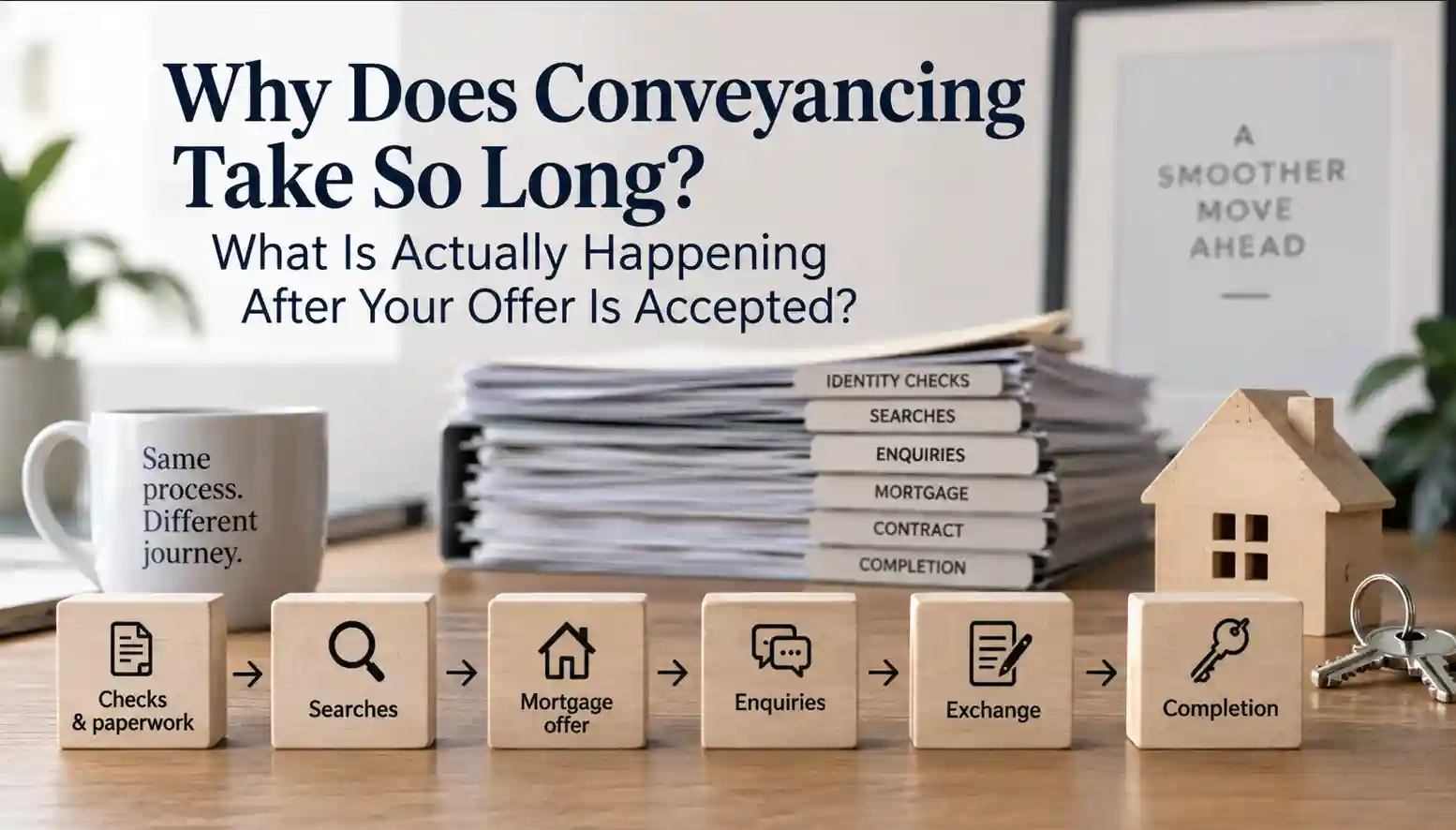
What’s actually happening, roughly in order
The first thing to understand is that conveyancing isn’t really a conveyor belt.
The stages below look sequential when written down, but several run at the same time. The buyer’s mortgage may be progressing while searches are outstanding. Enquiries may be under way before every search result is back. A survey may raise something that creates another legal question halfway through.
Think of it less as a queue and more as several tracks that all need to reach the same point before exchange can happen.
Instruction and identity checks. Both sides’ conveyancers open their files, establish who they are acting for and carry out the identity and anti-money-laundering checks required for the transaction.
For buyers, that commonly includes understanding where the purchase money is coming from. Where family money is contributing towards the deposit, further checks may be required on the person providing it.
The Solicitors Regulation Authority’s consumer guidance on anti-money-laundering checks explains why firms need this information.
This isn’t paperwork a conveyancer can simply waive because the client is in a hurry. If you’re asked for identification, bank statements or evidence of where funds came from, supplying everything promptly and together can prevent avoidable delay.
The seller’s information and draft contract. The seller’s conveyancer prepares the contract package and provides the buyer’s conveyancer with the legal title and information about the property.
Where Law Society forms are being used, that will typically include the TA6 Property Information Form, the TA10 Fittings and Contents Form and, for leasehold property, the TA7 Leasehold Information Form.
This is one of the places where preparation before the sale can save real time later.
Planning and building-control documents, guarantees, certificates for work carried out, information about boundaries and disputes, and leasehold paperwork may all become relevant.
Missing information doesn’t necessarily stop a sale.
It usually creates another question.
Searches. The buyer’s conveyancer orders searches to discover information that isn’t apparent simply from looking at the property or reading the title.
For an ordinary purchase, GOV.UK says these usually include a local authority search, drainage and water search and environmental search, with others added where the property or location justifies them.
The important point is that the conveyancer often isn’t the organisation producing the answer.
Search information can depend on local authorities, water companies and commercial search providers, and turnaround times vary.
A conveyancer can order searches promptly and chase where appropriate.
They cannot produce the underlying information themselves.
The mortgage offer. While the legal work is progressing, the buyer’s mortgage application follows its own track.
The lender may need its valuation completed, underwriting satisfied and any further financial information resolved before issuing the formal mortgage offer.
This is separate from conveyancing, but it intersects with it. Where the buyer’s conveyancer also acts for the lender, they must deal with the lender’s legal requirements too.
So a transaction can be legally well advanced and still unable to exchange because the mortgage side isn’t ready.
Enquiries. Once the buyer’s conveyancer has reviewed the title and seller’s information, questions begin. Search results and later documents may create more.
This is normal.
Enquiries are not evidence that something has gone badly wrong. They’re how the buyer’s legal adviser establishes what is unclear, missing or needs resolving before the buyer becomes legally committed.
Some are simple.
Others depend on somebody outside the transaction.
A leasehold enquiry may require a managing agent or freeholder. A question about an alteration may need historic documentation. An unclear right of way may require older title papers.
That’s why “the solicitors are still dealing with enquiries” can mean very different things.
The useful question isn’t simply how many remain.
It’s what is still unanswered, who needs to answer it, and whether it actually prevents exchange.
Reporting and the mortgage offer. As the picture becomes complete, the buyer’s conveyancer explains what has been found.
The buyer should understand the title they’re acquiring, important search results, significant replies to enquiries, relevant contract terms and any mortgage conditions affecting the legal transaction.
This is where conveyancing stops being document collection and becomes legal judgement.
Sometimes the report is straightforward.
Sometimes this is where the significance of a lease clause, restrictive covenant, estate charge or right affecting the property becomes properly clear.
Exchange, and the period before completion. Exchange happens only when the transaction is genuinely ready.
The contract must be agreed. The buyer must be satisfied with the legal work. The mortgage must be available where one is needed. The deposit must be ready. Critical enquiries must be resolved.
And, where there is a chain, the connected transactions normally need to be ready too.
That last point explains an enormous amount of apparent inactivity.
Your own transaction can be ready while somebody several links away is still waiting for a mortgage offer or management pack.
In England and Wales, exchange creates the legally binding contract and the completion date is agreed.
Buyers will also normally need the appropriate buildings-insurance arrangements in place from exchange. GOV.UK’s home-buying guide advises buyers to arrange buildings insurance for this point, although the precise position depends on the contract and property; leasehold flats, for example, may already be covered by a block policy.
Between exchange and completion, the final legal and financial preparations are made.
Completion and after. On completion day, the purchase money reaches the seller’s conveyancer, the transaction completes and the buyer gets the keys.
But the conveyancing file isn’t finished.
The buyer’s conveyancer still deals with the relevant property tax formalities — Stamp Duty Land Tax in England or Land Transaction Tax in Wales — and registers the change of ownership, along with any mortgage, at HM Land Registry.
That happens after the buyer has moved in.
So completion feels like the end of conveyancing to the buyer.
Administratively, there is still work left to do.
Where delays genuinely tend to come from
Not every hold-up has the same cause, and separating them is more useful than assuming every slow transaction has a slow conveyancer.
The chain. A chain is a group of transactions that depend on one another.
If somebody farther down cannot sell, a mortgage offer higher up is delayed or one seller’s legal problem takes weeks to resolve, everyone connected to the chain can be affected.
A chain doesn’t behave like a collection of independent purchases.
It behaves like one interconnected system.
Third parties. Some of the slowest information comes from organisations that are neither the buyer’s nor seller’s conveyancer.
Local authorities, mortgage lenders, managing agents, freeholders and estate-management companies can all become part of the critical path.
A good conveyancer can identify what is missing and chase it.
They cannot force an outside organisation to answer immediately.
Missing or incomplete seller information. A seller who starts gathering paperwork only when enquiries arrive can unintentionally add time.
Past extensions, replacement windows, electrical work, solar panels, guarantees, boundaries and estate-management arrangements can all generate questions if documentation is missing.
That is one reason the reform programme is focused so heavily on making more information available before an offer is accepted.
Genuine title or property complexity. Some legal issues simply take time to resolve properly.
An old covenant, unclear access rights, missing deeds, an unregistered title, a lease problem or incomplete paperwork for historic alterations cannot responsibly be dealt with by rushing.
Sometimes the frustrating delay is exactly what the buyer is paying the conveyancer to investigate.
The conveyancer’s own workload. This is a real cause too.
Not every delay belongs to a council, bank or managing agent.
A firm running too many files per case handler can take longer to review documents, raise enquiries or respond when information arrives. Poor communication makes the situation worse because the client cannot tell whether the problem is genuinely outside the firm’s control.
The distinction usually becomes clear when specific questions are asked.
“We’re waiting for the management pack requested on 4 September and chased yesterday”
is an explanation.
“It’s progressing”
isn’t.
Better questions than “any news?”
A general request for an update often produces a general answer.
Better questions expose the actual position.
What are we currently waiting for?
Who are we waiting for?
When was it requested?
When was it last chased?
Which enquiries remain outstanding?
Is anything unresolved that actually prevents exchange?
Is the mortgage offer fully in place?
Is the delay in my own transaction or somewhere else in the chain?
Is there anything I can provide or do myself?
Those questions identify the critical path — the thing that genuinely has to happen next before the transaction can move.
Sometimes the answer will still be frustrating: there may be nothing useful for the buyer or seller to do that day except wait for information already requested.
But at least they know what the silence means.
The reform picture, and what’s actually changed so far
The frustration behind all of this is not imaginary.
The government’s June 2026 Home Buying and Selling Reform Roadmap says the average transaction now takes around 120 days after an offer is accepted, with around one in three transactions falling through.
Its central argument is that too much important information currently appears too late.
The direction of reform is therefore towards more information upfront, more reusable digital property data, fewer duplicated checks and earlier commitment between buyer and seller.
During 2026, the roadmap includes work on better guidance around upfront property information, voluntary preparation of more legal and title information before marketing, digital identity and property-data improvements, and a new Code of Practice for property agents.
More fundamental measures — including mandatory sales packs and arrangements intended to allow earlier binding commitments — remain future reforms requiring further implementation and, where necessary, legislation.
That distinction matters.
A buyer whose offer has just been accepted is still moving through the existing conveyancing process described in this article.
The reform programme may eventually change that process substantially.
It hasn’t replaced it yet.
So for a buyer or seller in an England-and-Wales transaction today, the reason conveyancing can still feel painfully slow is much less mysterious.
Several different processes are moving at once, controlled by several different organisations, and exchange cannot happen until the important ones are ready at the same time.
That is what is happening during the weeks when it feels as though nothing is happening at all.
Important: This article provides general information about residential conveyancing, principally in England and Wales, and is not legal advice for a particular transaction. The precise process, searches, enquiries, insurance requirements and timescales depend on the property, lender, chain and circumstances. Scotland and Northern Ireland have different legal systems and home-buying procedures. Buyers and sellers should ask their own conveyancer for advice on their transaction.

