

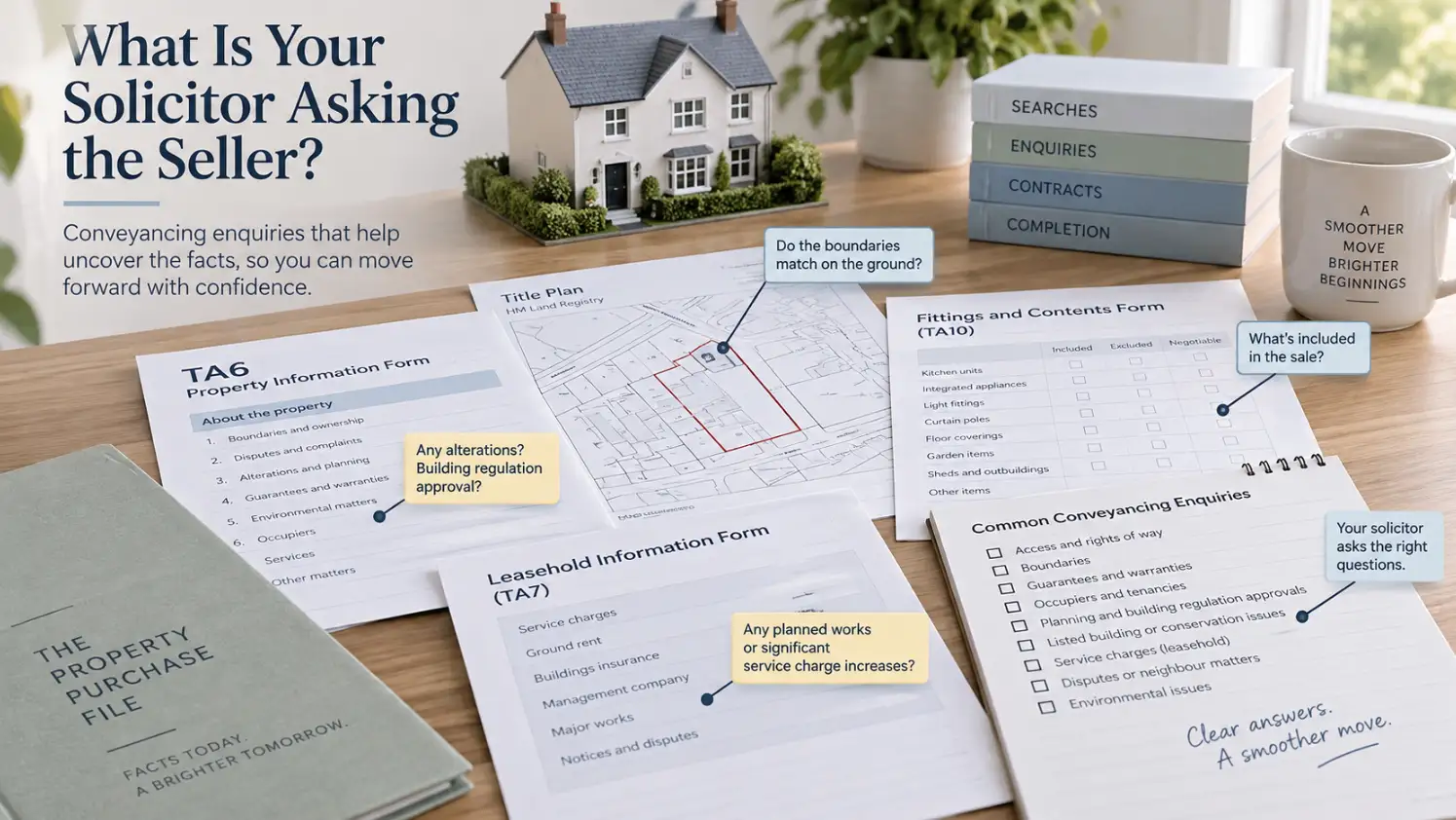
Somewhere in the middle of most house purchases, the update from your solicitor changes shape. For weeks it has been about searches, surveys and the contract pack. Then, quietly, it becomes: “We’re waiting for replies to enquiries.” A week later, perhaps: “Your conveyancer has raised further enquiries with the other side.”
To a buyer who has never been through the process before, this can sound like paperwork limbo — a queue with no visible end. In reality, it is one of the stages where the legal due diligence becomes most visible. Enquiries are where the buyer’s conveyancer starts testing gaps, inconsistencies and unanswered questions in the documents against the property the buyer believes they are purchasing.
Some replies close a point immediately. Others expose another question. A few uncover something that can affect the mortgage, the legal use of the property, the buyer’s future costs or whether they are still comfortable proceeding at all.
This article is about conveyancing practice in England and Wales. Scotland’s home-buying process is structured differently around solicitors’ missives, while Northern Ireland has its own conveyancing and land-registration system. Buyers elsewhere in the UK should ask their own solicitor or conveyancer how the equivalent stage operates.
Where enquiries actually come from
An enquiry is rarely invented from nothing. It usually comes from an inconsistency, a missing document or a question raised by information already in front of the buyer’s conveyancer.
One important source is the seller’s Property Information Form, the TA6. From 30 March 2026, firms accredited under the Law Society’s Conveyancing Quality Scheme have had to use the sixth edition for new transactions where the solicitor was instructed on or after that date. The Law Society’s current TA6 guidance confirms that the latest form was cut from 25 sections to 15, with a number of subjects introduced in the previous edition removed again, including council tax, asking price, tenure and ownership charges, building safety, restrictive covenants and several physical-property topics.
That does not mean those subjects have stopped mattering, nor does it mean every deleted TA6 question now has to be recreated as a bespoke enquiry. Some of the information comes from the title, searches, the marketing process or other transaction documents instead. What matters is whether the buyer’s conveyancer already has enough reliable information to advise on the particular property. Where they do not, a specific enquiry may still be necessary.
Alongside the TA6 sits the TA10 Fittings and Contents Form and, for leasehold property, the TA7 Leasehold Information Form, together with management information obtained from the landlord, freeholder or managing agent. The conveyancer will also be considering the registered title and title plan, any deeds referred to in the register, searches, planning and building-control documents supplied by the seller, guarantees, warranties and the mortgage lender’s requirements.
Relevant information from the buyer’s survey can feed into the process too. A surveyor and conveyancer are looking at different things, but if a survey reveals an extension, alteration, access arrangement or other issue with an obvious legal dimension, the buyer should make sure their conveyancer sees it rather than assume the two professionals automatically exchange every piece of information.
Enquiries arise where these sources fail to join up neatly. If the seller says an extension was built in 2018 but no planning or building-control documentation has been produced, there is something to investigate. If the title refers to rights over a shared drive but what exists on the ground appears different, the paperwork needs to be understood. If a leasehold management pack reveals proposed works that were not apparent earlier, the financial implications may need clarifying before the buyer can sensibly proceed.
“Not known” can be a proper answer — but it does not always close the question
The sixth-edition TA6 deliberately gives sellers more opportunities to answer “not known”. That reflects an important reality: sellers are not expected to possess technical or legal knowledge about everything that may have happened to a property during its history.
The Law Society’s TA6 explanatory notes tell sellers to answer truthfully, completely and as accurately as they can from their own knowledge, and to say so where they genuinely do not know. Buyers are also warned that sellers can only provide information about matters they know about.
A “not known” answer therefore is not automatically suspicious. Its significance depends on the question.
If it concerns something with little practical consequence, the buyer may simply be advised that the information is unavailable. If it concerns an alteration for which the buyer’s conveyancer cannot establish the necessary approvals, a right of access on which the property depends, or another matter relevant to the mortgage lender or future sale, the absence of an answer may itself become important.
At that point the enquiry is no longer just “does the seller know?” It becomes “can the position be established another way, and if it cannot, what does that uncertainty mean for the buyer?”
The current Law Society Conveyancing Protocol is also clear that conveyancers should not respond to every uncertainty by firing off generic additional questions. Additional enquiries should be relevant and necessary to the transaction, and indiscriminate use of standard enquiries can breach the protocol. The enquiry process is supposed to resolve genuine legal due-diligence issues, not replace the buyer’s survey or turn every possible unknown into correspondence between solicitors.
Not every enquiry carries the same weight
Buyers understandably tend to read every question from their solicitor as equally alarming. In practice, the importance lies less in how many enquiries appear on the list than in what remains unresolved after the replies come back.
| What is being investigated | Why it is being checked | Why the answer can matter |
|---|---|---|
| Guarantee for windows, roof or other work | To establish whether a relevant guarantee exists, remains valid and can pass to the buyer | May affect what protection the buyer has if the covered work later fails |
| Alteration with missing approval documents | To establish what consent or certification was required and what evidence exists | May affect lender requirements, future resale and the legal position of the alteration |
| Shared driveway or access | To establish the legal basis on which the property uses the access | Informal use may not provide the same security as an adequate legal right, although rights can also arise in other ways |
| Historic neighbour dispute | To understand what happened, whether it was resolved and whether anything remains outstanding | A continuing dispute or unresolved legal issue may materially affect the buyer’s decision |
| Apparent difference between title information and occupation on the ground | To understand the extent being bought and whether further evidence is needed | HM Land Registry title plans usually show general rather than exact boundaries, so discrepancies require careful interpretation rather than measurement from the plan |
| Leasehold service charges or proposed major works | To establish existing liabilities, anticipated expenditure and the management position | The answer can materially alter the future cost of owning the property |
The boundary point is particularly easy to misunderstand. A title plan is important, but it normally shows the general extent of a registered title rather than the precise legal line of every boundary. HM Land Registry’s current boundary guidance confirms that the great majority of registered titles use the general-boundaries system. A buyer therefore cannot simply put a ruler against the red line on the title plan and conclude that a fence is legally in the wrong place.
Similarly, an informal access arrangement is not automatically worthless merely because no obvious express right has yet been found in the register. Rights can arise in more than one way. The conveyancer’s job is to establish what right, if any, exists and whether it is adequate for the buyer and any mortgage lender, rather than jumping directly from “not in the document we expected” to “no right exists”.
A concise reply that properly closes an enquiry is therefore a good sign, not a bad one. Delay tends to arise when the answer is incomplete, a supporting document cannot be produced, another source contradicts it, the lender has to be consulted or the reply creates a new question that could not reasonably have been raised before.
When somebody else is living at the property
Occupiers are another area in which apparently routine questions can have a serious legal purpose.
On the seller’s side, a buyer expects the property to be transferred with the possession required by the contract. If somebody other than the registered owner is living there and there is a possibility that they may claim rights or remain in occupation, the conveyancers need to make sure the position is properly dealt with rather than discovering the problem on completion day.
There is a separate lender issue on the buyer’s side. Someone may intend to live in the purchased property without being named as a borrower — perhaps an adult child, partner or other relative. Under the UK Finance Mortgage Lenders’ Handbook, lenders generally require a signed deed or form of consent from known occupiers aged 17 or over who will not be party to the mortgage, unless the individual lender’s instructions provide otherwise. The purpose is to protect the lender’s mortgage against competing occupational rights.
These are two different situations, and they should not be confused. One is about ensuring the seller can give the required possession of the property being sold; the other concerns people who will occupy the property after the buyer completes and the mortgage takes effect.
Either can become a late-stage problem if the people involved are only identified shortly before completion.
Which enquiries actually need resolving before exchange?
The tempting distinction is between questions that “matter” and those that can be tidied up after completion. In practice, the more useful question is whether the buyer, their conveyancer and — where there is a mortgage — the lender have enough information to proceed safely before the buyer becomes legally committed.
In England and Wales, exchange is the critical point. GOV.UK’s conveyancing guidance explains that the agreement to buy and sell normally becomes legally binding when contracts are exchanged.
That does not mean every enquiry must produce a perfect document or a completely risk-free answer. Sometimes missing evidence can be dealt with through an acceptable alternative, an indemnity policy where appropriate, clarification from another source or a risk that the buyer knowingly decides to accept after advice. In a mortgaged purchase, however, the conveyancer must also satisfy the lender’s requirements; a buyer cannot simply instruct their solicitor to ignore something that prevents the solicitor from giving the lender the assurances it requires.
Nor should apparently small contractual matters automatically be left until after completion. If the TA10 says a fitted appliance, shed or other item is being removed but the buyer believes it was included in the deal, that disagreement is best resolved before exchange, when the contractual position can still be made clear.
The issues most likely to hold up exchange are therefore not defined by a particular subject heading. They are the ones that leave a meaningful question about title, legal use, access, obligations, lender security, significant financial exposure or what the buyer will actually acquire.
Why “waiting for enquiries” is rarely just administrative
It is easy to hear “we’re still waiting on replies” as a queue-management problem — as though the only thing standing between buyer and exchange is somebody typing faster. Sometimes the delay really is administrative. A document has not been sent, a managing agent has not replied or one side is simply slow.
But that is not the whole enquiry stage. Often the buyer’s conveyancer is trying to establish whether a reply actually answers the question, whether evidence supports it and whether the answer creates a new problem elsewhere in the transaction. The process can feel repetitive precisely because a useful enquiry narrows uncertainty: the first reply establishes one fact, which reveals the next thing that has to be checked.
There is no particularly useful “normal” number of enquiries. Ten questions that depend on missing documents or third-party evidence can take much longer to resolve than thirty straightforward factual enquiries that the seller’s solicitor can close quickly. The number alone tells the buyer very little about either the complexity of the purchase or how close it is to exchange.
There is no reliable standard timescale either. Some enquiries can be answered almost immediately; others depend on a managing agent, freeholder, lender, local authority, warranty provider or another organisation producing information first. A further round of enquiries does not necessarily mean the conveyancer has restarted the process or found a completely new set of problems. Often the first answer has simply established enough to reveal the next question that needs resolving.
For the buyer, the most useful question when an update says only “enquiries are outstanding” is therefore not simply when the replies are expected. Ask what kind of matters remain unresolved. Are they routine documents the seller has yet to provide? Is there a reply that the conveyancer considers inadequate? Does anything need to be reported to the mortgage lender? Most importantly, is there an outstanding point that could affect your decision to proceed or is genuinely preventing exchange?
That distinction tells you much more than the raw number of enquiries still open.
A purchase with twenty enquiries can be straightforward if nineteen are quickly answered and the twentieth is routine. A purchase with three can be much harder if one concerns the legal access to the house, one exposes substantial leasehold expenditure and the third leaves the lender waiting for evidence it requires.
“Waiting for enquiries” is therefore not a useful measure of how close a transaction is on its own. What matters is what remains unanswered — and whether the answer, when it comes, changes anything that matters.
This article provides general property and conveyancing information and does not constitute legal advice for an individual transaction. Conveyancing enquiries depend on the particular property, title, searches, lender requirements and documents involved. Practice and standard forms can change, and buyers should discuss any significant outstanding enquiry or proposed solution with their own solicitor or licensed conveyancer before deciding whether to exchange contracts.

