

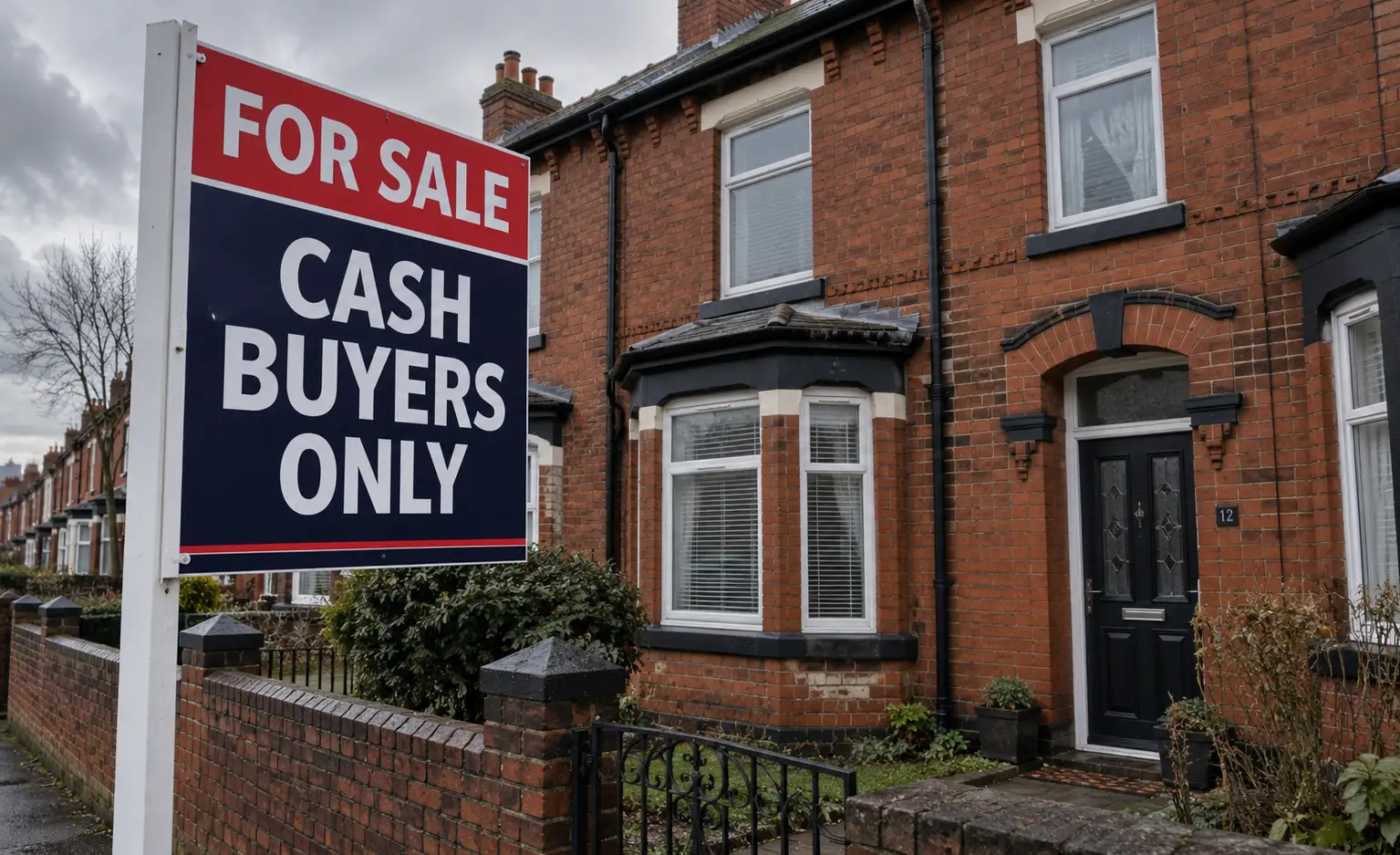
A property marketed at a price that looks noticeably better than similar homes nearby, with “cash buyers only” attached, tends to provoke one of two reactions. Either it looks like an opportunity nobody else has spotted, or it looks like a trap. Neither reaction is quite right on its own. The phrase itself isn’t a verdict on the property — it’s a prompt to find out specifically why ordinary mortgage finance isn’t part of the sale, because that reason is what actually determines whether the discount is worth having.
Two different situations get the same label
“Cash buyers only” can describe two genuinely different situations, and telling them apart matters more than almost anything else.
The first is that the seller simply prefers a buyer who isn’t dependent on a mortgage. There may be a tight timescale, a previous sale may have collapsed, the seller may be dealing with an estate or relocation, or they may simply value certainty over attracting the widest possible pool of buyers. In that situation, there may be nothing inherently wrong with the property from a lending point of view. A mortgage buyer who is particularly interested can still ask whether the restriction is genuinely absolute, although having a mortgage agreement in principle does not put them in the same position as somebody who can proceed without a lender.
It is also worth remembering that “cash buyer” does not automatically mean “chain-free”. Somebody may be buying without a mortgage but still relying on proceeds from the sale of another property before their money becomes available. From a seller’s perspective, the real attraction is therefore not simply the absence of a mortgage but the strength and certainty of the buyer’s overall position.
The second situation is more important for anyone tempted by an unusually low asking price: something about the property may fall outside the criteria of ordinary mortgage lenders. Even then, “unmortgageable” can be too absolute a description. A property rejected by one lender may be acceptable to another, and some problems can be investigated, remedied or documented well enough to restore access to a wider mortgage market.
A mortgage agreement in principle does not settle this question. It says something about the lender’s initial view of you as a borrower; the lender still has to decide whether it is prepared to accept the particular property as security. MoneyHelper — what happens after a mortgage in principle
Working out which one you’re looking at
The most direct route is simply asking the selling agent whether the cash-only restriction reflects the seller’s preference or a known problem with mortgage lending on the property.
If a previous sale has already fallen through, the useful question is what actually happened. Did the buyer’s own finances fail, or did their lender object to the property? Was there a valuation? Was further investigation requested? Did a solicitor identify something in the title or lease? Was the property given a nil valuation, or was the lender simply unwilling to proceed under its own criteria?
Those answers are far more useful than the words “cash buyers only” themselves.
An agent may not have a complete technical diagnosis, and a seller’s reassurance that a problem is minor should not be treated as a substitute for the relevant documents or professional investigation. But the more specific the explanation, the easier it becomes to work out whether the restriction is temporary, lender-specific or likely to follow the property for years.
The common reasons lenders may refuse a property
There is no single universal list that automatically turns a home into a cash-only purchase. Different lenders have different appetites for risk, and the same property can produce different decisions. But several problems appear repeatedly.
A short lease. A lease approaching or falling below 80 years deserves particular attention because shortening lease length can affect value, future saleability and the cost of extending it. But 80 years is not a universal mortgage cut-off. Different lenders apply different minimum requirements, and the remaining term at the end of the proposed mortgage can matter as well as the number today. The useful question is therefore not simply whether the lease has crossed a particular threshold, but whether the term will satisfy the lender you intend to use and what it will cost to deal with the lease if it does not. GOV.UK — buying or owning a leasehold home
Non-standard or defective construction. Certain concrete, steel-framed and system-built properties can be difficult to finance because particular construction systems have known defects or because some lenders have limited appetite for them. But non-standard construction is not another word for unmortgageable. Plenty of homes built using timber frames, system construction and modern methods are financed normally. What matters is the specific construction type, its condition, any recognised repair scheme or certification and the lender’s policy towards it. That can be difficult to judge from appearance alone, particularly where an older structure has subsequently been clad or altered.
Structural issues. Active subsidence, significant movement or another serious defect can cause a lender’s valuer to request further investigation, impose conditions or decide that the property is not acceptable security in its current state. That does not mean every crack or historic movement prevents a mortgage. The cause, severity, evidence of progression and any remedial work all matter.
A property that isn’t ready for ordinary occupation. Homes in the middle of major renovation, with essential facilities removed or in very poor condition, can fall outside standard residential lending criteria. Some lenders require a working kitchen and bathroom; others take a different approach, and specialist renovation finance operates differently again. The relevant question is what the particular lender considers acceptable security, not whether the property fits a single universal definition of habitable.
Building-safety and cladding issues. The position for flats affected by external-wall and fire-safety concerns has changed considerably since the first years after Grenfell. An affected flat should no longer automatically be assumed to be cash-only, and some major lenders will lend where appropriate remediation arrangements or protections are in place. An EWS1 form may still be relevant in some cases, but it is not required for every flat and is not itself a general certificate that a building is safe. RICS — cladding and EWS guidance
Legal and title complications. Sometimes there is nothing obviously wrong with the building at all. Problems with title, access rights, restrictive arrangements, unresolved disputes, unusual lease provisions or other legal defects can still make a lender uncomfortable with the property as security. Some issues can be resolved or insured against relatively straightforwardly; others can remain an obstacle for the next purchaser as well.
Japanese knotweed. This is an area where older rules of thumb still circulate. The former seven-metre approach is no longer the professional standard used by RICS, and modern assessment focuses more closely on the actual impact of the infestation on the property and its use. Depending on the circumstances, lenders may still want appropriate treatment or management arrangements, but knotweed should not automatically be translated into “no mortgage”.
This isn’t an exhaustive list, and that is really the point. “The bank won’t lend on it” is not yet enough information to decide whether a property is risky or attractive. You need to know which bank, why it objected, and whether the issue belongs to that lender’s criteria or to the property itself.
The distinction that matters: can the problem actually be resolved?
Once the reason is known, the most useful distinction is between a restriction that is temporary or realistically curable and one that is likely to remain part of the property.
A seller wanting a clean cash transaction creates no defect in the property at all. A home whose mortgage problem arises because essential renovation is unfinished, because a lease can realistically be extended or because a particular building issue is already moving through a funded remediation process may eventually return to a much wider lending market. If that happens, the buyer may be taking on a problem with a genuine end point.
A construction type that remains unacceptable to many lenders, an enduring title problem or another characteristic that cannot realistically be altered is different. The property may still be worth buying at the right price, but the discount is then compensating you not simply for today’s inconvenience but potentially for owning something with a permanently narrower market when you eventually sell.
That is why cash-only properties make little sense as a category on their own. The real question is what has caused the restriction and whether ownership changes that position.
Why the discount can be smaller than it looks
A cash-only property being cheaper than a comparable mortgageable one isn’t automatically a bargain. The reduced price is often the market’s way of reflecting precisely the problem that has excluded part of the buying population, and the useful calculation isn’t simply how much cheaper the property is than the house next door. It is how much cheaper it remains once you account for the cost, uncertainty and future resale effect of whatever has made it cash-only.
A short-lease flat might appear heavily discounted until the likely extension cost and professional fees are understood. A renovation property may still be genuinely attractive once the work required to make it acceptable to mainstream lenders has been properly costed. A structural problem might prove straightforward to deal with, or it might open into a much larger programme of investigation and remediation once the cause is understood.
There is another cost that does not appear on a builder’s quotation: liquidity. If the underlying problem remains when you eventually sell, your next buyer may face exactly the same lending restriction that you are facing today. That reduces the number of people able to compete for the property and can affect both how long it takes to sell and the price the market is prepared to support.
Buying it with cash doesn’t guarantee you can mortgage it later
One assumption deserves testing particularly carefully: the idea that you can buy the property for cash now, solve the immediate problem and simply put a mortgage on it afterwards.
Sometimes that works. It should not, however, be treated as an automatic exit route. The underlying reason lenders would not finance the purchase in the first place still has to be resolved to the satisfaction of whatever lender you approach later, and lender policies can also differ where a property has only recently changed hands.
If refinancing soon after purchase is part of the financial plan rather than merely something you might consider one day, establish that route before buying. A broker experienced with unusual properties can help determine whether the obstacle is genuinely curable and whether lenders are likely to consider the property once the work or documentation is complete.
Paying cash removes the lender from today’s transaction. It does not guarantee that a lender will be willing to enter the picture afterwards.
Think about the next buyer before becoming today’s cash buyer
This is where the decision moves beyond whether you personally have enough money to complete.
A cash buyer can proceed without a mortgage lender deciding whether the property is acceptable security, but that does not make the lender’s concerns irrelevant. It simply means the decision about that risk sits with the buyer instead.
Sometimes that is exactly where the opportunity lies. A knowledgeable buyer may be able to purchase a property whose problem is understood, properly costed and genuinely capable of being resolved, then restore access to a normal mortgage market. But buying with cash does not itself cure anything, and if the original problem is still there in five years, the next buyer may face exactly the same restriction.
The useful question is therefore not merely what an ordinary version of the property would be worth. It is what this particular property is worth while carrying the restriction, what it might cost to remove that restriction and what the future market will look like if it cannot be removed.
Once you know the problem, investigate that problem
The professional advice should follow the reason the property is cash-only.
A short lease or title issue belongs with a conveyancer or solicitor who understands the particular legal problem. Construction concerns need a surveyor with relevant experience of the building system involved; where there are serious structural concerns, a structural engineer may also be necessary. For an unusual or heavily altered property, the scope of the survey should be chosen around what actually needs investigating rather than simply ordering a survey level and assuming it will answer every question.
External-wall and building-safety problems may require information held by the building owner or managing agent rather than something that can be established by looking around the flat itself. And where the property appears physically and legally sound but lender appetite is the obstacle, an independent mortgage broker with experience of unusual properties can help establish whether “cash only” really means no mainstream finance or merely that the obvious lenders will not touch it.
What the buyer should resist is allowing the unusually low asking price to reverse that order — deciding first that the property must be a bargain and then looking for evidence that makes that conclusion comfortable.
The question worth carrying through the whole transaction is simple: why exactly is this property cash-only, and once you understand the answer, does the discount genuinely compensate you for the cost, uncertainty and future resale restriction you are taking on?
If the reason is clear and the risk properly understood, a cash-only property can sometimes represent a genuine opportunity. If the explanation remains vague, the apparent discount is not yet a saving. It is simply an unidentified risk with a price attached.
This article provides general property information, not surveying, legal or mortgage advice for your individual circumstances. Lender criteria vary, and a property rejected by one lender may be treated differently by another. Establish why a property is being marketed to cash buyers and obtain the appropriate legal, surveying or mortgage advice before committing to the purchase.

