

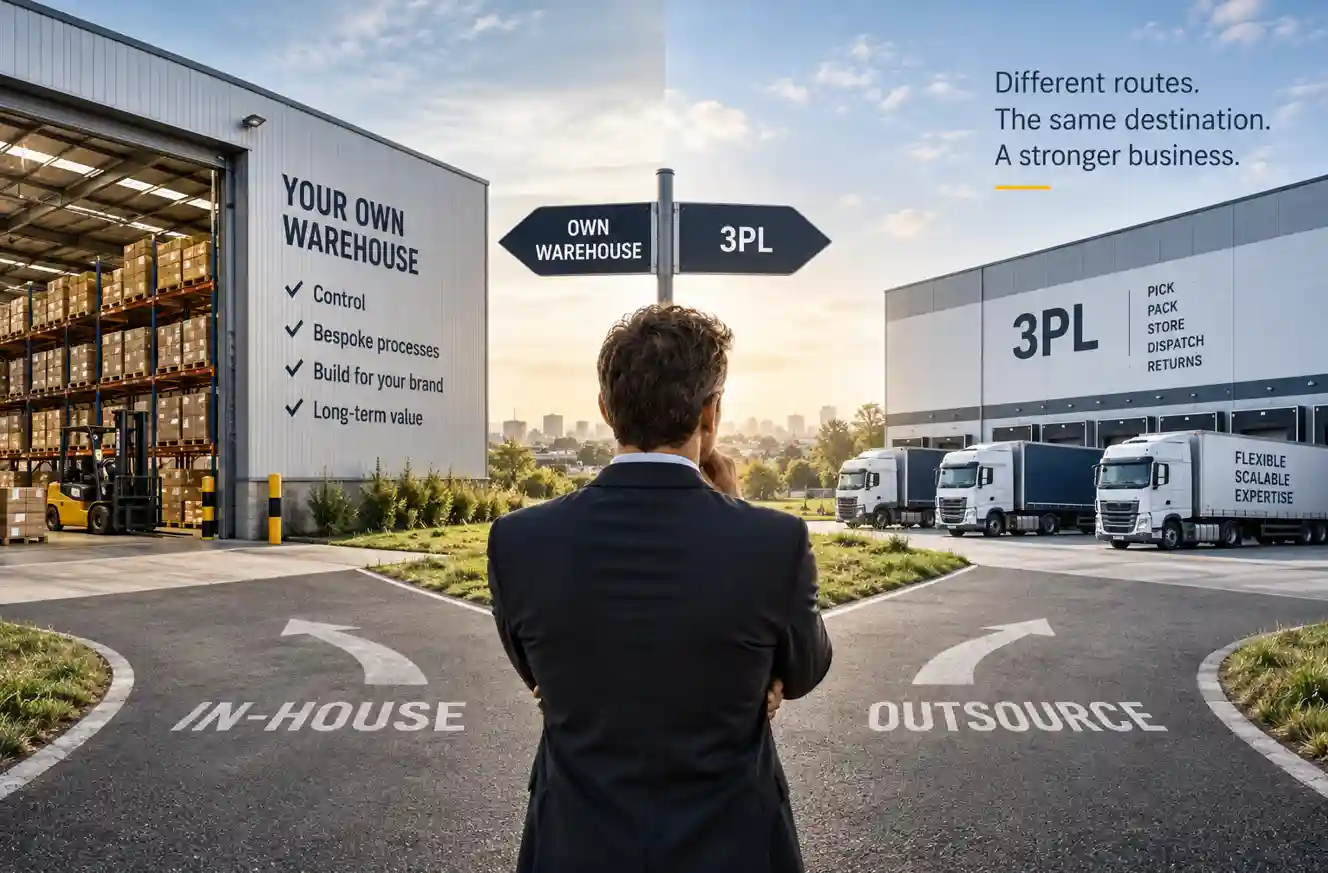
The question a growing business usually asks itself is “how big a warehouse do we need?” The question worth asking first is whether it needs to occupy a warehouse at all — or whether what it actually needs is logistics capability, which is a different thing, and one that can be bought from someone else’s building rather than rented in a lease of its own.
This isn’t a niche question for the smallest ecommerce startups. It’s a genuine decision point for retailers, wholesalers and distribution businesses at meaningfully larger scale too, and getting it wrong in either direction — outsourcing when the business really needs direct operational control, or building an in-house operation before the volume justifies it — carries a real commercial cost.
What taking your own space actually gives you
Occupying and running a warehouse directly offers real, substantive advantages: direct control over stock and the systems around it; the ability to build workflows around exactly how the business operates rather than fitting into someone else’s standard process; direct oversight of staff and quality; the ability to inspect and handle product exactly as the business needs; and genuinely bespoke packing, assembly or presentation where that matters to the customer experience.
At sufficient scale, it may also produce a lower cost per order or unit than continuing to pay a third-party margin on every movement through the operation.
That doesn’t mean sophisticated outsourced providers cannot offer stock visibility, branded packaging, dedicated processes, specialist handling or even dedicated areas and teams. Many can. The distinction is that those capabilities are delivered through a supplier relationship, agreed systems and contractual service levels rather than controlled directly by the business itself.
For some operators that distinction barely matters. For others, it sits at the centre of the decision.
And what it genuinely costs
Set against that control, occupying a warehouse directly means assuming the property and operating platform yourself: rent, business rates, service charges where applicable, utilities, staff, equipment, systems, security, insurance, maintenance and fit-out, along with the capital and management attention needed to establish and run the operation.
Those costs are covered in detail elsewhere in this section. The important distinction here is their behaviour.
A meaningful proportion of an in-house warehouse cost base continues whether the building processes 5,000 orders that month or 20,000. Rent does not fall because sales disappoint. Much of the staffing structure, equipment commitment and property cost remains in place too.
There is therefore capacity risk in both directions. Lease too much space and the business pays for capacity it isn’t using. Lease too little and growth can force another move, constrain stockholding or require expensive short-term overflow.
Taking a warehouse is not simply buying storage more cheaply. It is bringing a logistics operation, its assets and much of its capacity risk onto the business’s own balance sheet and management agenda.
What a 3PL actually does
A third-party logistics provider takes on some or all of storage, goods receiving, inventory handling, pick and pack, dispatch, carrier integration and returns handling on the client’s behalf, usually from facilities operated by the provider rather than by the client.
In effect, the business buys logistics capability instead of building the whole capability itself.
That is what makes this a genuine industrial-property question as well as an operations decision. The goods still occupy warehouse space, use racking, consume labour, require handling equipment and move through loading bays. The difference is that those resources sit behind a service contract rather than a lease taken directly by the business whose stock is being handled.
The distinction is commercially significant, but the physical requirement for warehousing has not disappeared.
The genuine advantages of outsourcing
A 3PL can convert part of a fixed warehouse commitment into a more variable service cost. Storage may increase and decrease with stockholding, while fulfilment charges broadly follow orders, picks, items or other activity measures according to the provider’s pricing model.
That can reduce the amount of property, equipment and warehouse labour the business has to commit to directly. It may also give access to established warehouse systems, management expertise, carrier networks and shipping rates that would be difficult for a smaller operation to reproduce on identical terms by itself.
The ability to add capacity without finding another unit, fitting it out and recruiting a second warehouse team can be particularly valuable during growth.
But flexibility is not the same thing as unlimited capacity on demand.
A 3PL still has buildings, staff, equipment and finite throughput. Contracts may contain minimum charges or volume commitments, providers may need forecasts, and substantial increases in volume can require capacity to be reserved in advance.
The advantage is therefore not that physical constraints cease to exist. It is that the provider can potentially manage them across a broader operation and client base rather than each customer carrying the entire infrastructure itself.
And the genuine disadvantages
Outsourcing replaces one set of commitments with another.
Storage fees, goods-in charges, pick-and-pack fees, additional-item charges, packaging costs, account or technology fees, returns handling, carrier charges and peak-period surcharges can accumulate in ways that make a low-looking headline fulfilment price a poor guide to the final bill.
Pricing models also vary considerably between providers. One may charge primarily around orders and storage; another may break the process into receiving, pallet or bin storage, picks, additional units, packaging, dispatch, returns and other services. Minimum monthly charges or committed volumes can change the economics again.
That is why quotes need modelling against the business’s actual order and inventory profile, rather than comparing one provider’s headline pick fee with another’s.
Control changes too. Inventory visibility depends on the provider’s systems and integration. Process changes may require agreement rather than being implemented internally that afternoon. Service performance is governed through the contract, operating procedures and agreed KPIs.
And exiting can be operationally awkward. Moving thousands of units of stock, changing systems integrations, redirecting carriers and transferring fulfilment without disrupting customers can make migration expensive even where the contractual notice period itself is straightforward.
Contract terms deserve proper attention for that reason. Logistics UK’s current Model Conditions of Storage illustrate the importance of clearly establishing responsibilities between warehouse provider and customer, including matters such as liability and the handling of goods.
Logistics UK — Model Conditions of Storage
The commercial comparison is therefore not lease versus no commitment.
It is one type of commitment versus another.
What’s being stored and shipped changes the answer
The right answer to “own or outsource?” depends heavily on the product itself.
Simple, uniform boxed goods lend themselves relatively easily to standardised fulfilment. Apparel and businesses with very high SKU counts create additional inventory and picking complexity regardless of who operates the warehouse, making systems capability particularly important.
Fragile goods need handling processes that should be tested rather than assumed. Oversized or bulky products may sit outside standardised fulfilment offers and require a provider specifically equipped for them. Chilled and frozen products need specialist facilities, substantially narrowing the suitable provider pool.
Products subject to particular regulatory, customs or storage requirements bring another layer of provider due diligence. The question is not simply whether the 3PL says it can store the goods, but whether its facility, processes, permissions and controls match the requirements the product creates.
Assembly, personalisation, kitting and other value-added work can also alter the decision. Some providers specialise in exactly those services; others are optimised around high-volume standardised pick-and-pack and become less attractive as the number of exceptions and manual interventions rises.
The more unusual the product and fulfilment process, the less useful a generic comparison between “warehouse” and “3PL” becomes.
The actual capabilities of the operation on each side have to be compared.
Seasonality changes the calculation, not just the numbers
A business with a huge, concentrated seasonal peak faces a different property decision from one with stable, predictable year-round volume.
Renting and staffing a warehouse around six weeks of peak demand can leave a substantial amount of underused capacity for the rest of the year. A 3PL may be better positioned to absorb that variation because warehouse space, labour and infrastructure can be deployed across a wider portfolio of customers.
But that advantage should not be taken for granted.
Christmas is not a peak experienced by one retailer in isolation. A 3PL serving multiple retail clients may face its own simultaneous demand surge, and extra storage or throughput capacity can require forecasting, reservation, temporary labour or peak pricing.
The due-diligence question is therefore not simply “can you handle our average volume?”
It is whether the provider can handle the required stockholding and daily throughput during the business’s real peak, what assumptions that capacity depends on, what it costs, and what happens if actual demand exceeds the agreed forecast.
For a strongly seasonal business, that flexibility can still be worth more than a theoretical in-house unit-cost advantage. It simply needs to be contracted and modelled rather than assumed.
Control versus scalability: the real axis of this decision
Strip away many of the individual pros and cons and one of the clearest tensions is still control versus flexibility.
A business whose product, brand or customer promise depends on tightly controlled or unusual fulfilment processes is naturally pulled towards greater direct control. One whose operation is relatively standardised and whose volumes vary significantly may place greater value on scalable outsourced capacity and lower direct management overhead.
But cost and control are not the only considerations.
Operational complexity matters. So does service criticality, inventory profile, geographic coverage, systems integration, carrier requirements, resilience and how strategically important fulfilment itself is to the business.
Geography can materially alter the comparison too. Taking one warehouse commits the operation to a particular point in the distribution network, with consequences for carrier collections, delivery times, transport cost, inventory positioning and resilience. A 3PL operating several suitable facilities may be able to offer access to a wider network without the client leasing multiple sites itself.
But that advantage should not be assumed from the provider’s estate map. A 3PL can operate ten warehouses while a particular client’s inventory is contracted to sit in only one of them. What matters is where the stock will actually be held, whether it can be split or moved across the network, what that costs and whether the arrangement genuinely changes the service geography available to the business.
If fulfilment is genuinely part of the company’s competitive advantage, retaining direct capability may be strategically valuable even where outsourcing initially appears cheaper.
If it is largely a necessary supporting function that a specialist provider can perform to the required standard, investing capital and management time in recreating that infrastructure internally may add very little.
This is ultimately a make-or-buy decision as much as a property one.
Why this is genuinely a property article, not just an operations one
Choosing a 3PL does not remove property from the supply chain.
It changes who carries the direct property exposure.
Instead of leasing 10,000 or 30,000 square feet, fitting it out and carrying the unused capacity yourself, the business buys storage and throughput from a provider that aggregates those requirements inside its own property estate.
That is not a marginal part of the UK industrial market. Savills’ 2024 research for the UK Warehousing Association found that third-party logistics remained the largest identified occupier group in its warehouse dataset, accounting for approximately 128 million sq ft — around 70% more space than in its 2015 study.
Savills and UKWA — The Size and Make-Up of the UK Warehousing Sector
So the property economics have not vanished. Rent, rates, utilities, labour, racking, equipment and underused capacity still exist somewhere in the chain.
With an in-house operation, the business encounters those costs directly.
With a 3PL, the provider carries them and recovers them through its pricing across its customers.
That is why the comparison is better understood as direct property and operational commitment versus outsourced warehouse capacity and service, rather than property versus no property.
Modelling the break-even, properly
Resist the temptation to look for a universal order-volume threshold above which in-house fulfilment becomes cheaper than outsourcing.
No credible number applies across different products, order profiles, stockholding requirements, locations and service levels.
The in-house side of the comparison needs the full warehouse cost already discussed elsewhere in this section: property occupation, labour, equipment, systems, energy, insurance, fit-out and management overhead, together with sensible treatment of the capital required to establish the operation.
The outsourced side needs the same completeness. Model goods-in, average and peak storage, order and item picks, packaging, returns, account or platform charges, carrier costs, minimum commitments, peak surcharges and any other charges generated by the real operating profile. Include onboarding and likely transition costs where they are material rather than pretending switching provider is frictionless.
Volume alone is also insufficient.
A business dispatching 10,000 simple single-item orders can produce a completely different fulfilment workload from one dispatching 10,000 multi-line orders with high returns, personalisation and several months of slow-moving inventory behind them.
Scenario modelling is therefore more useful than a single break-even number.
Run the comparison at today’s activity, expected growth and a credible downside case. Then test the peak.
And don’t stop at price.
Compare order cut-off times, accuracy requirements, returns performance, inventory visibility, implementation risk, resilience and the consequences of service failure. A 3PL that is fractionally cheaper but cannot support the business’s customer promise has not won the comparison. Nor has an in-house operation that looks cheaper per order only because management time, capital and spare capacity have been ignored.
The result should be a break-even point specific to the business — and an understanding of why it moves.
The hybrid option worth considering explicitly
Not every business needs to choose one model exclusively.
Some hold part of their operation in-house while using a 3PL for seasonal overflow. Others split by product category, retaining fragile, high-value or operationally complex products while outsourcing more standardised lines. A business may operate its core domestic fulfilment itself while using external providers for another geography, channel or customer type.
That can reduce the need to size an owned operation around every possible peak or exception.
But hybrid models are not free flexibility. Stock can become fragmented across locations, replenishment between facilities creates another movement to manage, systems need a coherent view of inventory, and responsibility for customer service can become harder to trace when an order crosses more than one operation.
The question is therefore whether the flexibility gained is worth the additional coordination.
For businesses whose product mix or demand pattern does not fit neatly into a single model, it often deserves modelling alongside the two supposedly obvious alternatives rather than being considered only after one of them fails.
The conclusion this section is willing to reach
For many growing businesses — not only the smallest ones — the right answer to “should we take a warehouse?” is genuinely no, at least not yet.
A good 3PL relationship can reduce capital commitment, management burden and direct exposure to warehouse capacity that may be difficult to forecast. For a business with variable demand and a relatively standard fulfilment requirement, paying a provider to maintain the operational platform can make more sense than recreating the same capability internally.
Equally, there comes a point for some businesses where outsourcing is no longer the obvious low-risk option. High and predictable throughput can change unit economics. The provider’s margin becomes more significant in absolute terms. Process control may become strategically important. The operation may be unusual enough that continually adapting somebody else’s platform creates more friction than running one designed specifically for the business.
There is no universal order count at which that point arrives.
Nor should the decision be framed as an inevitable progression in which every successful business eventually “graduates” from a 3PL into its own warehouse. Some large businesses continue to outsource substantial logistics activity because that remains the better operating model; others bring it in-house considerably earlier because fulfilment itself is central to what they do.
The right answer is the one that survives a proper comparison of total cost, capital, service requirements, operational complexity, capacity risk and control using the business’s own numbers.
The property should follow that decision.
It should not make it for you.
This article provides general commercial property and business information, not financial, legal, procurement or operational consultancy advice for individual circumstances. Third-party logistics pricing, service capabilities, contractual terms and in-house warehouse costs vary significantly between providers, properties and operating models. Businesses should model the alternatives against their own inventory, order profile, service requirements and growth assumptions and take appropriate professional advice before making a substantial property or outsourcing commitment.

