

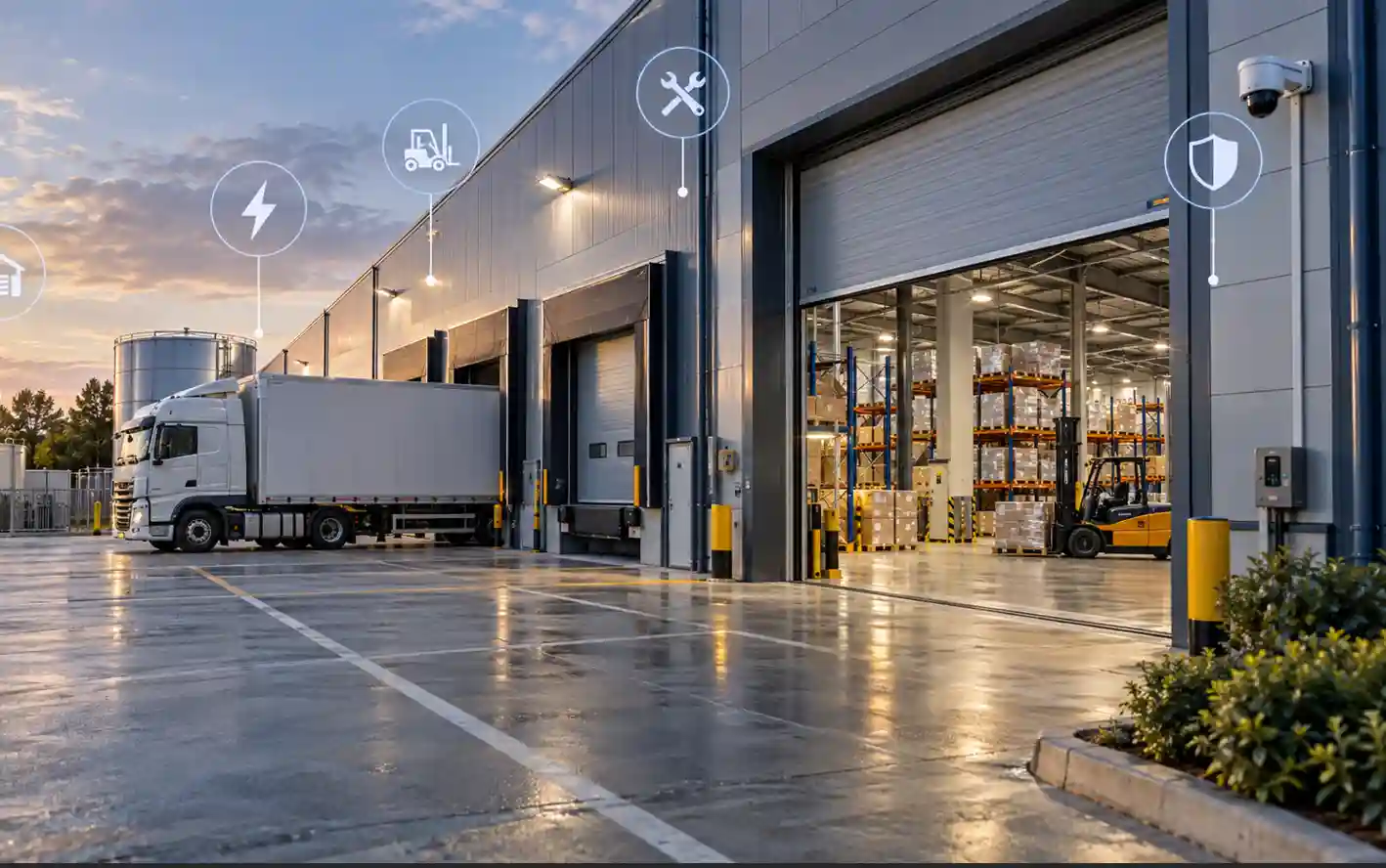
A business outgrowing self-storage, a garage or a small managed unit typically does the same sum when a proper warehouse comes into view: rent per square foot, multiplied by the floor area, compared against what they’re currently paying. It looks like an upgrade, and often it is.
What it isn’t is the actual cost of running the warehouse, because rent is the first line of a much longer calculation, and several of the numbers further down it are larger, less predictable and easier to overlook until the business has already committed.
There is an important distinction from the outset. Whether the building has enough power, whether the yard works, whether vehicles can reach the loading doors and whether the racking will physically fit are questions about operational suitability. This is the question that follows: assuming the warehouse can run the operation, what will running the operation from that warehouse actually cost?
The property cost stack beyond rent
Before forklifts move, staff arrive or a single order is dispatched, the occupation itself can carry considerably more cost than the asking rent suggests.
Business rates may be substantial. A managed estate may carry a service charge. The landlord may recover building-insurance costs through the lease. Rent, service charges and some other payments may carry VAT where the relevant interest in the property has been opted to tax. None of those numbers should be inferred from the marketing particulars alone.
For England in 2026/27, a warehouse or industrial property that does not qualify for the lower retail, hospitality and leisure multipliers will generally fall into the non-RHL structure. The multiplier is 43.2p for qualifying properties with a rateable value below £51,000, 48p from £51,000 to £499,999 and 50.8p for properties with a rateable value of £500,000 or more, before applicable reliefs and adjustments.
GOV.UK — estimate your business rates
Those figures are England-specific. Wales operates its own non-domestic rates multipliers, while Scotland and Northern Ireland have separate rating systems. The 2026 revaluation in England and Wales took effect on 1 April 2026 using rental values at 1 April 2024. Rateable value is not the same as either the rent or the final rates bill, so the relevant entry for the particular property should be checked rather than reverse-engineered from the asking rent.
Service charge deserves similar scrutiny. The current figure matters, but so does what it actually covers, how expenditure is apportioned between occupiers, what recent years have cost and whether substantial estate works are likely during the proposed occupation. RICS’s professional standard for commercial service charges places particular emphasis on transparency, budgets and year-end reporting.
RICS — Service charges in commercial property
VAT can change the cash-flow picture too. Commercial property rent is often exempt by default, but a landlord can opt to tax an interest in land or buildings, normally making supplies of that interest standard-rated.
HMRC — Opting to tax land and buildings
For a fully VAT-registered business able to recover the tax, that may largely be a cash-flow issue. For an occupier unable to recover all of its input VAT, it can become a genuine additional cost. By this point, the warehouse already has a more meaningful annual occupation cost than the headline rent — and the business has not yet started operating inside it.
What the operation adds to the building cost
This is where warehouse economics diverge dramatically between occupiers. Power is the obvious example.
The operational-suitability question is whether enough electrical capacity is available. The financial question is what the business will actually consume once machinery, refrigeration, heating, ventilation, battery charging, automation or production equipment is running for the hours required. A modern ambient-storage warehouse operating during ordinary daytime hours and a temperature-controlled facility running equipment continuously may occupy a similar number of square feet and produce completely different energy bills.
Historic consumption can help if the previous use was genuinely comparable. Otherwise, modelling the intended operation is considerably more useful than relying on a generic warehouse benchmark. The useful output is a defensible annual energy budget for this operation in this building, not an industry average.
Labour can be even more important. Moving from managed or outsourced storage into dedicated premises may create roles that did not previously exist: warehouse operatives, supervisors, cleaners, security staff or trained equipment operators. But the relevant number is incremental labour, not simply the whole warehouse payroll. If a team already exists regardless of which property is occupied, loading its entire wage bill against the new warehouse exaggerates the cost of the property decision. If taking the warehouse requires six additional people, those additional wages absolutely belong in the comparison.
The same principle applies elsewhere. Security should reflect the stock and risk actually being protected rather than a generic allowance for alarms, CCTV, access control and monitoring. Waste costs should reflect the materials and volumes the particular operation produces, including specialist disposal or environmental requirements where relevant. Warehouse-management systems, scanners, printers, networking and inventory software belong in the model where the move creates additional expenditure — but not where the business already pays the same technology cost regardless of location.
Fire safety sits across both the building and the operation. The existing measures cannot simply be assumed adequate for the incoming use; requirements depend on the premises, activities, people, stock and risk assessment. In England and Wales, the responsible person must carry out and regularly review a fire risk assessment and put appropriate precautions in place, while different legislation applies in Scotland and Northern Ireland.
GOV.UK — fire safety in the workplace
The commercial principle running through all of this is straightforward: budget for what changes because this operation is being put into this building. That produces a much cleaner financial model than throwing every overhead associated with the business into a column labelled “warehouse”.
Equipment and infrastructure: buying capacity before you’ve processed anything
A warehouse can require significant capital before it generates any operational benefit, and racking is an obvious example. The initial system may involve design, supply and professional installation, while later costs can include inspection, maintenance, damage repair and reconfiguration as the stock profile changes. Moving again can create another bill for dismantling, relocation or replacement.
The physical question — whether that racking fits the height, slab, columns and layout — belongs to the suitability assessment. The financial question is the lifecycle cost of providing the storage capacity the business needs. HSE’s warehousing guidance covers the management and inspection of storage systems alongside other warehouse risks.
HSE — Warehousing and storage: a guide to health and safety
Material-handling equipment creates a similar choice. Forklifts, reach trucks and pallet equipment may be bought outright, financed or hired, with each route producing a different balance between upfront cash and recurring expenditure. Servicing, tyres, batteries or fuel, charging, repairs, training and applicable examination requirements then sit around the initial acquisition cost. The economically useful question is not simply how much a forklift costs, but what it costs each year to provide the handling capacity the operation actually requires.
The same logic applies to other infrastructure. Additional lighting, electrical distribution, charging equipment, office accommodation, welfare facilities, mezzanines, partitioning, data infrastructure and other fit-out can all be necessary to turn an empty shell into an operating warehouse. Some of that spending creates productive capacity that the business expects to use for years; some of it has little value anywhere except the particular building being fitted out.
That distinction matters when comparing a cheaper unit requiring substantial works with a more expensive building that is much closer to operational readiness.
Getting into the warehouse is a different financial test from staying there
One of the easiest mistakes is to roll every cost into an annual occupancy figure and lose sight of when the money actually has to be spent.
A business can comfortably afford the rent and still not have enough cash to make the move safely. Before trading begins there may be a rent deposit, rent paid in advance, legal and other professional fees, removals, fit-out, racking, material-handling equipment, IT infrastructure and potentially additional stock or working capital required to support the larger operation. Those are entry costs, and they need to be separated from the recurring cost of remaining in occupation.
Repairs create a different form of exposure. Whether the roof leaks, the yard is deteriorating or the loading doors need attention is primarily a question for the condition assessment; the financial question is who ultimately carries the cost under the lease.
An occupier may assume repairing responsibility for part or all of a building. On an estate, certain expenditure may instead be incurred by the landlord and recovered through service charge. At the end of the term, repair, reinstatement and other obligations can create dilapidations exposure even if there was never one dramatic repair invoice during the occupation. That makes the schedule of condition, repairing covenant, alterations provisions, service-charge wording and yielding-up obligations financially important documents rather than legal paperwork to be considered after the rent has been agreed.
A lower-rent building with substantial fit-out and repair exposure can therefore end up being the more expensive choice. The same is true of insurance: building insurance may be arranged by the landlord and recharged through the lease, while stock, contents, machinery, business interruption and liabilities sit with the occupier according to the operation and cover required.
The important distinction is not simply between rent and everything else. It is between the cash required to get in, the expenditure required to stay in, and the liabilities that may not crystallise until the business eventually gets out.
The three numbers that make the warehouse decision clearer
Suppose a business is looking at a warehouse with headline annual rent of £80,000. That number is deliberately hypothetical and isn’t intended as a market benchmark for any particular size or UK location.
The useful exercise is not to apply an arbitrary multiplier to it. It is to build three numbers around the decision.
The first is cash required to occupy: the money needed before or around the move, including deposit and advance rent where required, professional costs, moving, fit-out, racking, equipment and the other capital expenditure needed to make the warehouse operational.
The second is recurring fixed and committed annual cost: rent, business rates, service charges, insurance recoveries, standing utility costs, equipment finance or hire, recurring software commitments, security monitoring and other expenditure that continues even when throughput disappoints.
The third is variable and semi-variable operating cost: energy consumption, labour hours, equipment use, waste, maintenance and other expenditure that may move with activity, although rarely in perfectly straight lines.
That produces a much more useful model than saying an £80,000 warehouse will somehow cost £120,000, £160,000 or £200,000 a year to run. There is no credible universal warehouse-to-rent multiple. For one low-intensity storage business, rent and rates may dominate the economics; for another, labour, refrigeration, automation or material handling may dwarf them.
The useful question is not what warehouses generally cost. It is which costs dominate this operation in this property.
That also makes alternatives easier to compare. A managed-storage or third-party logistics solution may have a much higher apparent unit charge but little capital requirement. Dedicated premises may create lower long-term unit costs while demanding far more cash and fixed commitment upfront. Comparing rent alone obscures that trade-off completely.
Turn the property decision into an operational number
Even the annual total is not the end of the calculation. It needs translating into a measure the operation actually lives by: perhaps warehouse cost per dispatched order, per pallet handled, per case, per tonne, per production unit or another denominator that reflects how the business earns money and uses capacity.
There is no universal metric. The point is to connect property cost to throughput.
A larger, more expensive warehouse may deliver better economics if its layout allows substantially more activity with less handling labour. A lower-rent building may prove more expensive per order if poor flow requires extra people, additional movements or limits practical capacity. This is where the distinction from the preceding property-suitability question becomes especially important: a building can be physically capable of running the operation and still produce poor economics, while another can carry a higher headline property cost and nevertheless be the better commercial choice.
The model then needs stress-testing rather than simply accepting the central forecast. If throughput is lower than expected, fixed costs are spread across fewer orders or pallets. Higher energy or labour costs may matter considerably more for one operation than another. Maintenance may prove heavier than expected. A business taking space ahead of growth may initially use only 60% of the warehouse while paying for all of it.
The opposite risk matters too. If demand grows faster than expected and the building reaches practical capacity much sooner than the lease does, the apparently cheaper option can force another move or constrain growth. Paying for empty capacity for several years can damage margins; taking too little capacity and moving again eighteen months later can be expensive in a completely different way.
The objective therefore isn’t to produce one perfectly precise forecast. It is to understand what the warehouse economics depend on, how sensitive they are to changes in activity and whether the property improves the economics of the business rather than simply giving it more space.
That is why the final question isn’t “can we afford the rent?”
It is:
“What cash does this move require, what fixed cost are we committing to, what does the operation cost at realistic throughput — and does that produce better economics than the alternatives?”
For many growing businesses, the answer will still justify taking dedicated warehouse space by a wide margin. But it will be a decision based on the real number rather than the one printed on the letting particulars.
This article provides general commercial property and business information, not financial, tax, legal, insurance or professional advice for individual circumstances. Business rates, VAT treatment, service charges, staffing, equipment, energy, repairs and fit-out costs vary significantly by jurisdiction, property, lease and operation and should be checked and modelled for the specific warehouse before a substantial property commitment is made.

