

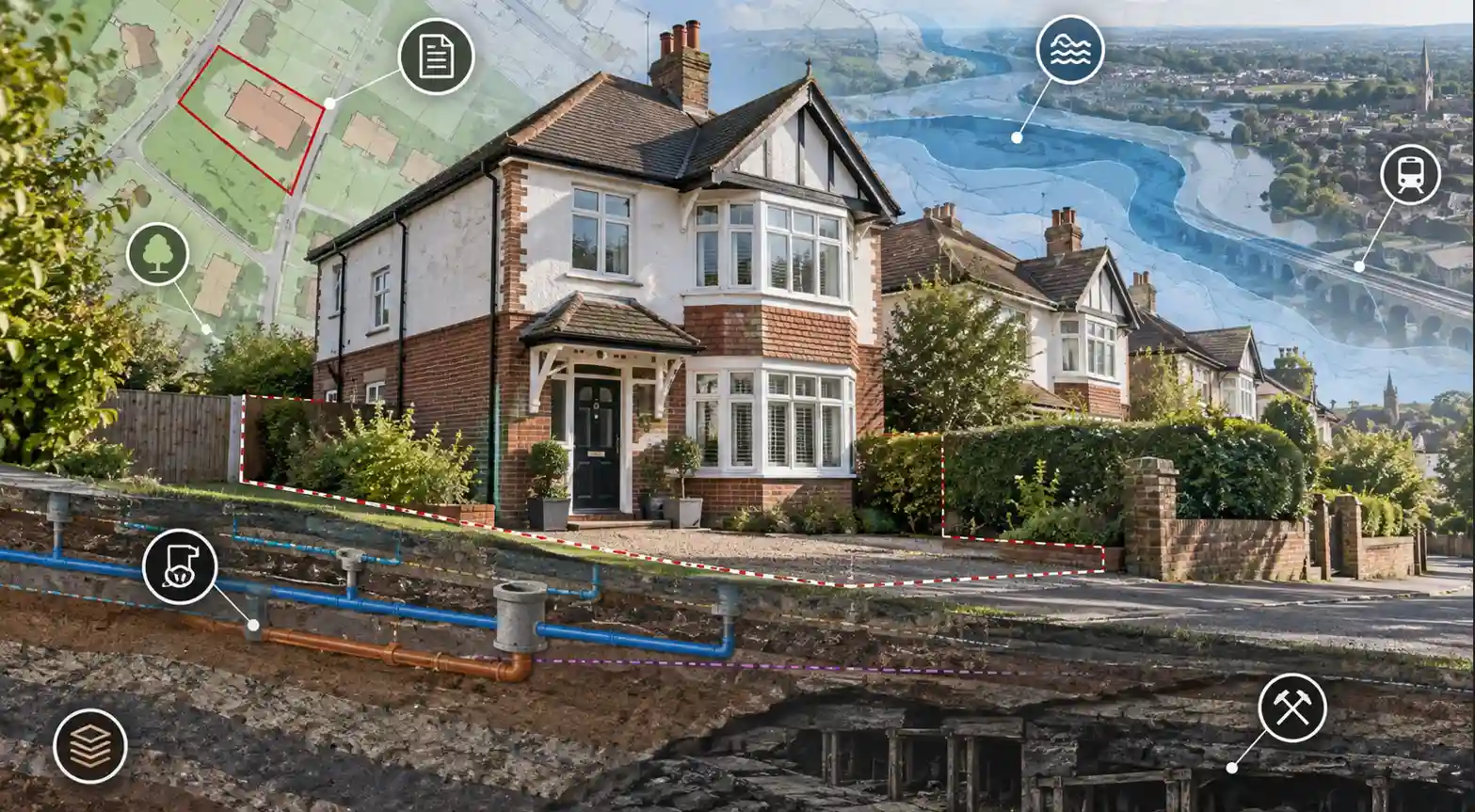
A viewing tells a buyer what a property looks and feels like. It tells them almost nothing about whether the road outside is affected by a proposed road scheme, whether the house sits within a former coal mining area, whether the drains connect to the public sewer network, or whether a public right of way is recorded across the land. That’s what searches are for — not a second opinion on the property’s condition, but an investigation into the legal, environmental and infrastructure context surrounding it, most of which simply can’t be seen by looking.
The search system described here is the one used in England and Wales. Scotland and Northern Ireland have different conveyancing processes and should not be assumed to use the same searches or forms.
Searches are not surveys, and they don’t do a survey’s job
This is worth stating plainly before anything else, because the two are commonly confused. A survey assesses the physical condition of the building — its structure, roof, walls and visible defects. Searches investigate matters about the land and its surroundings — planning history, legal restrictions, infrastructure and environmental risk — that have nothing to do with whether the roof needs replacing.
A clean set of searches says nothing about the state of the boiler or whether a wall is structurally sound, and a Level 3 survey does not replace the legal and infrastructure information obtained during conveyancing. Buyers may need both, because they answer fundamentally different questions.
The local authority search
This is the search buyers encounter as standard, and it is commonly described as having two parts: the LLC1 and the CON29R.
The LLC1 checks the Local Land Charges Register. It can reveal financial charges and legally binding restrictions or designations affecting the property — conditional planning permissions, conservation area status, listed building status and tree preservation orders among them. HM Land Registry explains that local land charges can restrict the way land and property are used.
These matters can continue to affect successive owners, which is precisely why they matter to a buyer even though many would never become apparent during a viewing.
Local Land Charges registers are also being transferred progressively from individual local authorities to HM Land Registry’s digital service. That changes where the LLC1 information is obtained in migrated areas, rather than changing what the buyer needs to know.
The CON29R contains the standard enquiries answered by the local authority. These cover matters including planning and building regulation history, roads and public rights of way, proposed road and rail schemes, outstanding notices, enforcement matters and compulsory purchase proposals. The Law Society publishes the CON29 forms and guidance on their scope.
There is also a CON29O, containing optional enquiries that can be requested where they are relevant to a particular property. These extend into additional matters that are not necessary for every transaction.
That distinction is important. A buyer should not assume that every conceivable issue will automatically appear in a standard search. Part of the conveyancer’s job is deciding what additional investigation is justified by the property, its location and anything revealed during the transaction.
Turnaround times for local searches vary considerably. A buyer working towards a tight exchange date should therefore ask when searches are being ordered rather than assuming they can safely be left until later in the transaction.
Drainage and water
The drainage and water search — commonly known by its form reference, CON29DW — uses records from the relevant water and sewerage undertaker to provide information about the property’s water and drainage arrangements.
It can show whether the property is recorded as connected to mains water and public sewerage and identify public sewer and water assets in and around the property.
This matters more than it might sound. A public sewer running through or close to a garden can affect what a future owner is able to build and whether approval from the sewerage undertaker may be required. Someone buying because they expect to extend the house, for example, may care considerably more about the sewer map than somebody with no intention of altering the property.
The records should not be treated as a perfect underground map. Historic sewers and lateral drains are not necessarily recorded with complete accuracy, so a buyer whose future plans depend on the precise position of an asset may need further investigation.
Environmental search
An environmental search is normally obtained from a specialist search provider. The precise contents vary between products, but residential searches commonly examine issues including flood risk, historic land use that might indicate contamination, landfill and other potentially hazardous sites.
Some products also incorporate information on matters such as ground stability or radon, which is why buyers should look at what their particular report actually includes rather than assuming every environmental search is identical.
Flood information deserves particular attention. A property does not need to show obvious evidence of previous flooding for flood risk to matter, and a search is principally an assessment based on the available data rather than a guarantee that the property has or has not flooded.
Where a result raises a concern, the answer is often further investigation rather than an immediate decision to abandon the purchase.
Additional searches, used where relevant rather than universally
Not every property needs every available search, and a competent conveyancer should be recommending additional searches based on the property’s location and characteristics rather than applying an identical list to every transaction.
A coal mining search is relevant where the property lies within an affected former coal mining area. The Mining Remediation Authority — the operating name used by the Coal Authority — holds extensive records of historic coal mining, and buyers can use the government’s coal mining property checker to see whether a property is in an area where a mining report may be appropriate.
A mining report can identify matters including nearby mine entries, recorded mining hazards and past mining activity. For a property in an affected area, that is potentially important information rather than an obscure historical detail.
Depending on location and circumstances, other searches may investigate different forms of historic mining or ground instability, major infrastructure or other locality-specific risks. The correct question is not whether a particular search appears on somebody else’s homebuying checklist, but whether there is a credible risk associated with this property that needs investigating.
Searches are also only one part of the conveyancer’s investigation. Private rights of way, easements, restrictive covenants and other rights affecting the property may instead emerge from the registered title, title plan, deeds and other transaction documents. Ordering searches does not mean every hidden legal issue has now been checked.
Nor does an ordinary local authority search necessarily tell a buyer everything that could happen on neighbouring land. The government’s homebuying guidance distinguishes the normal property searches from investigation into proposed development nearby. If the field behind the house, the vacant site opposite or the present outlook is important to the buying decision, separate planning research or a specialist planning search may be worth considering.
When a search does reveal something, it does not automatically mean the purchase is over. An unadopted road may lead to questions about maintenance and access. Flood information may justify obtaining insurance terms before exchange. A mining result may prompt further investigation. A planning or building control issue may lead the conveyancer to ask the seller for more information.
The point is to discover the issue while the buyer can still decide what it means for them — whether the answer is reassurance, another enquiry, negotiation, specialist advice or, in a sufficiently serious case, walking away.
What searches typically cost
There is no single national price for a standard search pack. Buyers should generally expect the core searches to cost several hundred pounds in total, but the final figure depends on location, the search provider and any additional searches required for the property.
HM Land Registry publishes its own Local Land Charges search fees, but that represents only one part of the wider search costs a buyer may incur.
For budgeting purposes, the useful figure is the actual search estimate supplied by the conveyancer handling the purchase rather than a generic national average. If an initial result suggests that further specialist searches are needed, those will usually add to the cost.
Cash buyers: the real position, not the myth
“Cash buyers don’t need searches” is a common shortcut, and it isn’t quite accurate.
A cash buyer is not subject to a mortgage lender’s search requirements, so they can decide, after taking legal advice, to proceed without them. A buyer using a mortgage is in a different position because the conveyancer must also comply with the lender’s instructions.
What doesn’t change is the underlying purpose of the searches themselves. The possibility that a property is affected by an enforcement notice, an unadopted road, mining risk or an unexpected drainage arrangement exists entirely independently of how the purchase is being funded.
A cash buyer who declines searches is therefore not avoiding risks that only exist because a lender is involved. They are choosing to buy without information that would otherwise have been obtained before exchange.
Search indemnity insurance: what it actually covers
Search indemnity insurance is sometimes considered where searches have not been obtained, have been delayed or cannot be relied upon in the usual way. Whether that is appropriate depends on the transaction, the wording of the policy and — where there is a mortgage — the lender’s requirements.
The most important distinction is that insurance provides financial protection against defined losses if an insured problem later emerges. It does not give the buyer the information that carrying out the search would have produced.
A buyer can therefore be insured against some consequences without actually knowing whether the underlying issue exists before buying the property. That is why search insurance and carrying out the search are not quite the same thing.
It should also not be confused with indemnity insurance for a known legal defect. If a specific title or documentation problem has already been identified, a different type of indemnity policy may sometimes be considered.
Mortgage lenders do not all take the same approach. The UK Finance Mortgage Lenders’ Handbook contains lender-specific conveyancing requirements, so an indemnity policy should never simply be assumed to be acceptable because one is available.
What searches are actually for
Searches exist to answer a question a viewing simply cannot: not “what is this property like to live in,” but “what legal, environmental and infrastructure context surrounds this specific piece of land, and could any of it affect what I can do with it, what it’s worth, or what it will cost me later?”
Most searches will not reveal something that fundamentally changes the buyer’s decision. Their value lies in the cases where they do — and there is no way of knowing in advance which transaction that will be.
That is why searches are better understood as due diligence than paperwork. They do not tell a buyer whether they will love the house. They help establish what, beyond the house itself, they are actually agreeing to buy.
This article provides general information about residential property searches in England and Wales and is not legal, surveying, environmental or financial advice. The searches required, their scope and the implications of any results depend on the individual property, transaction and mortgage lender. Buyers should discuss the appropriate searches and any adverse findings with their solicitor or licensed conveyancer before exchange of contracts.

