

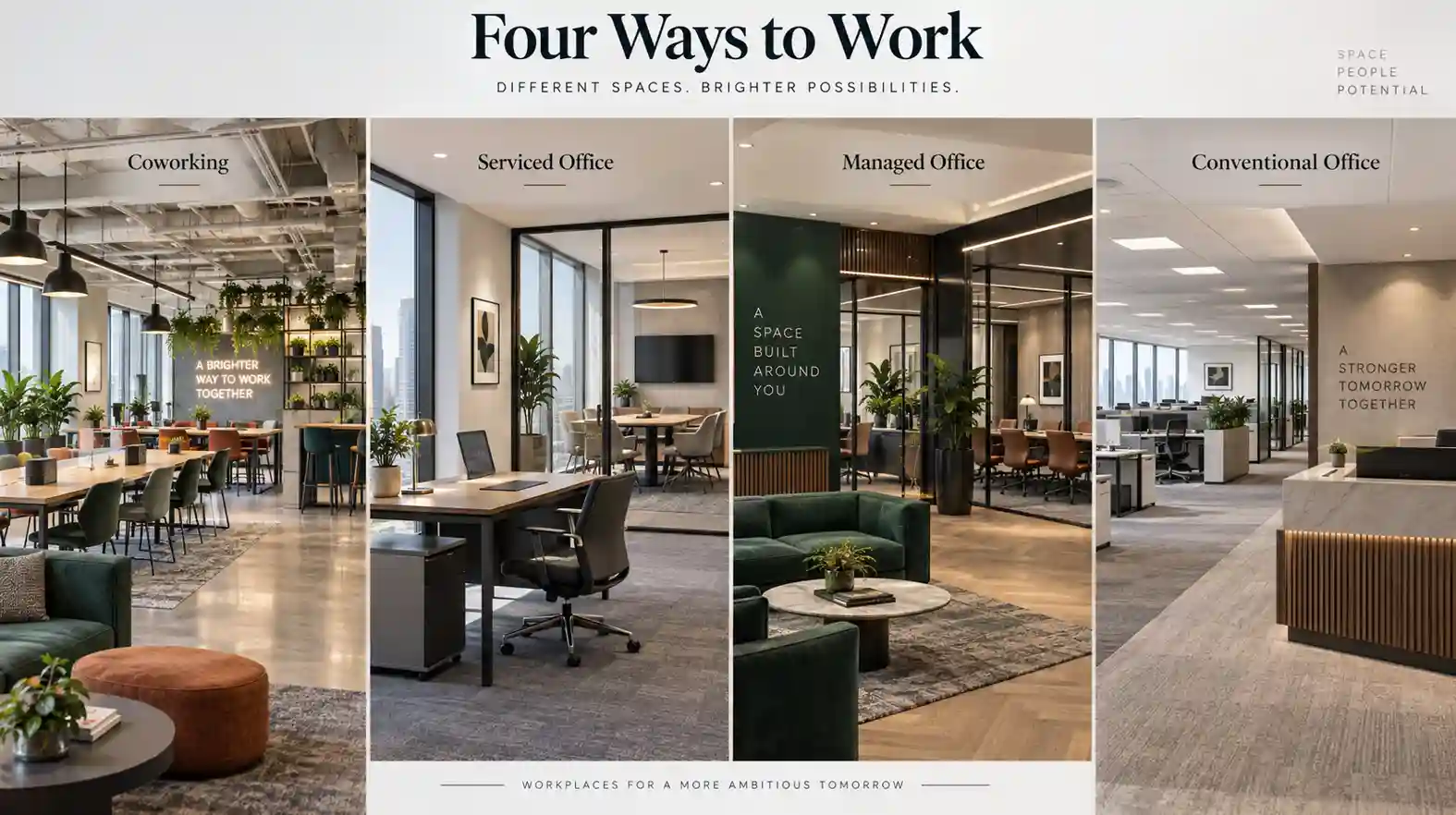
Four businesses, all looking for office space in the same year, can land on four completely different answers — and all four can be right.
That is the part most “guide to office types” content skips. Coworking, serviced offices, managed space and conventional leases are not a ladder running from temporary to professional, or from cheap to expensive. They allocate cost, control, commitment and operational risk differently.
The useful question is not “which type of office is best?” but “which model fits how this particular business actually operates — and which risks does it make sense for us to carry ourselves?”
Even those four labels are becoming less tidy in practice. Fitted leased space, landlord-operated flexible products, managed offices and serviced environments increasingly sit on a spectrum rather than in completely separate boxes. The British Council for Offices has described the market in exactly those terms, with traditional, fitted, managed and serviced products increasingly overlapping within the same buildings.
That makes the name on the particulars less important than the arrangement underneath it: who controls the space, who funds and operates it, how long the commitment lasts, what can change during the term and what happens when the occupier wants to leave.
The examples below are therefore deliberately archetypes, not size thresholds. A major corporate can use flexible workspace strategically, while a small professional firm may decide it needs its own leased office. Headcount alone rarely settles the question.
The two-person founder team: coworking, mostly
A pair of co-founders building a product six months into trading need somewhere to work that isn’t a kitchen table and isn’t a major property commitment. Coworking can solve that problem extremely well.
The business can buy access to workspace rather than taking responsibility for an office of its own. Furniture, connectivity, common facilities and much of the day-to-day building operation are already there, while the contractual commitment will often be significantly shorter than a conventional lease.
For a founder team whose headcount, funding and even business model may look different in six months, that flexibility has real economic value. Paying only for today’s requirement can be more rational than fitting out tomorrow’s hypothetical office.
Where the model starts to strain is not simply at a particular headcount. It is when the work no longer fits comfortably into a shared environment.
A founder taking the occasional investor call can book a room or phone booth. A boutique advisory business discussing confidential client affairs for much of the working day has a different problem. A team producing sensitive intellectual property may care more about physical access, network arrangements and visitor movement than another business sitting at the next bank of desks.
Coworking is not inherently insecure or unprofessional. The mistake is assuming the operator’s shared environment is suitable merely because the desk product is.
That makes the building itself part of the due diligence: how reliably can rooms be booked, what acoustic privacy exists, how is post handled, who can enter after hours, where can documents and equipment be secured, and what separates one occupier’s network access from another’s?
For two people building a product with highly uncertain growth, coworking may be exactly right. For two people handling confidential matters all day, the same headcount can produce a completely different answer.
The 15-person scale-up on an 18-month growth curve: serviced office
A business that has just raised capital and expects to move from 15 people to perhaps 30 or 40 has a different property problem.
It doesn’t really know how much office it needs.
A conventional lease can force management to make a long-term property decision using a headcount forecast that may prove wrong in either direction. Take too little and the company has to move again just as it grows. Take too much and it pays for empty desks while waiting for the organisation to catch up with the property.
A serviced office shifts some of that risk to the operator.
The team gets its own private suite within an operated building, with furniture, infrastructure and services already in place. Depending on availability, it may also be possible to take additional rooms, move into a larger suite or relocate within an operator’s portfolio without repeating the full process of acquiring and fitting out conventional space.
That flexibility is what the business is buying.
The monthly or per-desk figure can look expensive when placed beside a conventional office rent, but that comparison is incomplete unless the business normalises what each number contains. Fit-out, furniture, connectivity, utilities, cleaning, shared amenities, business rates and management may be bundled into the flexible-space price while appearing as separate expenditure under a conventional lease.
Nor should serviced space be assumed to mean there is no commitment. Notice periods, deposits, minimum terms, additional-service charges and exit provisions vary between operators and agreements.
For the scale-up, therefore, the real commercial question is not whether serviced space is cheaper per desk.
It is whether paying an operator to absorb space uncertainty, setup cost and part of the operational burden is worth more to the company than the saving it might achieve by taking those risks itself.
If the growth curve is genuinely uncertain, it often can be.
If management already has high confidence in the size and location of the team for the next several years, the value of paying continuously for that optionality starts to decline.
The 30-person business that wants its own office without building one: managed space
Managed offices occupy the territory that makes simple office-type comparisons difficult.
Take a 30-person business that wants its name over the door, its own meeting rooms, a layout built around the team and no strangers moving through its working area — but does not want to fund and manage a conventional fit-out or carry every operational responsibility itself.
A managed office can solve that problem.
The provider typically delivers a dedicated space for the occupier, with fit-out and some combination of furniture, facilities management, utilities and other services wrapped into the commercial arrangement. The result can look and feel much closer to the company’s own headquarters than a standard serviced suite while still outsourcing much of the work involved in creating and operating it.
But managed office is a market description, not one standard legal product.
Agreement structures, terms, inclusions and allocation of responsibility vary considerably. Managed space can sit much closer to flexible workspace in one transaction and much closer to conventional leasehold occupation in another.
That means the business needs to understand what it is actually buying from the provider.
Who controls the property? Who is responsible for the fit-out once it is installed? What happens if the specification changes? Which operating costs can move? What does the agreement say about termination, repair or reinstatement? How dependent is the occupier on the operator continuing to provide the service layer promised at the outset?
There is also an important counterparty dimension. Under a conventional lease, the occupier’s relationship with the property owner is comparatively direct. Under some managed structures an operator sits between the occupier and the underlying property interest, meaning the strength of that operating relationship matters as well as the quality of the building.
Managed space therefore works particularly well where a business values control and identity more highly than a standard serviced office allows, but values capital preservation and outsourced operation more highly than the complete control of a conventional lease.
That is a genuine middle ground. It should not be treated as simply a larger serviced office.
The 60-person professional services firm: conventional lease, deliberately
A stable professional-services firm with an established headcount, regular client visits and a five-to-ten-year view of the location has a different set of priorities again.
It may want complete control over the working environment, its own reception and client journey, a bespoke fit-out, direct influence over building decisions and a property strategy that is not dependent on a flexible-workspace operator.
For that occupier, a conventional lease may be the deliberate choice.
The trade is straightforward in principle: the business takes more responsibility and commits more capital in exchange for greater control over the premises and the potential to achieve attractive long-term occupation economics where the space is well utilised.
But a conventional lease is not automatically the cheapest model simply because its headline £/sq ft figure is lower.
Rent incentives, business rates, service charge, fit-out, professional fees, insurance, repairs, reinstatement and eventual dilapidations all need to be normalised before the comparison means much. Those exposures are covered in more depth in our guide to the hidden costs and liabilities of renting an office.
The rent profile may also move during the term through fixed increases, indexation or open-market review, while break rights and the ability to assign or sublet can have considerable value if the firm’s requirements change.
The RICS Code for leasing business premises is deliberately built around getting these commercial terms exposed and negotiated properly at heads-of-terms stage rather than allowing the occupier to discover their importance during legal drafting.
For an established firm that genuinely expects to occupy the same amount and type of space for years, accepting those responsibilities can be perfectly rational.
For a business that is still guessing what it will look like in 18 months, the same lease can amount to a long property commitment built around a short business forecast.
Multiple businesses under one roof: what shared space actually means day to day
The most useful distinction between shared and private workspace is not whether one is “professional” and the other isn’t.
It is how much control the business needs over its environment.
Coworking and serviced buildings can give smaller organisations access to reception, meeting facilities, breakout space and building amenities that would be expensive to replicate independently. They can also create professional communities that some businesses genuinely value.
The same shared infrastructure creates questions that need answering in the specific building.
Physical access is one. Network security is another. Confidential conversations, visitor management, secure storage, post, meeting-room availability and out-of-hours access all matter differently depending on the occupier.
The National Protective Security Authority’s guidance for users of shared workspaces distinguishes between open, private and confidential environments and encourages businesses to match the security level of the workspace to the work actually being carried out there.
For a regulated professional practice, technology company protecting valuable intellectual property or business routinely handling commercially sensitive information, that assessment may carry considerably more weight than whether the building has free coffee or a larger breakout lounge.
For a creative team that actively wants contact with other businesses, the same shared environment may be part of the attraction.
The workspace model isn’t creating the answer. The operating requirements of the business are.
The same applies to claims that a space is “fully equipped”. The phrase only has meaning against the occupier’s actual requirements.
A desk, Wi-Fi connection and meeting-room screen may be enough for one business and completely inadequate for another. A company dependent on continuous video calls may care about dedicated bandwidth, resilience and failover. A regulated occupier may care about access logs, visitor controls and secure disposal. A team working late may discover that reception, air conditioning or building access operates very differently outside the standard working day.
Then there are less technical frictions that often reveal themselves only after occupation: meeting rooms permanently booked at peak times, poor mobile coverage, acoustic leakage between rooms, insufficient power provision or a visitor system that makes every client arrival unnecessarily awkward.
None of those automatically makes the building poor space.
They demonstrate why specification and service need to be tested against how the business actually works, rather than against the operator’s definition of “equipped”.
A short framework, not a scorecard
There is little value in giving each office model a generic score out of ten. The weighting changes with the business.
A more useful decision is to answer a small number of questions honestly:
- How volatile is the space requirement? Not simply today’s headcount, but the plausible range over the next two or three years.
- How long is the business genuinely confident it wants this location? The answer should reflect business strategy rather than the term an agent happens to be offering.
- How much capital does it make sense to commit to property? A fit-out may be economically sensible for a stable occupier and a distraction for a business whose cash has better uses elsewhere.
- How much control does the operation require? Over branding, layout, access, technology, security, environmental systems and client experience.
- How private does the working environment need to be? Physical privacy, acoustic privacy and information security are separate questions.
- What flexibility has real financial value? Ability to grow, shrink, relocate, break, assign or simply leave at relatively short notice.
- What is actually included in the occupation agreement? The word “serviced”, “managed” or “coworking” is less important than the rights, services, exclusions, price changes and exit terms written underneath it.
Two businesses with identical headcounts can answer those questions differently and end up, correctly, in different kinds of office.
That is the point.
Coworking transfers much of the space commitment away from the occupier. Serviced space adds greater privacy while retaining flexibility. Managed space can combine dedicated identity with outsourced delivery. A conventional lease gives the occupier substantially more direct control while asking it to accept more capital commitment and property risk.
And increasingly, the market offers combinations somewhere between those points.
There is no universally right model because businesses do not all need property to do the same job.
The better question is which risks the business wants to own, which it wants somebody else to carry, and how much it is prepared to pay for the difference.
This article provides general commercial property information and is not legal, financial, cybersecurity or other professional advice for individual circumstances. Workspace descriptions such as serviced, coworking and managed office do not describe one universal contractual structure, and the rights, obligations, services and termination provisions vary between providers and agreements. Conventional lease law also differs across UK jurisdictions. Businesses making a material property commitment should take appropriate professional advice and review the actual occupation agreement before signing.

