

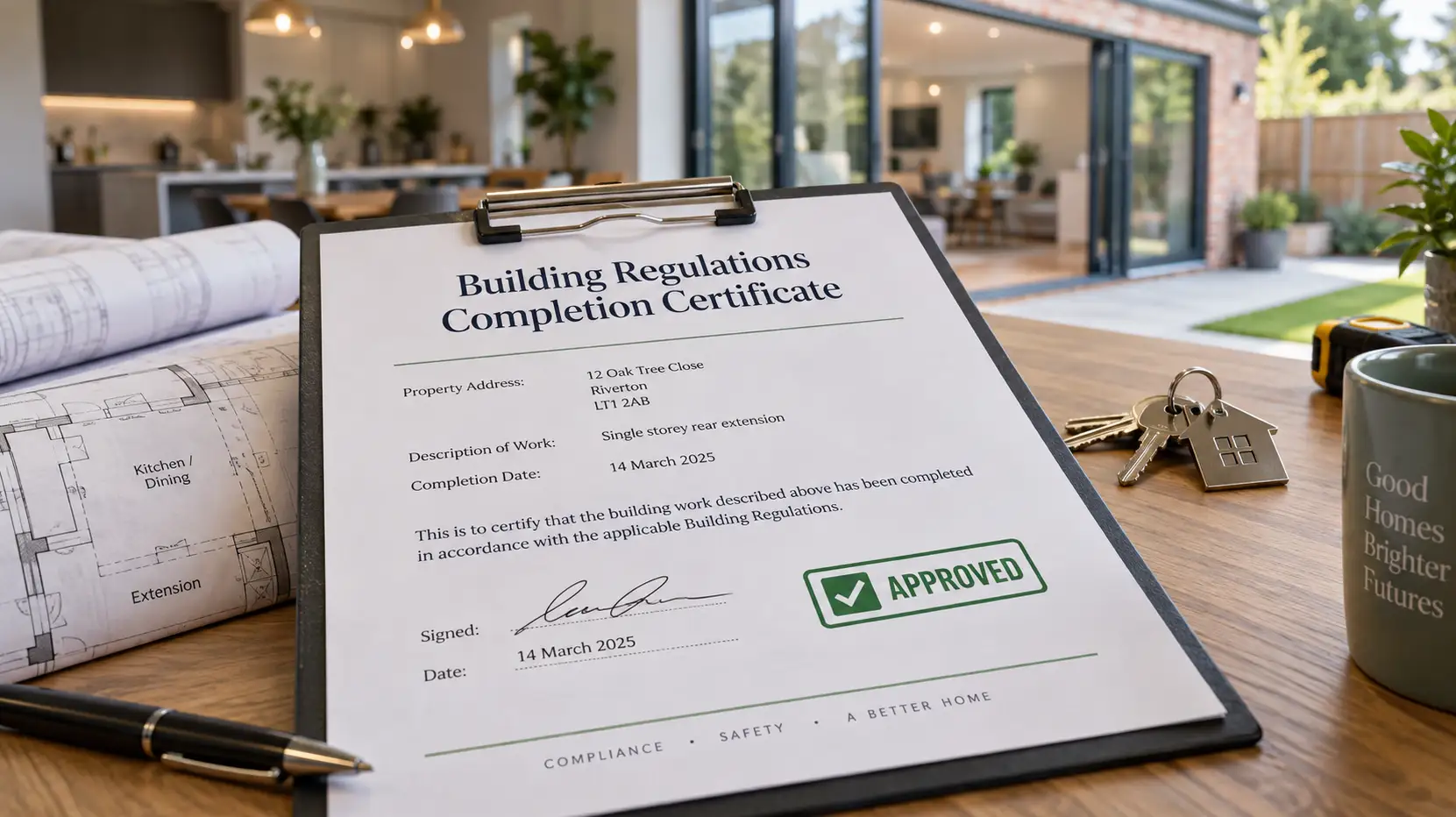
The moment usually arrives through a solicitor’s letter, a buyer’s enquiry, or a homeowner rummaging through a folder before a sale and coming up empty: an extension, a loft conversion, a knocked-through wall — and no Building Regulations completion certificate anywhere to be found. It’s an unsettling discovery, and it gets handled badly in both directions almost as often as it’s handled well: some people assume the house must be dangerous, others reach straight for an insurance policy and stop thinking about it any further. Neither reaction is quite right.
This article focuses on the Building Regulations system in England.
Start by working out what’s actually missing
“No certificate” can describe several genuinely different situations, and they don’t carry the same weight:
- No Building Regulations application was ever made for the work at all.
- An application was made, but the project never reached a final, completed inspection.
- Plans were approved in principle, but the work itself was never formally signed off as finished.
- A certificate probably was issued at the time, but it simply can’t currently be located.
- Work that should have gone through a competent person scheme — replacement windows, certain electrical or heating work — was carried out without scheme certification or equivalent Building Control evidence.
- The work is old enough that it may predate relevant requirements, or may have been genuinely exempt from Building Regulations at the time.
These situations call for different responses, and it’s worth taking the time to work out which one actually applies before deciding what to do next, rather than treating “no certificate” as a single problem with a single fix.
Sensible first steps
Before anything more formal, it’s worth simply asking the current or previous owner what they know, and searching through whatever paperwork exists — old correspondence, invoices, drawings, structural calculations and the folder from when the work was done.
Where an application is known to have existed, the next question should often be whether the certificate is genuinely missing or simply missing from your records. A local authority may still hold details of an application and its status, and the private building control provider that dealt with the work may also have relevant records if it can be identified.
It helps to establish, as precisely as possible, when the work was carried out and, ideally, who did it, since this affects which regulations applied at the time and which route, if any, is realistically available now.
One genuine word of caution here: where a property transaction is already under way and indemnity insurance is being considered, don’t automatically make direct enquiries to the local authority before speaking to your conveyancing solicitor. Many lack-of-Building-Regulations policies contain conditions relating to prior contact with the authority, and approaching it about the specific unauthorised work can prevent a proposed policy being available. The exact position depends on the policy, so the sequence matters.
Missing paperwork isn’t proof of a problem — and age isn’t proof of safety either
This distinction sits at the heart of handling this well. A missing certificate creates genuine uncertainty about whether work was properly checked at the time — it doesn’t, on its own, prove the work is defective, unsafe, or non-compliant. Plenty of unrecorded historic work is perfectly sound.
Equally, though, the fact that a structure has stood for ten or twenty years without visible problems doesn’t itself prove it was built compliantly or safely — it proves it hasn’t failed yet, which is a different and much weaker claim, particularly for anything structural. Both of the tempting shortcuts — “no certificate means something’s wrong” and “it’s been fine for years so it must be fine” — go further than the evidence actually supports.
If you’re buying: separate the questions
A buyer facing this situation is really weighing up several distinct things, and it’s worth keeping them apart rather than collapsing them into one anxious blur:
Documentation risk — the legal and administrative uncertainty of owning a property with work for which the expected approval evidence cannot be produced, which can affect a future transaction.
Actual physical condition — whether the work itself, regardless of paperwork, is sound. This is a genuinely separate question from documentation and needs its own answer.
Mortgage lender requirements — a lender may require the documentation gap to be addressed in a particular way before it will lend against the property; this varies by lender and by the nature and age of the work.
Future resale — even where a buyer today is relaxed about the gap, it’s worth considering whether the next buyer, and their solicitor and lender, will be equally relaxed.
These don’t all get solved by the same fix. Indemnity insurance, for instance, may address a defined enforcement-related financial risk and satisfy a lender in some circumstances, but it does nothing to establish whether an inadequately supported wall or poorly converted loft is physically safe.
Which problem are you actually trying to solve?
| Situation | The useful next question | Possible route |
|---|---|---|
| Certificate existed but has been lost | Can a copy or record of the completed application be obtained? | Trace the original Building Control record before assuming approval is missing |
| Application exists but was never completed | What remained outstanding? | Investigate whether the original Building Control process can still be closed out |
| No approval appears to have been obtained | Is regularisation available and proportionate? | Take advice on retrospective approval and the implications before contacting the authority during a sale |
| Structural work has no reliable records | Is the construction itself adequate? | Consider a structural engineer’s targeted assessment |
| Indemnity insurance is proposed | Exactly what risk does the policy cover and what invalidates it? | Have the conveyancer check the wording and lender requirements |
| Work is very old | What rules applied when it was carried out, and what enforcement/documentation issues remain today? | Establish the date rather than assuming age automatically solves the problem |
The important point is that paperwork, physical safety, enforcement and mortgageability are different questions. Sometimes one action helps with several of them; sometimes it solves only one.
When a physical assessment is worth getting
Where the missing paperwork relates to structural work — a load-bearing wall removal, a loft conversion, a significant extension — or where there’s any visible sign of a defect such as cracking, distortion or signs of movement, it’s worth considering a proper structural assessment rather than relying on documentation status alone to judge the risk.
It’s important to be realistic about what a standard property survey can and can’t tell you here: a typical survey is generally not equipped to confirm the compliance of concealed structural elements, and a specific structural engineer’s assessment is a different, more targeted piece of work if that’s genuinely what’s needed.
Even a structural engineer may not be able to verify every concealed detail without further investigation. The absence of a defect visible from the room below does not automatically reveal the size of a hidden beam, its bearings, the construction of a foundation or what insulation was placed inside a closed-up wall.
Regularisation: retrospective sign-off, not automatic or free
Where work in England was carried out without the required approval, a local authority Building Control body — not a private Registered Building Control Approver — can, in qualifying cases, assess it retrospectively through regularisation. The current government guidance confirms that this route is available for relevant unauthorised work carried out after 11 November 1985.
The official starting point is the GOV.UK Building Regulations application guidance.
It’s worth being clear-eyed about what this involves in practice. The local authority assesses the unauthorised work against the Building Regulations requirements applicable to it at the relevant time, based on whatever plans and evidence can be provided. Because there’s no complete original inspection trail to rely on, the authority can require further information and may require parts of the work to be exposed, tested or investigated before it can decide whether the requirements have been satisfied.
If the work doesn’t comply, remedial work may be required before a regularisation certificate can be issued. There is no automatic entitlement to a certificate simply because an application for regularisation has been made.
Regularisation charges are determined by the local authority, so costs vary. More importantly, opening-up investigations, professional reports and any remedial construction can add significantly to the practical cost beyond the application charge itself.
That is why regularisation can be an excellent solution in the right circumstances but should not be described as simply paying retrospectively for the certificate that should have been obtained originally.
Indemnity insurance: what it does, and what it emphatically doesn’t
Building Regulations indemnity insurance is a genuinely useful, commonly used tool in conveyancing, and it’s worth understanding precisely, because both the dismissive and the over-reliant reactions to it are wrong.
The exact cover depends on the policy, but these products are generally intended to protect against specified financial losses connected with the absence of Building Regulations approval and the risk of enforcement.
What they do not do, and this is worth stating plainly: they don’t inspect the building, they don’t establish that the work complied with Building Regulations, and they don’t repair an undersized beam, defective foundation, inadequate fire protection or any other physical defect merely because the defect exists.
Where remedial costs are covered at all, that will depend on the wording and circumstances of the particular policy — typically in connection with an insured enforcement event rather than simply because a defect is discovered.
It is therefore a financial protection product around a particular legal risk, not a technical assessment of the building’s condition and not retrospective Building Control approval.
Regularisation and indemnity are not substitutes for each other
| Regularisation | Indemnity insurance | |
|---|---|---|
| Does someone assess the work for Building Regulations purposes? | Yes, the local authority assesses the unauthorised work | No |
| Can opening-up or remedial work be required? | Yes | Not simply to obtain the policy |
| Can it result in retrospective regulatory certification? | Yes, if the authority is satisfied | No |
| Does it prove the construction is defect-free? | No | No |
| Main purpose | Resolve unauthorised Building Regulations work through the regulatory system | Insure specified financial risks arising from the missing approval |
| Can contacting the council matter? | Contact is inherent in the process | Prior contact can affect availability under some policies |
This article doesn’t recommend a specific insurer or product — that’s a decision for a conveyancing solicitor based on the property, the work, lender requirements and the actual policy wording.
Enforcement, time, and what “old work” really means
This area has changed significantly and older internet advice can now be misleading.
In England, the Building Safety Act 2022 extended the period during which a local authority can serve a section 36 notice requiring removal or alteration of non-compliant work from 12 months to 10 years from completion of the work.
The current provision sits in section 36 of the Building Act 1984.
Government guidance on the 2023 reforms also confirms that the extended enforcement provisions can apply to projects that began before 1 October 2023, subject to the statutory conditions and transitional provisions.
The important practical lesson is not simply “wait ten years”. The expiry of the section 36 notice period does not retrospectively make non-compliant work compliant, supply a missing certificate, establish that the construction is safe or guarantee that a future buyer or mortgage lender will ignore the documentation gap. Nor should the ten-year section 36 limit be treated as a universal limitation period covering every possible legal route.
And Building Regulations enforcement remains separate from planning enforcement, which operates under its own legislation and rules.
If you’re selling
Discovering a documentation gap before a property goes on the market is a considerably better position to be in than discovering it mid-transaction, under time pressure, with a buyer’s solicitor asking pointed questions and a chain waiting.
Where practical, addressing the position early — gathering what evidence exists, establishing the date of the work and understanding whether the original approval can simply be traced or completed — tends to go more smoothly than reacting once enquiries have already been raised.
That said, this isn’t a blanket instruction to contact Building Control or seek regularisation in every case regardless of circumstances. If indemnity insurance might be appropriate, contacting the authority first can affect that option. The right route genuinely depends on what is actually missing, the age and nature of the work, what records exist, the physical condition of the alteration, and the requirements of the buyer and their lender.
A conveyancing solicitor is best placed to determine the transaction sequence, while a surveyor or structural engineer addresses the quite separate question of physical condition.
If it’s your own recent project
Where the work in question is something you had done relatively recently, it’s worth being precise about which of three distinct states the project is actually in: the builder has finished and moved on; Building Control has completed its inspections; and a completion certificate has actually been issued.
These are three different milestones, not one event under different names, and our companion article on Building Control inspections covers this distinction properly.
If what’s missing is simply an outstanding completion certificate or final certificate for work that otherwise went through the proper Building Control process, investigate that original application first. Don’t assume that a regularisation application is automatically necessary simply because you don’t currently possess the certificate.
Two things this is not
It is not planning permission, and shouldn’t be confused with it — a property can have full planning permission and no Building Regulations sign-off, or the reverse, and the two are assessed, and resolved, through entirely separate systems, covered in our Planning Permission coverage.
And a completion certificate, when obtained, is not a guarantee of workmanship indefinitely into the future. Under the Building Regulations framework it is important evidence of compliance, but it is not conclusive evidence and it is not a structural warranty against every possible future defect.
Different nations, different procedures
This article describes the position in England. Wales, Scotland and Northern Ireland each run their own Building Regulations or Building Standards systems, with their own procedures for handling historic unauthorised work, and these shouldn’t be assumed to mirror England’s regularisation process. Where the property in question isn’t in England, the equivalent national process needs to be checked separately.
The measured version of events
A missing Building Regulations certificate is a genuine gap worth investigating properly — not a minor technicality to shrug off, and not, on its own, proof that a house is unsafe. Work out precisely what’s actually missing, check what records exist, get a physical assessment where the work is structural or a defect is visible, and treat regularisation and indemnity insurance as the genuinely different tools they are, addressing different parts of the problem, rather than interchangeable fixes for the same one.

