

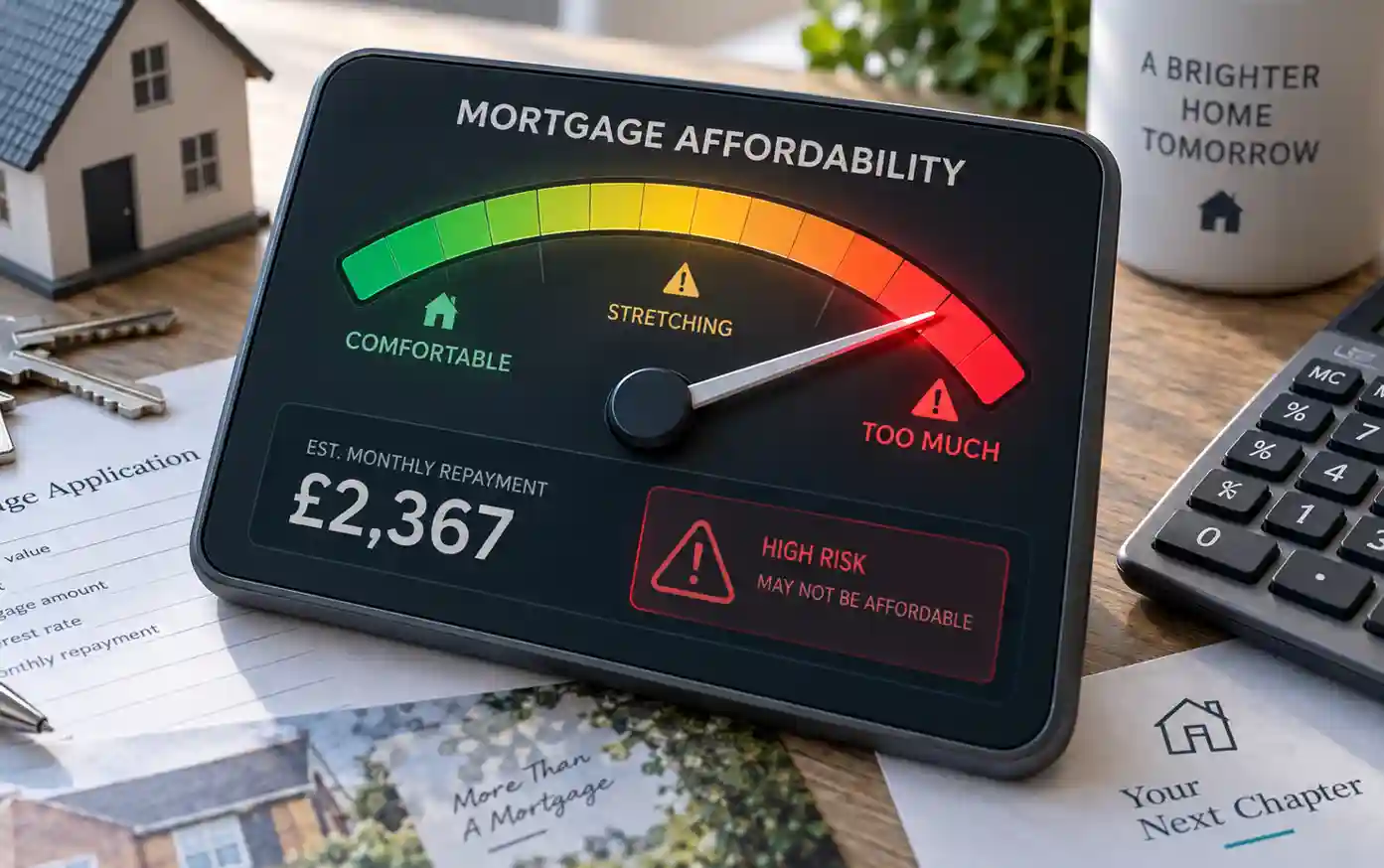
A lender gives you a maximum borrowing figure, and that number can feel like a verdict — proof, in writing, that this is what you can afford. It isn’t quite that. It is proof that, according to one lender’s model, applied to the income, debts and circumstances it has assessed, you meet its threshold for responsible lending. Whether borrowing that full amount actually fits the rest of your life is a different question entirely, and it is one the lender’s model was never designed to answer for you.
This gap — between “qualifies for” and “can comfortably live with” — is where financially stretched homeowners can end up, not necessarily because they were misled, but because they treated the maximum offer as the target rather than as a ceiling.
How the maximum is actually calculated
It is tempting to reduce mortgage affordability to a single rule of thumb — “you can borrow four and a half times your salary” — but that figure is not a universal personal limit.
MoneyHelper’s mortgage-affordability guidance says lenders typically cap borrowing at around 4.5 times annual income, while some borrowers may be offered more and many will be offered less. The income multiple is only one part of the decision. Lenders also look at income, existing debts, regular outgoings, the security and type of income, the mortgage term and the likely monthly payment.
They also have to consider affordability if interest rates rise in future where the FCA’s rules require it. The old Bank of England recommendation that effectively imposed a common three-percentage-point stress margin was withdrawn in 2022, but responsible-lending requirements did not disappear. The FCA’s current stress-test guidance gives lenders flexibility over how they assess likely future rate rises rather than imposing one universal stress rate on every mortgage.
That helps explain why two lenders can look at the same household and arrive at different maximum loan amounts. One may treat variable income more generously, another may take a different view of expenditure, and their product pricing and affordability models may not produce the same result.
None of this changes the more important point: the maximum a lender is willing to offer tells you what that lender considers acceptable under its rules. It doesn’t know about the wedding you’re planning next year, the car that’s on its last legs or the fact that one of you is hoping to drop to part-time hours once a baby arrives.
What the lender’s model doesn’t fully see
Lenders do take expenditure seriously. They can look at existing credit commitments, household bills, childcare and other regular spending, and they may ask for bank statements and evidence of income.
What they cannot do with the same precision is model a future life that has not happened yet.
Childcare is the clearest example. A couple applying before starting a family, or before a second child arrives, may have little or none of that future cost in their current spending. The same applies to a planned period of reduced income around parental leave, a longer commute that comes with changing jobs, or a decision already being discussed for one person to work fewer hours.
Homeownership itself can also change the budget in ways a first-time buyer has never previously had to absorb. Buildings insurance, repairs and maintenance, service or estate charges where they apply, higher council tax on a more expensive property and different utility or commuting costs all sit around the mortgage rather than inside it. MoneyHelper’s guide to buying and moving costs is a useful reminder that the monthly mortgage payment is only one part of the cost of owning the home.
Self-employed and irregular income adds another layer. Lenders often rely on historic accounts, tax records and other evidence to decide what income they are prepared to recognise. That can be entirely reasonable for underwriting purposes while still leaving the household to manage the reality that the money may arrive unevenly from one month to the next.
Work backwards from the payment you can live with
There is a useful way to turn the usual mortgage conversation around.
Instead of starting with “the lender says we can borrow £300,000 — what can we buy?”, start with the monthly payment that would still leave enough room for the rest of your life.
Take a purely illustrative 30-year repayment mortgage at 5%. A £300,000 mortgage would cost about £1,610 a month. Borrowing £270,000 on the same assumptions would cost about £1,449 — roughly £161 a month less.
Seen against the purchase price of a house, £161 can look insignificant. Inside a household budget it may be the difference between continuing to save each month and not saving, absorbing an insurance increase without concern, or dealing with an unexpected bill without putting it on a credit card.
The calculation can also run backwards. On the same illustrative assumptions, a household that decides £1,500 a month is the highest mortgage payment it would be genuinely comfortable carrying would support a loan of roughly £279,000, before allowing for lender criteria, fees or other borrowing.
The point is not that £1,500 is the correct payment, or that 5% will be the rate available to you. It is that the household can set its own comfort ceiling before allowing the lender’s maximum to set it instead.
There is an even simpler way to test that ceiling before buying. If your current housing costs are £1,500 a month but the property you are considering would realistically cost £2,050 once the mortgage and the other known housing costs are included, try putting the £550 difference aside each month while you are still searching.
Do it for long enough to experience ordinary life rather than one unusually cheap month. If the extra £550 can be saved without repeatedly being taken back out to cover normal spending, you have learned something useful and built a larger cash reserve at the same time. If the household repeatedly needs the money back, that tells you something useful too — before you have committed to the mortgage.
It is not a perfect simulation. Owning a home will still produce costs you cannot reproduce in advance. But it is a much more revealing test than looking at a lender’s maximum and assuming that anything below it must be comfortable.
The emergency fund question
One of the easiest ways to turn an otherwise manageable mortgage into a fragile one is to put every available pound into the deposit, legal fees and moving costs and complete with virtually nothing left in reserve.
That household may have reduced the mortgage by using every last pound as deposit, but it has also removed the cash buffer that would have absorbed the first broken boiler, period of reduced income or unexpected repair.
There is no single emergency-fund figure that is right for every buyer. MoneyHelper’s mortgage-affordability guidance suggests trying to build enough savings to cover around three months of expenses, including the mortgage payment. That will not be achievable for everyone, and it should not become another arbitrary hurdle to homeownership, but completing with genuinely nothing left deserves serious thought.
The useful distinction is between deposit money and resilience money.
If putting another £10,000 into the deposit moves you into a better loan-to-value band, that may be financially attractive. If doing so leaves almost nothing in the bank once the keys are collected, the apparently stronger mortgage position may have created a weaker household position.
Stress-testing yourself, beyond what the lender tests
The lender’s affordability assessment exists to decide whether it can responsibly make the loan. Your own stress test can ask a different question: whether you would still be comfortable with the decision if ordinary life became more expensive or less predictable.
- What would happen to your monthly budget if your payment rose when your current fixed deal ends — not hypothetically, but using a realistic higher rate?
- If one income fell for a period — reduced hours, a career break, illness — could the mortgage still be paid, even if other spending had to tighten?
- After the mortgage, bills and essentials, is there still something going into savings in a normal month, or is the budget already at zero?
- Could you cover a significant repair without immediately borrowing more?
- If childcare, commuting or another known future cost arrives, does the mortgage still fit?
- After completion, is there still a real cash reserve, or did the purchase absorb all of it?
A household that can answer those questions without the plan falling apart is in a fundamentally stronger position than one whose budget only works while every assumption remains favourable.
This is not about inventing a disaster scenario. It is about allowing for normal financial friction.
Recognising “house poor” without treating it as a scare word
“House poor” describes a household that owns the property it wanted but has very little financial flexibility once the mortgage, housing costs and essentials have been paid — little capacity to save, absorb a shock or spend on much beyond the house itself.
It is a useful phrase only if it describes a budget, not a person.
Someone can be comfortably inside a lender’s affordability model and still discover that the resulting lifestyle is much tighter than expected. Equally, a household may consciously choose a few lean years because a particular home, school catchment or location matters enough to them. That is a trade-off, not automatically a mistake.
The warning sign is when the trade-off was never consciously made.
Borrowing less than the maximum, choosing a less expensive property or retaining more cash after completion can all create breathing room. A longer mortgage term can reduce the monthly payment as well, although that comes with a cost of its own.
Term and deposit both change this picture — without replacing it
A longer mortgage term can reduce the monthly payment on the same loan amount, which can make the mortgage substantially easier to carry from month to month. The trade-off is that interest is normally paid for longer and the total interest cost can be much higher.
A larger deposit reduces the amount that needs to be borrowed and may improve the mortgage rate by moving the borrower into a lower loan-to-value band.
Both are genuine levers. Neither answers the central question on its own.
A 35-year term can make a large mortgage easier to service today without making the lender’s maximum the right household budget. A larger deposit can improve the mortgage rate while leaving the buyer dangerously short of accessible cash if every available saving has been committed to the purchase.
The useful exercise is to consider the term, deposit, monthly payment and remaining reserve together rather than optimising one of them in isolation.
First-time buyers and existing homeowners face different versions of the same question
A first-time buyer moving from rented accommodation may be taking responsibility for costs that were previously somebody else’s problem: buildings insurance, repairs, maintenance and, depending on the property, service charges or estate-management costs.
That makes comparing the rent directly with the mortgage payment misleading. The mortgage is only one part of the new housing budget.
An existing homeowner moving to a larger property has different blind spots. They may already understand maintenance and insurance, but could be taking on a materially larger mortgage at a rate very different from the one they became used to years earlier. A larger home can also mean higher council tax, energy use and maintenance exposure.
Both groups benefit from the same exercise: calculate the cost of the home you are actually considering, not merely the mortgage attached to it.
A brief word on older borrowers
Age can affect mortgage affordability because the proposed term may run into retirement.
There is no single maximum age that applies across UK mortgage lenders. Criteria vary significantly by lender and product, and where a mortgage is expected to continue after employment income reduces or stops, the lender may need evidence that pension or other retirement income can sustain the payments.
For somebody expecting retirement during the mortgage term, the useful question is therefore not simply “how many years will this lender give me?” It is whether the mortgage remains affordable on the income that will realistically exist later in the term.
That can become specialist territory quickly, particularly where retirement income, interest-only borrowing or later-life lending is involved.
The number that actually matters
A lender’s maximum tells you what its model is prepared to lend. It does not know your plans, your tolerance for financial pressure or which future costs matter most to your household, and it was never designed to know those things.
The more useful figure is the amount that still leaves room to save something in ordinary months, absorb a genuine setback without crisis and meet the real costs of owning the property as well as the mortgage itself.
Sometimes that amount will be close to the lender’s maximum. Sometimes it will be substantially below it.
The important thing is knowing the difference before you make the offer — and leaving yourself enough room to live the rest of your life alongside the mortgage rather than solely for it.
This article provides general information about mortgage affordability and is not personalised mortgage, financial or investment advice. The amount you can borrow and the amount that is appropriate for your household can differ, and both depend on income, expenditure, deposit, credit profile, mortgage term, property, interest rates and lender criteria. Worked examples are illustrative only. Before taking on a significant mortgage commitment, check the full costs and, where appropriate, seek advice from an FCA-authorised mortgage adviser.

