

A 25-year mortgage used to be the term people barely thought about. It was simply what a mortgage looked like.
That assumption has changed. UK Finance reported that the average first-time buyer mortgage term had reached 31 years by March 2025, up from 28 years a decade earlier. FCA product-sales data released in June 2026 also showed that sales of regulated mortgages lasting 35 years or more increased across every UK region between 2021 and 2025. The FCA’s 35-year-plus mortgage data recorded 318,839 such sales in 2025, compared with 260,688 in 2021, although that dataset includes internal product transfers, second-charge and lifetime mortgages as well as ordinary residential purchases.
Longer terms tend to get framed in one of two ways: either as straightforwardly bad news — buyers being forced to stay in debt for longer — or as little more than a useful trick for lowering the monthly payment.
Neither framing is quite enough.
A longer term is a genuine trade-off. It buys breathing room today, but in return the debt reduces more slowly and, if the mortgage runs for anything close to its original term, substantially more interest is paid overall. What matters is understanding the size of that trade-off in pounds, and what it means not only forty years from now but when the first fixed deal ends and the mortgage needs looking at again.
The trade-off, in worked numbers
Consider a £250,000 repayment mortgage at an illustrative 5% interest rate.
To make the effect of the term visible, assume for a moment that the rate stayed at 5% throughout. No real borrower should expect a 25-, 30- or 40-year mortgage to behave that neatly — rates change, borrowers remortgage or switch products, and some will overpay — but holding the rate constant isolates what the term itself is doing.
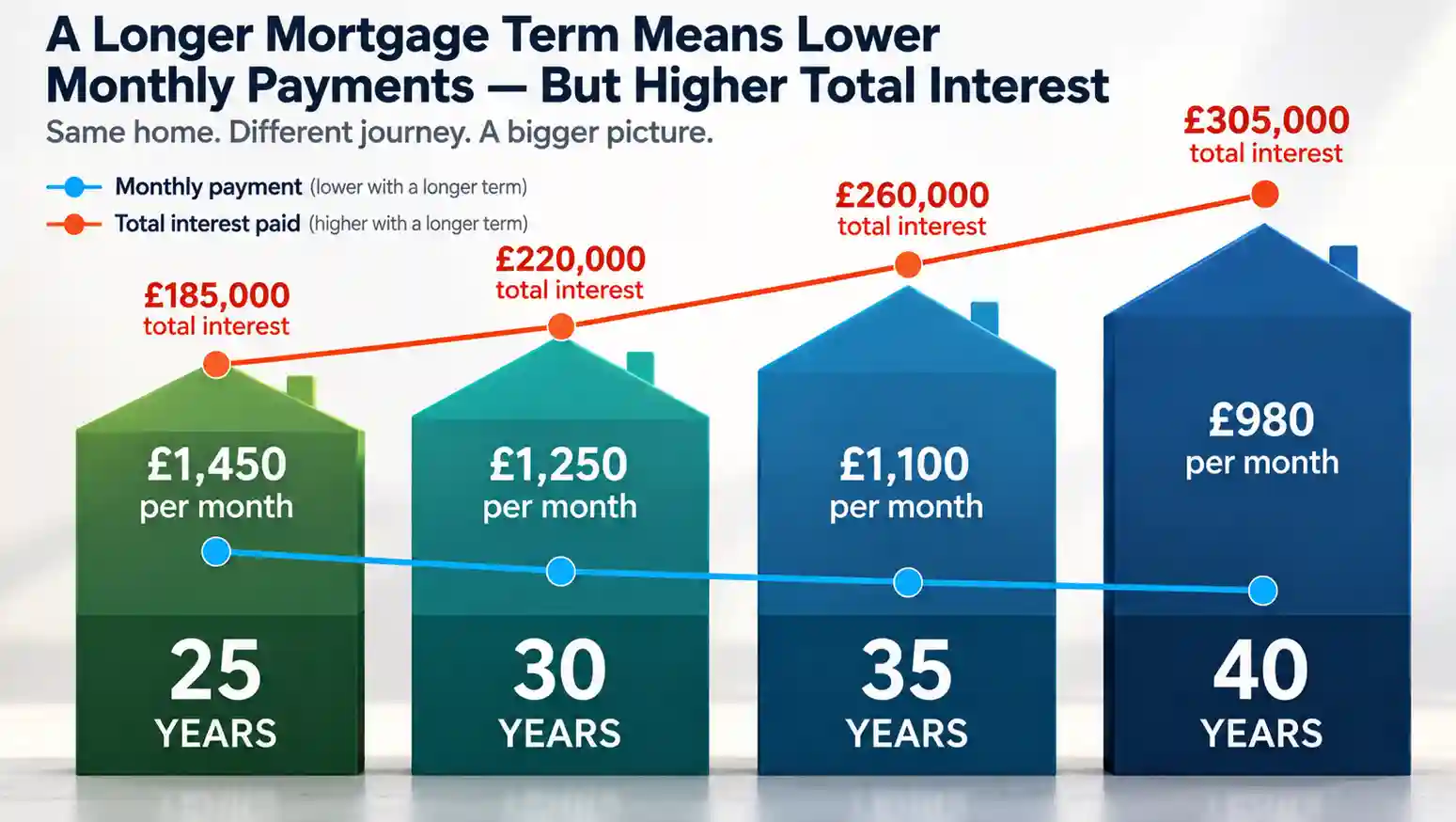
| Mortgage term | Approx. monthly payment | Approx. total interest if run to term | Balance after five years |
|---|---|---|---|
| 25 years | £1,461 | £188,443 | £221,450 |
| 30 years | £1,342 | £233,139 | £229,572 |
| 35 years | £1,262 | £279,922 | £235,035 |
| 40 years | £1,205 | £328,636 | £238,859 |
The first part of the trade-off is obvious. Stretching the mortgage from 25 to 40 years reduces the required payment by about £256 a month.
The second part is harder to ignore once it is put into pounds. On these assumptions, the 40-year term produces roughly £140,000 more interest over its full life than the 25-year mortgage.
There is also a diminishing return in the monthly saving. Moving from 25 to 30 years saves about £119 a month. Extending from 30 to 35 saves another £80. Going from 35 to 40 saves only another £56.
That last step is particularly revealing. In this simplified example, extending from 35 years to 40 years saves only about £56 a month, yet adds roughly £48,700 of lifetime interest if the mortgage follows that schedule throughout. After the first five years, the 40-year borrower also still owes about £3,800 more than the 35-year borrower.
That doesn’t automatically make the 40-year term a bad choice. £56 a month can matter to a household whose budget is genuinely tight. But it puts the marginal trade-off into much clearer terms: what are those extra five years actually buying you?
The difference is larger when 25 and 40 years are compared.
After five years, the 25-year borrower has reduced the original £250,000 debt by around £28,550. The 40-year borrower has reduced it by only about £11,140.
So when both arrive at their first major remortgage point, the borrower on the 40-year schedule still owes roughly £17,400 more, despite having started with exactly the same mortgage.
That matters because the outstanding balance affects how much future interest is charged and can also affect loan-to-value when the next mortgage deal is arranged.
The cost of a long term is therefore not something that only appears in year 38. Part of it is already visible after the first five.
Why longer terms have become common
The reason is mainly affordability arithmetic rather than a sudden enthusiasm for spending forty years with a mortgage.
House prices require many buyers to borrow substantial sums, while mortgage rates since 2022 have generally been much higher than during the ultra-low-rate years that preceded them. Increasing the term is one of the most direct ways to bring the required monthly payment down without reducing the loan itself.
MoneyHelper now has specific guidance on mortgages lasting 30 years or longer, reflecting how normal longer terms have become. Its central point is the same: the lower monthly payment can make buying workable, but the cost is slower repayment and more interest over time.
For somebody whose choice is between a 35-year mortgage they can comfortably afford and a 25-year mortgage that leaves the monthly budget permanently strained, the longer term can be entirely rational.
The danger is treating the lowest possible monthly payment as the objective.
A mortgage term should make the payment manageable. It does not follow that making the term as long as the lender will permit is automatically better.
The “take the long term, then overpay” strategy — and its conditions
There is a sensible argument for choosing a longer contractual term even when you hope to repay the mortgage much sooner.
The longer term gives you a lower required payment. You can then voluntarily overpay when income and circumstances allow, while retaining the ability to fall back to the lower contractual payment during a difficult month.
That flexibility has real value.
Return to the £250,000 example. The required payment on the illustrative 40-year mortgage is about £1,205 a month. If the borrower consistently paid an extra £100 a month and the rate somehow remained at 5% throughout, the mortgage would be cleared in roughly 32 years rather than 40, and the total interest would fall from about £329,000 to roughly £252,000.
That is a saving of around £77,000 in interest in this simplified example.
But there are two catches.
The first is contractual. Many mortgages permit overpayments, often up to a specified amount each year without an early repayment charge. MoneyHelper notes in its mortgage overpayment guidance that many lenders allow up to around 10% of the remaining mortgage balance each year, but the allowance varies by product and needs checking before money is paid in.
The second catch is behavioural.
Choosing a 40-year term while intending to overpay is not the same thing as choosing a shorter mortgage with the higher payment contractually required. The strategy only works if the overpayments actually happen.
A pay rise can become an overpayment. It can equally become a better car, more holidays or simply higher everyday spending.
Neither choice is automatically wrong. But the household should be honest about which one is more likely.
The quiet way a 30-year mortgage becomes a 35-year mortgage
There is another term decision that receives far less attention because it doesn’t happen when the house is bought.
It happens when the mortgage is refinanced.
Suppose somebody takes the £250,000 mortgage over 30 years. Five years later, under our constant-5% illustration, they owe roughly £229,600 and have 25 years left.
If they remortgage that balance over the remaining 25 years at the same rate, their payment remains at roughly £1,342.
But imagine they arrange the new mortgage over 30 years again.
The monthly payment falls to roughly £1,232 — around £110 less.
It feels like a modest affordability improvement. What has actually happened is that the original 30-year repayment schedule has quietly become a 35-year schedule in total.
Under the same simplified 5% assumption, resetting the balance over 30 years at that point adds roughly £41,000 of future interest compared with keeping the remaining 25-year repayment period.
Real rates will not remain constant and remortgage decisions rarely happen under such tidy assumptions. The principle is what matters.
When changing mortgage deal, don’t just compare the new rate. Look at the remaining term as well.
Repeatedly resetting the clock is one of the easiest ways to stay mortgaged for much longer than originally intended without ever consciously deciding to take out a 35- or 40-year mortgage.
Retirement is a real constraint, but there isn’t one universal age limit
Longer terms inevitably push repayment further into a borrower’s life.
Someone taking a 40-year mortgage at 28 would still be scheduled to make the final payment at about 68 if the term were never shortened. Start the same term at 40 and the scheduled end is 80.
There is no single UK-wide maximum mortgage age. Lender criteria differ, although MoneyHelper notes that many lenders impose limits where the borrower would be over roughly 70 or 80 when the mortgage ends.
What matters increasingly as the term extends towards or into retirement is whether the mortgage will remain affordable on the income expected at that point.
The FCA’s guidance on mortgage term extensions and rising borrowing costs says extending a mortgage beyond expected retirement age can lead to an affordability assessment because the change may be material to the borrower’s ability to maintain the payments.
That makes retirement less of an administrative box to tick and more of a genuine part of the term decision.
If a mortgage is scheduled to continue after employment income stops, the useful question is not simply whether a lender will permit it. It is what income will actually be paying the mortgage then.
The term isn’t fixed forever
The number chosen at the beginning does not necessarily remain unchanged until the mortgage is repaid.
Borrowers can sometimes shorten the remaining term when remortgaging or changing deal, particularly where income has risen and a larger monthly payment is affordable. A term may also be extended later if circumstances become tighter, subject to lender criteria and any required affordability assessment.
MoneyHelper’s longer-term mortgage guidance gives a useful example of a borrower taking a 35-year mortgage and then remortgaging onto a shorter remaining term after the initial five-year fixed period, reducing the eventual interest bill.
That flexibility matters because a 35- or 40-year term taken by a first-time buyer in their twenties does not automatically mean they will still have the mortgage at the original end date.
People move home. Salaries change. Mortgages are refinanced. Lump sums are paid in. Some borrowers overpay aggressively once childcare costs fall or earnings rise.
But “I can shorten it later” should still be treated as an option rather than a plan guaranteed to happen.
The longer contractual term is the schedule the mortgage will follow if nothing else changes.
What a longer term means when rates change
The lifetime-interest numbers in the table are deliberately artificial because they hold the mortgage rate at 5% for decades.
Real life is messier.
A borrower on a conventional mortgage may go through many fixed or variable deals during 30 or 40 years, and nobody today knows what those future rates will be.
The term still matters when rates change because longer-term borrowers generally reduce their capital more slowly.
In the worked example, after five years the 40-year borrower owes about £17,400 more than the 25-year borrower. If both then refinance at a higher interest rate, that higher rate is being applied to a larger remaining debt in the 40-year case.
This does not mean the shorter mortgage automatically wins. The shorter-term borrower has spent around £256 more every month for those first five years — more than £15,000 of additional cash outflow over that period.
That money has bought faster debt reduction.
The longer-term borrower has kept more monthly cash available for other purposes.
That is the trade-off in its clearest form: cash-flow flexibility now versus faster equity-building and lower interest exposure later.
A brief, honest note on inflation
It is sometimes argued that inflation makes a long mortgage less troubling because £1,200 or £1,500 a month may feel much smaller twenty years from now than it does today.
There is some truth in that.
A debt stated in pounds does not increase merely because general prices rise, and if a borrower’s earnings increase over time, the same nominal mortgage payment can consume a smaller share of income.
But there are several reasons not to build a mortgage decision around that assumption.
Most UK borrowers do not fix their interest rate for the entire mortgage term, so the payment itself may change substantially. Wages do not rise predictably for every household. Career breaks, retirement, illness and changing family circumstances can all alter income independently of inflation.
Inflation can change the real burden of debt over decades. It cannot make an uncomfortable mortgage affordable today.
What you’re actually buying with the lower payment
Stripped of the anxiety that tends to surround the subject, a longer mortgage term is a fairly straightforward exchange.
You are buying a lower compulsory monthly payment and more room in the budget today.
In return, you repay the capital more slowly and — if you follow that longer schedule for years — pay substantially more interest.
For some households, that flexibility is exactly what makes buying a sensible home possible. For others, extending from 30 to 35 or from 35 to 40 years may save surprisingly little each month compared with the extra years and interest being added.
That is why the most useful comparison isn’t simply “what is the lowest payment the calculator will give me?”
Look at the payment difference. Look at the balance you are likely to owe when the first deal ends. Look at the age at which the mortgage is scheduled to finish. And, if the plan depends on overpaying or shortening the term later, be honest about how likely that plan is to survive ordinary life.
A 25-year mortgage is not inherently more responsible than a 40-year one, and a 40-year mortgage is not automatically evidence that a buyer has stretched too far.
The right term is the one whose monthly saving is worth the additional time, interest and slower debt reduction it asks you to accept in return.
This article provides general information about mortgage terms and is not personalised mortgage, financial or investment advice. Worked examples assume a constant illustrative interest rate purely to show the effect of changing the repayment term; real mortgage rates, product fees and repayments will change over time. Overpayment allowances, maximum terms and lending into retirement vary by lender and product. Before choosing or changing a mortgage term, check the full product conditions and, where appropriate, seek advice from an FCA-authorised mortgage adviser.

