

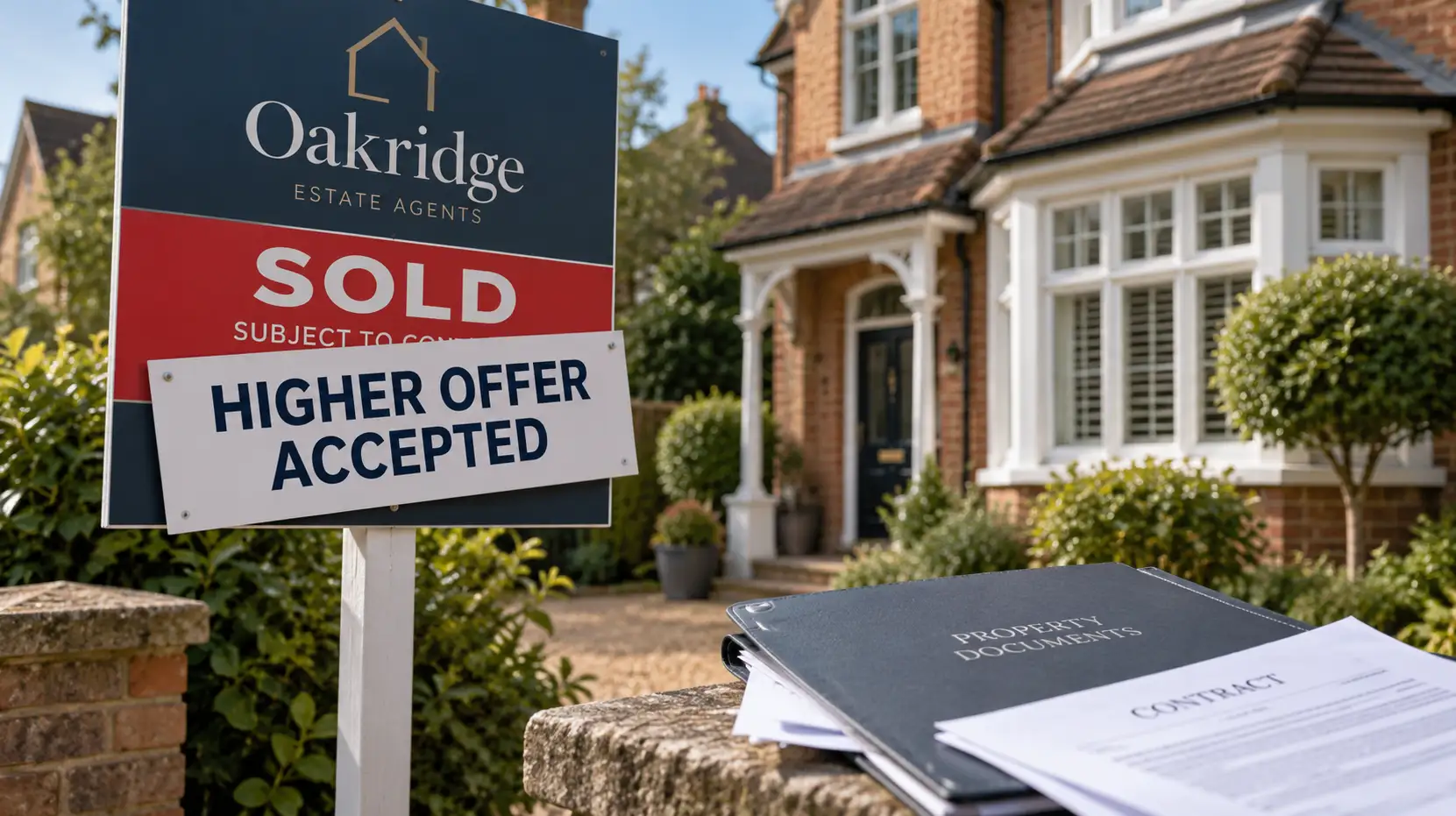
“Offer accepted” feels like a finish line. You stop looking at other properties, tell friends and family, and start planning where the sofa goes. For most buyers, it comes as a genuine surprise to learn that in England, Wales and Northern Ireland, an accepted offer is not, on its own, a binding agreement — and that in an ordinary purchase a seller can still decide to sell to someone else before contracts are exchanged.
That is the basis of what is commonly called gazumping: another buyer comes in after your offer has been accepted and the seller decides to proceed with them instead, often because they have offered more money or appear to be in a stronger position.
This is not a loophole or a failure of enforcement. It is a consequence of when the legal commitment occurs, and understanding exactly how far an accepted offer protects you — and where it doesn’t — changes how you should behave once the seller says yes.
There is one important qualification. The position can be different where buyer and seller have entered into a separate binding arrangement, such as a reservation or exclusivity agreement. Auctions and some new-build transactions can also operate differently. But for an ordinary resale purchase, an accepted offer alone does not lock either side into the transaction.
The legal position in England, Wales and Northern Ireland
In England and Wales, an offer is not legally binding merely because the seller has accepted it. GOV.UK’s guidance on making an offer confirms that the purchase becomes legally binding when contracts are exchanged. Northern Ireland follows the same broad structure: its official step-by-step home-buying guidance identifies exchange of contracts as the point at which the sale becomes legally binding.
That leaves a period in which a transaction can feel settled without actually being secured.
| Stage | What it means in an ordinary purchase |
|---|---|
| Offer made | A proposed price and, sometimes, conditions |
| Offer accepted | The seller has agreed in principle, but the ordinary sale is not yet legally binding |
| Sold subject to contract / sale agreed | Conveyancing, mortgage work, surveys and enquiries continue; either side can still withdraw |
| Exchange of contracts | Buyer and seller become legally committed |
| Completion | Purchase money is transferred and ownership changes |
By the time another buyer appears, the original buyer may already have paid for searches, a survey, mortgage work and legal work. None of those steps, by itself, turns the accepted offer into the purchase contract.
In an ordinary transaction there is also no automatic rule requiring the seller to reimburse those costs merely because they change buyer before exchange. What the buyer actually loses depends on what has already been paid and the arrangements they have made with their conveyancer, surveyor, mortgage provider or any home-buyer’s protection policy. A separate reservation or exclusivity agreement could also create different rights.
The same pre-exchange freedom exists on the buyer’s side. A buyer can withdraw or seek to renegotiate before exchange. That does not mean every renegotiation is “gazundering”: reducing an offer after a survey reveals a serious roof problem or previously unknown structural defect may simply be a negotiation based on new information. Gazundering is more commonly used to describe a late reduction in the agreed price, particularly where the timing puts the seller under pressure.
Estate agents also remain part of the picture after the first offer is accepted. Government buying guidance says agents must pass offers to their seller client, and sellers are free to consider price alongside matters such as chain position, finance and the likelihood of completing. A buyer with no chain, a mortgage progressing and a conveyancer already moving may therefore be more attractive than somebody offering slightly more but starting from scratch.
A rival offer must also be genuine. The Property Ombudsman’s March 2026 residential estate agency code says member agents must not invent or misrepresent another offer and must keep records of the offers they receive. It also requires an accepted buyer to be told promptly if the seller accepts another offer.
Scotland works differently — but “offer accepted” still needs context
Scotland has a different conveyancing system and buyers moving between systems should not assume the same milestones apply.
Offers are commonly made formally through solicitors. If the seller is willing to proceed, their solicitor may issue a qualified acceptance containing conditions, after which the two solicitors exchange formal communications known as missives while the terms are settled.
Once the missives are concluded, buyer and seller have a binding contract. Scotland’s official guidance on making an offer and concluding missives explains that withdrawing after this point can expose the party in breach to a damages claim.
The important qualification is that an offer being described as “accepted” does not necessarily mean that missives have already been concluded. A qualified acceptance can still leave conditions under negotiation. The safer question in a Scottish purchase is therefore not simply “has my offer been accepted?” but “have missives been concluded?”
That is a genuinely different structure from the extended sold-subject-to-contract period familiar to buyers in England and Wales, but it should not be reduced to the slogan that every Scottish offer immediately becomes binding.
Why the exposed period still exists — and what could change
The gap between offer acceptance and exchange has been criticised for years because both sides can spend money and make plans while the transaction remains capable of collapsing.
The government’s Home Buying and Selling Reform Roadmap, published in June 2026, proposes moving towards earlier commitment. The longer-term intention is to require binding conditional contracts once comprehensive upfront sales packs have been tested and embedded.
That change has not happened yet.
During 2026 the government is instead preparing the industry for future binding contracts and encouraging awareness of voluntary reservation agreements. It anticipates that most of the measures in the roadmap will ultimately apply across England, Wales and Northern Ireland, while Scotland’s distinct system is expected largely to remain separate; the precise territorial reach of future legislation will have to be decided measure by measure.
Separate government research on reservation agreements was published on 8 September 2026. It examines whether earlier agreements between buyers and sellers could reduce failed transactions, but it does not make reservation agreements compulsory or alter the existing binding point.
They can nevertheless matter in an individual transaction. An exclusivity or lock-out agreement may prevent a seller negotiating with another buyer for a specified period, while a reservation agreement can impose commitments on both parties and potentially financial consequences if somebody withdraws without an agreed reason.
Those agreements are not standardised substitutes for exchange. Their value depends entirely on their terms: how long the protection lasts, what each side promises to do, what circumstances allow withdrawal and what happens to any money paid. Anyone being asked to sign one should have their conveyancer explain exactly what protection it provides and what obligations come with it.
How common is gazumping?
There is no reliable current national gazumping rate.
Various property companies and lenders publish surveys showing buyers who say they have experienced it, but definitions, samples and methodologies differ. There is no official national record that identifies a rival offer as the reason every failed transaction collapsed.
The stronger current statistic concerns the wider transaction system. The government’s 2026 reform roadmap says around one in three home-buying transactions fall through. That includes broken chains, finance problems, surveys, changed circumstances, renegotiations and people simply changing their minds as well as rival offers.
It is therefore evidence that transaction failure is a substantial problem, not evidence that one in three buyers are gazumped.
For somebody whose offer has already been accepted, the more useful question is how exposed their own transaction remains and what they can realistically do about it.
What a buyer can sensibly do after an offer is accepted
The first thing is to distinguish “sold subject to contract” from actual legal protection. SSTC tells the market that the seller has accepted an offer but contracts have not yet been exchanged. It may discourage some competing buyers, but it does not prevent another offer being made or accepted.
Government guidance recommends asking the estate agent to stop actively marketing the property and remove it from online portals once your offer is accepted, although the seller ultimately chooses whether to do so. It is worth asking that question directly rather than assuming the SSTC label means further viewings have stopped. The same GOV.UK buying guidance recommends keeping a clear upper limit in mind when making an offer and being prepared to walk away above it.
That becomes particularly important if the agent calls to say another buyer has offered more.
You do not have to match or beat the new figure simply because somebody else has bid. The rival offer changes the competition for the property; it does not change your income, your mortgage affordability or automatically change what the house is worth to you. Reconsider the property against the limit you had already set, taking account of anything you have since learned from the survey, searches or local market, rather than allowing the fear of losing it to establish a new price on its own.
Speed also matters, although it cannot provide certainty. Instructing a conveyancer promptly, progressing the mortgage application, booking the survey and responding quickly to requests for documents reduces avoidable delay. If you are selling another property, keeping that transaction moving strengthens your position too.
A proceedable buyer can be difficult for a seller to replace. If one purchaser already has searches under way, mortgage work progressing, survey completed and a short or nonexistent chain, a marginally higher offer from someone whose transaction has barely begun may not look so attractive. The seller is entitled to consider the likelihood of completion as well as the headline price.
If the property is unusually competitive, the potential abortive costs are large or the seller has already shown signs of uncertainty, it may also be worth asking your conveyancer whether any form of exclusivity or reservation agreement is realistic. That will not be appropriate in every transaction, but it is one of the few ways of potentially creating actual contractual protection before ordinary exchange.
The uncomfortable gap between “agreed” and “bought”
The difficult part of gazumping is that buyers tend to adjust emotionally much earlier than the law does. Once an offer is accepted, people stop thinking of themselves as house hunters and start thinking of themselves as the future owners.
Legally, those are different stages.
In England, Wales and Northern Ireland, an ordinary accepted offer gives you a transaction to progress, not a completed commitment from the seller. “Sold subject to contract” tells the market that an agreement has been reached in principle, but the important words are still “subject to contract”.
The system may eventually move towards earlier binding commitments if the government’s planned sales packs and conditional-contract reforms reach the statute book and are brought into force. As at September 2026, that has not happened.
Until then, the sensible response is neither panic nor complacency. Move the transaction forward, establish whether the seller is continuing to market the property, know what you are prepared to pay if another offer appears, and understand which milestone finally turns an agreement in principle into a legally binding purchase.
This article provides general property information and does not constitute legal advice. The point at which a property transaction becomes legally binding differs across the UK and can also be affected by auction terms, reservation agreements, exclusivity agreements, new-build contracts and the particular transaction. If another offer has been made on a property you are buying or you are considering an early binding agreement, speak to your conveyancer about your specific position.

